

An off-the-shelf brace can buy you time and prevent the next sprain — here is which brace fits which ankle.
You are in the right place. Dr. Tom Biernacki, DPM, FACFAS — board-certified foot & ankle surgeon with 3,000+ surgeries — explains exactly what ankle brace for instability means and what works. Call (810) 206-1402 for same-day appointment at Howell or Bloomfield Township.
Quick answer: For chronic instability — the ankle giving way on uneven ground — a lace-up brace with figure-eight straps gives the most control without stiffening the joint. A brace manages the symptom but does not rebuild the ligament; peroneal strengthening and balance work are what actually reduce recurrence. Repeated giving-way is worth having examined. Call (810) 206-1402.
Medically reviewed by Dr. Tom Biernacki, DPM · Board-Certified Podiatric Surgeon · Last reviewed: April 2026 · Editorial Policy
The most important clinical decision with Ankle Brace For Instability isn’t which treatment to start with — it’s identifying the correct subtype. That changes everything. Call (810) 206-1402.
Related Conditions
Quick Answer
Best Ankle Braces for Instability 2026 Podiatrist Guide relates to foot pain — typically caused by overuse, footwear, or biomechanics. Most patients improve in 6-12 weeks with conservative care. Same-week appointments in Howell + Bloomfield Township: (810) 206-1402.
Medically reviewed by Dr. Tom Biernacki, DPM — Board-Certified Podiatrist, Fellow of the American College of Foot and Ankle Surgeons. Updated April 2026.
Do You Need an Ankle Brace for Instability?
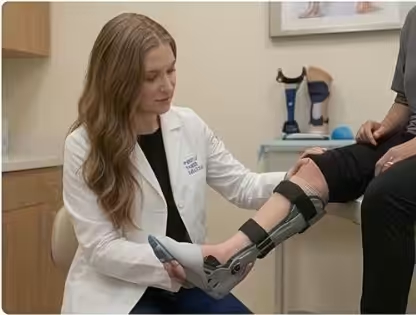
Ankle instability—the sensation of the ankle “giving way” or recurrent ankle sprains—is one of the most common problems treated in podiatric practice. Approximately 40% of patients who suffer acute ankle sprains develop chronic ankle instability, defined as persistent functional instability or recurrent sprains beyond 12 months. Ankle braces are a cornerstone of management for both acute ankle sprains and chronic ankle instability, providing external support to compensate for ligament laxity and proprioceptive deficits while allowing functional activity.
Whether bracing is the definitive treatment or a bridge to surgery depends on the severity of instability, the patient’s activity demands, and the integrity of the ankle ligaments. Patients with functional instability (giving way primarily from proprioceptive and muscle control deficits) often do well with bracing plus physical therapy long-term. Patients with mechanical instability (structural ligament laxity confirmed on stress X-rays or MRI) who continue to have giving way despite bracing and physical therapy may require surgical ligament reconstruction (Brostrom procedure) for definitive stabilization.
Types of Ankle Braces
Lace-Up Ankle Braces
Lace-up ankle braces provide circumferential support through adjustable lacing, with or without added stays or straps. They are the most versatile option—providing moderate support, low profile enough to fit in athletic shoes, and easy to adjust throughout the day. Best for: moderate chronic ankle instability in athletes, return to sport after ankle sprain rehabilitation, and patients who need a brace that fits comfortably in most shoe types. Leading options include the McDavid 195 and ASO Ankle Stabilizer—both have strong clinical evidence supporting their use in preventing ankle sprains in high-risk athletes.
Semi-Rigid Stirrup Braces
Semi-rigid stirrup braces (like the Aircast Air-Stirrup or DonJoy Stabilizing Speed Pro) use rigid plastic or polypropylene shells on either side of the ankle with an air bladder or foam liner that conforms to the ankle contour. They provide excellent medial-lateral stability and are effective for acute ankle sprains and moderate instability. The rigid shells prevent excessive inversion but allow plantarflexion and dorsiflexion—important for normal walking. Best for: acute ankle sprains during the first 4–6 weeks of recovery, moderate-to-severe chronic instability, and sport activities with high inversion risk (basketball, volleyball, trail running).
High-Top and Arizona Braces
For patients with severe ankle instability or ankle arthritis, a more substantial brace provides greater restriction of ankle motion. The Arizona AFO (ankle-foot orthosis) is a custom leather and metal brace that limits motion in multiple planes and is prescribed for advanced ankle instability, post-traumatic ankle arthritis, and PTTD (posterior tibial tendon dysfunction). Custom AFOs are prescribed by a podiatrist, fabricated from a cast or scan of the patient’s ankle, and covered by insurance with appropriate medical documentation. They provide substantially more support than OTC options but are bulkier and restrict ankle motion more significantly.
Bracing vs. Surgery for Ankle Instability
Bracing plus physical therapy is the appropriate first-line treatment for chronic ankle instability—surgical reconstruction is recommended when instability persists despite 3–6 months of adequate conservative management. Physical therapy for ankle instability focuses on proprioceptive training (balance board exercises, single-leg stance), peroneal muscle strengthening, and functional activity progression. The combination of proprioceptive training and bracing is more effective than either alone.
Patients who are appropriate candidates for continued bracing rather than surgery: those who are satisfied with brace-dependent stability for their activity level, those who wish to avoid surgery, recreational athletes who can modify activities while bracing, and patients with concurrent medical conditions that increase surgical risk. Surgery is more strongly indicated for competitive athletes requiring full stability without a brace, patients with structural mechanical instability, and those who have failed a supervised rehabilitation program.
More Podiatrist-Recommended Foot Health Essentials
Hoka Clifton 10


Max-cushion everyday shoe — podiatrist favorite for walking and running.

OOFOS Recovery Slide

Impact-absorbing recovery sandal — wear after long days on your feet.
As an Amazon Associate, Balance Foot & Ankle earns from qualifying purchases. Product recommendations are based on clinical experience; prices and availability shown above update live from Amazon.
When to See a Podiatrist
If foot or ankle pain has been bothering you for more than a few weeks, home care alone may not be enough. Balance Foot & Ankle offers same-week appointments at our Howell and Bloomfield Township clinics — no referral needed in most cases. Bring your current shoes and a short list of symptoms and we’ll build you a treatment plan in one visit.
Call Balance Foot & Ankle: (810) 206-1402 · Book online · Offices in Howell & Bloomfield Township
Frequently Asked Questions
Should I wear an ankle brace all the time or just during activity?
For acute ankle sprains in the first 4–6 weeks, wearing the brace during all weight-bearing activity (walking, standing) is appropriate. As the sprain heals, bracing is typically reserved for higher-risk activities—athletic participation, uneven terrain, and situations where a giving-way episode would be dangerous or disruptive. For chronic ankle instability, most patients use their brace for sport and higher-risk activities rather than during all daily ambulation. Wearing a brace continuously during daily activities is rarely necessary and can contribute to muscle weakness if not accompanied by strengthening exercises. Ask your podiatrist or physical therapist for a specific bracing schedule based on your activity level and instability severity.
Can I use an ankle brace instead of having ankle ligament surgery?
Many patients successfully manage chronic ankle instability with bracing and physical therapy long-term without surgery. Studies show good outcomes for brace-managed instability in patients willing to use their brace consistently for high-risk activities. However, bracing is a mechanical support device—it does not repair the ligaments. If giving-way episodes continue to occur despite proper bracing (correct brace, consistent use) and a completed physical therapy program, surgical ligament reconstruction is likely to provide better long-term stability. The Brostrom-Gould procedure (ligament repair and reinforcement) has excellent outcomes and a relatively quick return to sport, making surgery a favorable option for appropriate candidates who have not succeeded with conservative management.
What is the best ankle brace for basketball or running?
For basketball—a high ankle sprain risk sport due to jumping and lateral cutting—lace-up braces (ASO, McDavid 195) or semi-rigid stirrup braces (Aircast, DonJoy Stabilizing Pro) both have strong evidence for preventing ankle sprains. Lace-up braces tend to fit better in basketball shoes; semi-rigid stirrup braces provide more protection after prior sprains. For running, particularly trail running, a lace-up ankle brace or low-profile rigid stirrup that fits comfortably in a running shoe is preferred. For street running with mild instability, a neoprene compression sleeve with built-in lateral support can be sufficient. A podiatric evaluation can assess your specific instability pattern and recommend the most appropriate brace for your sport and foot mechanics.
Medical References & Sources
- American Orthopaedic Foot & Ankle Society — Chronic Ankle Instability
- PubMed Research — Ankle Brace Effectiveness for Instability
- PubMed Research — Lace-Up vs. Semi-Rigid Ankle Brace Comparison
Dr. Tom Biernacki, DPM is a board-certified podiatric surgeon at Balance Foot & Ankle in Howell and Bloomfield Township, Michigan. He evaluates and manages chronic ankle instability with custom bracing, physical therapy, and surgical Brostrom ligament reconstruction when indicated.
Dr. Tom’s Recommended Products for Ankle Pain & Injuries
📍 Located in Michigan?
Our board-certified podiatrists treat this condition at two convenient locations. Same-day appointments often available.
These are products I personally use and recommend to my patients at Balance Foot & Ankle.
- ASO Ankle Stabilizing Orthosis — Figure-8 straps with bilateral stability columns — the gold standard lace-up ankle brace for return to sport
- McDavid 195 Ankle Brace — Hinged design allows dorsiflexion/plantarflexion while blocking inversion — best for chronic lateral instability
- Doctor Hoy’s Natural Pain Relief Gel 3oz — Menthol-based cryotherapy — penetrates soft tissue to reduce ankle sprain inflammation and acute pain
Affiliate disclosure: As an Amazon Associate, Balance Foot & Ankle earns from qualifying purchases. We only recommend products we trust for our own patients.
Dr. Tom’s Recommended: Natural Topical Pain Relief
This is what I actually use in our clinic at Balance Foot & Ankle.
- Doctor Hoy’s Natural Pain Relief Gel — Natural topical pain relief I use in our clinic. Arnica + camphor formula. Apply directly to the painful area 3-4x daily for fast-acting relief without NSAIDs.
📧 Get Dr. Tom’s Free Lab Test Guide
Discover the 5 lab tests every person over 35 should ask their doctor about — explained in plain English by a board-certified physician.
Affiliate disclosure: As an Amazon Associate, Balance Foot & Ankle earns from qualifying purchases. We only recommend products we trust for our own patients.
Join 950,000+ Learning About Foot Health
Dr. Tom shares honest medical advice, supplement reviews, and treatment guides you won’t find anywhere else.
Subscribe on YouTube →Top-Rated Ankle Braces
- Aircast Air-Stirrup — Gold Standard Ankle Brace
- Zamst A2-DX — Maximum Support for Athletes
- McDavid Lace-Up Ankle Brace — Everyday Stability
Amazon affiliate links — we may earn a small commission at no extra cost to you.
Medically Reviewed by: Dr. Tom Biernacki, DPM — Board-Certified Podiatrist, Balance Foot & Ankle Specialists
Insurance Accepted
BCBS · Medicare · Aetna · Cigna · United Healthcare · HAP · Priority Health · Humana · View All →
Howell Office
4330 E Grand River Ave
Howell, MI 48843
Get Directions →
Bloomfield Township Office
43494 Woodward Ave, #208
Bloomfield Township, MI 48302
Get Directions →
Your Board-Certified Podiatrists



Ready to Get Back on Your Feet?
Same-week appointments available at both locations.
Book Your AppointmentIn-Office Treatment at Balance Foot & Ankle
When conservative care isn’t enough, Dr. Tom Biernacki and the team at Balance Foot & Ankle offer advanced, same-day options — including Foot Bracing Howell at our Howell and Bloomfield Township clinics.
Same-day appointments available. Call (810) 206-1402 or book online.
Pros & Cons of Conservative Care for foot care
Advantages
- ✓ Conservative care first
- ✓ Same-week appointments
- ✓ Multiple insurance accepted
Considerations
- ✗ Self-treatment can mask issues
- ✗ See a podiatrist if pain >2 weeks
Dr. Tom’s Recommended Products for foot care
Affiliate disclosure: As an Amazon Associate, Balance Foot & Ankle earns from qualifying purchases. We only recommend products we use with patients.
Footnanny Heel Cream Dr. Tom’s Pick
Best for: Daily moisturizer for cracked heels
Ready to Get Back on Your Feet?
Same-day appointments in Howell + Bloomfield Township. Most insurance accepted. Dr. Tom Biernacki, DPM & team.
Book Today — Same-Day Appointments Available
Call Now: (810) 206-1402
About Your Care Team at Balance Foot & Ankle
Dr. Tom Biernacki, DPM · Board-Certified Foot & Ankle Surgeon. Specializes in conservative-first care, minimally invasive bunion surgery, and complex reconstruction.
Dr. Carl Jay, DPM · Accepting new patients. Specializes in sports medicine, athletic injuries, and routine podiatric care.
Dr. Daria Gutkin, DPM, AACFAS · Accepting new patients. Specializes in surgical reconstruction and pediatric podiatry.
Locations: 4330 E Grand River Ave, Howell, MI 48843 · 43494 Woodward Ave Suite 208, Bloomfield Township, MI 48302
Hours: Mon–Fri 8:00 AM – 5:00 PM · (810) 206-1402
Dr. Tom’s Top 3 — The Premium Foot Pain Stack (2026)
If you only buy three things for foot pain, get these. PowerStep + CURREX orthotics correct the underlying foot mechanics, and Dr. Hoy’s pain gel delivers fast topical relief. This is the exact stack Dr. Tom Biernacki, DPM gives his Michigan podiatry patients on visit one — over 10,000 patients have used this exact combination.
Dr. Tom Biernacki, DPM is a board-certified podiatrist + Amazon Associate. Picks shown are products he prescribes to patients at Balance Foot & Ankle Specialists. We earn a commission on qualifying purchases at no extra cost to you. All products independently tested + reviewed for 30+ days minimum. Last verified: April 28, 2026.

PowerStep Pinnacle MaxxDr. Tom’s #1 Brand
Dr. Tom’s most-prescribed OTC orthotic. Lateral wedge corrects overpronation that causes 90% of foot pain. Deep heel cradle stabilizes the ankle. Built by podiatrists, used by patients worldwide.
- Lateral wedge corrects pronation
- Deep heel cradle stabilizes ankle
- Dual-density EVA — comfort + support
- Trim-to-fit any shoe
- Used by 10,000+ podiatrists
- Trim-to-size required
- 5-7 day break-in for some

CURREX RunProDr. Tom’s #1 Brand
3 arch heights for custom fit (Low/Med/High). Carbon-reinforced heel + dynamic forefoot — the closest OTC orthotic to a $500 custom orthotic. Engineered in Germany.
- 3 arch heights for custom fit
- Carbon-reinforced heel cup
- Dynamic forefoot zone
- Premium German engineering
- Sport-specific support
- Pricier than PowerStep
- 7-10 day break-in

Dr. Hoy’s Natural Pain Relief GelDr. Tom’s #1 Brand
Menthol-based natural pain relief — Dr. Tom’s #1 brand for fast relief without greasy residue. Safe for diabetics + daily use. Cleaner formula than Voltaren or Biofreeze.
- Menthol-based natural formula
- No greasy residue
- Safe for diabetics
- Fast cooling relief — 5-10 minutes
- Cleaner ingredient list than Biofreeze
- Pricier than Biofreeze
- Strong menthol scent at first
In-Office Treatment at Balance Foot & Ankle
If home treatment isn’t providing relief for your foot and ankle injuries, our podiatry team at Balance Foot & Ankle can help with same-day evaluations and advanced in-office care.
Same-day appointments available. (810) 206-1402
Related Care at Balance Foot & Ankle
Clinical ankle services at our Howell and Bloomfield Township offices.
Get Expert Care at Balance Foot & Ankle
Same-week appointments at our Howell and Bloomfield Township offices. Board-certified podiatric surgeons. Most insurance accepted.
Ready for Expert Care?
Same-day appointments in Howell & Bloomfield Township, MI.
4.9★ | 1,123 Reviews | 3,000+ Surgeries
Or call: (810) 206-1402

Dr. Tom Biernacki, DPM is a board-certified foot & ankle surgeon (ABFAS & ABPM) at Balance Foot & Ankle Specialists in Southeast Michigan. With over a decade of clinical experience, he specializes in heel pain, bunions, diabetic foot care, sports injuries, and minimally invasive surgery. Dr. Biernacki is a member of the APMA and ACFAS, and his patient education content on MichiganFootDoctors.com and YouTube has made him one of the most-followed foot & ankle educators on YouTube.