
You are in the right place. Dr. Tom Biernacki, DPM, FACFAS — board-certified foot & ankle surgeon with 3,000+ surgeries — explains exactly what when to wear an ankle brace means and what actually works. Call (810) 206-1402 for a same-day appointment at our Howell or Bloomfield Hills office.

Foot pain isn't resolving?
Same-week appointments at Howell & Bloomfield Hills
Ankle braces are one of the most prescribed devices in our podiatric practice at Balance Foot & Ankle — yet they are also one of the most misused. Patients wear the wrong brace type, wear it too long (creating muscle atrophy), or use it as a substitute for rehabilitation exercises rather than a support for them. In the right situation, a properly selected ankle brace reduces re-injury risk by 50–70% and significantly accelerates return to activity. Understanding which brace to use, when to use it, and — critically — when to stop using it, is the difference between recovery and dependency.
Types of Ankle Braces
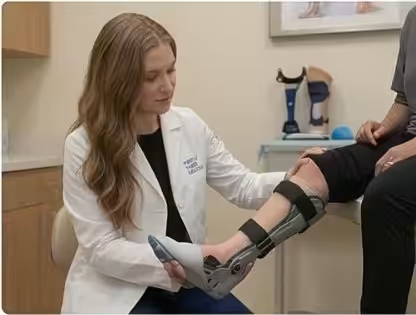
Ankle braces exist on a spectrum from flexible prophylactic sleeves to rigid walking boots. Each type serves a specific clinical purpose:
| Brace Type | Support Level | Best For | Limitations |
|---|---|---|---|
| Compression sleeve | Minimal — swelling only | Mild swelling control, return to activity with resolved sprain | No inversion protection; not a true brace |
| Lace-up brace (e.g., ASO, Swede-O) | Mild to moderate | Grade 1 sprains, prophylactic sport use, post-rehabilitation maintenance | Loosens with activity; requires retying; some fit issues with wide ankles |
| Semi-rigid hinged brace (e.g., Active Ankle, Aircast Sport) | Moderate | Grade 2 sprains, chronic instability, return to sport after Grade 3 repair | Bulkier; may not fit in all shoes |
| Rigid stirrup brace / Air Cast | High | Grade 2–3 sprains, osteochondral lesions, post-fracture weight-bearing | Significant bulk; limits some agility movements |
| Short walking boot (CAM boot) | Very high | Grade 3 sprains, stress fractures, peroneal tendon tears, post-surgical | Alters gait biomechanics; requires contralateral heel lift |
When to Wear an Ankle Brace
The decision to brace should be based on one of four clinical scenarios, each with a different brace type and duration:
Acute Ankle Sprain
The most common indication. Current evidence strongly supports functional bracing (wearing a brace and maintaining protected mobility) over casting and immobilization for Grade 1 and Grade 2 ankle sprains. Functional bracing allows normal ankle motion while protecting against re-injury, which maintains muscle activation and proprioceptive input during healing — both critical for full recovery. Grade 3 sprains and fractures require more restrictive options (rigid stirrup or boot).
Prophylactic Protection During High-Risk Sports
Athletes with a history of ankle sprains benefit significantly from prophylactic bracing during basketball, volleyball, soccer, and football — the sports with the highest lateral ankle sprain incidence. Multiple randomized controlled trials confirm that lace-up ankle braces reduce sprain recurrence by 50–70% in previously injured athletes. The evidence for first-time prevention in uninjured athletes is more limited but still supports use in very high-risk positions (basketball, volleyball jumpers).
Chronic Lateral Ankle Instability
Patients with recurrent giving-way of the ankle despite prior rehabilitation have chronic mechanical or functional instability. A semi-rigid brace provides the mechanical constraint their damaged lateral ligaments (ATFL, CFL) cannot. This is a long-term management strategy, but it must be combined with ongoing peroneal strengthening — the brace addresses the deficit, while rehab works to restore native stability.
Post-Surgical Protection
After lateral ankle ligament reconstruction (Brostrom procedure), osteochondral defect repair, or peroneal tendon surgery, an ankle brace provides the external stability required during the early return-to-sport phase when the repaired structures are still maturing. The specific brace type and duration are prescribed by Dr. Tom based on the procedure performed.
Brace Selection by Sprain Grade
Choosing the right brace for your sprain grade prevents both under-protection (re-injury) and over-protection (prolonged dependency). This is our clinical protocol at Balance Foot & Ankle:
| Sprain Grade | Pathology | First-line Brace | Duration |
|---|---|---|---|
| Grade 1 (stretch) | Microtearing of ATFL; no instability | Lace-up brace (ASO or equivalent) | 2–4 weeks during sport; wean when rehab milestones met |
| Grade 2 (partial tear) | Partial ATFL tear; mild instability | Semi-rigid stirrup or hinged brace | 4–6 weeks; continue with sport for 3 months |
| Grade 3 (complete tear) | Complete ATFL + CFL tear; frank instability | Rigid stirrup initially, then semi-rigid | 6–8 weeks; continue with sport for 6 months or until surgical decision made |
| Fracture (non-displaced) | Fibula or avulsion fracture at 5th metatarsal base | CAM walking boot | 4–6 weeks; transition to brace upon boot discontinuation |
Prophylactic Bracing for Athletes
Prophylactic ankle bracing is one of the highest-evidence injury prevention interventions in sports medicine. The 2019 Cochrane Review of ankle bracing for prevention of lateral ankle sprains found that functional ankle supports reduce the incidence of ankle sprains in high-risk sports by approximately 50% in athletes with a prior sprain history. Key implementation points:
- Target population: Athletes with ≥1 prior lateral ankle sprain in the preceding 2 years, or athletes in positions with very high ankle load (basketball guard, volleyball middle blocker, football wide receiver)
- Brace type: Lace-up braces (ASO, Swede-O) provide equivalent protection to semi-rigid braces for prophylactic use and are more comfortable and better tolerated long-term
- Does not weaken ankles: A common concern is that bracing will weaken the ankle over time. Research shows this is not true when bracing is combined with peroneal strengthening exercises. Bracing alone without rehabilitation does create dependency — this is why rehab must occur in parallel.
- Tape vs. brace: Athletic taping and lace-up braces provide similar inversion protection. Braces are preferred for long-duration use (practices, tournaments) as they maintain their support level throughout activity, while athletic tape loses 50% of its restrictive force within 20 minutes of activity.
Ankle Bracing for Chronic Instability
Chronic lateral ankle instability affects approximately 20–40% of patients who sustained an initial lateral ankle sprain, particularly those who returned to sport too quickly or did not complete a rehabilitation program. The clinical presentation is recurrent giving-way on uneven terrain, persistent lateral ankle discomfort, and a sense of apprehension with directional changes.
In our clinic, we classify chronic instability as mechanical (demonstrable laxity on stress testing) or functional (symptoms without measurable laxity, driven by proprioceptive deficits). Mechanical instability requires a semi-rigid brace for sport activities, combined with a 6–8 week peroneal rehabilitation program. If instability persists after conservative management, surgical reconstruction (Brostrom-Gould lateral ankle ligament repair) is highly effective with 85–90% patient satisfaction at 5-year follow-up.
How Long to Wear an Ankle Brace
Duration of bracing depends on the indication and rehabilitation progress, not a fixed calendar schedule. General guidelines from our clinical protocol:
- Grade 1 acute sprain: Brace during sport for 2–4 weeks. Discontinue when you can complete 3 × 30-second single-leg balance on an unstable surface without pain or giving-way sensation.
- Grade 2 acute sprain: Brace during all weight-bearing activities for 3–4 weeks, then sport-only for 2–3 months. Wean when single-leg heel rise (20 reps, 3 sets) is pain-free and symmetric.
- Grade 3 acute sprain: Rigid brace for 6–8 weeks, semi-rigid for sport for 6 months. Surgical repair changes the timeline significantly.
- Prophylactic sport use: Indefinitely for high-risk sport in athletes with prior sprain history — the evidence supports continued use without muscular detriment when combined with rehab.
- Post-surgical: As directed by Dr. Tom — typically 3–6 months for return-to-sport activities.
When NOT to Wear an Ankle Brace
Despite their benefits, ankle braces are contraindicated or harmful in certain situations:
- As a permanent substitute for rehabilitation: Wearing a brace indefinitely without completing a strengthening and proprioception program creates muscle dependency and atrophy over time. The brace is a bridge, not a destination.
- During sleep: Unless specifically prescribed for a fracture or post-surgical protocol, sleeping in an ankle brace disrupts normal sleep and does not benefit healing. Remove the brace at night.
- For undifferentiated ankle pain without diagnosis: Wearing a brace before determining the cause of ankle pain can mask a fracture, tendon tear, or syndesmotic injury that requires a different treatment. Get a diagnosis first.
- When it causes skin breakdown or numbness: A brace that produces pressure points, skin irritation, or numbness is improperly fitted. An ill-fitting brace can cause peroneal nerve compression or skin wounds, particularly in diabetic patients.
- For medial ankle instability: Lateral ankle braces do not address medial ankle (deltoid ligament) instability or syndesmotic (high ankle sprain) injuries. These require specific orthopaedic management.
How to Fit and Wear a Brace Correctly
An improperly fitted brace provides less protection than a properly fitted one and can cause new problems. Follow these principles:
- Sizing: Most ankle braces size by shoe size, not ankle circumference. Follow the manufacturer’s size chart exactly — a too-large brace shifts on the ankle and loses its mechanical function.
- Sock thickness: Measure your brace size wearing the sock thickness you will use during sport. A brace fitted over a thin sock may be uncomfortably tight over a thick sock.
- Lace-up technique: Start lacing from the bottom (toe end) and tighten progressively up the ankle. The brace should feel firm but not tight — you should be able to slide one finger under the lacing.
- Stirrup positioning: The stirrup arms of a semi-rigid brace must be seated against the malleoli (the ankle bones), not above or below them. Improper stirrup positioning provides no inversion protection.
- Re-tighten during activity: Lace-up braces loosen during activity. Retighten at halftime and between periods. Stirrup braces maintain their fit better throughout activity.
- Shoe selection: Wear the brace inside a supportive athletic shoe with adequate width. Very narrow shoes cannot accommodate most semi-rigid braces properly. Basketball shoes with high ankle collars work particularly well with semi-rigid braces.
Warning Signs Requiring Evaluation
- Ankle pain after a significant injury and you cannot bear weight — rule out fracture before applying a brace (Ottawa Ankle Rules)
- High ankle (syndesmotic) sprain — pain above the ankle with external rotation or squeeze test; these require orthopaedic evaluation, not a lateral brace
- Ankle giving way despite correct bracing and rehabilitation — may indicate osteochondral lesion, peroneal tendon pathology, or true mechanical instability requiring surgery
- Numbness or tingling after applying the brace — stop wearing immediately; peroneal nerve compression from an ill-fitting brace
- Ankle pain that began without injury and has persisted more than 4 weeks — get a diagnosis before self-treating with a brace
Most Common Mistake We See
The most common mistake we see is patients continuing to wear an ankle brace as a long-term crutch without ever completing the rehabilitation that would restore their native ankle stability. We see patients who have worn a brace daily for 2, 3, even 5 years after an ankle sprain — their peroneal muscles are measurably weaker than the uninjured side, their proprioception is impaired, and they experience giving-way whenever they forget to brace. At that point, they need both a structured rehabilitation program and a gradual brace-weaning protocol. The brace is an excellent rehabilitation tool; it is a poor permanent solution.
Recommended Products
Doctor Hoy’s Natural Pain Relief Gel — Before and After Bracing for Acute Sprains
For the acute ankle sprain phase when you are beginning functional bracing, Doctor Hoy’s Natural Pain Relief Gel provides effective topical analgesia to the lateral ankle ligament complex. Apply around the lateral ankle malleolus and along the peroneal tendon path before putting on the brace and again after activity. Its arnica and camphor formula reduces acute inflammatory pain without the risk of masking important symptoms that would otherwise indicate re-injury.
Best for: Grade 1–2 sprain acute phase, post-activity soreness with bracing, peroneal tendon irritation
Not ideal for: Grade 3 injuries requiring medical management; open skin or abrasions from the brace
DASS Medical Compression Socks — Edema Control During Ankle Recovery
Wearing DASS 15–20 mmHg compression socks under your ankle brace improves edema control throughout the recovery day. The graduated compression helps manage ankle and lower leg swelling that worsens with prolonged standing and activity, while the sock’s smooth profile provides comfortable padding between skin and the brace shell.
Best for: Grade 2–3 ankle sprains with significant swelling, recovery between therapy sessions
Not ideal for: Patients with peripheral arterial disease or known compression contraindications
In-Office Care at Balance Foot & Ankle
Ankle sprains are among the most undertreated sports injuries in medicine. At Balance Foot & Ankle, Dr. Tom Biernacki offers comprehensive ankle assessment — sprain grading, stress testing, X-ray, ultrasound for ligament and tendon evaluation, brace prescription, and structured rehabilitation planning. Patients who receive a proper initial evaluation and treatment plan have significantly lower re-injury rates and faster return to full activity. Same-day appointments in Howell and Bloomfield Hills.
Ankle Sprain or Chronic Instability?
Sprain grading + stress testing + brace prescription + rehab plan — same visit.
Book Same-Day AppointmentHowell & Bloomfield Hills · (810) 206-1402
Frequently Asked Questions
Does wearing an ankle brace weaken the ankle?
Wearing an ankle brace without doing rehabilitation exercises can lead to peroneal muscle deconditioning over time. However, research consistently shows that bracing combined with strength and proprioception training does not weaken the ankle — in fact, braced athletes who complete rehab have stronger and more stable ankles than unbraced athletes who skip rehab. The key is doing both: brace for protection, rehab for restoration.
Can I play sports with an ankle brace?
Yes — for Grade 1 sprains, most athletes can continue playing with a lace-up brace and taping. For Grade 2–3 sprains, return to sport with a brace should follow the functional milestone protocol (single-leg balance, heel rise, sport-specific drills). Playing through a Grade 2–3 sprain without proper brace support and rehabilitation risks chronic instability and long-term joint damage.
Is a brace or taping better for ankle sprains?
Both provide similar initial inversion protection. Ankle braces maintain their restrictive force throughout activity (athletic tape loses approximately 50% of restriction within 20 minutes). Braces are reusable, require no skill to apply correctly, and are more cost-effective for regular use. Taping is preferred for temporary use, when brace bulk is not tolerable in a specific shoe, or for additional compression support on top of a brace.
How tight should an ankle brace be?
An ankle brace should be firm but not tight. You should be able to slide one finger under the lacing or straps. The brace should not produce numbness, tingling, or skin color changes. If you experience any of these, loosen or remove the brace immediately and consult a podiatrist about proper fitting. A brace that is too tight can compress the peroneal nerve or impair circulation.
When should I see a podiatrist about my ankle brace?
See a podiatrist if your ankle continues to give way despite bracing and rehabilitation, if you have had more than 2 sprains in the same ankle in 12 months, if bracing causes skin breakdown or nerve symptoms, or if you are uncertain which brace type is appropriate for your condition. A proper clinical assessment prevents both under-treatment and unnecessary long-term bracing. Call Balance Foot & Ankle at (810) 206-1402.
Sources
- Doherty C, Bleakley C, Delahunt E, Holden S. Treatment and prevention of acute and recurrent ankle sprain: an overview of systematic reviews with meta-analysis. Br J Sports Med. 2017;51(2):113–125.
- Petersen W, Rembitzki IV, Koppenburg AG, et al. Treatment of acute ankle ligament injuries: a systematic review. Arch Orthop Trauma Surg. 2013;133(8):1129–1141.
- Kemler E, van de Port I, Backx F, van Dijk CN. A systematic review on the treatment of acute ankle sprain: brace versus other functional treatment types. Sports Med. 2011;41(3):185–197.
- McGuine TA, Hetzel S, Wilson J, Brooks A. The effect of lace-up ankle braces on injury rates in high school football players. Am J Sports Med. 2012;40(1):49–57.
- Hupperets MD, Verhagen EA, van Mechelen W. Effect of unsupervised home based proprioceptive training on recurrences of ankle sprain: randomised controlled trial. BMJ. 2009;339:b2684.
Ready to fix this for good?
Reading goes only so far. The fastest path to relief is a 30-minute office visit with Dr. Biernacki — same-day Howell or Bloomfield Hills. Call (810) 206-1402 or use our online booking.
PowerStep Pinnacle Insoles
Medical-grade arch support. The OTC insole I recommend most in our clinic. Reduces stress on the foot with every step. ($25–35)
Shop PowerStep →American Academy of Orthopaedic Surgeons: Ankle Sprains
In-Office Treatment at Balance Foot & Ankle
If home treatment isn’t providing relief for your ankle instability, our podiatry team at Balance Foot & Ankle can help with same-day evaluations and advanced in-office care.
Same-day appointments available. (810) 206-1402
Our podiatrists treat the underlying cause, not just the symptom. Same-week appointments at our Howell and Bloomfield Hills, Michigan offices.
Same-Week Appointments in Howell & Bloomfield Hills
Three board-certified podiatric surgeons. 1,123+ five-star reviews. Most insurance accepted.

Dr. Tom Biernacki, DPM is a board-certified foot & ankle surgeon (ABFAS & ABPM) at Balance Foot & Ankle Specialists in Southeast Michigan. With over a decade of clinical experience, he specializes in heel pain, bunions, diabetic foot care, sports injuries, and minimally invasive surgery. Dr. Biernacki is a member of the APMA and ACFAS, and his patient education content on MichiganFootDoctors.com and YouTube has made him one of the most-followed foot & ankle educators on YouTube.