
Quick answer: The right ankle brace depends on your injury — there are four types: lace-up (e.g., ASO) for chronic instability and daily prevention, semi-rigid stirrup (e.g., Aircast) for acute sprains and sports, a compression sleeve (e.g., Bauerfeind MalleoTrain) for mild arthritis and swelling, and a rigid CAM walker boot for severe sprains or fractures. Match the brace to the injury pattern.
Still hurting after switching shoes? Footwear helps, but it can’t fix the underlying problem. See a podiatrist — pick a real appointment time online, 24/7: Howell or Bloomfield Township. Takes about a minute, 24/7.
Medically reviewed by Dr. Tom Biernacki, DPM · Board-Certified Podiatric Surgeon · Last reviewed: May 2026 · Editorial Policy
![Side & Lateral Foot Pain FIX! [The BEST At-Home Relief Methods]](https://www.michiganfootdoctors.com/wp-content/cache/flying-press/f6e0fc625e9262561884edec4a43745c.jpg)
Best Ankle Braces: Podiatrist-Ranked Guide for Every Situation
Not all ankle braces are created equal — and choosing the wrong type can actually slow recovery or provide false confidence. Here’s what podiatrists actually recommend based on your specific situation.
The 4 Types of Ankle Braces (And When to Use Each)
1. Lace-Up Ankle Braces — Best for Daily Use & Mild Sprains
Lace-up braces provide excellent medial and lateral support with adjustable compression. They fit most shoe types, can be worn all day, and are the most prescribed type for mild-to-moderate ankle sprains and chronic instability prevention.
Best for: Grade 1–2 ankle sprains, return to activity after sprain, chronic ankle instability prevention during daily activity
Top choice: ASO Ankle Stabilizer — consistently shown in research to reduce ankle sprain recurrence in athletes
2. Semi-Rigid Stirrup Braces — Best for Acute Sprains & Sports
Semi-rigid braces feature hard plastic shells on the medial and lateral sides that limit inversion/eversion (the motion that causes most ankle sprains) while allowing plantarflexion and dorsiflexion (walking motion). The Aircast Air-Stirrup is the gold standard in this category, with the strongest evidence base for reducing re-sprain rates.
Best for: Acute Grade 2–3 sprains during recovery, high-impact sports (basketball, volleyball, soccer), patients with documented instability
3. Sleeve-Style Compression Braces — Best for Mild Pain & Swelling
Neoprene or elastic sleeves provide proprioceptive feedback (improving joint position sense) and mild compression. They don’t provide significant structural support but help with mild soreness and swelling, and are very comfortable for everyday wear.
Best for: Mild ankle soreness, arthritis, swelling management, proprioception during recovery
4. Rigid CAM Walker Boots — Best for Severe Injuries
Not technically a brace — a CAM walker boot is a medical device prescribed for Grade 3 sprains, fractures, and severe tendon injuries. It fully immobilizes the ankle and should be prescribed and fitted by a podiatrist.
Best for: Grade 3 ligament tears, fractures, severe Achilles or peroneal tendon injuries
Podiatrist’s Top Ankle Brace Picks by Condition
For Ankle Sprain Prevention During Sports
The evidence is strongest for lace-up braces (ASO) and semi-rigid stirrup braces (Aircast) for preventing ankle sprains in court sports. A landmark study in the New England Journal of Medicine found lace-up ankle supports reduced sprain rates by 50% compared to no brace in high school basketball players.
For Chronic Ankle Instability
Patients who repeatedly sprain the same ankle benefit most from rigid stirrup braces during activity combined with a dedicated peroneal strengthening program. Braces alone without rehabilitation lead to continued re-sprains.
For Arthritis or General Ankle Pain
Compression sleeves with mild support reduce pain signals and swelling in arthritic ankles without restricting necessary movement. The Bauerfeind MalleoTrain series is highly rated for ankle arthritis management.
For Returning to Sports After a Sprain
Start with a semi-rigid stirrup brace and taper to a lace-up brace as confidence and strength return. Most podiatrists recommend 4–6 months of bracing support during return to pivoting sports after a significant Grade 2–3 sprain.
Important: Braces Don’t Replace Rehabilitation
Ankle braces reduce re-injury risk, but they do NOT strengthen the ligaments or retrain proprioception. A structured peroneal strengthening and balance training program alongside brace use is essential for true recovery. Without rehab, patients become brace-dependent and remain vulnerable when the brace comes off.
⚠️ When to See a Podiatrist About Your Ankle
Over-the-counter braces are appropriate for mild sprains — but see a podiatrist if:
- You can’t bear weight after an ankle injury
- The ankle is significantly swollen, bruised, or deformed
- You’ve sprained the same ankle multiple times
- Your ankle still feels unstable or gives way weeks after injury
- Pain persists beyond 2–3 weeks of proper RICE treatment
- You have diabetes or neuropathy — ankle injuries need professional evaluation
- You’re unsure whether you need a brace or a boot
Ankle Pain That Won’t Resolve? We Can Help.
Our podiatrists diagnose ankle instability, sprains, and fractures with in-office X-ray and ultrasound. We prescribe the right brace, custom orthotics, and rehabilitation plan to get you stable and pain-free for good.
Or call us at (810) 206-1402
Related Articles
- Foot or Ankle Sprain vs. Break: How to Tell the Difference
- How Long Does a Sprained Ankle Take to Heal?
- Is It Safe to Walk on a Sprained Ankle?
- Medical Walking Boot Guide: When You Need One
Related Treatment Guides
- Ankle Sprain Treatment
- Plantar Fasciitis & Heel Pain Treatment
- Custom 3D Orthotics
- Sports Foot & Ankle Injury Treatment
Insurance Accepted
BCBS · Medicare · Aetna · Cigna · United Healthcare · HAP · Priority Health · Humana · View All →
Howell Office
4330 E Grand River Ave
Howell, MI 48843
Get Directions →
Bloomfield Township Office
43494 Woodward Ave, #208
Bloomfield Township, MI 48302
Get Directions →
Your Board-Certified Podiatrists



Ready to Get Back on Your Feet?
Same-week appointments available at both locations.
Book Your Appointment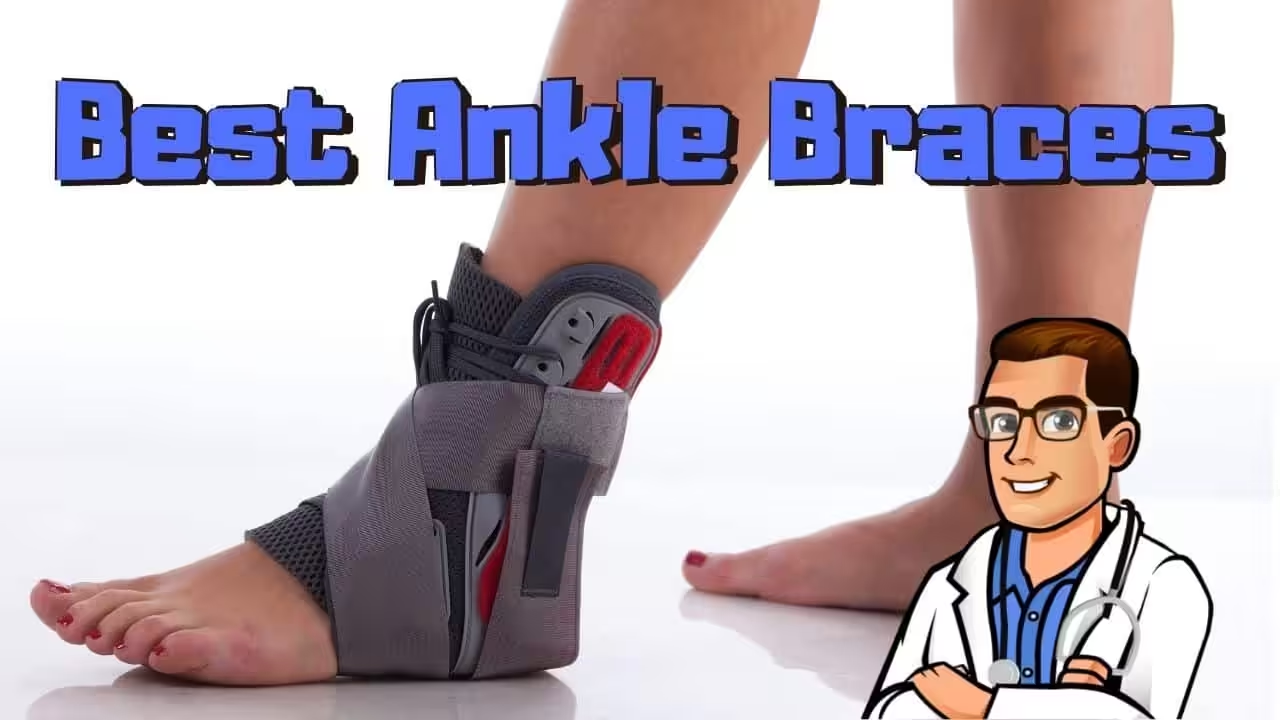
When to See a Podiatrist
If foot or ankle pain has been bothering you for more than a few weeks, home care alone may not be enough. Balance Foot & Ankle offers same-week appointments at our Howell and Bloomfield Township clinics — no referral needed in most cases. Bring your current shoes and a short list of symptoms and we’ll build you a treatment plan in one visit.
Call Balance Foot & Ankle: (810) 206-1402 · Book online · Offices in Howell & Bloomfield Township
Pros & Cons of Conservative Care for Ankle Instability
Advantages
- ✓ Conservative care first
- ✓ Same-week appointments
- ✓ Multiple insurance accepted
Considerations
- ✗ Self-treatment can mask issues
- ✗ See a podiatrist if pain >2 weeks
Ready to Get Back on Your Feet?
Same-day appointments in Howell + Bloomfield Township. Most insurance accepted. Dr. Tom Biernacki, DPM & team.
Book Today — Same-Day Appointments Available
Call Now: (810) 206-1402
About Your Care Team at Balance Foot & Ankle
Dr. Tom Biernacki, DPM · Board-Certified Foot & Ankle Surgeon. Specializes in conservative-first care, minimally invasive bunion surgery, and complex reconstruction.
Dr. Carl Jay, DPM · Accepting new patients. Specializes in sports medicine, athletic injuries, and routine podiatric care.
Dr. Daria Gutkin, DPM, AACFAS · Accepting new patients. Specializes in surgical reconstruction and pediatric podiatry.
Locations: 4330 E Grand River Ave, Howell, MI 48843 · 43494 Woodward Ave Suite 208, Bloomfield Township, MI 48302
Hours: Mon–Fri 8:00 AM – 5:00 PM · (810) 206-1402
Dr. Tom’s Ankle Brace + Support Stack
- Doctor Hoy’s Natural Pain Relief Gel — Ankle pain inside or around a brace: arnica + camphor gel applied to the malleolar region before brace application reduces brace-induced compression irritation.
- DASS Medical Compression Socks — Ankle swelling that persists between brace use: graduated compression worn at night (when the brace is off) maintains 24-hour edema control.
- PowerStep Pinnacle — Pair any ankle brace with insole support: PowerStep Pinnacle inside the braced shoe provides arch correction the brace alone can’t deliver.
Ankle instability requiring a brace for more than 3 months? Lateral ligament reconstruction evaluation may be needed. Balance Foot & Ankle → (810) 206-1402
In-Office Treatment at Balance Foot & Ankle
If home treatment isn’t providing relief for your foot and ankle injuries, our podiatry team at Balance Foot & Ankle can help with same-day evaluations and advanced in-office care.
Same-day appointments available. (810) 206-1402
Frequently Asked Questions
Which ankle brace is best for chronic instability?
ASO Lace-Up is the most-prescribed lace-up brace for chronic instability. The crisscross figure-8 strap pattern mimics ligament direction and provides multi-plane stability without losing dorsiflexion.
How long should I wear an ankle brace after a sprain?
For grade 1-2 sprains, 4-6 weeks of bracing during weight-bearing, then 6-8 weeks during sport. For grade 3 sprains, often 8-12 weeks plus formal physical therapy.
Are ankle braces better than tape?
For chronic instability, braces win on cost and consistency. For acute sprains in athletes, tape provides better proprioceptive feedback short-term. Most athletes transition from tape to brace once symptoms stabilize.
Do ankle braces weaken your ankle over time?
No—wearing an ankle brace does not weaken the ankle or make the muscles atrophy. Studies of athletes who brace to prevent sprains show no meaningful loss of strength or balance (proprioception). The idea that braces “make you dependent” comes from using one as a substitute for rehabilitation rather than alongside it. Pair bracing with the strengthening and balance exercises your podiatrist or physical therapist prescribes, and the ankle gets stronger over time—not weaker.
Can you sleep in an ankle brace?
For most sprains you don’t need to sleep in a rigid or stirrup brace. Bracing matters most during weight-bearing and activity, when the ligaments are loaded; at night the joint is at rest. Take a lace-up or stirrup brace off to sleep unless your podiatrist specifically asked you to keep the ankle immobilized—for example, in a CAM walker boot after a severe injury. In the first few days after a sprain, elevating the ankle overnight does more for swelling than a brace does.