
Medically reviewed by Dr. Tom Biernacki, DPM — Board-certified podiatric surgeon | Balance Foot & Ankle | Last reviewed: May 2026
Shoe inserts are one of the most cost-effective interventions in podiatric medicine — and one of the most misunderstood. Patients regularly show up in our Howell and Bloomfield Township clinics with $60 gel insoles from a drugstore display that have done nothing for their plantar fasciitis, while also having patients experience dramatic relief from $35 PowerStep insoles correctly matched to their foot type. The insert matters enormously; the marketing on the package matters not at all. This guide gives you the clinical framework for selecting the right insert for your specific problem.
OTC Inserts vs. Custom Orthotics: When to Use Which
Custom orthotics — prescription devices fabricated from a cast or scan of your foot — provide millimeter-level biomechanical correction for individual anatomy. They’re the clinical standard for complex pathology. OTC inserts provide population-average correction at a price point that makes them appropriate for mild-to-moderate conditions and as a trial before investing in custom devices.
| Condition Severity | Recommendation | Rationale |
|---|---|---|
| Mild discomfort, no diagnosis | OTC insert ($25–$60) | Trial appropriate before specialist consultation |
| Moderate plantar fasciitis, mild flat feet | OTC insert (PowerStep, PowerStep Pinnacle) first | 60–70% of patients respond adequately |
| Severe plantar fasciitis, significant PTTD, post-surgical | Custom orthotics | OTC correction insufficient for the degree of pathology |
| Diabetic neuropathy with ulcer history | Custom molded insoles | Pressure redistribution requires individual fabrication; Medicare covers this |
| OTC inserts failed after 6–8 weeks | Custom orthotics | Upgrade to individualized correction |
Best Shoe Inserts 2026: By Condition
The insole we recommend most — PowerStep Pinnacle, a podiatrist-designed full-length orthotic (30,000+ reviews). Verified in stock:

- #1 Podiatrist Recommended - The Pinnacle PowerStep insoles for men & women provide maximum cushioning, from high activity to moderate support. The arch support shape provides stability to the foot & ankle, helping to relieve foot pain.
- When you spend all day on your feet, every step counts. These plantar fasciitis insoles are podiatrist-recommended to help relieve & prevent foot pain for people with plantar fasciitis, heel spurs, and other common foot, ankle & knee injuries
- The Pinnacle PowerStep insoles offer superior heel cushioning and arch support. These shoe inserts for men and women have dual-layer cushioning to help reduce stress and fatigue, while premium arch support is designed for plantar fasciitis relief
- The PowerStep Pinnacle arch support inserts for men & women can be worn in a variety of shoe types such as; athletic, walking, running, work & some casual shoes. Orthotic Inserts are ordered by shoe size, no trimming required.
- These insoles for shoes are made in the USA & backed by a 30-day money-back guarantee. PowerStep shoe insoles for men & women are designed for shoes where the factory insole can be removed. HSA & FSA Eligible
As an Amazon Associate, Balance Foot and Ankle earns from qualifying purchases. Product links are affiliate links and we may earn a commission at no extra cost to you. This does not influence our clinical recommendations. Last update on 2026-11-08 / Images from Amazon Product Advertising API
Best Insole for Plantar Fasciitis: PowerStep Pinnacle
PowerStep Pinnacle is the OTC insole I recommend most consistently for plantar fasciitis. The semi-rigid polypropylene shell provides genuine arch support — not the foam arch “contour” that most comfort insoles use — and the dual-layer cushioning places additional padding precisely at the heel, where plantar fasciitis pain concentrates. Clinical studies have compared PowerStep favorably to more expensive custom orthotics for mild-to-moderate plantar fasciitis in terms of pain reduction and function outcomes.
→ PowerStep Pinnacle — check sizes and prices
- Best for: Plantar fasciitis, heel pain, general arch support
- Shell: Semi-rigid polypropylene | Arch height: Medium | Price: $35–$45
- Fits in: Athletic shoes, walking shoes, work boots with removable insoles
Best Insole for Flat Feet / Overpronation: PowerStep Pinnacle
PowerStep Pinnacle has the deepest heel cup and highest arch profile of any mainstream OTC insole — the combination that flat-footed patients need. The stabilizer cap (high-density foam base layer) maintains the heel in a neutral position throughout stance phase, limiting the pronation that drives shin splints, plantar fasciitis, and tibialis posterior tendon overload in flat-footed individuals. The GREEN is firm — patients accustomed to gel insoles are often surprised by how stiff it is. That firmness is exactly why it works.
- Best for: Flat feet, overpronation, shin splints, PTTD prevention
- Shell: High-density foam stabilizer cap | Arch height: High | Price: $45–$55
- Fits in: Athletic shoes, hiking boots, work shoes
Best Insole for High Arches: PowerStep Pinnacle Maxx
High-arched (cavus) feet have reduced natural shock absorption and need cushioning more than correction. The PowerStep Pinnacle Maxx provides significant forefoot cushioning with an arch contour that fills the space under the high arch without overcorrecting it. For runners and walkers with high arches who develop metatarsal pain, sesamoiditis, or lateral ankle sprains, the ORANGE’s forefoot padding distributes load more evenly across the metatarsal heads. Available in a Performance version with more forefoot thickness for athletic use.
- Best for: High arches, metatarsalgia, sesamoiditis, lateral ankle instability
- Cushion level: High (forefoot foam layer) | Arch height: Medium-low contour | Price: $50–$60
Best Insole for Work Shoes / Dress Shoes: Tread Labs Pace
Most work and dress shoes have no space for a full-profile athletic insole — they need slim-profile inserts that provide meaningful support without adding bulk. The Tread Labs Pace uses a thin carbon fiber-reinforced arch support topped with a cushioned top cover — the profile is slim enough to fit in most dress shoes and work footwear while still providing genuine biomechanical correction. Available in four arch height variants (low, medium, high, extra-high) — the most precise OTC sizing system available.
→ Tread Labs Pace insoles on Amazon
- Best for: Dress shoes, low-profile work shoes, occupational footwear
- Profile: Slim | Arch options: Low/Medium/High/X-High | Price: $75–$90
Best Insole for General Comfort: Spenco Total Support Original
Spenco’s Total Support line is the best option for patients who don’t have a specific pathology but want meaningful comfort improvement over their shoe’s stock insole. The 4-POD cushioning system varies hardness across the forefoot to match natural pressure distribution, and the patented arch support cross-section is clinically validated for reducing plantar pressure. For people who stand 6+ hours daily (teachers, nurses, retail workers) without significant pathology, Spenco provides the most noticeable comfort improvement per dollar in the category.
→ Spenco Total Support insoles on Amazon
- Best for: General comfort, prolonged standing, occupational fatigue
- Price: $25–$35 | Available in: Original, Max, Gel versions
Best Insole for Metatarsal Pain: Dr. Scholl’s Ball of Foot
For isolated ball-of-foot pain — metatarsalgia, Morton’s neuroma, sesamoiditis — a metatarsal pad placed correctly just proximal (behind) the metatarsal heads is more effective than a full-length insole. Dr. Scholl’s Ball of Foot cushions are the most widely available option and provide genuine relief when positioned correctly. The common error: placing the pad directly under the painful area rather than just behind it — the pad works by lifting the metatarsal heads slightly to reduce ground pressure, which only works when it’s proximal to them.
→ Dr. Scholl’s Ball of Foot Cushions on Amazon
How to Choose the Right Insert
- Identify your primary problem. Heel pain → PowerStep Pinnacle. Flat feet → PowerStep Pinnacle. High arches → PowerStep Pinnacle Maxx. General comfort → Spenco. Forefoot pain → metatarsal pad. Dress/work shoes → Tread Labs Pace.
- Match the insert to the shoe type. Full-length athletic insoles need shoes with removable stock insoles and adequate depth. 3/4-length insoles work in most shoes including those without removable insoles. Slim insoles for dress shoes.
- Give it 4–6 weeks. Biomechanical insoles take time to change loading patterns — soreness in the first 1–2 weeks is normal as muscles adapt. If pain worsens after 2 weeks of use, the insert is the wrong type for your mechanics.
- Replace every 12 months. Insole foam loses its support properties over 12–18 months of regular use. A flat insole provides no meaningful support regardless of its original quality.
When OTC Inserts Aren’t Enough — See a Podiatrist
- Foot or heel pain persists after 6–8 weeks of correctly chosen OTC insert use
- You have significant flat feet (visible collapse of the arch when standing) or high arches with repeat injuries
- You’ve had foot surgery and need specific biomechanical correction during recovery
- You have diabetes or peripheral neuropathy — standard OTC insoles don’t address diabetic foot pressure distribution
- You’re a serious athlete with recurring overuse injuries
Frequently Asked Questions
Are expensive insoles worth it?
Up to about $60, generally yes — the quality difference between a $15 gel cushion and a $45 PowerStep or PowerStep Pinnacle is substantial and clinically meaningful. Above $60 for OTC insoles, the incremental improvement becomes marginal. The real value jump is from quality OTC insoles ($35–$60) to custom orthotics ($300–$600), which is appropriate when OTC options have failed.
Can shoe inserts fix flat feet?
Inserts manage flat foot symptoms — reducing pain, controlling pronation, and preventing related conditions — but do not structurally correct the arch. For mild-to-moderate flexible flat feet, a quality OTC insert like PowerStep Pinnacle provides meaningful functional improvement. For severe structural flat foot (adult-acquired flat foot / PTTD), custom orthotics and sometimes surgical intervention are required.
How do I know if my insoles are working?
Insoles are working if: pain decreases over 4–6 weeks of consistent use, you notice less fatigue during prolonged standing, and your typical pain pattern shifts (e.g., heel pain moves earlier in the day then resolves). If after 6 weeks there’s no improvement, you either have the wrong insert type for your mechanics, or the pathology requires custom devices or other treatment.
The Bottom Line
The right shoe insert — matched to your foot type and specific problem — can eliminate or dramatically reduce pain that has been limiting your activity for months. PowerStep Pinnacle for plantar fasciitis, PowerStep Pinnacle for flat feet, PowerStep Pinnacle Maxx for high arches, Tread Labs Pace for dress shoes, Spenco for occupational comfort. If OTC insoles fail after 6–8 weeks, custom orthotics are the appropriate next step and frequently the most cost-effective long-term solution.
Call Balance Foot & Ankle at (810) 206-1402 in Howell or Bloomfield Township for custom orthotic consultation, gait analysis, and individualized insole recommendations.
Custom Orthotic Consultation — Balance Foot & Ankle
Howell & Bloomfield Township, Michigan | (810) 206-1402
4.9★ | 1,200+ Reviews | 3,000+ Surgeries Performed
Sources
- Landorf KB, et al. “Efficacy of foot orthoses to treat plantar fasciitis.” Arch Intern Med. 2006;166(12):1305–1310.
- Burns J, et al. “Interventions for the prevention and treatment of pes cavus.” Cochrane Database Syst Rev. 2007;(4):CD006154.
- Murley GS, et al. “Effect of foot posture, foot orthoses and footwear on lower limb muscle activity during walking and running.” Gait Posture. 2009;29(2):172–187.
- Redmond AC, et al. “Development and validation of a novel rating system for scoring standing foot posture.” Clin Biomech. 2006;21(1):89–98.
📋 Dr. Tom Biernacki, DPM, FACFAS answers:
I prescribe custom orthotics regularly, but I am also realistic with my patients about over-the-counter insoles — the evidence shows that quality prefabricated inserts produce very good clinical outcomes, particularly for plantar fasciitis, overpronation, and metatarsalgia. The key word is quality. The gel insoles sold at drugstore checkouts have almost no biomechanical value; they provide a bit of cushioning but no structural support, and they compress flat within weeks. The inserts I recommend to patients who want a cost-effective starting point are PowerStep Pinnacle Green (the gold standard for flat feet and overpronators — the firm semi-rigid shell actually controls foot motion), Powerstep Pinnacle (slightly more cushioned than PowerStep Pinnacle, still has the structural shell that matters), and for runners, Currex insoles which are available in three arch profiles so patients can match to their foot type. When I do prescribe custom orthotics, it is typically for patients with moderate to severe deformity, post-surgical requirements, leg length discrepancy, or conditions like PTTD where precise biomechanical control is essential. For the majority of my plantar fasciitis patients, I start with a quality prefab insert, combine it with calf and fascia stretching, and reassess at 6 to 8 weeks. If OTC insoles do not achieve adequate relief, then we proceed to custom fabrication.
For heel pain specifically, our review site narrows the field in best insoles for plantar fasciitis, including what the randomised trials found about prefabricated versus custom.
In-Office Treatment at Balance Foot & Ankle
Dr. Tom Biernacki DPM provides expert in-office care at Balance Foot & Ankle, serving Howell and Bloomfield Township, Michigan. Learn more about scheduling your appointment at Balance Foot & Ankle. Appointments: (810) 206-1402 | New Patient Information
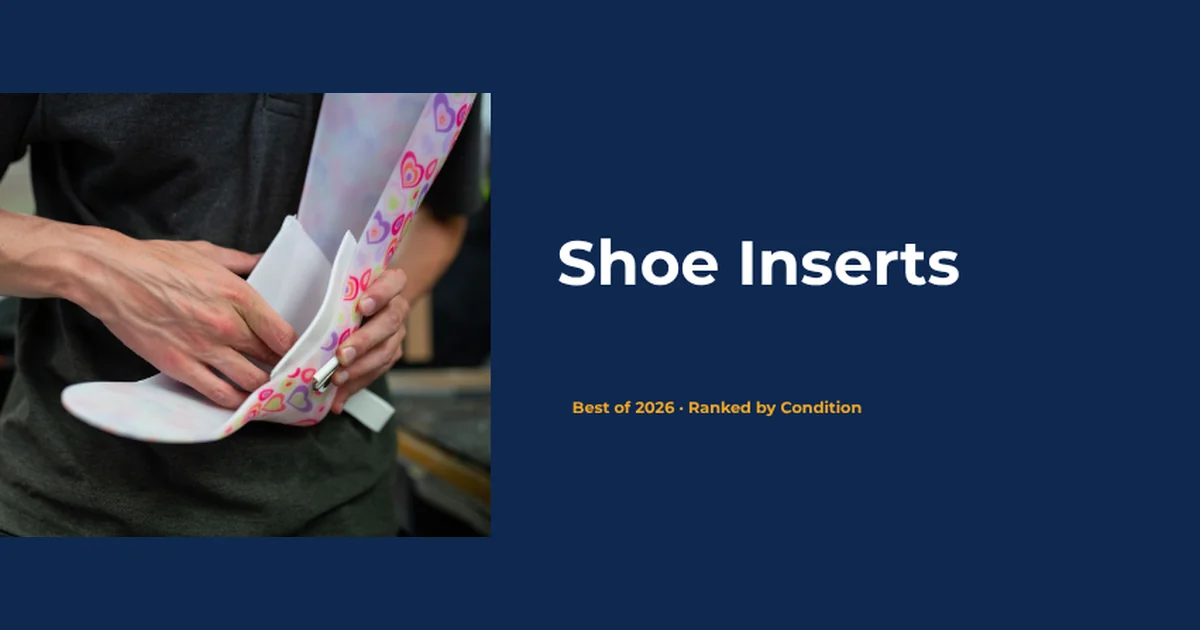
When off-the-shelf inserts aren’t enough, custom 3D-printed orthotics are molded to your foot by a podiatrist.

Dr. Tom Biernacki, DPM is a board-certified foot & ankle surgeon (ABFAS & ABPM) at Balance Foot & Ankle Specialists in Southeast Michigan. With over a decade of clinical experience, he specializes in heel pain, bunions, diabetic foot care, sports injuries, and minimally invasive surgery. Dr. Biernacki is a member of the APMA and ACFAS, and his patient education content on MichiganFootDoctors.com and YouTube has made him one of the most-followed foot & ankle educators on YouTube.