
✅ Medically Reviewed by Dr. Tom Biernacki, DPM
Board-certified podiatric physician & surgeon | Balance Foot & Ankle | Updated April 2026
Quick answer
Foot and toe cramps at night (a charley horse in the foot) are very common and usually harmless. The most frequent triggers are dehydration, an electrolyte imbalance (magnesium, potassium, calcium), overworked foot muscles, and cold feet at night. Stretching the toes upward, standing on the foot, hydration, and warm socks relieve most episodes. See a podiatrist if cramps are frequent or worsening, or if you have diabetes or poor circulation. Balance Foot & Ankle: (810) 206-1402.
Most nighttime toe cramps are harmless and caused by things like dehydration, overuse, or mineral imbalances. But in rare cases they can signal a nerve or circulation issue — and if your cramps persist or keep getting worse, they are worth getting checked out. In this guide I’ll cover what night toe cramps are, what actually causes them, and exactly how to relieve and prevent them at home.
What Are Night Time Toe Cramps?
- Toe cramps at night are very common.
- Up to 60% of adults have had night-time leg or foot cramps.
- They are usually harmless; frequent or worsening cramps deserve a closer look, especially if you smoke, have diabetes or circulation problems, or are older.
- The leading explanation is nerve over-excitability: the nerve to a tired, shortened muscle fires when it should not, and the muscle locks into a contraction.
Causes of Night Toe Cramps:
There is still no exact consensus in the scientific community.
But the majority of theories center around an electrical imbalance that has to do with your nerves.
Specific Causes Of Electrical Imbalance:
- Overuse of muscles throughout the day.
- A lack of muscle flexibility in the calf & bottom of your foot.
- Dehydration due to lack of water.
- Dehydration due to alcohol or caffeine.
- Imbalance of electrolytes: magnesium, potassium & calcium.
- Irritation due to the cold.
- Some medications, such as diuretics and statins.
Home Treatment for Night Toe Cramps
Treatment has two parts: stopping the cramp that wakes you up, and preventing the next one.
When a cramp strikes
- Stretch the toes upward. Pull your toes gently toward your shin (dorsiflexion) and hold. This is the fastest way to break a cramp.
- Stand up and put weight on the foot. Loading the foot forces the cramping muscle to lengthen.
- Massage the arch and toes until the muscle releases.
- Warm the foot — a warm towel or heating pad relaxes the muscle and improves blood flow.
Preventing the next one
- Hydrate through the day, and replace electrolytes after exercise, alcohol, or caffeine.
- Stretch your calves and the bottom of your feet before bed. A short nightly stretching routine measurably reduces cramp frequency.
- Keep your feet warm at night — socks or heavier bedding if your feet run cold.
- Support overworked feet. If you are on your feet all day, supportive shoes or orthotics reduce the muscle overuse that triggers cramping.
- Review your medications. Diuretics, statins, and some asthma medications are associated with nocturnal cramping — ask your prescriber before changing anything.
One honest note on supplements: magnesium is widely recommended for cramps, but the clinical evidence is mixed. Correcting a genuine deficiency helps; megadosing when your levels are normal does not. Hydration, stretching, and warmth have the most consistent results.
Foot Arch Cramps: Why the Arch Is the Most Common Site
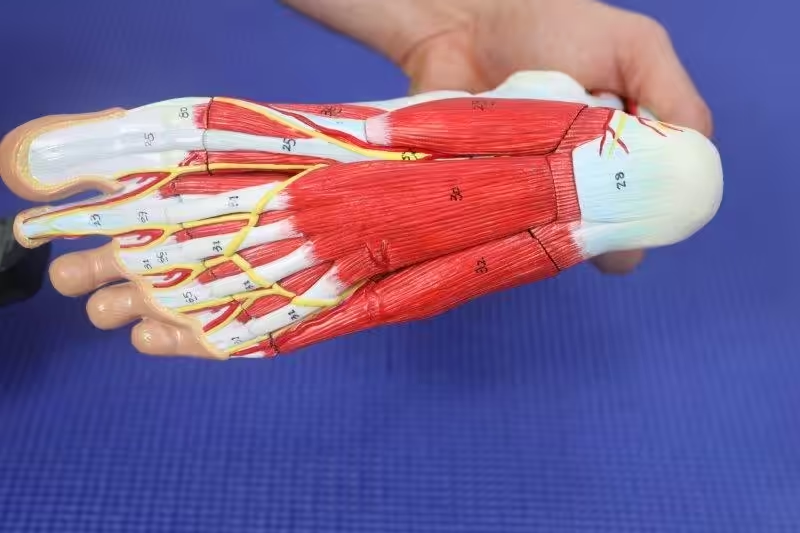
Although people describe these as toe cramps, the muscle actually seizing is very often in the arch. The intrinsic muscles of the foot run from the heel out to the toes along the sole, and when they contract involuntarily the toes curl as a consequence. That is why the toes look like the problem while the pain sits in the middle of the foot.
The arch is the most frequent site for a few reasons. These are small muscles doing postural work all day, they are often already fatigued by evening, and they shorten while you sleep because most people rest with the foot pointed. A muscle that is fatigued, shortened, and poorly hydrated is a muscle primed to cramp.
Arch cramping also travels with mechanical problems. A flat or collapsing arch makes the intrinsic muscles work harder to hold a shape the bone structure is not holding on its own. Plantar fasciitis frequently coexists, and patients often cannot tell the two apart, since both produce arch pain that is worst on the first steps in the morning. The distinction that matters: a cramp is a sudden, visible, palpably hard contraction lasting seconds to minutes, while plantar fasciitis is a steady ache with tenderness at the heel attachment.
How to Stop a Foot Cramp Fast
The fastest way out of an active cramp is to lengthen the muscle that is contracting. Fighting it or massaging it first usually prolongs it.
The stretch that works
Sit up, straighten the knee, and pull the toes and forefoot up toward your shin with your hand or a towel looped around the ball of the foot. Hold steadily rather than bouncing. Most cramps release within twenty to thirty seconds. If you cannot reach, stand up and press the heel down flat with the toes against a wall, or simply walk on the heel for a few steps.
Then, and only then, massage
Once the contraction has released, firm massage of the arch and calf helps clear the residual soreness that otherwise lingers into the next day. Warmth helps here too. A warm shower aimed at the calf and sole, or a heating pad for ten minutes, does more than ice for a cramp, since the problem is contraction rather than inflammation.
Reducing how often they happen
Stretch the calf and the sole of the foot before bed rather than only after a cramp. Keep bedding loose over the feet, because heavy blankets push the foot into the pointed position that predisposes to arch cramping. Stay hydrated across the whole day rather than drinking heavily in the evening. If you are on your feet at work, replace shoes with collapsed midsoles, since a foot that is fighting an unsupportive shoe all day arrives at bedtime already exhausted.
What Deficiency Causes Foot Cramps?
This is one of the most searched questions about cramps, and the honest answer is more nuanced than the supplement aisle suggests.
Magnesium, potassium, calcium, and sodium all participate in muscle contraction and relaxation, and a genuine deficiency in any of them can produce cramping. Where that deficiency is real and documented, correcting it helps. The complication is that most adults with night cramps do not turn out to be deficient in anything, and the clinical trials of magnesium supplementation for ordinary nocturnal leg and foot cramps in the general adult population have largely failed to show a meaningful benefit over placebo. Pregnancy appears to be the exception, where the evidence is more encouraging.
Low sodium and low potassium from heavy sweating, vomiting, diarrhoea, or diuretic medication are more likely culprits than magnesium in practice. So is plain dehydration, which is not a deficiency at all. If cramps are frequent, a basic metabolic panel is a more useful first step than a trial of supplements, because it either identifies something real or rules the question out.
One caution worth stating plainly: quinine is still recommended informally for cramps and is no longer considered acceptable for this purpose, because of the risk of serious blood and kidney reactions. It should not be used for cramping.
Types of Foot and Toe Cramps, and What Else It Might Be
Not everything that clenches at night is a cramp, and the differences change what to do about it.
A true muscle cramp
Sudden, involuntary, painful, with a muscle you can feel gone rock hard. It lasts seconds to a few minutes and often leaves the area sore the next day. This is the classic nocturnal foot cramp.
Restless legs syndrome
Frequently confused with cramping, but it is a different problem. Restless legs produces an uncomfortable urge to move rather than a painful contraction, it builds during rest and in the evening, and it is relieved by movement. There is no hard, seized muscle. It is also linked to low iron stores, which is worth checking, and it responds to entirely different treatment.
Dystonia and toe curling
Where the toes pull into a sustained, patterned position rather than a brief violent contraction, and particularly if it happens with a specific activity, this may be dystonia rather than a cramp. It warrants a different evaluation.
Nerve and circulation causes
Peripheral neuropathy commonly produces cramping alongside burning, numbness, or pins and needles. Peripheral artery disease deserves specific mention: pain that comes on predictably while walking and eases with rest points to circulation, and in advanced disease, foot pain at night that improves when the foot is hung over the edge of the bed is a warning sign that needs prompt assessment rather than a stretching routine.
Medications and medical conditions
Statins, diuretics, some blood pressure and asthma medicines, and certain osteoporosis drugs are all associated with cramping. An underactive thyroid, diabetes, kidney disease, and liver disease can all present this way too. If cramps started within a few months of a new prescription, that connection is worth raising with the prescriber before anything else.
Foot Cramps During Pregnancy
Cramping in the legs and feet is common in pregnancy, most often in the second and third trimesters and most often at night. The contributing factors stack up: added weight through a foot whose ligaments are already more lax from relaxin, changed circulation and venous return, shifting fluid and electrolyte balance, and altered posture.
The practical measures are the same ones that help anyone, with a few additions. Stretch the calves before bed, avoid standing still for long stretches, elevate the legs when resting, and choose supportive footwear rather than flats, since arch collapse during pregnancy is a large part of why the intrinsic muscles fatigue. Magnesium supplementation has better supporting evidence in pregnancy than in the general population, but as with anything taken during pregnancy it should be cleared with your obstetric provider first.
One thing not to dismiss: calf pain that is one-sided, constant rather than intermittent, and accompanied by swelling, warmth, or redness is not a cramp and needs urgent assessment, because pregnancy raises the risk of blood clots.
When arch cramping keeps coming back
Recurrent arch and toe cramping that has not responded to stretching, hydration, and better footwear usually has a mechanical or neurological explanation that can be identified. We evaluate cramping alongside arch structure, gait, nerve function, and circulation at our Howell and Bloomfield Township offices, and treatment often comes down to supporting the arch properly rather than chasing a supplement. Call (810) 206-1402 to arrange an evaluation.
Cramps in the Calf, During the Day or While Walking
Night cramps in the foot and the calf often travel together, and the same stretching, warmth and hydration help both. Our guide to calf cramps at night covers the calf in detail, and leg cramps at night covers the whole leg. Cramping that comes on predictably while you walk and eases when you stop is different: it can be a sign of poor circulation (claudication) and is covered in foot cramping while walking. Swimmers get their own pattern of toe and arch cramps from kicking with a pointed foot in cool water; see swimming foot cramps.
When to See a Podiatrist
- Cramps are frequent, worsening, or now happen during the day too
- You have diabetes, peripheral artery disease, or you smoke — cramping can signal a circulation problem
- Cramps come with numbness, tingling, or burning (possible nerve involvement)
- Your foot or calf stays sore, swollen, or discolored after cramps
- Home treatment for 2–3 weeks hasn’t reduced them
Waking Up With Toe Cramps at Night?
Nighttime toe cramps are more than an inconvenience — they can signal nerve, circulation, or biomechanical problems. Our podiatrists find the cause and stop the cramps. Appointments at our Howell and Bloomfield Township, MI offices.
Or call: (810) 206-1402
Sources
- Nocturnal Leg Cramps — StatPearls (NCBI)
- Allen RE, Kirby KA. “Nocturnal leg cramps.” Am Fam Physician. 2012;86(4):350-355.
- Garrison SR, et al. “Nocturnal leg cramps and prescription use that precedes them.” Arch Intern Med. 2012;172(2):120-126.
- Blyton F, et al. “Non-drug therapies for lower limb muscle cramps.” Cochrane Database Syst Rev. 2012;(1):CD008496.
Related guides

Dr. Tom Biernacki, DPM is a board-certified foot & ankle surgeon (ABFAS & ABPM) at Balance Foot & Ankle Specialists in Southeast Michigan. With over a decade of clinical experience, he specializes in heel pain, bunions, diabetic foot care, sports injuries, and minimally invasive surgery. Dr. Biernacki is a member of the APMA and ACFAS, and his patient education content on MichiganFootDoctors.com and YouTube has made him one of the most-followed foot & ankle educators on YouTube.