
A new blister can derail a long run or trip — the right popping decision and dressing makes the difference.
You are in the right place. Dr. Tom Biernacki, DPM, FACFAS — board-certified foot & ankle surgeon with 3,000+ surgeries — explains exactly what foot blisters means and what works. Call (810) 206-1402 for same-week appointment at Howell or Bloomfield Township.


Dr. Tom’s Top Picks for Dress Shoes & Sandals (2026)
Affiliate disclosure: As an Amazon Associate, Balance Foot & Ankle earns from qualifying purchases.
| Product | Best For | Dr. Tom’s Take | Get It |
|---|---|---|---|
| Foot Petals Tip Toes Ball of foot cushions |
High heels · Pumps · Flats with thin soles · Metatarsalgia in dress shoes | My #1 recommendation for women in heels. Gel cushioning that actually stays in place. | Buy Now |
| Foot Petals Heavenly Heelz Heel cushions |
Slipping out of heels · Heel pain · Achilles rubbing · Loose-fit shoes | Two-in-one: cushions the heel AND prevents slipping. Saves a $200 pair of shoes. | Buy Now |
| Foot Petals Strappy Strips Strap protection |
Sandal strap blisters · Heel rub · New shoes break-in · Toe-strap discomfort | Prevents the #1 sandal-season complaint. Apply BEFORE the blister forms. | Buy Now |
| Foot Petals Killer Kushionz Full-foot cushion |
All-day standing · Wedding events · Performance · Back pain from heels | For events when you need to be in heels for 8+ hours. Gel pad reduces forefoot impact 40%. | Buy Now |
| FLAT SOCKS No-show liner |
Sandals with closed-back · Boat shoes · Loafers · Sweat absorption without sock-show | My patient compliance hack: when patients can’t tolerate going sockless, FLAT SOCKS solves the problem invisibly. | Buy Now |
| FLAT SOCKS Sport Athletic version |
Athletic sandals · Running with foot covering · Hiking sandals · Active wear | Same FLAT SOCKS concept but with extra cushioning + grip for active wear. Game-changer. | Buy Now |
Why I recommend Foot Petals over generic gel pads: They actually stay in place. Cheaper alternatives slide forward within 30 minutes; Foot Petals’ adhesive lasts a full day of wear and replaces clean.
Medically reviewed by Dr. Tom Biernacki, DPM · Board-Certified Podiatric Surgeon · Last reviewed: April 2026 · Editorial Policy
Medically reviewed by Dr. Tom Biernacki, DPM — Board-Certified Podiatric Surgeon — Balance Foot & Ankle, Howell & Bloomfield Township, MI. Last updated April 2026.
How to Treat a Foot Blister: The Five-Step Method
This is the sequence we use in the office, and it resolves the large majority of friction blisters. The order matters more than any single product.
- Stop the rubbing before anything else. Take the shoe off. A blister is a shear injury, and every further step makes the raw base wider than the roof covering it — which is what turns a two-day problem into a two-week one. If you are mid-shift or mid-hike and cannot stop, cover it and change what is moving against it.
- Clean around it, not the blister itself. Soap and water on the surrounding skin is enough. Scrubbing an intact dome risks tearing the one dressing you cannot buy.
- Decide honestly whether it needs draining. Most do not. Small, not under direct pressure, and not changing how you walk means leave it alone and protect it. The rule for the exceptions is under “Should You Pop a Blister?” below.
- Cover it with something that reduces shear, not just something absorbent. A hydrocolloid blister plaster is the single most useful item here: it cushions, it keeps the base moist so new skin forms faster, and its slick outer surface lets the sock slide over it instead of gripping. A plain adhesive bandage is better than nothing but does very little about friction. Leave a hydrocolloid on until it loosens by itself rather than changing it daily.
- Change the cause before you go back to the same activity. A different sock, a better fit, a heel-lock lacing pattern, or tape over the hot spot. Returning to the identical shoe on day three is the most common reason a blister refills in exactly the same place.
How long it actually takes. The fluid in an intact blister is usually reabsorbed within 24 to 48 hours, but the raw layer underneath needs roughly 7 to 10 days to rebuild into skin that tolerates friction again. Feeling better on day three is not the same as being healed, and that gap is where most people re-injure it.
What to Actually Put on a Foot Blister
Three things people reach for, and only one of them is doing much of the work.
- Hydrocolloid dressings — yes. The closest thing to a genuinely useful blister product. They cushion the area, hold the base moist so it resurfaces faster, and present a slippery face to the sock. Leave one on until it starts lifting at the edges instead of replacing it every day.
- Petroleum jelly — yes, for two specific jobs. Before activity, a thin film over a known hot spot lets the sock slide rather than grip. On an already-open blister, a thin layer stops the dressing bonding to fragile new skin. It is not an antiseptic and it does not speed healing by itself.
- Antibiotic ointment — only if there is a reason. Neosporin and other triple-antibiotic ointments do not make an ordinary blister heal faster, because an intact or freshly drained blister is not infected. They are for a blister that has opened and is at real risk, or one showing early infection — and even then plain petrolatum performs comparably in most wound-care evidence. There is also a specific reason for caution: neomycin, one of the active ingredients, is among the more common causes of allergic contact dermatitis. A blister that becomes itchier, redder and more widespread a few days after you start applying it may be reacting to the ointment rather than becoming infected. As a default for an open blister, petrolatum under a non-stick dressing is the safer routine.
Skip hydrogen peroxide, rubbing alcohol and iodine on the open base. All three damage the cells trying to rebuild the skin along with everything else, and they sting for no gain.
What Causes Foot Blisters?
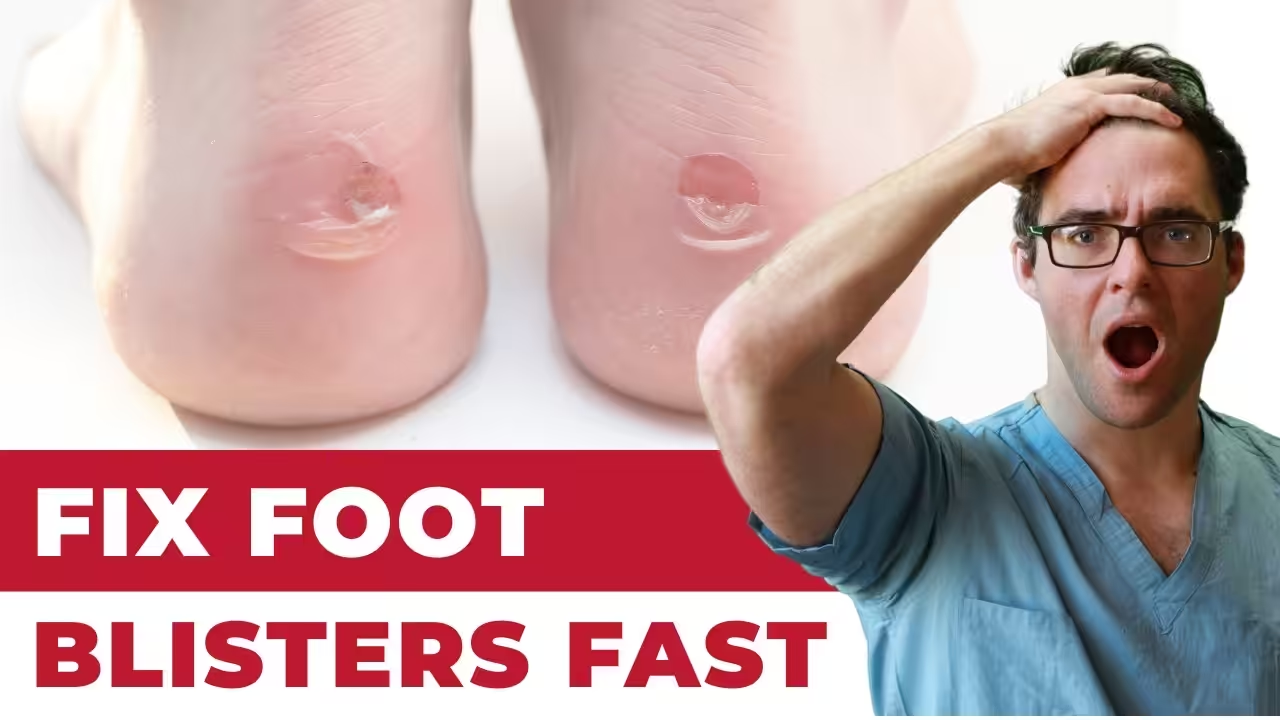
Foot blisters are fluid-filled pockets that form in the upper layers of skin in response to repetitive friction, heat, or chemical irritation. The most common cause is mechanical friction—when skin repeatedly slides against shoe material or socks, the upper and lower skin layers separate and the space fills with interstitial fluid as a protective response. Once formed, blisters provide a natural cushion over the irritated skin and protect against deeper injury. The friction threshold for blister formation is reduced by moisture (wet feet blister much faster than dry feet) and heat—which is why blisters are particularly common in new shoes, during long hikes, and after excessive sweating.
Common Locations and Causes
Heel blisters are the most common location, typically from new shoes with stiff heel counters that haven’t been broken in, or from shoes that don’t fit properly in the heel (too loose, causing repetitive sliding). Ball-of-foot blisters develop from forefoot pressure and moisture accumulation. Toe blisters occur from shoe toe box contact in runners (particularly the second toe on downhills or long distances) and from narrow shoes that compress the toes laterally. Interdigital (between-toe) blisters form from skin-on-skin friction combined with moisture accumulation in the toe web spaces. Burns (from beach sand, pavement in summer, or hot water) produce a different blister type—the fluid is initially clearer but may become bloody with deeper burns requiring medical evaluation.
Should You Pop a Blister?
The standard medical recommendation is to leave intact blisters unpopped—the blister roof provides a sterile, protective barrier over healing tissue. However, large, tense blisters that are painful enough to limit walking can be safely drained using proper technique: clean the skin and a fine needle with alcohol, puncture the blister at the edge (not the center) in 1–2 spots, allow the fluid to drain, then cover it with a hydrocolloid dressing or a thin film of petroleum jelly under a bandage. Do not remove the blister roof—it continues to protect the raw skin beneath while healing proceeds. For athletic competition or when a blister cannot be protected adequately, draining with appropriate sterile technique is preferable to rupturing spontaneously from activity.
Blood blisters (filled with blood rather than clear fluid) suggest deeper tissue injury and generally should not be drained at home. Infected blisters—recognized by increasing redness beyond the blister margins, pus, significant warmth, or fever—require medical evaluation and should not be drained at home. Diabetic patients with foot blisters should seek podiatric evaluation before attempting any self-treatment, as even minor foot wounds carry significant infection risk.
Friction, Blood and Infected Blisters Are Not the Same Problem
Most advice online treats every blister on the foot as one thing. In the office they behave quite differently, and telling them apart changes what you should do.
- Friction blister (clear fluid). The common one. Shear force separates the layers of the skin and clear serum fills the gap. Manage it as above and fix the rubbing that caused it.
- Blood blister (dark red or purple). The shear went deeper and tore small vessels. These are more painful, take longer to resolve, and carry a higher infection risk once opened, so the threshold for draining one should be higher, not lower.
- Infected blister. Cloudy or yellow fluid, increasing rather than decreasing pain after the first day, spreading redness, warmth, red streaking up the foot, or fever. This one is not a self-care problem. It needs to be seen.
One more that gets missed: a blister that appears with no obvious friction, or a crop of them, is not necessarily a friction blister at all. Blistering can come from contact dermatitis, an allergic reaction to something in the shoe or sock, a fungal infection, or a burn the patient did not register, which is common in anyone with reduced sensation. If you cannot point to the rubbing that caused it, the diagnosis is not settled.
When a Foot Blister Is an Emergency
Almost every blister is minor. A small number are not, and the difference is worth knowing because the people most at risk are often the least likely to feel the warning signs.
If you have diabetes, peripheral neuropathy, peripheral arterial disease, or any condition that reduces sensation or circulation in your feet, do not treat a foot blister at home. Have it looked at. A blister on a neuropathic foot is the way a great many diabetic foot ulcers begin: the protective pain response that would normally make you stop and take the shoe off is absent, so the damage continues for hours or days without being noticed. What would be a trivial injury on a healthy foot can become a wound that takes months to close. If that describes your situation, our guide to blisters on a diabetic foot covers how to tell a friction blister from bullosis diabeticorum and from one that is already infected, and why none of the three has to hurt.
Seek same-day care, regardless of your health history, for any of the following:
- Spreading redness, red streaks travelling up the foot or leg, or a fever
- Pus, or fluid that is cloudy rather than clear
- Pain that is getting worse after the second day rather than better
- A blister that has opened down to a raw base and is not starting to close within a few days
- Numbness, or a foot that is cold, pale or dusky compared with the other one
Blister Prevention Strategies
Footwear and Sock Selection
Properly fitted shoes—with adequate length (1–1.5 cm of space to the toe), width (no lateral toe compression), and appropriate heel fit—prevent the majority of friction blisters. Double-layer socks (inner moisture-wicking liner and outer protective layer) reduce friction between the foot and sock by providing a slip plane between the two sock layers. Merino wool socks regulate moisture and provide natural friction resistance. Avoiding cotton socks (which retain moisture) significantly reduces blister risk in athletes. Breaking in new shoes gradually before wearing them for prolonged distances prevents heel and lateral foot blisters from stiff shoe materials.
Moisture Management
Moisture dramatically reduces friction threshold—wet skin blisters at one-third the friction force of dry skin. Applying antiperspirant to blister-prone areas (particularly the heel and ball of foot) before athletic activity significantly reduces blister formation in endurance athletes. Foot powder or cornstarch in the shoe reduces in-shoe moisture. Waterproofing socks or using moisture-barrier cream on high-friction areas provides additional protection for wet-condition activities (trail running, military operations).
Friction Reduction at Known Hot Spots
Preventive taping of known blister-prone areas before activity provides a friction barrier. Moleskin (with the center cut out to form a donut pad around the blister-prone area) and gel blister pads (Compeed, Band-Aid Blister Guard) significantly reduce blister incidence when applied to known hot spots before walking or running. Lubricants (petroleum jelly, BodyGlide, or specialized anti-friction products) applied to friction-prone areas reduce mechanical friction in real-time—particularly effective for long-distance runners and hikers.
Frequently Asked Questions
How long does a foot blister take to heal?
Most intact foot blisters heal within 3–7 days if protected from further friction and left undisturbed. The fluid is gradually reabsorbed, and the blister roof slowly dries and detaches as the underlying skin heals. Drained blisters (where the roof is intact but fluid has been removed) also typically heal in 3–7 days. Blisters where the roof has been completely torn off heal more slowly—7–14 days—as the exposed raw skin must re-epithelialize from the blister margins. Keeping the wound clean, covered with a non-stick dressing, and protected from further friction optimizes healing rate. If a blister shows signs of infection (increasing redness, warmth, pus) it requires medical evaluation as healing will be significantly delayed until infection is treated.
When should I see a doctor for a foot blister?
See a podiatrist if: the blister shows signs of infection (expanding redness, pus, fever, red streaking from the blister), you are diabetic or immunocompromised (any foot wound requires prompt evaluation), the blister is blood-filled and painful suggesting deep injury, the blister fails to heal within 2 weeks despite proper care, or blisters recur repeatedly in the same location despite footwear and sock modifications (suggesting an underlying biomechanical issue like hammertoe or callus that increases friction at that specific point). Diabetic patients especially should not attempt self-management of foot blisters—what appears to be a minor blister can progress to a serious wound or infection with the impaired healing and immune response associated with diabetes.
Why do I keep getting blisters in the same spot?
Recurrent blisters at the same location indicate a persistent friction hotspot—usually from footwear fit issues (the shoe contacts the foot abnormally at that point), foot deformity (a hammertoe, bunion, or bony prominence that creates a high-pressure contact zone), or biomechanical abnormality (overpronation that causes the heel to slide in the shoe, or abnormal push-off mechanics). If preventive taping and shoe modification don’t resolve recurrent blisters, podiatric evaluation can identify the underlying cause. Custom orthotics address biomechanical friction sources, and minor in-office procedures (treating a callus or corn under the recurrent blister site, addressing a hammertoe creating shoe pressure) often permanently eliminate recurrent blister formation.
Can blisters heal in 3 days?
A small friction blister can look and feel healed in about three days once the rubbing stops, but the skin underneath is not finished. The fluid is usually reabsorbed within 24 to 48 hours, while the raw layer beneath needs roughly 7 to 10 days to rebuild into skin that tolerates friction again. Going back into the same shoe on day three is the single most common reason a blister refills in exactly the same spot. If it is still tense, painful, or filling again after three days, something is still rubbing and the shoe or sock needs to change before the skin will keep up.
Why put Vaseline on a blister?
Petroleum jelly does two different jobs depending on when you use it. Before activity, a thin film over a known hot spot lets the sock slide against the skin instead of gripping it, which prevents the shearing that forms a blister in the first place. On a blister that has already opened or been drained, a thin layer stops the surface drying out and sticking to the dressing, so the fragile new skin is not torn off at the next bandage change. It is not an antiseptic and it does not speed healing by itself, so it does not replace cleaning the area and keeping it covered. Do not seal it under an airtight dressing on a blister that is red, warm, spreading or draining pus – that needs to be looked at, not covered up.
Medical References & Sources
- PubMed Research — Friction Blisters in Athletes
- PubMed Research — Blister Prevention Strategies
- American Podiatric Medical Association — Blisters
Dr. Tom Biernacki, DPM is a board-certified podiatric surgeon at Balance Foot & Ankle in Howell and Bloomfield Township, Michigan. He treats foot blisters, skin breakdown, and underlying biomechanical conditions that predispose to recurrent blisters and friction injuries.
Join 950,000+ Learning About Foot Health
Dr. Tom shares honest medical advice, supplement reviews, and treatment guides you won’t find anywhere else.
Subscribe on YouTube →Blister-Prevention Socks and Products
- Darn Tough Merino Wool Socks — Lifetime Guarantee
- Balega Hidden Comfort — Ultra-Padded Running Socks
- Body Glide Anti-Blister Balm — Friction Prevention
Amazon affiliate links — we may earn a small commission at no extra cost to you.
📍 Located in Michigan?
Our board-certified podiatrists treat this condition at two convenient locations. Most new patients are seen the same week.
Insurance Accepted
BCBS · Medicare · Aetna · Cigna · United Healthcare · HAP · Priority Health · Humana · View All →
Howell Office
4330 E Grand River Ave
Howell, MI 48843
Get Directions →
Bloomfield Township Office
43494 Woodward Ave, #208
Bloomfield Township, MI 48302
Get Directions →
Your Board-Certified Podiatrists



Ready to Get Back on Your Feet?
Same-week appointments available at both locations.
Book Your AppointmentPros & Cons of Conservative Care for foot care
Advantages
- ✓ Conservative care first
- ✓ Same-week appointments
- ✓ Multiple insurance accepted
Considerations
- ✗ Self-treatment can mask issues
- ✗ See a podiatrist if pain >2 weeks
Dr. Tom’s Recommended Products for foot care
Affiliate disclosure: As an Amazon Associate, Balance Foot & Ankle earns from qualifying purchases. We only recommend products we use with patients.
Footnanny Heel Cream Dr. Tom’s Pick
Best for: Daily moisturizer for cracked heels
Ready to Get Back on Your Feet?
Same-week appointments in Howell + Bloomfield Township. Most insurance accepted. Dr. Tom Biernacki, DPM & team.
Book Today — Same-Week Appointments Available
Call Now: (810) 206-1402
About Your Care Team at Balance Foot & Ankle
Dr. Tom Biernacki, DPM · Board-Certified Foot & Ankle Surgeon. Specializes in conservative-first care, minimally invasive bunion surgery, and complex reconstruction.
Dr. Carl Jay, DPM · Accepting new patients. Specializes in sports medicine, athletic injuries, and routine podiatric care.
Dr. Daria Gutkin, DPM, AACFAS · Accepting new patients. Specializes in surgical reconstruction and pediatric podiatry.
Locations: 4330 E Grand River Ave, Howell, MI 48843 · 43494 Woodward Ave Suite 208, Bloomfield Township, MI 48302
Hours: Mon–Fri 8:00 AM – 5:00 PM · (810) 206-1402
In-Office Treatment at Balance Foot & Ankle
If home treatment isn’t providing relief for your foot and ankle conditions, our podiatry team at Balance Foot & Ankle can help with same-week evaluations and advanced in-office care.
Same-week appointments available. (810) 206-1402
VitaMedica Arnica Gel
Arnica gel plus 15 plant compounds for sore feet, plantar fasciitis flares and post-activity soreness. Apply a thin layer to the sore area.
Shop VitaMedica Arnica Gel →Related Conditions
Ready for Expert Care?
Same-week appointments in Howell & Bloomfield Township, MI.
