
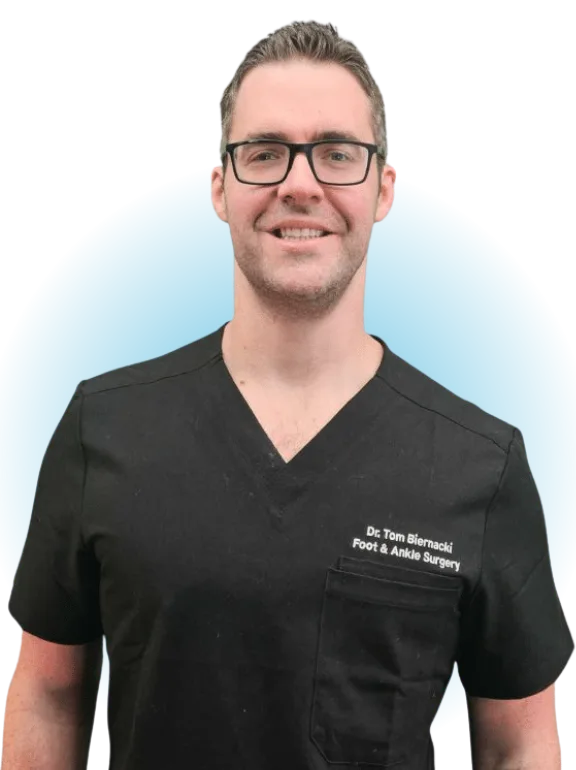
Medically reviewed by Dr. Tom Biernacki, DPM
Board-certified podiatric surgeon | Balance Foot & Ankle, Howell & Bloomfield Township, MI
Last reviewed: May 2026

| PTTD Stage | Arch Status | Pain Location | Clinical Finding | Treatment |
|---|---|---|---|---|
| Stage I | Normal arch; flexible | Medial ankle / PTT course | Tendon swelling; full strength single-heel raise | Orthotics + PT + anti-inflammatory |
| Stage II | Collapsed; flexible (correctable) | Medial ankle + arch; lateral impingement | Cannot do single-heel raise; pes planus | CROW brace or AFO; PT; consider surgery |
| Stage III | Rigid flat foot | Lateral hindfoot (subfibular impingement) | Fixed deformity; subtalar arthritis | Surgical correction (triple arthrodesis) |
| Stage IV | Rigid flat + ankle valgus | Ankle + hindfoot | Ankle joint involvement | Surgical: tibiotalar + subtalar fusion |
| Conservative Treatment | Stage | Goal | Expected Outcome |
|---|---|---|---|
| Custom orthotics (UCBL or semi-rigid) | I–II | Support arch; reduce PTT load | Pain reduction; halt progression in Stage I |
| Arizona AFO (ankle-foot orthosis) | II (moderate) | Control hindfoot valgus; offload tendon | Significant pain relief; function improvement |
| Physical therapy (PTT strengthening) | I | Strengthen tendon; calf stretching | Slows progression; best for early disease |
| Activity modification | I–II | Reduce tendon stress | Controls symptoms; prevents worsening |
| Short-leg walking cast / boot | Acute flare (II) | Rest acutely inflamed tendon | Rapid pain reduction; sets stage for bracing |
Quick answer: Foot Pain Arch Collapse has multiple potential causes including mechanical, neurological, vascular, and inflammatory. The most common causes we identify are overuse, ill-fitting shoes, and biomechanical imbalance. Red flags requiring urgent evaluation: warmth/redness (infection), inability to bear weight (fracture), and unilateral swelling without injury (DVT). Call (810) 206-1402.
Medically Reviewed | Dr. Tom Biernacki, DPM | Board-Certified Podiatrist | Balance Foot & Ankle, Michigan
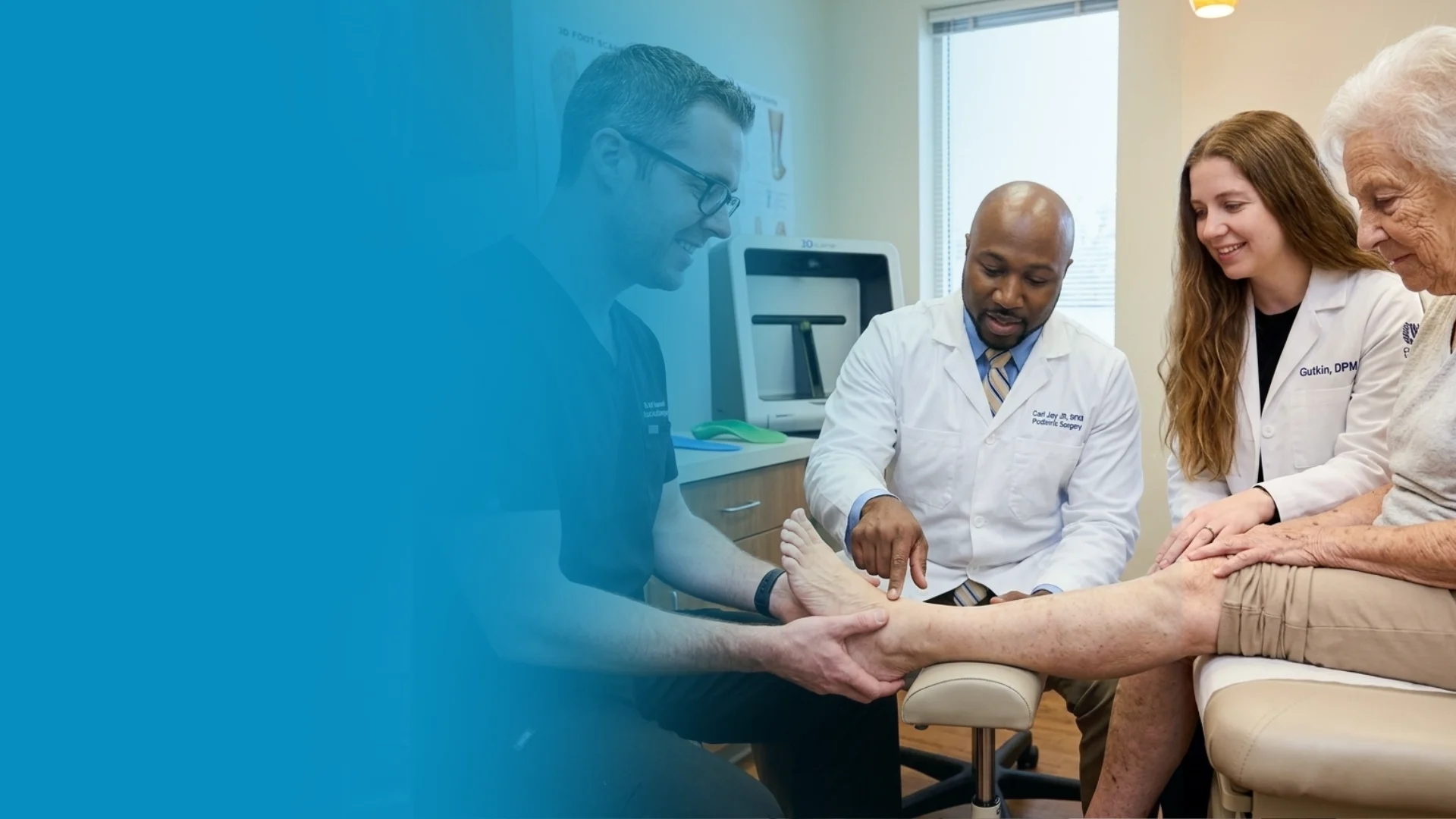

Watch: How to Cure Plantar Fasciitis in One Week? [FAST Heel Pain Relief!] — MichiganFootDoctors YouTube
Foot Arch Collapse: Quick Answer
Sudden or progressive arch collapse signals important biomechanical or medical conditions requiring evaluation. Untreated arch collapse leads to chronic foot pain, deformity, and disability. We treat hundreds of arch collapse cases yearly at Balance Foot and Ankle. Here is the complete guide.
What Is Arch Collapse?
Arch collapse refers to flattening of the medial longitudinal arch of the foot. Two types: Sudden collapse (acute injury or rupture); Progressive collapse (gradual development over months to years). Different from congenital flat feet (present from birth) – arch collapse occurs in someone who previously had normal arch.
Most Common Cause: Posterior Tibial Tendon Dysfunction (PTTD)
What it is: Failure of posterior tibial tendon supporting arch. Most common cause of adult-acquired flat foot. Symptoms: Inside ankle/arch pain; visible arch flattening; “too many toes” sign from behind; cant do single-leg heel raise. Stages I-IV: Stage I (tendinitis – reversible); Stage II (flexible flat foot); Stage III (rigid flat foot); Stage IV (ankle involvement).
Other Causes of Arch Collapse
1. Trauma: Lisfranc injury; Achilles rupture; severe ankle sprain. 2. Spring ligament tear: Inside arch ligament rupture. 3. Plantar fascia rupture: Sudden severe arch pain with bruising. 4. Inflammatory arthritis: Rheumatoid; psoriatic. 5. Charcot foot (diabetic neuropathy). 6. Pregnancy: Hormonal ligament loosening. 7. Aging: Gradual ligament weakening. 8. Obesity: Excess loading on supporting structures.
Symptoms
Visible signs: Arch flattening (compare to other foot or pre-symptom photos); “too many toes” sign from behind; ankle drift inward; bony bumps on inside of foot; difficulty wearing previously fitting shoes. Pain symptoms: Inside ankle/arch pain; sometimes lateral foot/ankle pain (from impingement); chronic foot fatigue; back/hip/knee pain (from compensation).
Diagnosis
Clinical exam: Standing alignment; “too many toes” sign; single-leg heel raise test; range of motion; tenderness over posterior tibial tendon. Standing X-rays: Show alignment changes; identify joint involvement; rule out fractures. Diagnostic ultrasound: Posterior tibial tendon evaluation. MRI: Best for ligament evaluation; rule out tears (spring ligament, plantar fascia); assess tendon condition.
Conservative Treatment by Stage
Stage I (PTTD – Reversible): Custom orthotics with deep heel cup; lace-up ankle brace; eccentric strengthening; PT; NSAIDs. 80-90% improve. Stage II (Flexible Flat Foot): Custom orthotic with deep heel cup, arch support, medial wedge; possibly Arizona AFO (articulated ankle-foot orthosis); PT. Stage III-IV (Rigid): Bracing palliative; consider surgical reconstruction.
Surgical Treatment
For Stage II PTTD failed conservative care: 1. FDL tendon transfer: Strong tendon transferred to compensate for failed posterior tibial. 2. Calcaneal osteotomy: Heel bone repositioned. 3. Lateral column lengthening: Calcaneocuboid distraction. 4. Cotton osteotomy: Medial cuneiform. For Stage III-IV (Rigid): Triple arthrodesis (joint fusions); ankle replacement or fusion if ankle involved.
Why Early Treatment Matters
Stage I PTTD is largely reversible with proper conservative care. Stage II onward cannot be reversed – only managed or surgically corrected. Without treatment, PTTD progresses through stages over months to years, ultimately causing severe deformity and disability. Early intervention with custom orthotics, bracing, and PT can prevent progression.
When to See a Podiatrist Same-Week
See us for any: 1. Sudden onset arch flattening (rule out tendon rupture). 2. Progressive arch flattening over months. 3. Inside ankle/arch pain not improving in 2 weeks. 4. “Too many toes” sign visible. 5. Difficulty doing single-leg heel raise. 6. Pre-existing flat feet getting worse. 7. Pregnant patient with severe arch pain. 8. Diabetic with warm swollen foot (Charcot concern). Book online 24/7 at Balance Foot and Ankle. Schedule online.
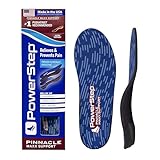
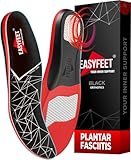
Podiatrist-Recommended Products


Frequently Asked Questions About Foot Arch Collapse
What causes adult arch collapse?
Most common: posterior tibial tendon dysfunction (PTTD). Other causes: trauma (Lisfranc injury, Achilles rupture), spring ligament tear, plantar fascia rupture, inflammatory arthritis, Charcot foot in diabetics, pregnancy, aging, obesity.
Can arch collapse be reversed?
Stage I PTTD largely reversible with proper conservative care. Stage II onward cannot be reversed – only managed conservatively or surgically corrected. Early intervention is critical.
How do I know if my arch is collapsing?
Visible arch flattening; “too many toes” sign from behind; ankle drift inward; difficulty wearing previously fitting shoes; inside ankle/arch pain. Compare to other foot or pre-symptom photos.
What is “too many toes” sign?
Standing visible from behind: more than 2 outer toes visible past the heel indicates significant flat foot deformity. Classic sign of moderate-severe PTTD or established flat foot.
Will custom orthotics help arch collapse?
Yes – especially in early stages. Custom orthotic with deep heel cup, arch support, medial wedge can prevent progression and provide pain relief in Stage I-II PTTD.
Will I need surgery for arch collapse?
80-90% of Stage I PTTD improve without surgery. Stage II often requires surgery if conservative care fails 6 months. Stage III-IV usually requires major reconstructive surgery.
Can pregnancy cause arch collapse?
Yes – hormonal ligament loosening combined with weight gain causes arch flattening in many pregnancies. 50% of women have permanently larger feet after first pregnancy from arch flattening.
Related Resources from Balance Foot & Ankle
Still Dealing With Foot Arch Collapse?
Appointments at Balance Foot & Ankle in Howell & Bloomfield Township, MI.
Book Your Appointment⚕ Doctor Recommended
VitaMedica Arnica GelFragrance-free, non-greasy relief for foot & ankle soreness
View Product →⚠️ Most Common Mistake: Ignoring persistent foot pain and continuing normal activity without evaluation. Early podiatric care prevents minor foot issues from becoming chronic, difficult-to-treat conditions.
Frequently Asked Questions
🏥 Recommended by Dr. Biernacki — Foundation Wellness Products
These are the same products Dr. Biernacki recommends to his patients at Balance Foot & Ankle in Michigan. Available through our trusted partners.
Ready to feel better?
Appointments available in Howell and Bloomfield Township, Michigan.
Book Your VisitIn-Office Treatment at Balance Foot & Ankle
If home treatment isn’t providing relief for your plantar fasciitis, our podiatry team at Balance Foot & Ankle can help with expert evaluations and advanced in-office care.
Ready to Get Relief?
Book online 24/7 in Howell & Bloomfield Township, MI
4.9★ | 1,200+ Reviews | 3,000+ Surgeries
Or call: (810) 206-1402

Dr. Tom Biernacki, DPM is a board-certified foot & ankle surgeon (ABFAS & ABPM) at Balance Foot & Ankle Specialists in Southeast Michigan. With over a decade of clinical experience, he specializes in heel pain, bunions, diabetic foot care, sports injuries, and minimally invasive surgery. Dr. Biernacki is a member of the APMA and ACFAS, and his patient education content on MichiganFootDoctors.com and YouTube has made him one of the most-followed foot & ankle educators on YouTube.