


Board-Certified Podiatric Foot & Ankle Surgeon · Last reviewed: May 5, 2026
Related Conditions
In This Article
- What are the best foot stretches for pain relief?
- Quick Answer: Best Foot Stretches
- Why Stretching Feet Matters
- Plantar Fascia Stretch
- Calf and Achilles Tendon Stretch
- Toe Flexor and Extensor Stretches
- Intrinsic Foot Muscle Exercises
- Arch Stretches and Foot Rolling
- Morning Stretch Routine
- Supportive Products from Our Clinic
- When Stretching Is Not Enough
- The Most Common Stretching Mistake
- In-Office Treatment at Balance Foot & Ankle
- Frequently Asked Questions
- Sources
Foot pain affects more than 75% of Americans at some point in their lives, and in a large proportion of cases, the underlying driver is muscle tightness and fascial restriction — both of which respond directly to targeted stretching. The frustrating reality we see in clinic is that most patients with plantar fasciitis, Achilles tendinopathy, and arch pain are stretching inconsistently, stretching the wrong structures, or using good technique for the wrong duration. The difference between a stretch that resolves chronic heel pain and one that doesn’t is often just the timing, hold duration, and frequency.

Why Stretching Feet Matters
The foot contains 26 bones, 33 joints, and more than 100 muscles, tendons, and ligaments. This complex architecture depends on adequate length and flexibility of each component to distribute load efficiently across the entire structure. When any one element — the plantar fascia, Achilles tendon, calf complex, or intrinsic foot muscles — becomes tight or shortened, the load redistribution becomes abnormal, creating pathological stress concentrations that cause injury.
In our clinic, we see this pattern constantly: a patient with plantar fasciitis who has tight calves and a restricted plantar fascia is generating 40–60% more tensile stress on their heel attachment point with every step than someone with normal flexibility. The research consistently shows that stretching programs targeting the plantar fascia and gastrocnemius/soleus complex reduce plantar fasciitis pain significantly — with some studies showing 90% improvement rates at 8 weeks with a dedicated stretching protocol alone.
Beyond injury treatment, preventive stretching maintains the foot’s shock-absorption capacity, reduces the risk of stress fractures by improving load distribution, preserves joint range of motion as we age, and reduces the risk of falls in older adults by maintaining proprioceptive function in the ankle-foot complex.
Plantar Fascia Stretch
The plantar fascia stretch is the single most evidence-backed foot stretch for the most common foot complaint we treat — plantar fasciitis. It directly tensions the plantar fascia band, increases its length and compliance over time, and specifically targets the insertion point at the medial calcaneal tubercle where inflammation concentrates. When performed before the first step of the day, it pre-loads the fascia so it doesn’t sustain microtears during that vulnerable transition from rest to weight-bearing.
Sitting plantar fascia stretch (preferred):
- Sit on the edge of your bed before your feet touch the floor in the morning
- Cross the affected foot over your opposite knee
- Grip the toes and pull them firmly toward your shin until you feel a strong stretch along the bottom of your foot
- Hold 30 seconds. Repeat 3 times on each foot
- Perform this sequence before every episode of weight-bearing (morning, after sitting, after driving)
You should feel the stretch along the entire arch, from the heel to the ball of the foot. If you feel nothing, pull harder. If you feel sharp pain at the heel (as opposed to the pulling sensation of a stretch), ease off slightly and focus on holding at a lower tension for longer duration.
Standing plantar fascia stretch (wall version): Stand facing a wall with toes elevated on the wall (foot angled 30–45°). Lean gently into the wall to tension the plantar fascia and calf simultaneously. This variant works well mid-day or post-exercise when sitting is inconvenient. Hold 30 seconds, 3 repetitions per side.
Clinical evidence: DiGiovanni et al. (JBJS, 2003) found plantar fascia-specific stretching produced superior outcomes to Achilles stretching alone at 8 weeks. The 2023 clinical practice guideline for plantar heel pain (JOSPT) gives plantar fascia-specific and calf stretching its highest grade of recommendation (A), for both short- and long-term pain relief.
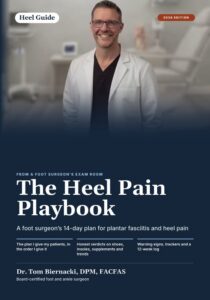
Want the whole plantar fasciitis routine on paper? Dr. Tom’s free printable from The Heel Pain Playbook puts this stretch and the four moves that go with it on five pages, with photos and a 14-day tracker. Get the free printable exercises.
Calf and Achilles Tendon Stretch
Gastrocnemius and soleus tightness is one of the most underappreciated drivers of foot pain. In our clinic, equinus contracture (restricted ankle dorsiflexion due to calf tightness) is present in the majority of plantar fasciitis patients, almost all Achilles tendinopathy patients, and many patients with metatarsalgia and forefoot overload. A tight calf effectively increases the mechanical demand on the plantar fascia with every step — addressing it is non-negotiable for durable results.
Gastrocnemius stretch (straight leg): Stand facing a wall, affected leg straight behind you, front knee bent. Keep the back heel flat on the ground. Lean forward until you feel a deep stretch in the upper calf (behind the knee). Hold 30 seconds, 3 reps. This stretches the gastrocnemius, which crosses the knee joint.
Soleus stretch (bent knee): Same wall position, but bend the back knee slightly while keeping the heel on the ground. This directs the stretch to the soleus (deeper calf muscle) which does NOT cross the knee. Hold 30 seconds, 3 reps. This is the stretch most patients omit — and it’s often the tighter of the two muscles.
Eccentric calf raise (Alfredsson protocol): Stand with the ball of the foot on a step edge, heel hanging off. Rise up on two feet, then lower slowly (3 seconds) on the affected foot only. 3 sets of 15 repetitions, twice daily. This eccentric loading protocol is clinically validated for Achilles tendinopathy and produces tendon structural changes that pure stretching cannot achieve. There will be moderate discomfort — work through it unless the pain is sharp or severe.
| Stretch | Target Structure | Hold Duration | Frequency | Best For |
|---|---|---|---|---|
| Sitting plantar fascia stretch | Plantar fascia | 30 sec × 3 | Before first steps, after rest | Plantar fasciitis, heel pain |
| Gastrocnemius stretch (straight leg) | Gastrocnemius | 30 sec × 3 | 3× daily | Plantar fasciitis, Achilles pain |
| Soleus stretch (bent knee) | Soleus | 30 sec × 3 | 3× daily | Achilles tendinopathy, ankle stiffness |
| Eccentric calf raise | Achilles tendon | 3 sec lowering × 15 | 2× daily | Achilles tendinopathy |
| Toe dorsiflexion stretch | Plantar fascia, toe flexors | 30 sec × 3 | Before weight-bearing | Sesamoiditis, forefoot pain |
Toe Flexor and Extensor Stretches
Toe flexibility is one of the most overlooked components of foot health. Stiff toe flexors contribute to hammertoe progression, increase forefoot pressure, and reduce the toe-off push efficiency that is critical for normal gait mechanics. In our clinic, we routinely find that patients with persistent metatarsalgia and forefoot pain have significantly restricted toe extension — and that restoring this range of motion dramatically reduces their symptoms.
Toe extension stretch: Sit with feet flat. Place your fingers under all five toes and gently pull them upward toward your shin, keeping the ball of the foot flat on the floor. Hold 20 seconds, 3 repetitions. You should feel the stretch on the plantar surface of the toes and forefoot. This stretch simultaneously tensions the plantar fascia distally and stretches the toe flexor tendons.
Individual toe stretch: For hammertoe or a stiff middle joint — grasp the affected toe with thumb and forefinger, stabilize the base with your opposite thumb, and gently pull the distal portion toward extension (upward). Hold 20–30 seconds. Daily gentle stretching of early hammertoe deformity can slow progression and reduce joint capsule contracture.
Toe flexion strengthening: Spread a towel flat on the floor and use your toes to scrunch it toward you. This simultaneously stretches the toe extensors and strengthens the intrinsic toe flexors — the small muscles that help stabilize the metatarsophalangeal joints and prevent hammertoe progression.
Intrinsic Foot Muscle Exercises
The intrinsic muscles of the foot — the small muscles that originate and insert within the foot itself — are arguably the most important and most neglected component of foot rehabilitation. These muscles act as a dynamic support system for the medial longitudinal arch, help stabilize each toe during push-off, and provide the fine motor control that allows the foot to adapt to uneven surfaces. In people who wear supportive shoes constantly, these muscles atrophy from disuse — contributing to arch collapse, plantar fasciitis, and toe deformity over time.
Short foot exercise (the most important intrinsic exercise): Sit with foot flat on the floor. Without curling your toes, try to shorten your foot by drawing the ball of the foot toward the heel — you’re contracting the intrinsic muscles to “dome” the arch upward. Hold 5 seconds, repeat 10 times. This is difficult to learn initially; practice in front of a mirror. Progress to performing it standing, then standing on one foot. Research by Mulligan and Cook (2013) showed the short foot exercise produces measurable improvements in arch height and reduces plantar pressure in people with flat feet.
Marble pick-up: Place 10–15 marbles on the floor. Use only your toes to pick them up and transfer them to a cup. Works all five toe flexors and trains coordinated intrinsic activation. Can be done barefoot while watching television — compliance is high.
Toe spreading: Spread all five toes as wide as possible, hold 5 seconds, relax. Repeat 10 times. This activates the abductor digiti minimi and abductor hallucis — key stabilizers that become inhibited in bunion deformity. Daily practice can slow bunion progression in early-stage cases.

Arch Stretches and Foot Rolling
Foot rolling with a firm ball or specialized roller provides a combination of mechanical fascia release and sensory stimulation that complements active stretching. In our clinic, we recommend it as a warm-up before the plantar fascia stretch — 2 minutes of rolling softens the fascia and makes the subsequent stretch more effective.
Frozen water bottle rolling: Freeze a standard water bottle and roll the arch of your foot over it for 5 minutes. The cold provides anti-inflammatory benefit while the mechanical rolling addresses fascial tightness. Ideal for acute plantar fasciitis where inflammation is a component. Perform in the morning before your first steps.
Golf ball / lacrosse ball rolling: Sit and place a golf ball or lacrosse ball under your foot. Apply moderate downward pressure and slowly roll through the entire arch — from heel to ball of foot — spending extra time on any tender spots. 2–3 minutes per foot. The firmer ball generates more pressure and is appropriate for thicker-skinned, less sensitive feet or for maintenance stretching rather than acute pain management.
Achilles tendon stretching with a slant board: A 15° incline board allows sustained Achilles and gastrocnemius stretching in a hands-free position, making it practical during daily activities (standing at a kitchen counter, watching television). We recommend 5–10 minutes of sustained loading on the slant board as a superior alternative to 3×30-second timed calf stretches for patients who need more consistent fascial loading.
Morning Stretch Routine
The timing of stretching matters as much as the technique. The most critical window for foot stretching is before your first step of the day. During sleep, the plantar fascia and Achilles tendon cool and shorten — then the sudden load of standing creates microtears at the vulnerable insertion point. This is the exact mechanism behind the classic plantar fasciitis symptom of severe first-step morning pain that eases after a few minutes of walking.
Our recommended morning sequence (perform before getting out of bed):
- Ankle circles — 10 clockwise, 10 counter-clockwise each foot (30 seconds) — warms the ankle joint and improves synovial fluid distribution
- Towel/hands plantar fascia stretch — 30 seconds × 3 each foot — the most important stretch; do not skip
- Calf stretch (supine, loop towel around ball of foot) — pull toes toward you, knee straight, 30 seconds × 3 — targets gastrocnemius from a position where no weight is on the foot
- Toe spreading and flexion — 10 repetitions each — activates intrinsic muscles before they bear weight
- Short foot exercise (seated on bed edge) — 10 repetitions each foot — activates arch support musculature
Total time: 7–10 minutes. This sequence, performed consistently every morning, is the foundation of our conservative management for plantar fasciitis, Achilles tendinopathy, arch pain, and most forms of overuse foot pathology. In our experience, patients who are disciplined about this morning routine achieve results comparable to more expensive interventions in a fraction of the time.
Supportive Products from Our Clinic
Stretching works best when paired with appropriate foot support during weight-bearing activity. These two Foundation Wellness products complement the stretching program by addressing the biomechanical drivers of foot tightness between stretching sessions.
PowerStep Pinnacle Insoles
The semi-rigid arch support in PowerStep Pinnacle works synergistically with a stretching program — the insole maintains the corrected arch position during activity while your stretching program improves the flexibility and strength of the structures that support it. In patients with plantar fasciitis, combining a stretching program with arch support insoles produces faster and more durable improvement than either intervention alone. The deep heel cup also reduces the calcaneal loading that drives plantar fascial strain.
Best for: Plantar fasciitis, arch pain, heel pain, overpronation. Use throughout the day while you’re working on your stretching program.
Not Ideal For: High-arched (cavus) feet where the arch height is excessive. Patients with acute Achilles insertional pain who need a heel lift rather than arch support. People who require a custom-molded orthotic for complex deformity correction.
CURREX RunPro Insoles
For runners and active patients working through a foot stretching and rehabilitation program, CURREX RunPro provides profile-matched dynamic support (available in three arch profiles: low, medium, high) that maintains optimal biomechanical positioning during high-impact activity. Unlike static insoles, the flexible CURREX design allows the natural arch movement that your stretching program is working to restore, while still providing the structural guidance that prevents overpronation and excessive plantar fascial loading. We recommend them for patients transitioning back to running after plantar fasciitis or Achilles treatment.
Best for: Runners, hikers, and athletes in the rehabilitation or return-to-sport phase of foot treatment.
Not Ideal For: Casual daily wear shoes (they’re designed for athletic footwear with removable insoles). Patients who need maximum rigidity for severe flat foot correction. Walking boot use.
When Stretching Is Not Enough
⚠ When to See a Podiatrist Instead of Stretching More
- Pain that is getting worse despite 6 weeks of consistent stretching — the diagnosis may be wrong (stress fracture, nerve entrapment) and needs imaging
- Pain that is sharp, stabbing, or electric — nerve involvement (tarsal tunnel syndrome, Baxter’s nerve entrapment) requires specific evaluation, not just stretching
- Morning pain lasting more than 30 minutes — this level of morning start-up pain suggests significant fascial involvement that needs professional treatment
- Heel pain that came on suddenly without overuse history — consider calcaneal stress fracture, especially in osteoporotic patients and runners with recent training increases
- Swelling, redness, or warmth — these are inflammatory signs that may indicate infection, gout, or inflammatory arthritis rather than tight soft tissue
- Pain at rest or at night — a key differentiating feature from mechanical plantar fasciitis; systemic causes and tumor must be ruled out
The Most Common Stretching Mistake
The most common mistake we see is patients stretching once a day — typically before their run or workout — and wondering why their plantar fasciitis isn’t improving. The research is clear: frequency of stretching matters enormously for plantar fascia and Achilles pathology. Three times daily, performed specifically before each episode of weight-bearing after a period of rest, is the protocol that generates clinical results. A single daily stretch maintains current length but does not produce the progressive length gain and fascial remodeling needed to reverse established plantar fasciitis.
The fix: anchor your three daily stretch sessions to predictable daily events — morning before first steps, after lunch break, before bed. Set phone reminders for the first two weeks until it becomes automatic. Patients who achieve 90%+ compliance with the three-times-daily protocol consistently outperform those who stretch once or twice a day at 4-week outcomes.
In-Office Treatment at Balance Foot & Ankle
At Balance Foot & Ankle, we prescribe individualized stretching programs based on a comprehensive biomechanical examination — identifying which specific structures are restricted, how severe the restriction is, and what other treatments (orthotics, physical therapy, shockwave therapy) should be combined with stretching for maximum results. Dr. Tom Biernacki has personally managed over 3,000 cases of plantar fasciitis and related foot conditions, and he can design a stretching and treatment protocol based on the specific mechanics of your feet.
Visit us at our Howell or Bloomfield Township location. Learn more about plantar fasciitis treatment and Achilles tendinopathy treatment. Appointments are typically available. Call (810) 206-1402 to schedule.
Foot Pain That Stretching Isn’t Fixing? We Can Help.
Biomechanical evaluation + individualized treatment plan. Book online 24/7. Howell & Bloomfield Township, MI.
Book Online (810) 206-1402Frequently Asked Questions
How often should I stretch my feet?
For plantar fasciitis and Achilles pathology, stretch 3× daily — before first steps in the morning, after your longest rest period of the day, and before bed. For general maintenance and flexibility, 1–2 times daily is sufficient. The most important session is the morning one before weight-bearing. Consistency over weeks matters more than any single intense stretching session.
How long does it take for foot stretches to work?
With consistent 3× daily stretching, most patients notice meaningful reduction in morning start-up pain within 2–4 weeks. Significant functional improvement typically occurs by 6–8 weeks. Full resolution of plantar fasciitis may take 3–6 months. Achilles tendinopathy requires 12–16 weeks of consistent eccentric loading. Stretching is a sustained intervention, not a quick fix — but the results are durable.
Should I stretch if my feet hurt?
Generally yes, with exceptions. Stretching through the mild discomfort of a tight plantar fascia is appropriate and beneficial. Stretching through sharp, stabbing, or electric pain is not — this suggests nerve involvement or acute injury where stretching may be harmful. If foot pain increased significantly after starting a stretching program, consult a podiatrist to confirm the diagnosis before continuing.
Can stretching fix flat feet?
Stretching cannot change the bony architecture of a flat foot, but it can significantly reduce the symptoms caused by flat feet. Intrinsic muscle strengthening (short foot exercise, toe spreading, marble pick-up) combined with calf stretching reduces the load on the plantar fascia in flat-footed patients and can alleviate arch pain. Arch support insoles should accompany the stretching program for best results.
When should I see a podiatrist for foot pain instead of stretching?
See a podiatrist if: pain persists beyond 6 weeks of consistent daily stretching; pain is sharp, electric, or associated with numbness/tingling; you have diabetes or circulation problems; morning pain lasts more than 30 minutes; pain came on suddenly without a clear overuse history; or you notice visible swelling, bruising, or deformity. These presentations require diagnostic evaluation before starting any self-treatment program.
Sources
- DiGiovanni BF, et al. “Plantar fascia-specific stretching exercise improves outcomes in patients with chronic plantar fasciitis.” Journal of Bone and Joint Surgery. 2003;85(7):1270–1277.
- Sweeting D, et al. “Plantar fasciitis stretching — systematic review and meta-analysis.” Journal of Foot and Ankle Research. 2024;17(1):8.
- Alfredson H, et al. “Heavy-load eccentric calf muscle training for the treatment of chronic Achilles tendinosis.” American Journal of Sports Medicine. 1998;26(3):360–366.
- Mulligan EP, Cook PG. “Effect of plantar intrinsic muscle training on medial longitudinal arch morphology and dynamic function.” Manual Therapy. 2013;18(5):425–430.
- Martin RL, et al. “Heel pain — plantar fasciitis: clinical practice guidelines.” Journal of Orthopaedic & Sports Physical Therapy. 2025;55(2):CPG1–CPG38.
Appointments in Howell & Bloomfield Township
Three board-certified podiatric surgeons. 1,200+ five-star reviews. Most insurance accepted.

Dr. Tom Biernacki, DPM is a board-certified foot & ankle surgeon (ABFAS & ABPM) at Balance Foot & Ankle Specialists in Southeast Michigan. With over a decade of clinical experience, he specializes in heel pain, bunions, diabetic foot care, sports injuries, and minimally invasive surgery. Dr. Biernacki is a member of the APMA and ACFAS, and his patient education content on MichiganFootDoctors.com and YouTube has made him one of the most-followed foot & ankle educators on YouTube.