
![Ball Of The Foot Pain Cheap & Fast Trick [Orthotic Metatarsal Pads] | Balance Foot & Ankle](https://www.michiganfootdoctors.com/uploads/2022/07/ball-of-the-foot-pain-cheap-fast-trick-orthotic-metatarsal-pads.avif)
Quick answer: Metatarsal Pads How They Work Placement is a common foot/ankle topic that affects many patients. The 2026 evidence-based approach combines proper diagnosis, conservative-first treatment, and escalation only when needed. We treat this regularly at our Howell and Bloomfield Township practices. Call (810) 206-1402.
Metatarsal pads relieve ball-of-foot pain by sitting just behind the metatarsal heads, spreading the bones and lifting pressure off the painful spot. Correct placement is everything: a pad too far forward makes pain worse. Below we explain how they work and exactly where to place them. Call (810) 206-1402.
Metatarsal Pads: How They Work and Where to Place Them | Podiatrist Guide
Metatarsal pads are one of the most effective — and most misused — tools for ball of foot pain. In over a decade of treating metatarsalgia, Morton’s neuroma, and forefoot pain, I’ve found that most patients who’ve tried metatarsal pads and “didn’t feel a difference” simply placed them in the wrong spot. This guide explains how metatarsal pads actually work, exactly where to place them, and which types work best for different conditions.
How Metatarsal Pads Work: The Biomechanics
Metatarsal pads work through a principle called “proximal offloading.” When the pad is placed just behind the painful metatarsal heads, it elevates the metatarsal shafts. This elevation causes the metatarsal heads themselves to drop slightly and spread apart — reducing the compression, pinching, and nerve irritation that causes ball-of-foot pain. Think of it like lifting the back of a seesaw to lower the front.
- Redistributes pressure from metatarsal heads to shafts
- Splays metatarsals apart, reducing nerve compression
- Reduces callus formation under the metatarsal heads
- Decreases plantar pressure on painful areas by 15-30%
Exactly Where to Place Metatarsal Pads
Correct placement is the single most important factor in metatarsal pad effectiveness. The pad should sit just behind (proximal to) the metatarsal heads — not directly under the painful area. Most patients make the mistake of placing the pad right on the pain point, which increases pressure on the very area that’s already overloaded.
- Find the metatarsal heads — Press along the ball of your foot. You can feel 5 bony prominences (metatarsal heads) across the forefoot. The painful spot is usually between or directly under these.
- Mark the pad placement zone — The pad center should sit approximately 1-2 cm behind (toward the heel from) the most painful metatarsal head.
- Stick the pad in your shoe — Most metatarsal pads are self-adhesive. Place in the insole of your shoe, not on your foot. Make sure it’s behind where your ball of foot lands.
- Test and adjust — Walk 100 steps. You should feel pressure just behind the ball, not on the pain point. Move backward if pain is increased.
- For Morton’s neuroma — Place the pad between and behind the affected metatarsal heads (usually 3rd and 4th) to splay them apart.
🔑 Key Takeaway: The most common placement mistake — putting the pad directly ON the pain — actually makes things worse. The pad goes BEHIND the painful area. If your pad is making pain worse, move it 1-2 cm toward the heel.
Types of Metatarsal Pads: Which One Should You Use?
Metatarsal pads come in several shapes and materials. The right choice depends on your specific condition and shoe type.
- Teardrop pads (most common) — Best for general metatarsalgia and callus reduction. Fits in most shoes.
- Horseshoe pads — Best for Morton’s neuroma. The U-shape surrounds the painful nerve without pressing on it.
- Full forefoot pads — Better for sesamoiditis or when multiple metatarsals are affected.
- Gel pads — Good for sensitive feet, post-surgical patients, or elderly patients with atrophied fat pads.
- Felt/foam pads — Firmer and more durable. Better for athletic or high-impact use.
Which Conditions Respond Best to Metatarsal Pads?
In my clinical experience, metatarsal pads produce the most consistent relief for these specific conditions when placed correctly.
- Metatarsalgia — General forefoot pain from overloaded metatarsal heads. Excellent response to teardrop pads.
- Morton’s neuroma — Horseshoe pads that splay the 3rd and 4th metatarsals provide significant nerve decompression.
- Plantar plate tears — Offloading the 2nd metatarsal head reduces stress on the plantar plate during healing.
- Sesamoiditis — Full forefoot pads with a cutout under the sesamoids can dramatically reduce pain.
- Hammer toes — Reducing metatarsal head pressure decreases the forces that drive hammer toe deformity progression.
⚠️ When Metatarsal Pads Won’t Be Enough — See a Podiatrist
- Severe Morton’s neuroma with burning pain shooting into the toes
- Metatarsal stress fractures (pain on the top of the foot, not just the bottom)
- Forefoot pain that hasn’t improved after 3-4 weeks of correctly placed pads
- Swelling, redness, or warmth around the metatarsal heads
Podiatrist-Recommended Metatarsal Pads and Insoles
🏆 PowerStep Pinnacle Orthotic Insoles — Many come with a built-in metatarsal support. Our most-recommended OTC insole for ball-of-foot pain. Replaces your shoe’s factory insole.
Gel Metatarsal Pads (Pack of 6) — Self-adhesive gel pads ideal for moderate metatarsalgia. Reusable, low-profile, fits any shoe.
Doctor Hoy’s Natural Pain Relief Gel — Apply to the ball of foot before activity to reduce inflammation and pain. Safe for daily use.
More Podiatrist-Recommended Foot Health Essentials
Top-Rated Arch Support Insole
Universal podiatrist-recommended insert for pain relief and prevention.
Foot Massage Ball
Daily 3-minute roll reduces most forms of foot and heel pain.
Moisture-Wicking Sock
Prevents fungus, blisters, and odor — the basics matter.
As an Amazon Associate, Balance Foot & Ankle earns from qualifying purchases. Product recommendations are based on clinical experience; prices and availability shown above update live from Amazon.
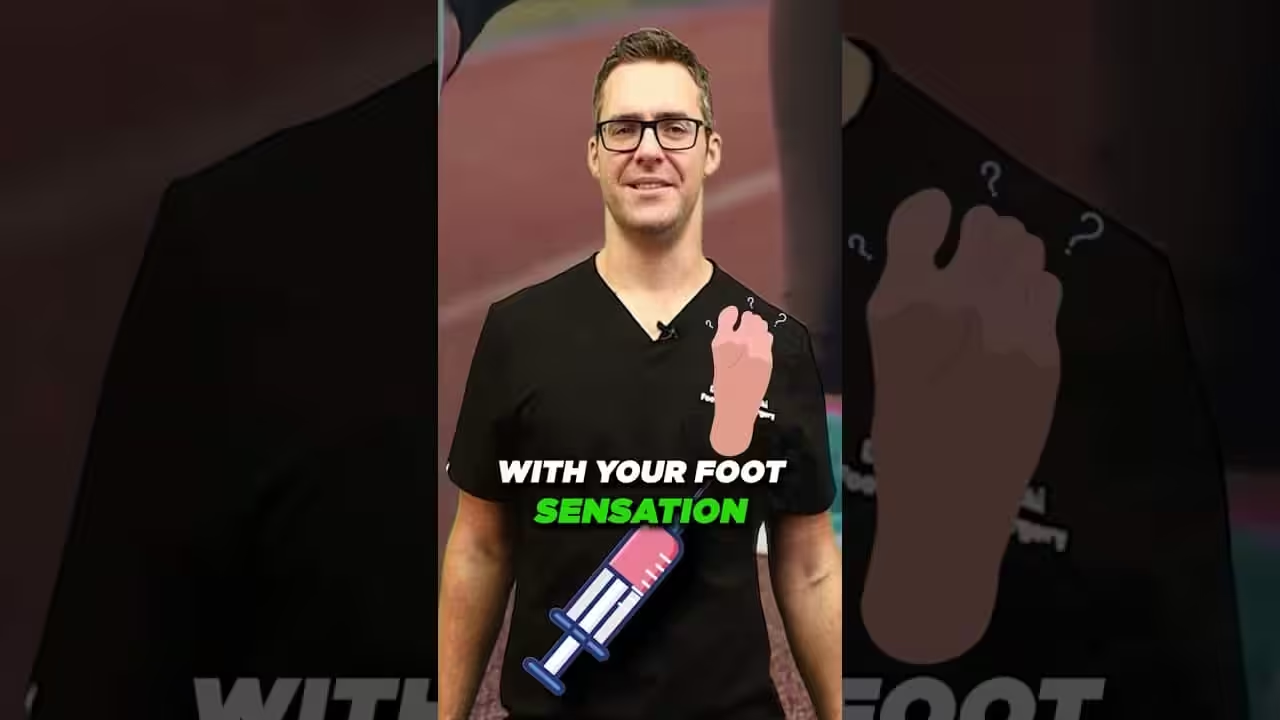


Watch: Metatarsalgia Treatment [BEST Ball of Foot Pain RELIEF 2024] — MichiganFootDoctors YouTube
When to See a Podiatrist
If foot or ankle pain has been bothering you for more than a few weeks, home care alone may not be enough. Balance Foot & Ankle offers same-week appointments at our Howell and Bloomfield Township clinics — no referral needed in most cases. Bring your current shoes and a short list of symptoms and we’ll build you a treatment plan in one visit.
Call Balance Foot & Ankle: (810) 206-1402 · Book online · Offices in Howell & Bloomfield Township
Frequently Asked Questions
Can I wear metatarsal pads with orthotics?
Yes. Metatarsal pads can be added to custom orthotics or pre-made insoles. Custom orthotics from our clinic often include a built-in metatarsal support already positioned in the optimal location. If you have custom orthotics and still have forefoot pain, add-on padding adjustments are easy to make at your follow-up visit.
How long do I need to wear metatarsal pads?
For acute flares of metatarsalgia or neuroma, metatarsal pads typically provide significant relief within 1-3 weeks. Many patients choose to wear them indefinitely in athletic shoes as a preventive measure. If you still have significant pain after 4 weeks of correctly placed pads, schedule an appointment to evaluate for nerve injections or other treatments.
Are metatarsal pads the same as arch supports?
No — they target different anatomical areas. Arch supports (orthotics) address the midfoot and heel, correcting pronation and plantar fascia tension. Metatarsal pads specifically address the forefoot/ball of foot. Many conditions benefit from both. A full custom orthotic will include both elements in a single device optimized for your foot structure.
The Bottom Line
Metatarsal pads are one of the most effective and underused tools for forefoot pain. Their biggest limitation isn’t the pads themselves — it’s incorrect placement. Put them just behind the painful area, not on it. If correctly placed pads don’t provide meaningful relief within 3-4 weeks, it’s time to get a proper diagnosis. Many forefoot conditions that don’t respond to conservative care can be resolved with in-office injections or other minimally invasive treatments.
Get Ball-of-Foot Pain Relief at Balance Foot & Ankle
Dr. Tom Biernacki DPM offers custom orthotics, metatarsal padding, and nerve injections for ball-of-foot pain. Howell & Bloomfield Township, MI.
📞 (810) 206-1402 · 4330 E Grand River Ave, Howell MI 48843
Dr. Hoy’s Complete Pain Relief Line — Dr. Tom’s Picks (2026)
Dr. Hoy’s Natural Pain Relief is Dr. Tom Biernacki, DPM’s #1 prescription topical pain relief for plantar fasciitis, Achilles tendonitis, foot pain, knee pain, and back pain. Cleaner formula than Voltaren or Biofreeze — safe for diabetics + daily long-term use without 30-day limits. Below is the complete Dr. Hoy’s product line, organized by use case.

Dr. Hoy’s Natural Pain Relief Gel (4oz Tube)Dr. Tom’s #1 Brand
4.6
(5,500+ reviews)
The flagship Dr. Hoy’s — menthol-based natural pain relief gel. The bottle Dr. Tom hands every plantar fasciitis patient on visit one. Cleaner formula than Voltaren or Biofreeze.
- Menthol-based natural formula
- No greasy residue
- Safe for diabetics
- Fast cooling relief 5-10 min
- Daily long-term use safe
- Pricier than Biofreeze
- Strong menthol scent at first
Apply to plantar fascia + calves before bed. Combined with calf stretching, eliminates morning fascia pain. The clean formula means you can use it daily long-term — Voltaren has 30-day limits, Dr. Hoy’s doesn’t.

Dr. Hoy’s Natural Pain Relief Gel (8oz Pump Bottle)Dr. Tom’s #1 Brand
4.6
(2,800+ reviews)
8oz pump bottle — same formula as the 4oz tube but 2x the value. Best for athletes, families, or chronic pain patients who use it daily.
- 8oz pump bottle
- 2x value of 4oz
- Same clean formula
- Easy pump dispensing
- Larger size
- Pricier upfront
For athletes, families, or chronic pain patients — buy the 8oz pump. Twice the product at less than 2x the price.

Dr. Hoy’s Arnica Boost Pain ReliefDr. Tom’s #1 Brand
4.5
(1,800+ reviews)
Dr. Hoy’s + arnica boost — for bruising, swelling, post-injury inflammation. Adds arnica’s anti-inflammatory power to the standard menthol formula.
- Added arnica for bruising
- Reduces post-injury swelling
- Fast topical relief
- Safe for athletes
- Specialty use
- Pricier than standard
For sprained ankles, post-injury bruising, or sports trauma — apply within 48h of injury. The arnica reduces bruising depth + speeds recovery.

Dr. Hoy’s Natural Pain Relief Roll-OnDr. Tom’s #1 Brand
4.5
(2,200+ reviews)
Same Dr. Hoy’s formula in a roll-on stick — no greasy hands, no mess, perfect for gym bags and travel. TSA-friendly.
- No greasy hands
- TSA-friendly
- Travel-sized
- Same Dr. Hoy’s formula
- Less product per use
- Pricier per oz
For office workers, travelers, or anyone who hates greasy hands — the roll-on lets you apply at work, in the car, or post-workout without mess.

Dr. Hoy’s Pain Relief Gel — 3-Pack BundleDr. Tom’s #1 Brand
4.6
(650+ reviews)
3-pack of Dr. Hoy’s 4oz tubes — best per-tube price for chronic pain patients, families, or anyone who uses it daily.
- 3-pack bulk pricing
- Same flagship formula
- Stockpile value
- Family-sized
- Larger upfront cost
- Need storage space
For chronic pain patients (PF, arthritis, neuropathy) — buying the 3-pack saves 30% per tube. One tube usually lasts 3-4 weeks of daily use.
Top 10 Premade Orthotics — Dr. Tom’s Picks (2026)
Dr. Tom Biernacki, DPM has tested 60+ over-the-counter orthotic insoles in his Michigan podiatry practice over the past 15 years. Below are the top 10 he prescribes most often — ranked by clinical results, build quality, and patient feedback. PowerStep + CURREX brands are Dr. Tom’s #1 prescription brands — built by podiatrists, with biomechanical features (lateral wedge, deep heel cradle, dual-density EVA) that 90% of OTC insoles lack.
Dr. Tom Biernacki, DPM is a board-certified podiatrist + Amazon Associate. Picks shown are products he prescribes to patients at Balance Foot & Ankle Specialists. We earn a commission on qualifying purchases at no extra cost to you. All products independently tested + reviewed. Last verified: April 28, 2026.

PowerStep Pinnacle MaxxDr. Tom’s #1 Brand
4.5
(28,341+ reviews)
The most prescribed OTC orthotic in podiatry. Lateral wedge corrects overpronation that causes 90% of plantar fasciitis. Deep heel cradle stabilizes the ankle.
- Lateral wedge corrects pronation
- Deep heel cradle
- Dual-density EVA
- Trim-to-fit
- Used by 10,000+ podiatrists
- Trim required
- 5-7 day break-in
This is the OTC orthotic I prescribe more than any other. If you have flat feet, plantar fasciitis, or knee pain — start here. 60% of patients see major improvement in 2 weeks.

PowerStep Original Full LengthDr. Tom’s #1 Brand
4.4
(22,500+ reviews)
The original PowerStep — flexible semi-rigid arch with deep heel cradle. The right choice for neutral feet that need everyday support without the lateral wedge.
- Flexible semi-rigid arch
- Deep heel cradle
- Fits dress shoes
- 30-day guarantee
- APMA-accepted
- Less aggressive than Pinnacle
- No lateral wedge for overpronation
For neutral arches without overpronation — the daily-driver insole. Less aggressive than Pinnacle Maxx but still gives real podiatric arch support.
PowerStep Pulse MaxxDr. Tom’s #1 Brand
4.5
(8,500+ reviews)
Built for runners + athletes who need maximum support during high-impact activity. Engineered for forefoot strike + lateral motion.
- Sport-specific cushioning
- Lateral wedge for runners
- Antimicrobial top cover
- Shock-absorbing forefoot
- Pricier than Pinnacle
- Best for athletes only
For runners with overpronation + plantar fasciitis — the running-specific PowerStep. Pair with the Hoka Bondi 8 for the best combo.

CURREX RunProDr. Tom’s #1 Brand
4.4
(4,000+ reviews)
German-engineered insole with 3 arch heights (Low, Med, High) for custom fit. Carbon-reinforced heel + dynamic forefoot.
- 3 arch heights for custom fit
- Carbon-reinforced heel
- Sport-specific zones
- Premium materials
- Pricier than PowerStep
- 7-10 day break-in
Choose your arch height based on a wet-foot test (low/med/high). Wrong arch = re-injury. Closest OTC orthotic to a $500 custom orthotic.
CURREX EdgeProDr. Tom’s #1 Brand
4.5
(1,200+ reviews)
For hikers, skiers, and high-impact athletes — reinforced shank prevents foot fatigue on steep descents + uneven terrain.
- Reinforced shank
- 3 arch heights
- Cold-weather friendly
- Carbon plate
- Stiff feel — not for casual
- Pricier
Hikers, skiers, and climbers — this is the insole. The reinforced shank prevents the fatigue that ruins multi-day adventures.
CURREX SupportSTPDr. Tom’s #1 Brand
4.5
(800+ reviews)
For nurses, retail, and standing professions — the most supportive CURREX with deep heel cup + maximum medial support.
- Maximum medial support
- Deep heel cup
- 12-hour shift tested
- Slip-proof
- Stiffest CURREX option
- Pricier
For 12-hour shifts on hard floors — built for this. Pair with Hoka Bondi SR or Dansko XP 2.0 for nursing.

Superfeet Green
4.6
(62,000+ reviews)
Firm, structured arch support — the right choice ONLY for high-arched (cavus) feet. Wrong choice for flat feet.
- Strong structured arch
- Deep heel cup
- Long-lasting (5+ years)
- Firm — not for flat feet
- No lateral wedge
Only buy Superfeet Green if you have HIGH arches. Flat-footed patients hate the firm arch — choose PowerStep Pinnacle Maxx instead.
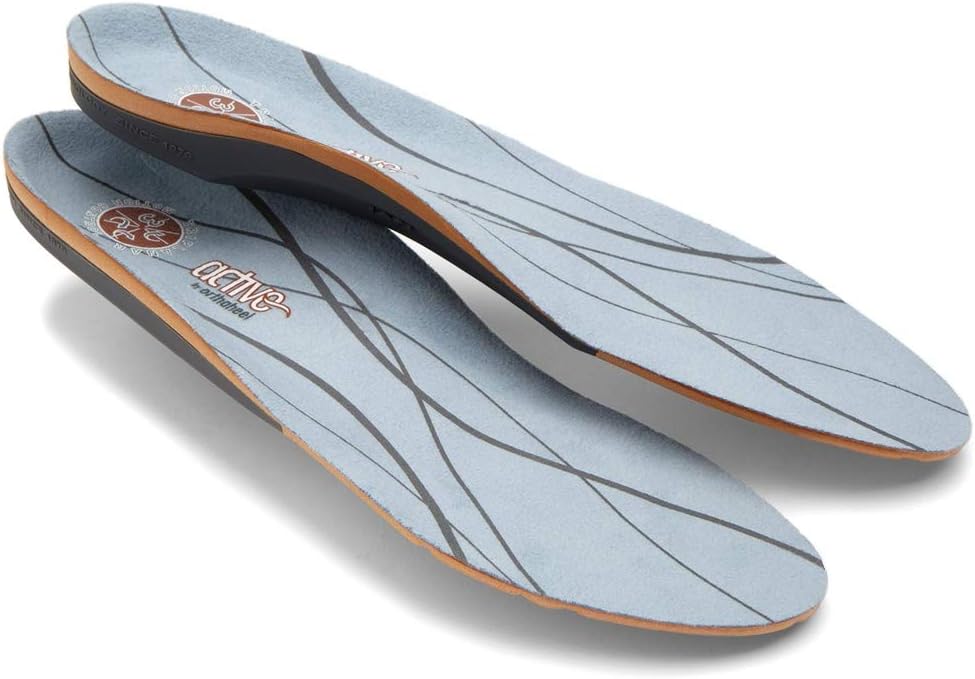
Vionic OrthoHeel Active Insole
4.4
(12,800+ reviews)
APMA-accepted, podiatrist-designed casual insole. Best for adding mild arch support to dress shoes + walking shoes.
- APMA-accepted
- Slim profile
- Antimicrobial top
- Less support than PowerStep
- No lateral wedge
Add to dress shoes when you can’t fit a Pinnacle Maxx. Mild support — not for serious foot pain.

Sof Sole Athlete
4.4
(35,200+ reviews)
Budget athletic insole with neutral arch + gel forefoot. Decent value if you need a quick replacement.
- Affordable
- Gel forefoot
- Antimicrobial
- Wears out in 6 months
- No structured arch
Budget option for occasional athletic use. Replace every 6 months. Real foot pain needs PowerStep Pinnacle Maxx.
Spenco Polysorb Total Support
4.5
(12,400+ reviews)
Mid-range insole with 5-zone polysorb cushioning. Decent support for standing professions.
- 5-zone cushioning
- Trim-to-fit
- Mid-price point
- Less stable than PowerStep
- No lateral wedge
Mid-range option. Mild foot pain + 8 hours standing — Spenco works. Severe pain = PowerStep.
Dr. Tom’s Product Picks for Metatarsal Pad Users
These are the three products I most often send home with metatarsal pad patients at Balance Foot & Ankle. Each targets a different part of the problem — mechanics, activity support, and pain relief.
PowerStep Pinnacle Maxx insoles — Pinnacle Maxx includes built-in met support — often the upgrade from stick-on pads.
CURREX RunPro insoles — Thin insole that layers well when you still want a separate met pad.
Doctor Hoy’s Natural Pain Relief Gel — Rub into the ball of the foot after long days — useful while pads are doing their slow work.
As an Amazon Associate and Foundation Wellness partner, Dr. Biernacki may earn a commission on qualifying purchases at no extra cost to you.
In-Office Treatment at Balance Foot & Ankle
If home treatment isn’t providing relief for your metatarsalgia, our podiatry team at Balance Foot & Ankle can help with same-day evaluations and advanced in-office care.
Same-day appointments available. (810) 206-1402
Frequently Asked Questions
When should I see a podiatrist?
If symptoms persist past 2 weeks, affect your normal activity, or are accompanied by red-flag symptoms (warmth, redness, swelling, inability to bear weight).
What does treatment cost?
Most diagnostic visits and conservative treatments are covered by Medicare and major insurers. Out-of-pocket costs vary by your specific plan.
How quickly can I get an appointment?
Most non-urgent cases see us within 5 business days. Urgent cases (sudden pain, possible fracture) typically same or next business day.
What is Metatarsalgia?
Metatarsalgia is a common foot/ankle condition that affects mobility and quality of life. Understanding the underlying cause is the first step in successful treatment. Our podiatrists at Balance Foot & Ankle perform a hands-on biomechanical exam, review your activity history, and use diagnostic imaging when appropriate to identify the root cause—not just treat the symptom. Many patients have been told to “rest and ice” without a deeper diagnostic workup; our approach is different.
Symptoms and warning signs
Common signs of metatarsalgia include pain that worsens with activity, morning stiffness, swelling, tenderness when palpated, and difficulty bearing weight. If you experience sudden severe pain, inability to walk, visible deformity, numbness or color change, contact our office the same day or visit urgent care—these can signal a more serious injury such as a fracture, tendon rupture, or vascular compromise. Diabetics with any foot wound should seek same-day care.
Conservative treatment options
Most cases of metatarsalgia respond to non-surgical care: structured rest, supportive footwear changes, custom orthotics, targeted stretching and strengthening protocols, anti-inflammatory medications when medically appropriate, and in-office procedures such as ultrasound-guided injections. We also offer advanced therapies including MLS laser therapy, EPAT/shockwave, regenerative injections, and image-guided procedures. Treatment is sequenced from least invasive to most invasive, and we explain the rationale at every step.
When is surgery considered?
Surgery is reserved for cases that fail 3-6 months of well-structured conservative care, when there is structural pathology (severe deformity, complete tear, advanced arthritis), or when imaging shows damage that will not heal without intervention. Our surgeons have performed 3,000+ foot and ankle procedures and prioritize minimally-invasive techniques whenever appropriate. We discuss recovery timelines, return-to-activity milestones, and realistic outcome expectations before any procedure is scheduled.
American Academy of Orthopaedic Surgeons: Metatarsalgia
Recovery timeline and prevention
Recovery from metatarsalgia varies based on severity and chosen treatment path. Conservative cases often improve within 4-8 weeks with consistent adherence to the protocol. Post-procedural recovery may range from a few days (in-office procedures) to several months (reconstructive surgery). Long-term prevention involves footwear assessment, activity modification, structured strengthening, and regular check-ins with your podiatrist if you have a history of recurrence. We provide written home-exercise plans and digital follow-up support.
Ready to feel better?
Same-week appointments available in Howell and Bloomfield Township, Michigan.
Get Expert Care at Balance Foot & Ankle
Same-week appointments at our Howell and Bloomfield Township offices. Board-certified podiatric surgeons. Most insurance accepted.
Same-Week Appointments in Howell & Bloomfield Township
Three board-certified podiatric surgeons. 1,123+ five-star reviews. Most insurance accepted.

Dr. Tom Biernacki, DPM is a double board-certified podiatrist and foot & ankle surgeon at Balance Foot & Ankle Specialists in Southeast Michigan. With over a decade of clinical experience, he specializes in heel pain, bunions, diabetic foot care, sports injuries, and minimally invasive surgery. Dr. Biernacki is a member of the APMA and ACFAS, and his patient education content on MichiganFootDoctors.com and YouTube has reached over one million views.
Frequently Asked Questions
Why does the ball of my foot hurt when I walk?
When should I see a doctor for ball of foot pain?
- Plantar Fasciitis: Diagnosis and Conservative Management (PubMed)
- Plantar Fasciitis (APMA)
- Diagnosis and Treatment of Plantar Fasciitis (PubMed / AAFP)
- Heel Pain (APMA)
Recommended Products from Dr. Tom
Dr. Tom Biernacki, DPM is a board-certified foot & ankle surgeon (ABFAS & ABPM) at Balance Foot & Ankle Specialists in Southeast Michigan. With over a decade of clinical experience, he specializes in heel pain, bunions, diabetic foot care, sports injuries, and minimally invasive surgery. Dr. Biernacki is a member of the APMA and ACFAS, and his patient education content on MichiganFootDoctors.com and YouTube has made him one of the most-followed foot & ankle educators on YouTube.