
Medically reviewed by Dr. Tom Biernacki, DPM
Board-certified podiatric surgeon | Balance Foot & Ankle
Last reviewed: May 2026
The most important clinical decision with Navicular Fracture isn’t which treatment to start with — it’s identifying the correct subtype. That changes everything. Call (810) 206-1402.
Navicular Fracture: Causes, Diagnosis & Treatment from a Podiatrist
The navicular is a small boat-shaped bone at the apex of the medial arch — and it’s one of the most critical structural elements of the foot. A navicular fracture can be an innocuous avulsion at the dorsal lip or a career-threatening stress fracture in an athlete. What distinguishes these injuries is their mechanism, their location, and critically, their treatment — getting the diagnosis right and matching it to appropriate management determines whether a patient heals in 6 weeks or struggles with chronic non-union for years.
Types of Navicular Fractures
Navicular fractures are classified into four main types:
- Cortical avulsion fractures — small chip fractures at the dorsal or tuberosity margins from ligament or tibialis posterior tendon pull. The most common type; usually low-risk and managed non-operatively.
- Tuberosity fractures — avulsion at the medial navicular tuberosity from the tibialis posterior tendon insertion; occasionally require fixation if significantly displaced.
- Body fractures — complete fractures through the navicular body from direct trauma or high-energy mechanisms; classified as Type 1 (dorsal lip), Type 2 (sagittal fracture line entering the naviculocuneiform joint), or Type 3 (comminuted with lateral displacement) by the Sangeorzan classification.
- Stress fractures — the most clinically important and most commonly missed; occur in the central third of the navicular body where blood supply is poorest and compressive forces are highest during the push-off phase of gait.
Key takeaway: Navicular stress fractures are classified as high-risk injuries because of the poor blood supply to the central navicular body. The non-union rate with inadequate treatment (particularly partial or full weight-bearing) is substantial. Standard treatment is strict non-weight-bearing in a short-leg cast for 6-8 weeks minimum — even for non-displaced fractures. Athletes often prefer surgical fixation to accelerate return to sport.
Navicular Fracture Symptoms
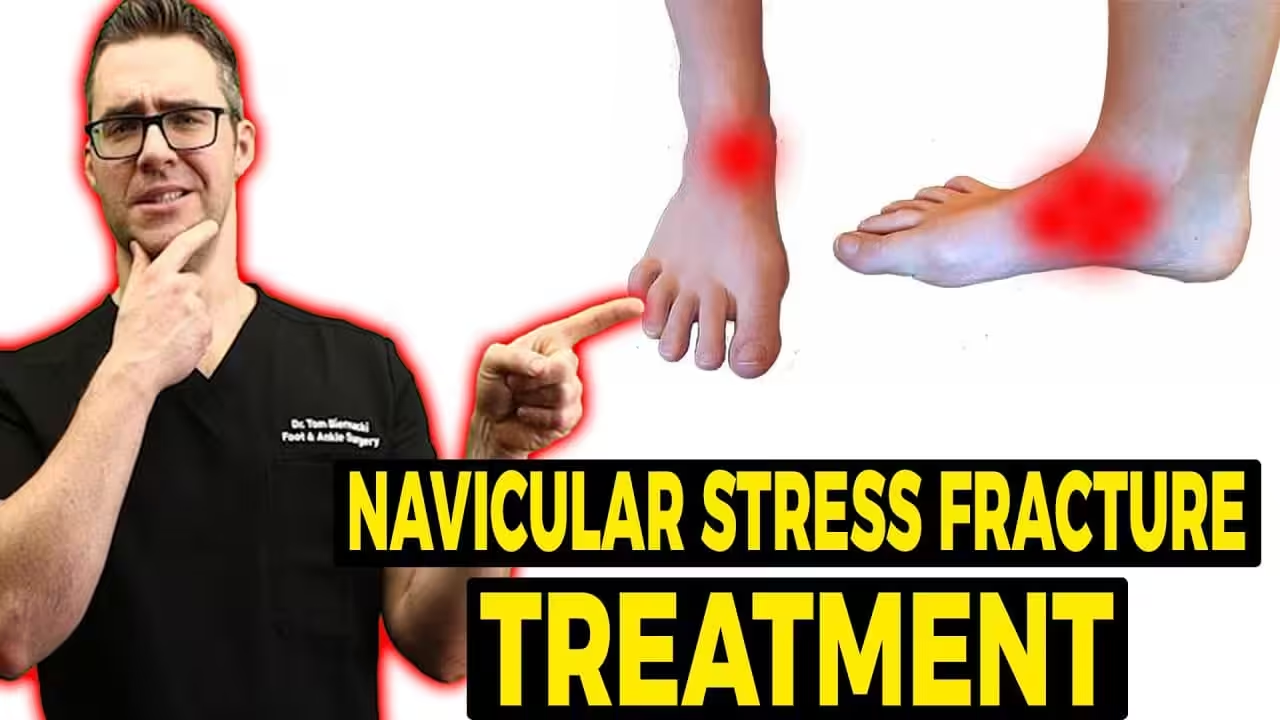
- Dorsal midfoot pain — localized to the top of the foot, centered over the navicular at the apex of the arch
- Activity-related pain in stress fractures — gradual onset, worsening with running or jumping, improving with rest; classic stress fracture pattern
- N-spot tenderness — focal point tenderness directly over the dorsal navicular is highly specific for navicular stress fracture
- Swelling and bruising — in acute body fractures from direct trauma
- Arch pain with weight-bearing — pain along the medial arch exacerbated by resisted toe raise (loading the tibialis posterior, which inserts on the navicular tuberosity)
How We Diagnose Navicular Fractures
Plain X-rays miss navicular stress fractures in up to 80% of cases. The fracture typically runs in the sagittal plane in the central third of the navicular — a plane that is poorly visualized on standard AP, lateral, and oblique views. When navicular stress fracture is clinically suspected (dorsal midfoot pain in a runner or jumping athlete, N-spot tenderness, insidious onset), we proceed directly to CT scan — the most sensitive modality for cortical stress fractures, able to identify partial and complete fracture lines invisible on X-ray. MRI detects bone marrow edema and stress reaction before a fracture line forms and can confirm healing with serial imaging. For acute trauma fractures, standard X-rays are the starting point with CT for surgical planning.
Navicular Fracture Treatment
Stress fractures: The evidence-based standard is strict non-weight-bearing in a short-leg cast for 6-8 weeks. “Strict” means no weight at all — even brief ambulation on the fracture during the healing phase risks displacement and non-union. After cast removal, progressive weight-bearing over 4-6 weeks precedes return to impact activity. Return to competitive running or jumping takes 4-6 months from diagnosis. For high-level athletes or fractures with displacement or delayed union, surgical fixation with percutaneous screws (guided by fluoroscopy or CT navigation) allows earlier return to sport with reduced non-union risk.
Dorsal lip avulsion fractures: These low-risk injuries are managed with a walking boot or stiff-soled shoe for 4-6 weeks with progressive weight-bearing as tolerated.
Acute body fractures (Sangeorzan classification): Type 1 (dorsal fragment, no joint involvement) — may be treated non-operatively in a non-weight-bearing cast for 6 weeks if undisplaced. Type 2 (sagittal fracture entering the naviculocuneiform joint) — requires ORIF to restore articular congruity and prevent post-traumatic midfoot arthritis. Type 3 (comminuted with lateral column displacement) — complex reconstruction with ORIF; may require spanning external fixation in severely comminuted cases.
The Most Common Mistake We See
The most catastrophic error is allowing even limited weight-bearing in a removable boot for a navicular stress fracture because it “looks stable” on CT. The navicular’s central blood supply cannot sustain even modest mechanical disruption during early fracture healing. We have seen multiple patients referred after weeks of “conservative management in a boot” with progressed fracture displacement and early avascular necrosis of the navicular. Once avascular necrosis develops, reconstruction is dramatically more complex. Non-weight-bearing in a cast is non-negotiable for this injury.
⚠️ Seek urgent podiatric evaluation for midfoot pain if:
- You are a runner or jumping athlete with new dorsal midfoot pain — navicular stress fracture until proven otherwise
- Midfoot pain that has not improved after 2 weeks of rest from running
- Acute severe midfoot pain after a direct blow or axial loading injury
- Midfoot swelling and bruising after a fall, motor vehicle accident, or sports impact
- Any midfoot pain in a diabetic patient — infection and Charcot fracture are in the differential
Frequently Asked Questions
How long does a navicular stress fracture take to heal?
With strict non-weight-bearing for 6-8 weeks, most navicular stress fractures heal without complication. Return to full impact activity takes 4-6 months from diagnosis. Surgical fixation cases can return to sport in 3-4 months but the overall timeline depends on fracture completeness and biology.
Can I walk on a navicular fracture?
For stress fractures: no — strict non-weight-bearing is required. For dorsal avulsion fractures: walking in a boot is typically permitted. The type of navicular fracture determines weight-bearing status; this is not a decision that should be made without definitive imaging and podiatric evaluation.
What happens if a navicular fracture doesn’t heal?
Navicular stress fracture non-union produces chronic midfoot pain and eventual avascular necrosis of the navicular body. Treatment of non-union is complex — requiring bone grafting, fixation, and potentially salvage procedures like midfoot arthrodesis. Prevention through adequate initial treatment is far preferable.
The Bottom Line
Navicular fractures span a wide spectrum from minor avulsions to high-risk stress fractures that can end athletic careers if mismanaged. The central theme: when a navicular stress fracture is suspected, get CT imaging, assume non-weight-bearing until proven otherwise, and treat with strict NWB in a cast for 6-8 weeks minimum. The consequences of undertreating this injury — avascular necrosis, non-union, midfoot arthritis — are dramatically worse than the inconvenience of appropriate immobilization.
Sources
- Sangeorzan BJ et al. Displaced intra-articular fractures of the tarsal navicular. JBJS. 1989 (classification, updated 2022).
- Torg JS et al. Navicular stress fractures. Am J Sports Med. 2020.
- Saxena A et al. Return to activity after navicular stress fractures in athletes. J Foot Ankle Surg. 2021.
Ready to Get Relief? Same-Day Appointments Available.
Howell & Bloomfield Township, MI
4.9★ | 1,123 Reviews | 3,000+ Surgeries
Or call: (810) 206-1402

Dr. Tom Biernacki, DPM is a board-certified foot & ankle surgeon (ABFAS & ABPM) at Balance Foot & Ankle Specialists in Southeast Michigan. With over a decade of clinical experience, he specializes in heel pain, bunions, diabetic foot care, sports injuries, and minimally invasive surgery. Dr. Biernacki is a member of the APMA and ACFAS, and his patient education content on MichiganFootDoctors.com and YouTube has made him one of the most-followed foot & ankle educators on YouTube.