
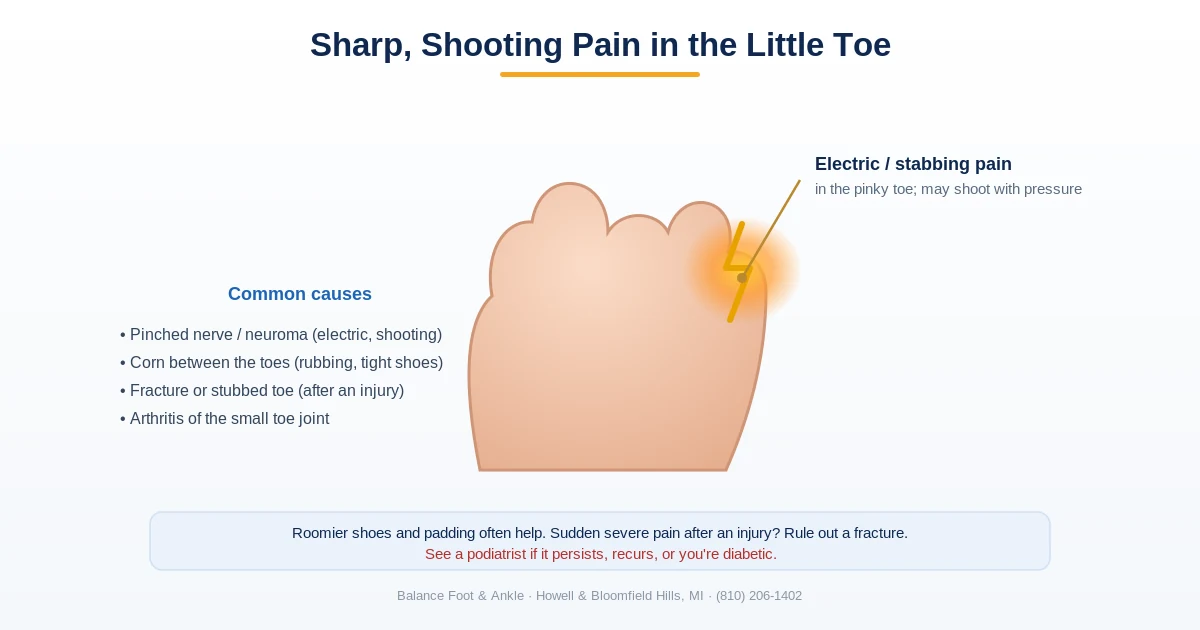
Quick answer: Sharp, shooting pain in the little (pinky) toe is most often a pinched nerve — a neuroma, a corn pressing on the nerve, or a tight shoe — though a fracture or arthritis can also cause it. Roomier shoes, padding, and toe spacers help many cases; pain that’s severe, constant, or follows an injury should be evaluated by a podiatrist.
Sharp pain in the little toe deserves more clinical attention than it typically receives. Patients often dismiss it as a minor shoe fit problem — and sometimes it is. But the 5th toe is also the location of specific anatomical vulnerabilities: the tailor’s bunion, the 5th metatarsal (which is the most frequently fractured bone in the foot), and a small digital nerve that is particularly susceptible to compression in narrow footwear.
The most important clinical decision with Sharp Shooting Pain Little Toe isn’t which treatment to start with — it’s identifying the correct subtype. That changes everything. Call (810) 206-1402.
Quick Answer: Sharp Pain in the Little Toe
Sharp pain in the little toe is most often caused by a tailor’s bunion (a bony prominence on the outer foot rubbing against footwear) or nerve compression from tight shoes. Switching to a wide toe box shoe and adding a metatarsal pad resolves most cases within 2–4 weeks. If you cannot bear weight, heard a pop, or have rapid swelling, get an X-ray same-day to rule out a Jones fracture. For tailor’s bunion treatment and other little toe conditions, same-day appointments: (810) 206-1402 — Balance Foot & Ankle, Howell & Bloomfield Hills, MI.
The Most Common Mistake With Little Toe Pain
The most common mistake patients make is ignoring sharp little toe pain and pushing through it in tight shoes — this can convert a simple bursitis or nerve irritation into a chronic neuroma or a missed fracture. The fix: switch to a wide toe box shoe immediately and give it 2 weeks. If pain is not improving, have it evaluated — a Jones fracture that is caught early heals with a boot; one that is missed often requires surgery.
The 6 Causes of Sharp Pain in the Little Toe
Medically reviewed by Dr. Tom Biernacki, DPM
Board-certified podiatric surgeon | Balance Foot & Ankle
Last reviewed: May 2026
Cause 1: Tailor’s Bunion (Bunionette)
A tailor’s bunion is a prominence of the 5th metatarsal head — the bony bump on the outside of the foot at the base of the little toe. It is the lateral counterpart of a hallux valgus bunion. The name comes from tailors who historically sat cross-legged, placing pressure on the outer foot.
The bunionette creates pain in two ways. First, direct pressure on the bony prominence from tight shoes produces a localized aching-to-sharp pain at the 5th metatarsal head. Second, as the deformity progresses, the little toe may deviate medially (toward the other toes), stretching the medial digital nerve of the 5th toe and producing a shooting or radiating pain along the inner aspect of the toe.
Conservative treatment: wide toe box shoes, 5th metatarsal head padding (a donut-shaped pad that removes direct pressure from the prominence), and accommodative orthotics to redistribute plantar pressure. Surgical correction (5th metatarsal osteotomy) is reserved for failure of conservative measures.
Cause 2: Heloma Durum (Hard Corn)
A hard corn (heloma durum) on or between the toes is among the most common causes of sharp, localized toe pain. Corns are circumscribed, cone-shaped thickenings of keratin that form in response to repeated focal pressure. The apex of the cone points downward into the dermis — and when it presses against a digital nerve, the result is a sharp, intense pain that is often disproportionate to the small size of the corn.
On the little toe, hard corns typically form at the dorsolateral (top-outside) surface from shoe pressure, or between the 4th and 5th toes (called a soft corn or heloma molle in the moist interdigital space). A corn directly over the 5th toe joint can make wearing any closed shoe impossible due to the sharp pressure pain.
Treatment: debridement of the corn (removing the central keratin plug) provides immediate relief. Eliminating the underlying pressure source prevents recurrence — typically requiring shoe width modification or a toe sleeve/padding. Surgical removal is rarely needed; recurring corns almost always recur because of the pressure source, not inadequate surgical technique.
Key takeaway: A hard corn on the little toe can produce dramatically sharp pain from what looks like a small skin lesion. The cone-shaped keratin core pressing on the digital nerve explains the intensity. Padding eliminates pressure; debridement eliminates the corn.
Cause 3: Hammertoe with Shoe Pressure
A hammertoe deformity of the 5th toe causes the proximal interphalangeal (PIP) joint to buckle upward (flexion deformity). The buckled joint then presses against the top of the shoe with every step. The chronic pressure creates both a hard corn over the PIP joint and direct compressive pain in the joint itself — which can radiate as a sharp sensation along the toe.
The 5th toe hammertoe is particularly problematic because the toe is already on the outer edge of the foot where shoe material is often rigid. Conservative management: extra-depth shoes with a higher toe box, silicone toe sleeves over the PIP joint, and stretching. Surgical correction is a straightforward outpatient procedure for flexible hammertoes that fail conservative treatment.
Cause 4: 5th Metatarsal Stress Fracture
The 5th metatarsal is the most frequently fractured bone in the foot. Stress fractures of the 5th metatarsal — from repetitive loading in runners, dancers, and active patients — produce pain at the base or shaft of the bone that often radiates into the little toe as a sharp or aching sensation.
The critical distinction: a stress fracture produces pain along the metatarsal shaft (on the outside of the midfoot), not at the toe itself. Pressing directly on the metatarsal bone — not the toe — reproduces the pain. Stress fractures worsen with activity and improve with rest. An X-ray may be negative early (within the first 2 weeks), but MRI or bone scan will show the stress reaction.
The Jones fracture (at the 5th metatarsal metaphyseal-diaphyseal junction) is a specific fracture pattern with a notoriously poor healing rate due to poor blood supply at that location. It often requires surgical fixation with an intramedullary screw. This is why a correct diagnosis matters — treating a Jones fracture as a sprain leads to nonunion and months of persistent pain.
Cause 5: Digital Nerve Entrapment
The digital nerves to the 5th toe run along both sides of the toe. Chronic compression — from narrow shoes, overlapping toes, or a bony prominence from a bunionette — can entrap these small nerves, producing a shooting, burning, or electric-shock quality pain along the length of the toe.
Digital nerve entrapment of the 5th toe is less common than Morton’s neuroma (which affects the 3rd web space) but presents similarly — episodic sharp electrical pain that is worse in shoes and relieved by removing footwear. A Tinel’s sign (tapping over the nerve reproduces the shooting pain) helps confirm the diagnosis at examination.
Treatment follows the same algorithm as Morton’s neuroma: wide toe box shoes first, then a corticosteroid injection into the area of entrapment if shoe modification doesn’t resolve it, then surgical decompression or neurectomy for refractory cases.
Cause 6: Peripheral Neuropathy
Peripheral neuropathy — from diabetes, B12 deficiency, alcoholism, or idiopathic causes — commonly begins in the most distal distribution of the longest nerves. The little toe, being the most distal and lateral, is often one of the first toes to develop neuropathic symptoms: shooting, electric, burning, or stabbing pain that is worse at night and does not correlate with activity or pressure.
The key distinguishing feature: neuropathic pain in the little toe does not respond to shoe modification or offloading because the pain isn’t from mechanical pressure — it’s from abnormal nerve firing. If sharp toe pain persists without a shoe or at rest, neuropathy should be evaluated. A neurological examination, nerve conduction study, and HbA1c (to screen for diabetes) are the appropriate workup.
Key takeaway: Pain that is present without shoes and worse at night strongly suggests neuropathy rather than mechanical causes. Neuropathic little toe pain does not respond to shoe modifications — it requires treatment of the underlying nerve disease.
How to Distinguish the Causes by Examination
In our practice, the clinical examination of a patient with little toe pain follows a systematic approach:
- Where exactly? Outer base → tailor’s bunion or 5th metatarsal fracture. Top of PIP joint → hammertoe corn. Lateral shaft pressure → corn. Shooting along full length → nerve. Diffuse burning worse at night → neuropathy.
- Shoe off vs. shoe on? Immediately better without shoes → mechanical (corn, bunionette, hammertoe). Unchanged or worse at night → neuropathy.
- With activity or constant? Worse with walking/running, better with rest → stress fracture or tailor’s bunion. Random sharp shooting pain → nerve entrapment or neuropathy.
- Visible skin lesion? Circumscribed hyperkeratosis → corn. Bony prominence lateral 5th MTP → bunionette. No skin finding → nerve or neuropathy.
⚠️ When little toe pain requires urgent evaluation:
- Sharp pain after a specific injury with immediate swelling and bruising — fracture
- Severe pain at the base of the 5th metatarsal after an ankle roll (possible Jones fracture)
- Diabetic patient with any toe pain, redness, or skin breakdown
- Numbness combined with sharp pain — nerve injury or compression requiring prompt evaluation
- Little toe pain with fever, warmth, and swelling (septic joint or infection)
- Pain that has been present for more than 6 weeks without clear cause
Differential Diagnosis: What Else Can Cause Sharp Little Toe Pain
Several conditions can mimic or overlap with tailor’s bunion pain. Here is how to distinguish them:
- Jones fracture — sharp outer foot pain after a roll or direct impact; point tender at 5th metatarsal base; cannot bear weight. Needs X-ray same-day.
- Avulsion fracture (dancer’s fracture) — sudden inversion sprain with a pop; base of 5th metatarsal is tender. Usually heals with a boot in 4–6 weeks.
- Digital neuroma (5th toe) — burning, shooting, or electric pain; often triggered by tight toe box; may have numbness. Responds to cortisone injection or orthotics.
- Hammertoe (5th) — the little toe bends abnormally and rubs on shoes; visible deformity; responds to toe pads and roomier footwear.
- Peroneal tendonitis — pain along the outer foot and ankle; worse with activity; tender along the peroneal tendon, not just the toe.
Warning Signs: When Little Toe Pain Needs Same-Day Care
Most little toe pain responds to shoe changes within 2–4 weeks. See Dr. Biernacki DPM same-day if you experience:
- You cannot bear weight on the foot after an injury
- You heard or felt a pop or crack at the time of injury
- Rapid swelling and bruising appear within 1 hour
- Numbness or tingling in the little toe or outer foot
- Pain has not improved in 2 weeks despite wide shoe changes
- You are diabetic — foot injuries can escalate rapidly without sensation
Same-day X-rays and treatment available: (810) 206-1402 — Howell & Bloomfield Hills, MI. Book online →
Frequently Asked Questions
Why does my little toe hurt when I wear shoes?
Pain specifically in shoes that resolves when barefoot almost always means mechanical compression — a corn, hammertoe rubbing the toe box, tailor’s bunion pressing against the shoe side, or shoe width inadequacy. A wider toe box shoe is the first trial. If it resolves completely, the diagnosis is confirmed. If it persists barefoot, a structural cause needs evaluation.
Can a little toe fracture heal on its own?
Simple distal or mid-shaft fractures of the 5th toe (not the 5th metatarsal) typically heal with buddy taping to the 4th toe and a stiff-soled shoe over 3–4 weeks. A Jones fracture at the 5th metatarsal base often does NOT heal reliably without surgical fixation — this is the distinction that makes X-ray diagnosis critical.
Is little toe pain a sign of gout?
Gout classically affects the 1st MTP joint (the big toe base), not the little toe. However, gout can affect any joint. If little toe pain presents as a sudden, intensely inflamed, swollen, hot joint — especially after alcohol intake, a large meal, or illness — gout should be considered and uric acid level checked.
The Bottom Line
Sharp pain in the little toe has a specific diagnostic differential — it is not just “foot pain.” The cause determines the treatment completely: a corn requires debridement and pressure relief; a tailor’s bunion needs shoe modification or surgical correction; a 5th metatarsal fracture may require surgery depending on location; and neuropathic pain requires addressing the underlying nerve disease. Accurate diagnosis is the first step toward effective relief.
Sources
- Fallat LM, Buckholz J. “An analysis of the tailor’s bunion by radiographic and anatomical display.” J Am Podiatr Med Assoc. 1980.
- Porter DA, et al. “Fifth metatarsal Jones fractures in the elite athlete.” Foot Ankle Int. 2005.
- Boulton AJM, et al. “Diabetic neuropathies: a statement by the American Diabetes Association.” Diabetes Care. 2005.
Ready to Get Relief?
Same-day appointments available in Howell & Bloomfield Hills, MI
4.9★ | 1,123 Reviews | 3,000+ Surgeries
Or call: (810) 206-1402
In-Office Treatment at Balance Foot & Ankle
Dr. Tom Biernacki DPM provides expert in-office evaluation and treatment at Balance Foot & Ankle. Learn more about tailor’s bunion and 5th metatarsal treatment in Michigan. Same-day appointments available. (810) 206-1402 | New Patient Information.

Dr. Tom Biernacki, DPM is a board-certified foot & ankle surgeon (ABFAS & ABPM) at Balance Foot & Ankle Specialists in Southeast Michigan. With over a decade of clinical experience, he specializes in heel pain, bunions, diabetic foot care, sports injuries, and minimally invasive surgery. Dr. Biernacki is a member of the APMA and ACFAS, and his patient education content on MichiganFootDoctors.com and YouTube has made him one of the most-followed foot & ankle educators on YouTube.
Let us know if this post helped your sharp shooting pain in the little toe! Just remember we can’t give specific medical advice!