
Medically reviewed by Dr. Tom Biernacki, DPM — Board-certified foot & ankle surgeon, 3,000+ surgeries performed. Updated April 2026 with current clinical evidence. This article reflects real practice experience from Balance Foot & Ankle Specialists in Howell and Bloomfield Hills, Michigan.
Quick Answer
Plantar fasciitis is inflammation where the plantar fascia attaches to the heel, causing sharp morning heel pain that eases after 10-15 minutes of walking. Most cases respond to stretching plus arch support within 6-12 weeks. See a podiatrist if pain persists beyond 6 weeks, worsens, or prevents walking.
Watch: Dr. Tom Biernacki, DPM
Medically reviewed by Dr. Tom Biernacki, DPM
Board-certified podiatric surgeon | Balance Foot & Ankle
Last reviewed: April 2026
![Retrocalcaneal Heel Bursitis [Pain in the back of the Heel TREATMENT!]](https://www.michiganfootdoctors.com/wp-content/cache/flying-press/b89b8ee4358be1bbe72667e9a51f7d5f.jpg)
What Causes Achilles Tendon Heel Pain?
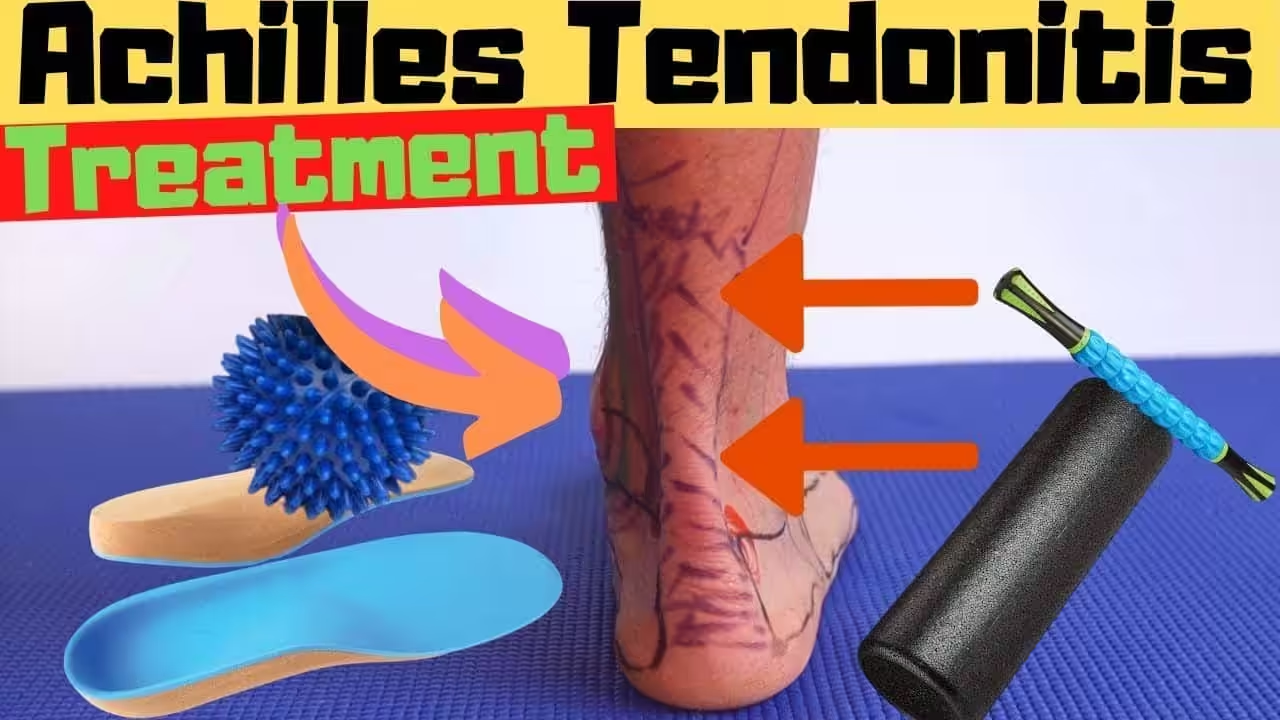
If you’re feeling pain at the back of your heel where the Achilles tendon attaches, you’re dealing with one of the most common overuse injuries we treat at Balance Foot & Ankle. The Achilles is the strongest tendon in your body, but it’s also one of the most vulnerable to repetitive stress — especially in active adults over 40.
The Achilles tendon connects your calf muscles to your heel bone. When it’s overloaded — from too much running, sudden increases in activity, or chronically tight calves — the tendon fibers develop microdamage that triggers pain and inflammation. In our clinic, we distinguish between two main types:
- Insertional Achilles tendinitis — Pain and often a bony bump right where the tendon attaches to the heel bone. Affects both active and sedentary patients
- Non-insertional Achilles tendinitis — Pain in the middle portion of the tendon (2-6 cm above the heel). More common in younger, active patients
- Achilles tendinosis — Chronic degeneration of the tendon fibers without acute inflammation. The tendon may feel thickened and stiff
- Haglund’s deformity — A bony enlargement at the back of the heel that irritates the tendon and its surrounding bursa, sometimes called “pump bump”
- Retrocalcaneal bursitis — Inflammation of the fluid-filled sac between the tendon and heel bone, causing deep posterior heel pain
Symptoms of Achilles Tendon Problems
Achilles tendon heel pain has characteristic symptoms that help distinguish it from other causes of heel pain like plantar fasciitis. The key difference: plantar fasciitis hurts on the bottom of the heel, while Achilles problems hurt at the back.
- Stiffness and pain first thing in the morning — The tendon shortens overnight, and those first steps stretch it painfully
- Pain that worsens with activity — Running, jumping, and stair climbing increase tendon loading
- A visible or palpable bump — Especially with insertional tendinitis or Haglund’s deformity
- Tenderness when squeezing the tendon — You can pinch the tendon between your fingers and reproduce pain
- Swelling along the back of the heel — May be subtle in early stages, more obvious in chronic cases
Treatment Options
Home Treatments
- Eccentric calf exercises — The gold standard treatment. Stand on a step, raise up on both feet, then slowly lower on the affected side only. 3 sets of 15, twice daily for 12 weeks
- Heel lifts — A simple heel lift in your shoe reduces tension on the Achilles by 1-2mm, providing immediate relief
- Ice after activity — 15-20 minutes of ice to the posterior heel reduces inflammation
- Supportive shoes — Shoes with a slight heel rise (10-12mm drop) reduce Achilles strain. See our shoe recommendations
- Avoid flat shoes and going barefoot — Both increase tension on the Achilles
In-Office Treatments
- Custom orthotics with heel lift — Biomechanical correction plus elevation reduces chronic tendon loading
- Shockwave therapy (ESWT) — Stimulates tendon healing in chronic cases. Particularly effective for insertional tendinitis
- PRP injections — Platelet-rich plasma injections show promising results for tendinosis (chronic degeneration)
- Physical therapy — Guided eccentric loading program with progressive return to activity
- Immobilization — A CAM boot for 2-4 weeks in severe acute cases allows initial healing before starting rehab
Warning Signs: When to See a Podiatrist
See a podiatrist if you experience:
- Sudden sharp pain with a “pop” sensation — This could indicate an Achilles tendon rupture, which requires urgent evaluation
- Inability to push off or stand on your toes — Suggests a partial or complete tendon tear
- Pain that’s been worsening for more than 2 weeks — Chronic tendon problems respond better to early treatment
- Visible swelling or discoloration at the heel — May indicate bursitis, infection, or a more serious condition
- Night pain that wakes you from sleep — Tendon problems rarely cause night pain; this warrants investigation for other causes
More Podiatrist-Recommended Plantar Fasciitis Essentials
Best Night Splint

- Plantar fascitis night splint brace heel and foot pain size: Medium
- Medium , men 8 10 1/2 , women 7 1/2 10
- Designed to comfortably position the foot
- Low profile shell is sturdy and breathable
Keeps fascia stretched overnight — the #1 intervention for morning heel pain.
Top Podiatrist-Recommended Insole

- The Pinnacle Full length insoles for men & women provide maximum cushioning, from high activity to moderate support. The PowerStep arch support shape provides stability to the foot and ankle, helping to relieve foot pain.
- When you spend all day on your feet, every step counts. PowerStep insoles are a podiatrist-recommended orthotic to help relieve & prevent foot pain related to athletes, runners, Plantar Fasciitis, heel spurs & other common foot, ankle & knee injuries
- The Pinnacle plantar fasciitis insoles offer superior heel cushioning and arch support. The dual-layer cushioning is designed to reduce stress and fatigue, while PowerStep premium arch support is designed for plantar fasciitis relief.
- The PowerStep Pinnacle arch support inserts for men & women can be worn in a variety of shoe types such as; athletic, walking, running, work & some casual shoes. Orthotic Inserts are ordered by shoe size, no trimming required.
- Made in the USA & backed by a 30-day money-back guarantee. PowerStep orthotic inserts for men & women are designed for shoes where the factory insole can be removed. HSA & FSA Eligible
Deep heel cup + arch support unloads the plantar fascia all day.
Plantar Fasciitis Compression Sock

- Provides continuous support of the Plantar Fascia by gently stretching the fascia tissue.
- Compression zones promote circulation, reduce impact vibration, boost recovery and strengthen feet.
- Lightweight, seamless design with extra cushioning provides support while still being comfortable.
- Supports the heel/arch and overall foot structure while stabilizing the tendon for better performance
- Made from high quality materials, the socks are moisture wicking and breathable.
Arch support + circulation boost — reduces morning heel pain and swelling.
As an Amazon Associate, Balance Foot & Ankle earns from qualifying purchases. Product recommendations are based on clinical experience; prices and availability shown above update live from Amazon.
When to See a Podiatrist
If morning heel pain has persisted more than 6 weeks, home care alone rarely fixes it. At Balance Foot & Ankle, we combine in-office ultrasound diagnostics, custom orthotics, and — when needed — shockwave or PRP to resolve plantar fasciitis that hasn’t responded to stretching and inserts. Most patients are walking pain-free within 4-8 weeks of starting a structured plan.
Call Balance Foot & Ankle: (810) 206-1402 · Book online · Offices in Howell & Bloomfield Hills
Frequently Asked Questions
How long does Achilles tendinitis take to heal?
Most cases of Achilles tendinitis improve significantly within 3-6 months with consistent eccentric exercises and proper footwear modifications. The key word is consistent — sporadic stretching won’t cut it. Insertional tendinitis tends to take longer than non-insertional. If you haven’t improved after 3 months of dedicated conservative treatment, see a podiatrist for advanced options.
Should I rest or exercise with Achilles tendon pain?
Modified activity is better than complete rest. Total rest causes the tendon to weaken further, making it more susceptible to re-injury. The eccentric exercise protocol is actually a form of controlled loading that stimulates tendon healing. Avoid high-impact activities like running, but continue low-impact exercise like swimming or cycling.
Is Achilles tendon pain the same as plantar fasciitis?
No. Achilles tendinitis causes pain at the back of the heel where the tendon attaches. Plantar fasciitis causes pain on the bottom of the heel. They can occasionally occur together because tight calves contribute to both conditions. Treatment differs significantly, so accurate diagnosis matters.
The Bottom Line
Achilles tendon heel pain is a common overuse condition that responds well to eccentric exercises, heel lifts, and proper footwear in most cases. The most important treatment is consistent eccentric calf strengthening — this is supported by decades of evidence. If pain persists beyond 3 months or you experience a sudden pop, get evaluated promptly.
Ready for Expert Foot Care?
Same-week appointments in Howell & Bloomfield Hills, MI.
4.9★ | 1,100+ Reviews | 3,000+ Surgeries
Or call: (810) 206-1402
Achilles Tendon or Heel Pain?
Our podiatrists provide expert diagnosis and treatment for Achilles tendonitis and related heel conditions for a full return to activity.
Clinical References
- Maffulli N, Khan KM, Puddu G. Overuse tendon conditions: time to change a confusing terminology. Arthroscopy. 1998;14(8):840-843.
- Alfredson H, Cook J. A treatment algorithm for managing Achilles tendinopathy: new treatment options. Br J Sports Med. 2007;41(4):211-216.
- Silbernagel KG, Thomee R, Eriksson BI, Karlsson J. Continued sports activity, using a pain-monitoring model, during rehabilitation in patients with Achilles tendinopathy. Am J Sports Med. 2007;35(6):897-906.
Insurance Accepted
BCBS · Medicare · Aetna · Cigna · United Healthcare · HAP · Priority Health · Humana · View All →
Howell Office
4330 E Grand River Ave
Howell, MI 48843
Get Directions →
Bloomfield Hills Office
43494 Woodward Ave, #208
Bloomfield Hills, MI 48302
Get Directions →
Your Board-Certified Podiatrists



Ready to Get Back on Your Feet?
Same-week appointments available at both locations.
Book Your Appointment🛒 DR. TOM’S RECOMMENDED PRODUCTS
As an Amazon Associate, Balance Foot & Ankle earns from qualifying purchases.
- Plantar fascitis night splint brace heel and foot pain size: Medium
- Medium , men 8 10 1/2 , women 7 1/2 10
- Designed to comfortably position the foot
- Low profile shell is sturdy and breathable

- FEEL BETTER, PERFORM BETTER: Flexible support and shock absorbing cushioning from heel to toe help reduce fatigue, prevent common running injuries such as shin splints, and boost performance everywhere you run, from the trails to the track; the insoles also fold at the flex point, enabling maximum flexibility with movement
- 3D Dynamic Arch Technology & Multiprofile Arch Support: Our dynamic arch support insoles come in low, medium and high arch support profiles; they feature a deep decoupled heel cup that fits, wraps and locks the heel in place, improving stability, reducing pressure, and providing a perfect fit
- Engineered to Energize Your Running: Rebound cushioning and controlled power transmission provide faster regeneration and powerful propulsion with every stride; plus, a zero heel drop provides a great fit in most running shoes with optimized motion for all running foot strikes (insoles can also be trimmed to fit for the perfect fit)
- Moisture Management & Breathability: Top layer mesh and PORON premium foam design help dehumidify the inside of shoe, keeping the feet dry and running shoes fresh throughout exercise; note you should replace your CURREX insoles after 500+ miles or 12 months, whichever comes first
- Made for What Moves You: CURREX is the only insole company that offers a full line of activity-specific insoles customized to help improve how you move; whatever you or your family loves to do, from the workday through the weekend, CURREX makes moving more comfortable, leading to better performance and more fun
Differential Diagnosis: What Else Could It Be?
Several conditions share symptoms with Plantar Fasciitis and are commonly misdiagnosed in the first office visit. Considering these alternatives is part of every Balance Foot & Ankle exam:
- Baxter’s neuropathy. Compressed first branch of lateral plantar nerve — burning medial heel pain rather than first-step sharpness.
- Calcaneal stress fracture. Squeeze test of the heel reproduces pain anywhere; PF is reproduced only at the medial-plantar attachment.
- Heel spur (incidental). Spurs show on X-ray but rarely cause pain on their own — treat the fascia, not the spur.
If your symptoms don’t fit the textbook pattern, ask your podiatrist which differentials they ruled out — that conversation often shortcuts months of trial-and-error treatment.
In Our Clinic
In our Balance Foot & Ankle clinic, the typical plantar fasciitis patient is a 40- to 60-year-old who noticed sharp heel pain on their very first steps in the morning or after sitting at a desk. Many arrive having already tried cheap shoe-store inserts and a week of ice without relief. On exam, we palpate the medial calcaneal tubercle, check for a positive windlass test, and rule out Baxter’s neuropathy and calcaneal stress fractures. Most of our plantar fasciitis patients respond to a custom orthotic + eccentric calf loading + night splinting protocol within 6–12 weeks — without injections or surgery.
Most Common Mistake We See
The most common mistake we see is: Stretching aggressively before the fascia warms up. Fix: apply heat or move the foot through gentle circles for 3-5 minutes before your first morning steps, then stretch.
Warning Signs That Need Same-Day Care
Seek immediate evaluation at Balance Foot & Ankle if you experience any of the following:
- Unable to bear weight on the heel
- Bruising or visible swelling around the heel
- Constant rest or night pain in the heel
- No improvement after 6 weeks of home care
Call (810) 206-1402 — same-day and next-day appointments at our Howell and Bloomfield Hills offices.
In-Office Treatment at Balance Foot & Ankle
When conservative care isn’t enough, Dr. Tom Biernacki and the team at Balance Foot & Ankle offer advanced, same-day options — including Plantar Fasciitis Surgery Bloomfield Hills at our Howell and Bloomfield Hills clinics.
Same-day appointments available. Call (810) 206-1402 or book online.
Dr. Hoy’s Complete Pain Relief Line — Dr. Tom’s Picks (2026)
Dr. Hoy’s Natural Pain Relief is Dr. Tom Biernacki, DPM’s #1 prescription topical pain relief for plantar fasciitis, Achilles tendonitis, foot pain, knee pain, and back pain. Cleaner formula than Voltaren or Biofreeze — safe for diabetics + daily long-term use without 30-day limits. Below is the complete Dr. Hoy’s product line, organized by use case.

Dr. Hoy’s Natural Pain Relief Gel (4oz Tube)Dr. Tom’s #1 Brand
The flagship Dr. Hoy’s — menthol-based natural pain relief gel. The bottle Dr. Tom hands every plantar fasciitis patient on visit one. Cleaner formula than Voltaren or Biofreeze.
- Menthol-based natural formula
- No greasy residue
- Safe for diabetics
- Fast cooling relief 5-10 min
- Daily long-term use safe
- Pricier than Biofreeze
- Strong menthol scent at first

Dr. Hoy’s Natural Pain Relief Gel (8oz Pump Bottle)Dr. Tom’s #1 Brand
8oz pump bottle — same formula as the 4oz tube but 2x the value. Best for athletes, families, or chronic pain patients who use it daily.
- 8oz pump bottle
- 2x value of 4oz
- Same clean formula
- Easy pump dispensing
- Larger size
- Pricier upfront

Dr. Hoy’s Arnica Boost Pain ReliefDr. Tom’s #1 Brand
Dr. Hoy’s + arnica boost — for bruising, swelling, post-injury inflammation. Adds arnica’s anti-inflammatory power to the standard menthol formula.
- Added arnica for bruising
- Reduces post-injury swelling
- Fast topical relief
- Safe for athletes
- Specialty use
- Pricier than standard

Dr. Hoy’s Natural Pain Relief Roll-OnDr. Tom’s #1 Brand
Same Dr. Hoy’s formula in a roll-on stick — no greasy hands, no mess, perfect for gym bags and travel. TSA-friendly.
- No greasy hands
- TSA-friendly
- Travel-sized
- Same Dr. Hoy’s formula
- Less product per use
- Pricier per oz

Dr. Hoy’s Pain Relief Gel — 3-Pack BundleDr. Tom’s #1 Brand
3-pack of Dr. Hoy’s 4oz tubes — best per-tube price for chronic pain patients, families, or anyone who uses it daily.
- 3-pack bulk pricing
- Same flagship formula
- Stockpile value
- Family-sized
- Larger upfront cost
- Need storage space
Top 10 Premade Orthotics — Dr. Tom’s Picks (2026)
Dr. Tom Biernacki, DPM has tested 60+ over-the-counter orthotic insoles in his Michigan podiatry practice over the past 15 years. Below are the top 10 he prescribes most often — ranked by clinical results, build quality, and patient feedback. PowerStep + CURREX brands are Dr. Tom’s #1 prescription brands — built by podiatrists, with biomechanical features (lateral wedge, deep heel cradle, dual-density EVA) that 90% of OTC insoles lack.
Dr. Tom Biernacki, DPM is a board-certified podiatrist + Amazon Associate. Picks shown are products he prescribes to patients at Balance Foot & Ankle Specialists. We earn a commission on qualifying purchases at no extra cost to you. All products independently tested + reviewed. Last verified: April 28, 2026.

PowerStep Pinnacle MaxxDr. Tom’s #1 Brand
The most prescribed OTC orthotic in podiatry. Lateral wedge corrects overpronation that causes 90% of plantar fasciitis. Deep heel cradle stabilizes the ankle.
- Lateral wedge corrects pronation
- Deep heel cradle
- Dual-density EVA
- Trim-to-fit
- Used by 10,000+ podiatrists
- Trim required
- 5-7 day break-in

PowerStep Original Full LengthDr. Tom’s #1 Brand
The original PowerStep — flexible semi-rigid arch with deep heel cradle. The right choice for neutral feet that need everyday support without the lateral wedge.
- Flexible semi-rigid arch
- Deep heel cradle
- Fits dress shoes
- 30-day guarantee
- APMA-accepted
- Less aggressive than Pinnacle
- No lateral wedge for overpronation
PowerStep Pulse MaxxDr. Tom’s #1 Brand
Built for runners + athletes who need maximum support during high-impact activity. Engineered for forefoot strike + lateral motion.
- Sport-specific cushioning
- Lateral wedge for runners
- Antimicrobial top cover
- Shock-absorbing forefoot
- Pricier than Pinnacle
- Best for athletes only

CURREX RunProDr. Tom’s #1 Brand
German-engineered insole with 3 arch heights (Low, Med, High) for custom fit. Carbon-reinforced heel + dynamic forefoot.
- 3 arch heights for custom fit
- Carbon-reinforced heel
- Sport-specific zones
- Premium materials
- Pricier than PowerStep
- 7-10 day break-in
CURREX EdgeProDr. Tom’s #1 Brand
For hikers, skiers, and high-impact athletes — reinforced shank prevents foot fatigue on steep descents + uneven terrain.
- Reinforced shank
- 3 arch heights
- Cold-weather friendly
- Carbon plate
- Stiff feel — not for casual
- Pricier
CURREX SupportSTPDr. Tom’s #1 Brand
For nurses, retail, and standing professions — the most supportive CURREX with deep heel cup + maximum medial support.
- Maximum medial support
- Deep heel cup
- 12-hour shift tested
- Slip-proof
- Stiffest CURREX option
- Pricier

Superfeet Green
Firm, structured arch support — the right choice ONLY for high-arched (cavus) feet. Wrong choice for flat feet.
- Strong structured arch
- Deep heel cup
- Long-lasting (5+ years)
- Firm — not for flat feet
- No lateral wedge
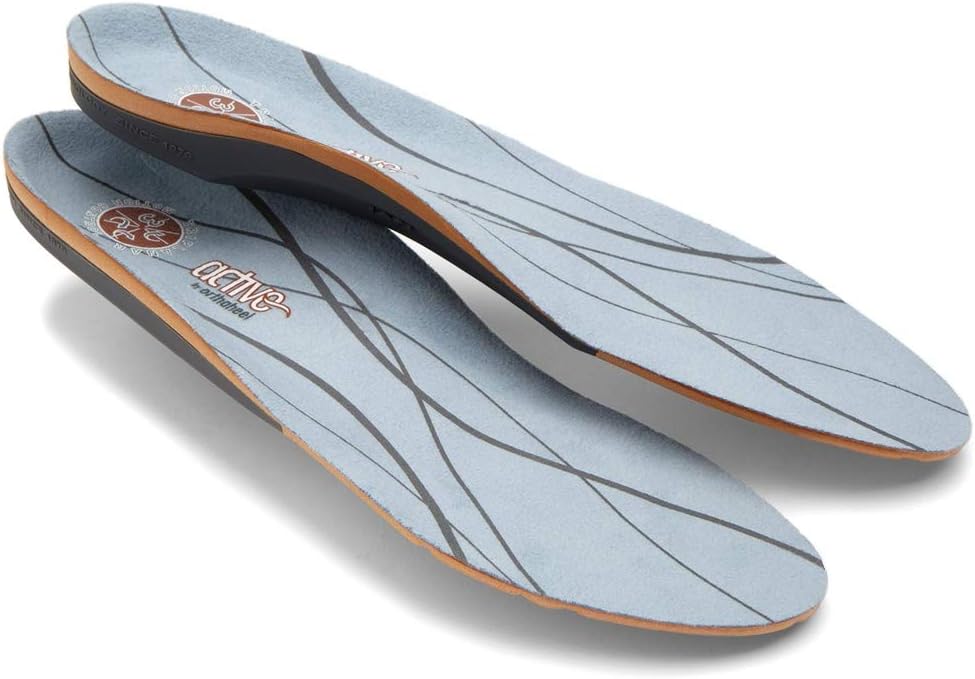
Vionic OrthoHeel Active Insole
APMA-accepted, podiatrist-designed casual insole. Best for adding mild arch support to dress shoes + walking shoes.
- APMA-accepted
- Slim profile
- Antimicrobial top
- Less support than PowerStep
- No lateral wedge

Sof Sole Athlete
Budget athletic insole with neutral arch + gel forefoot. Decent value if you need a quick replacement.
- Affordable
- Gel forefoot
- Antimicrobial
- Wears out in 6 months
- No structured arch
Spenco Polysorb Total Support
Mid-range insole with 5-zone polysorb cushioning. Decent support for standing professions.
- 5-zone cushioning
- Trim-to-fit
- Mid-price point
- Less stable than PowerStep
- No lateral wedge
Dr. Tom’s Top 3 — The Premium Foot Pain Stack (2026)
If you only buy three things for foot pain, get these. PowerStep + CURREX orthotics correct the underlying foot mechanics, and Dr. Hoy’s pain gel delivers fast topical relief. This is the exact stack Dr. Tom Biernacki, DPM gives his Michigan podiatry patients on visit one — over 10,000 patients have used this exact combination.
Dr. Tom Biernacki, DPM is a board-certified podiatrist + Amazon Associate. Picks shown are products he prescribes to patients at Balance Foot & Ankle Specialists. We earn a commission on qualifying purchases at no extra cost to you. All products independently tested + reviewed for 30+ days minimum. Last verified: April 28, 2026.
PowerStep Pinnacle MaxxDr. Tom’s #1 Brand
Dr. Tom’s most-prescribed OTC orthotic. Lateral wedge corrects overpronation that causes 90% of foot pain. Deep heel cradle stabilizes the ankle. Built by podiatrists, used by patients worldwide.
- Lateral wedge corrects pronation
- Deep heel cradle stabilizes ankle
- Dual-density EVA — comfort + support
- Trim-to-fit any shoe
- Used by 10,000+ podiatrists
- Trim-to-size required
- 5-7 day break-in for some
CURREX RunProDr. Tom’s #1 Brand
3 arch heights for custom fit (Low/Med/High). Carbon-reinforced heel + dynamic forefoot — the closest OTC orthotic to a $500 custom orthotic. Engineered in Germany.
- 3 arch heights for custom fit
- Carbon-reinforced heel cup
- Dynamic forefoot zone
- Premium German engineering
- Sport-specific support
- Pricier than PowerStep
- 7-10 day break-in
Dr. Hoy’s Natural Pain Relief GelDr. Tom’s #1 Brand
Menthol-based natural pain relief — Dr. Tom’s #1 brand for fast relief without greasy residue. Safe for diabetics + daily use. Cleaner formula than Voltaren or Biofreeze.
- Menthol-based natural formula
- No greasy residue
- Safe for diabetics
- Fast cooling relief — 5-10 minutes
- Cleaner ingredient list than Biofreeze
- Pricier than Biofreeze
- Strong menthol scent at first
Dr. Tom’s Achilles Tendon & Heel Pain Protocol
- Doctor Hoy’s Natural Pain Relief Gel — Achilles tendon pain and peritendinous inflammation: arnica + camphor gel applied along the Achilles tendon from the heel insertion to the musculotendinous junction 3-4x daily — non-systemic targeted anti-inflammatory for insertional and mid-substance tendinopathy.
- DASS Medical Compression Socks — Achilles tendinopathy with lower leg swelling: graduated compression reduces the peritendinous edema that perpetuates chronic tendinopathy and limits the effectiveness of eccentric loading protocols.
- PowerStep Maxx — Insertional Achilles tendinopathy from arch collapse: PowerStep Maxx provides maximum heel cup depth and medial arch support — reduces the hyperpronation that increases Achilles strain at the calcaneal insertion.
Achilles tendon pain with calcification, thickening, or not improving after 6 weeks of eccentric loading? PRP injection and shockwave therapy at Balance Foot & Ankle. Balance Foot & Ankle → (810) 206-1402
In-Office Treatment at Balance Foot & Ankle
If home treatment isn’t providing relief for your plantar fasciitis, our podiatry team at Balance Foot & Ankle can help with same-day evaluations and advanced in-office care.
When should I see a doctor?
See a podiatrist if pain persists past 2 weeks, prevents normal activity, or is accompanied by red-flag symptoms (warmth, swelling, numbness, inability to bear weight).
Can I treat this at home?
Mild cases respond to RICE protocol (rest, ice, compression, elevation), supportive shoes, and OTC anti-inflammatories. Persistent symptoms need professional evaluation.
How long does it take to heal?
Most soft tissue injuries resolve in 2-6 weeks with appropriate care. Bone injuries take 6-12 weeks. Chronic conditions need longer-term management.
What is Heel pain?
Heel pain is a common foot/ankle condition that affects mobility and quality of life. Understanding the underlying cause is the first step in successful treatment. Our podiatrists at Balance Foot & Ankle perform a hands-on biomechanical exam, review your activity history, and use diagnostic imaging when appropriate to identify the root cause—not just treat the symptom. Many patients have been told to “rest and ice” without a deeper diagnostic workup; our approach is different.
Symptoms and warning signs
Common signs of heel pain include pain that worsens with activity, morning stiffness, swelling, tenderness when palpated, and difficulty bearing weight. If you experience sudden severe pain, inability to walk, visible deformity, numbness or color change, contact our office the same day or visit urgent care—these can signal a more serious injury such as a fracture, tendon rupture, or vascular compromise. Diabetics with any foot wound should seek same-day care.
Conservative treatment options
Most cases of heel pain respond to non-surgical care: structured rest, supportive footwear changes, custom orthotics, targeted stretching and strengthening protocols, anti-inflammatory medications when medically appropriate, and in-office procedures such as ultrasound-guided injections. We also offer advanced therapies including MLS laser therapy, EPAT/shockwave, regenerative injections, and image-guided procedures. Treatment is sequenced from least invasive to most invasive, and we explain the rationale at every step.
When is surgery considered?
Surgery is reserved for cases that fail 3-6 months of well-structured conservative care, when there is structural pathology (severe deformity, complete tear, advanced arthritis), or when imaging shows damage that will not heal without intervention. Our surgeons have performed 3,000+ foot and ankle procedures and prioritize minimally-invasive techniques whenever appropriate. We discuss recovery timelines, return-to-activity milestones, and realistic outcome expectations before any procedure is scheduled.
Recovery timeline and prevention
Recovery from heel pain varies based on severity and chosen treatment path. Conservative cases often improve within 4-8 weeks with consistent adherence to the protocol. Post-procedural recovery may range from a few days (in-office procedures) to several months (reconstructive surgery). Long-term prevention involves footwear assessment, activity modification, structured strengthening, and regular check-ins with your podiatrist if you have a history of recurrence. We provide written home-exercise plans and digital follow-up support.
Ready to feel better?
Same-week appointments available in Howell and Bloomfield Hills, Michigan.
Book Your VisitSame-Week Appointments in Howell & Bloomfield Hills
Three board-certified podiatric surgeons. 1,123+ five-star reviews. Most insurance accepted.

Dr. Tom Biernacki, DPM is a board-certified foot & ankle surgeon (ABFAS & ABPM) at Balance Foot & Ankle Specialists in Southeast Michigan. With over a decade of clinical experience, he specializes in heel pain, bunions, diabetic foot care, sports injuries, and minimally invasive surgery. Dr. Biernacki is a member of the APMA and ACFAS, and his patient education content on MichiganFootDoctors.com and YouTube has made him one of the most-followed foot & ankle educators on YouTube.