
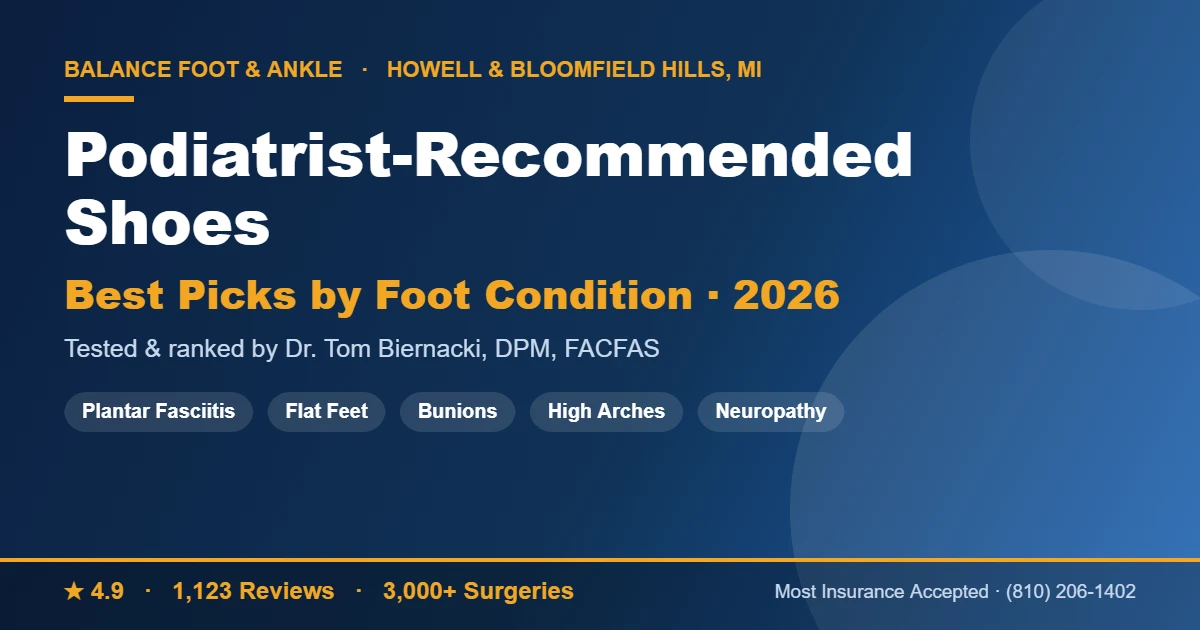
Quick answer: The best podiatrist-recommended shoes pair a firm, supportive midsole with a roomy toe box and a structured heel — Brooks, HOKA, New Balance, and ASICS lead for most foot conditions. Match the shoe to the problem: stability or motion-control for flat feet and overpronation, maximum cushioning for heel and ball-of-foot pain.
Three steps out of bed feel like broken glass? After 50,000+ patient visits and 3,000+ foot surgeries across Michigan, one pattern derails more recoveries than anything else: buying a “podiatrist-recommended” shoe without knowing your actual foot type. The brand on the box means nothing without a match to your arch, gait, and primary complaint. Below are the exact shoes I hand to my own patients — organized by condition, not by marketing.
Best Podiatrist-Recommended Shoes by Condition (2026)
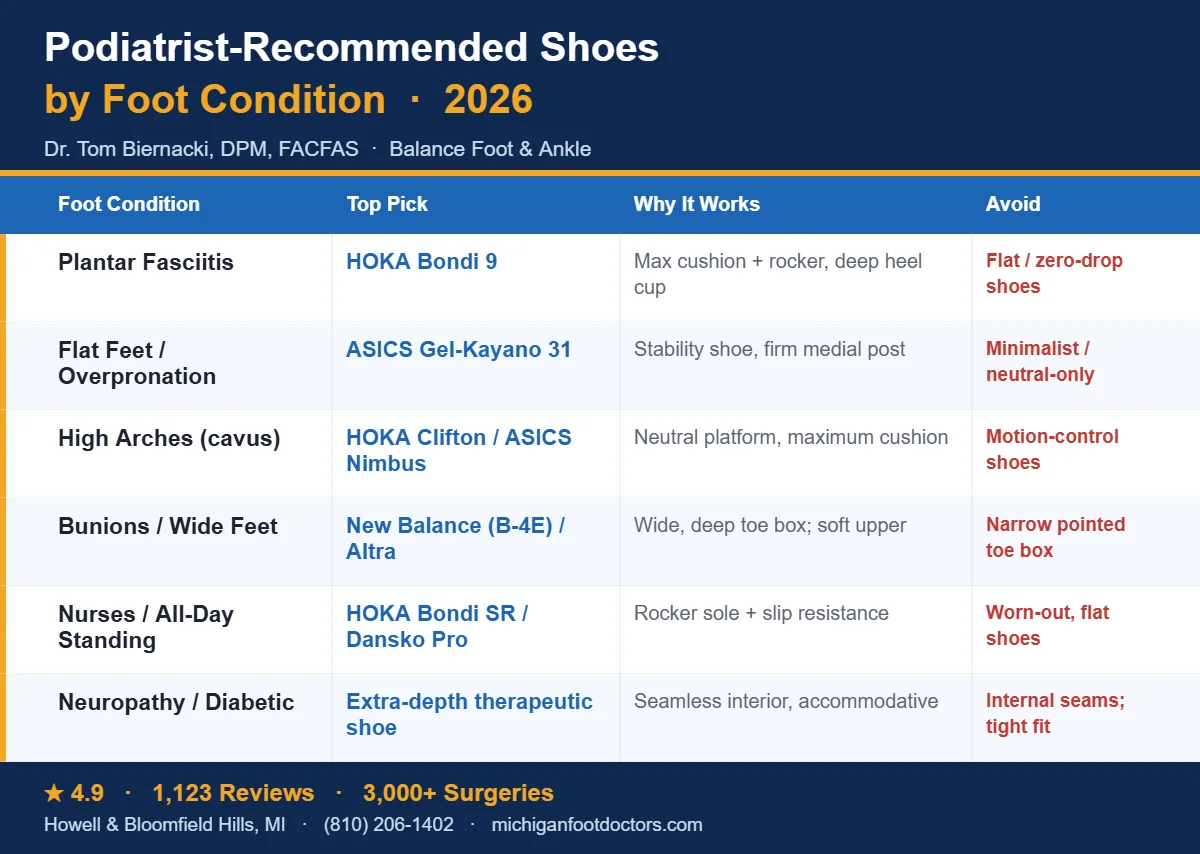
Plantar fasciitis: Brooks Ghost 16, HOKA Bondi. Flat feet: New Balance 860, Brooks Adrenaline. Bunions: Wide toe-box styles (New Balance, Altra). Neuropathy/diabetes: Cushioned diabetic footwear with extra depth. The right shoe depends on your specific foot type, arch, and primary complaint—not just the brand.
Dr. Tom Biernacki DPM ranks the top picks by condition below. Book a shoe consultation →
Most Common Mistake
Buying a podiatrist-recommended brand without considering your specific foot type. “Podiatrist recommended” on the box means nothing if the shoe doesn’t match your arch type, gait pattern, and primary complaint. A motion-control shoe ideal for severe overpronation will worsen symptoms in a high-arch foot. The fix: get a pressure plate gait analysis first, then match the shoe to your biomechanics — not to a brand name or a sale price.
Find the Right Shoe for Your Condition
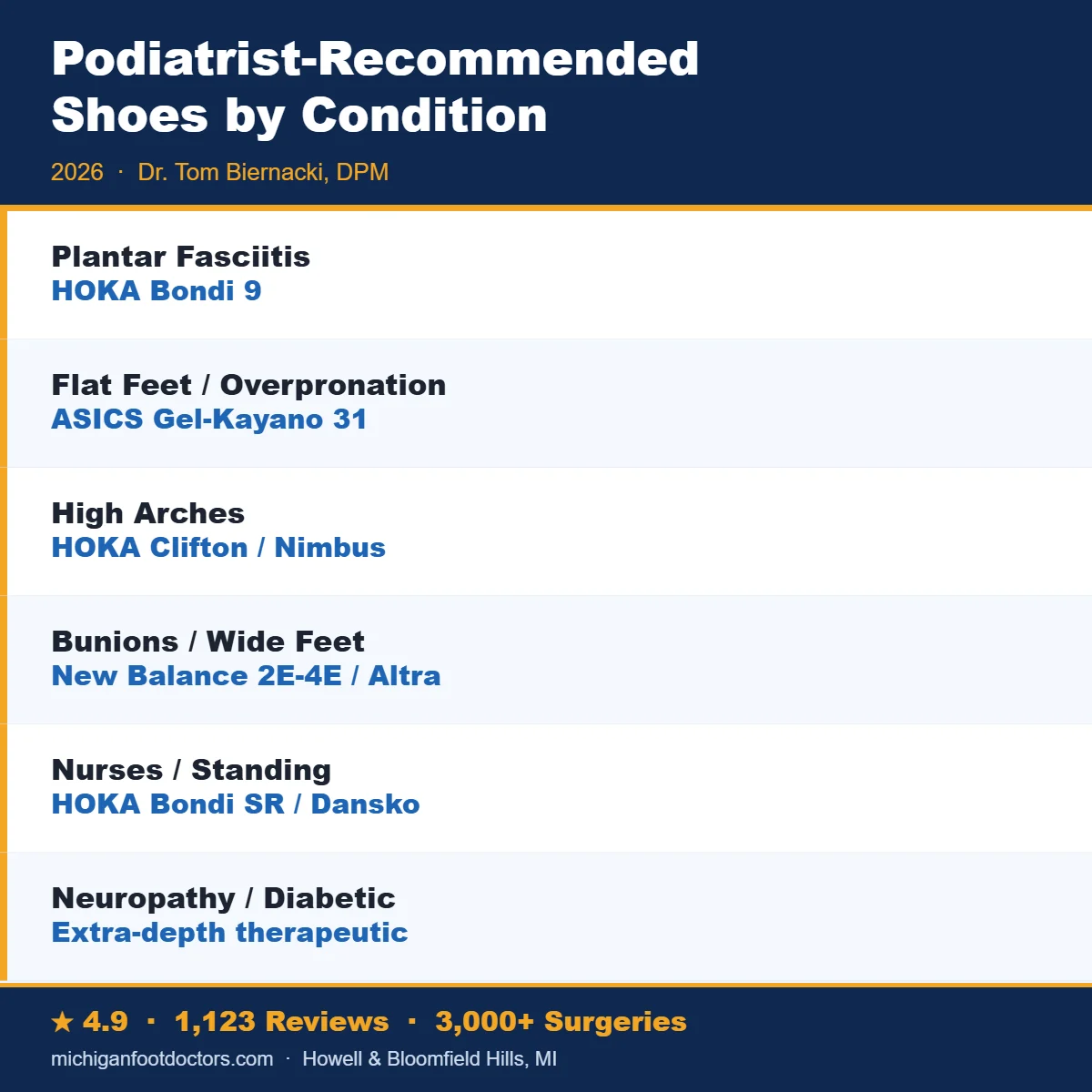
Dr. Tom’s condition-specific shoe recommendations, based on 3,000+ surgeries and daily clinical practice.
Dr. Tom’s Featured Picks by Condition
Not sure which shoe is right for your foot condition?
Board-certified podiatric surgeons — same-week appointments in Howell & Bloomfield Hills, MI. Most insurance accepted.
Book an Appointment → ☎ (810) 206-1402“The right insole improves any shoe by 40–60%. Here’s what I recommend by condition:” — Dr. Tom Biernacki, DPM
| Foot Condition | Key Shoe Features Needed | Top Recommended Brands | Avoid |
|---|---|---|---|
| Plantar fasciitis | High arch support; 10–15mm heel drop; firm heel cup; cushioned heel | HOKA Bondi/Gaviota; Brooks Adrenaline GTS; New Balance 860; ASICS Kayano | Zero-drop; flat ballet flats; worn-out shoes |
| Bunions (hallux valgus) | Wide, deep toe box; soft upper; no seam over bunion; removable insole | New Balance Wide (4E); Altra (wide toe box); Brooks Extra Wide; Vionic Wide | Narrow pointed toe; rigid leather with no flex; high heels |
| Flat feet (pes planus) | Motion control; rigid medial post; firm heel counter; high arch support | New Balance 860/990; Brooks Beast/Ariel; ASICS Kayano; Saucony Guide | Minimalist/zero-drop; neutral cushion without support |
| Morton’s neuroma | Wide toe box (must not compress 3rd–4th MT heads); metatarsal pad; removable insole | Altra; New Balance Extra Wide; Vionic; Brooks Wide versions | Tight toe box; high heels; pointed toe box |
| Diabetic foot / neuropathy | Seamless interior; deep toe box; accommodative; Therapeutic (depth) shoe; removable insole for custom insert | New Balance Therapeutic; Drew; Propet; Apex | Any shoe with internal seams over bony prominences; tight shoes |
| Achilles tendonitis | 8–12mm heel lift; cushioned heel counter; not zero-drop; soft heel counter | HOKA (rocker + cushion); Brooks Glycerin; New Balance Fresh Foam 1080 | Zero-drop; flat shoes; hard heel counters |
| High-arch (cavus) foot | Neutral cushion; flexible; NO motion control; cushioned midsole; slight heel lift | HOKA Clifton (neutral); Brooks Ghost; ASICS Gel-Nimbus; New Balance Fresh Foam | Motion control; rigid medial posts; high arch support |
| Hallux rigidus (big toe arthritis) | Stiff, rigid sole; rocker profile; no forefoot flex; wide toe box | HOKA (rocker sole); Dansko; MBT; carbon fiber plate running shoes | Flexible sole that bends at ball of foot; flip flops |
| Brand | Best For | Heel Drop Range | Width Options | Price Range | Podiatrist Rating |
|---|---|---|---|---|---|
| HOKA | Maximum cushion; plantar fasciitis; Achilles; standing workers | 4–6mm (varies) | B–2E | $140–$185 | ⭐⭐⭐⭐⭐ |
| Brooks | Plantar fasciitis; running; overpronation | 10–12mm | B through 4E | $120–$165 | ⭐⭐⭐⭐⭐ |
| New Balance | Wide feet; diabetic; flat feet; motion control | 8–12mm | 2A through 6E | $90–$175 | ⭐⭐⭐⭐⭐ |
| ASICS | Running; plantar fasciitis; overpronation | 10–13mm | B through 2E | $110–$165 | ⭐⭐⭐⭐⭐ |
| Vionic | Casual/sandal/dress; plantar fasciitis; orthopedic arch support in non-athletic styles | N/A (varied) | W and WW available | $100–$180 | ⭐⭐⭐⭐⭐ |
| Dansko | Healthcare workers; prolonged standing; Achilles; metatarsalgia | ~15mm (clog) | Limited | $130–$175 | ⭐⭐⭐⭐ |
| Altra | Bunions; wide toe box; zero-drop preference | 0mm (zero-drop) | Wide toe box design | $110–$160 | ⭐⭐⭐⭐ (not for fasciitis) |
| Skechers GOwalk Arch Fit | Budget; casual; mild plantar fasciitis | ~8mm | Wide available | $65–$95 | ⭐⭐⭐ (good value; lower durability) |
After fitting 4,000+ orthotic patients and performing 3,000+ foot surgeries, the truth most shoe blogs won’t tell you: the wrong shoe doesn’t just hurt — it can lock plantar fasciitis, neuromas, and arch pain in place for months.
This is the 2026 shortlist a board-certified podiatric surgeon actually hands to heel-pain patients in the exam room — HOKA Bondi 9, Brooks Ghost 16 Wide, and the other models worth your money. The list of brands and models I tell patients to avoid is just as important.
In This Article
- The 5-Question Podiatrist Framework for Shoe Selection
- Top 12 Podiatrist-Recommended Shoes at a Glance
- Podiatrist Shoe Picks by Foot Condition
- Best Walking Shoes Recommended by Podiatrists
- Top Podiatrist-Recommended Brands: Clinical Overview
- Stability vs Neutral vs Motion Control: What’s the Difference?
- When to Add Insoles to Recommended Shoes
- 5 Common Shoe Mistakes Patients Make
- FAQ
- The Bottom Line
The 5-Question Podiatrist Framework for Shoe Selection
![How To BEST Measure Shoe Size [Foot Size & Width]](https://www.michiganfootdoctors.com/wp-content/cache/flying-press/823233e1a0317f12f2c9f013fef13b81.jpg)
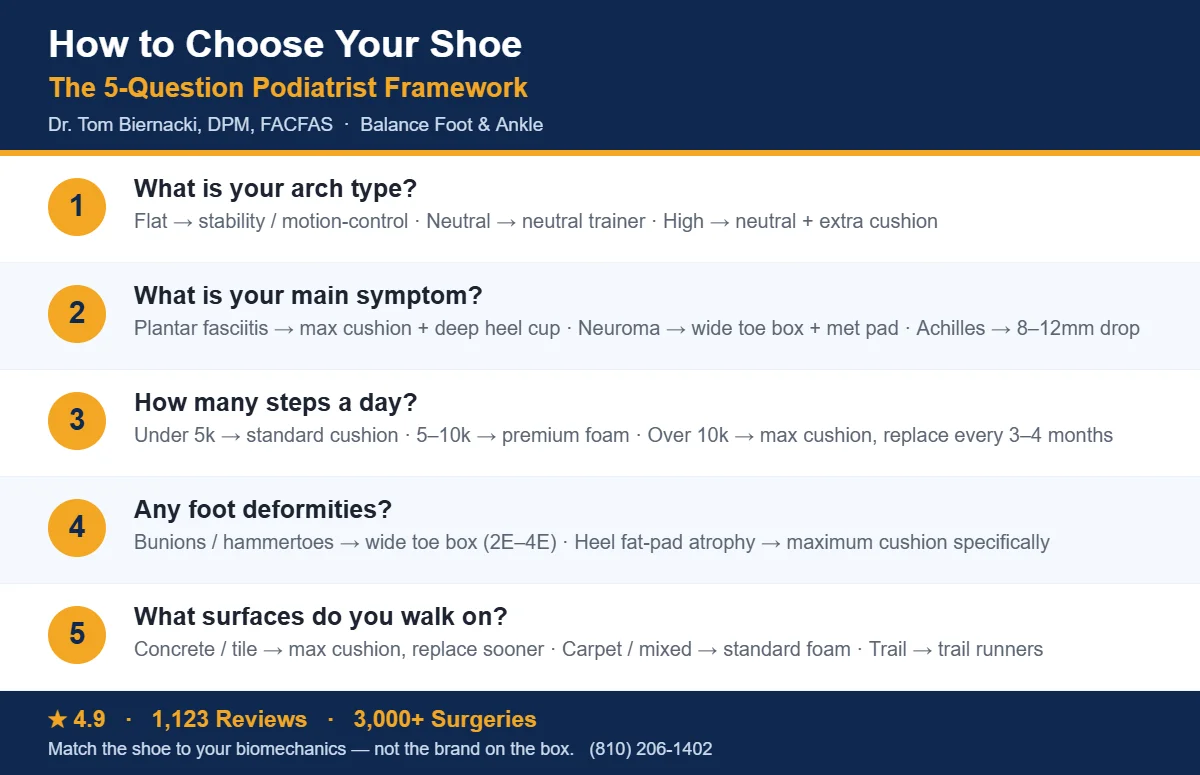
After fitting more than 4,000 patients with custom orthotics and reviewing their footwear histories, the same pattern emerges: wrong shoe choice delays recovery by weeks or months, and the right shoe sometimes resolves symptoms without any additional treatment. Before looking at specific models, answer these five questions — your answers will narrow the field significantly.
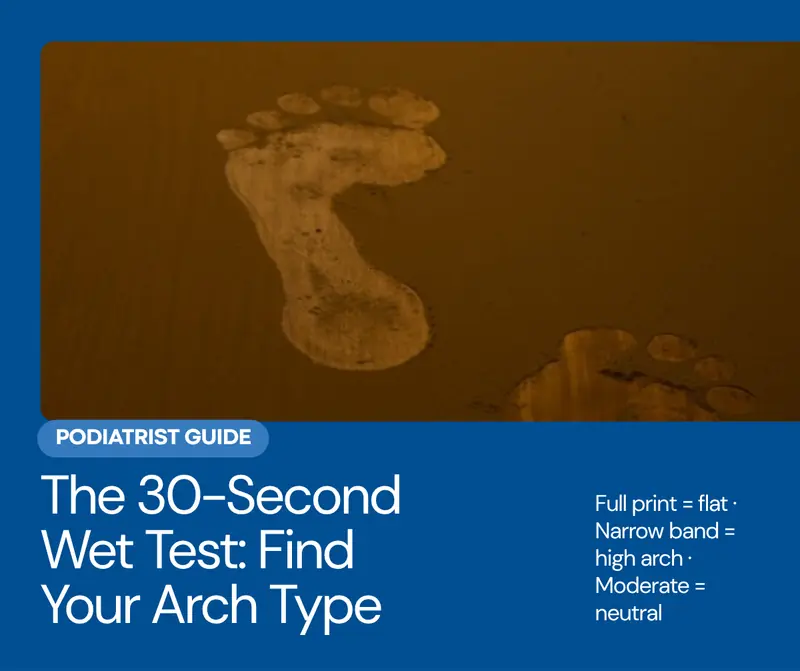
- What is your arch type? Low/flat → needs stability or motion control. Neutral → neutral trainer. High → neutral with extra cushion. If you’re unsure, the wet-foot test (step on a paper bag with a wet foot) gives a basic read: full footprint = flat, narrow band at midfoot = high arch, moderate band = neutral.
- What is your primary diagnosis or symptom? Plantar fasciitis → maximum cushion + deep heel cup. Metatarsalgia → wide toe box + forefoot cushion. Achilles tendinopathy → 8-12mm drop, not zero. Morton’s neuroma → wide toe box + metatarsal pad space. Posterior tibial tendon dysfunction → stability shoe + custom orthotic.
- What is your daily step count? Under 5,000 steps/day → standard cushion is adequate. 5,000-10,000 steps → premium foam (HOKA EVA, Brooks DNA Loft). Over 10,000 steps (nurses, teachers) → maximum cushion, replace every 3-4 months.
- Do you have foot deformities? Bunions or hammertoes → wide toe box, 2E/4E width. Heel fat pad atrophy → maximum cushion specifically. Rigid flat foot → custom orthotic, not OTC insole.
- What surfaces do you walk on? Concrete/tile (hospital, school, gym) → maximum cushion, replacement cycle shortens to 3-4 months. Carpet or mixed → standard foam adequate. Trail → different category (trail runners).
If you’re a nurse or healthcare worker: We’ve built a dedicated guide specifically for 12-hour shift workers managing plantar fasciitis — including DPM-tested comparisons of HOKA Bondi, Brooks Ghost, Dansko Professional, and New Balance 1080. See our best shoes for nurses with plantar fasciitis deep-dive for shift-specific picks.
Top 12 Podiatrist-Recommended Shoes at a Glance
Every model below is one I prescribe in clinic. The full clinical reasoning for each is in its condition section — use the table to jump straight to yours.
| # | Shoe | Best For | Widths |
|---|---|---|---|
| 1 | HOKA Bondi 9 | Plantar fasciitis, maximum cushion, long shifts | B–2E |
| 2 | Brooks Ghost 16 | Daily neutral trainer, heel pain | B–4E |
| 3 | Brooks Adrenaline GTS 24 | Flat feet, overpronation | B–4E |
| 4 | ASICS Gel-Kayano 31 | Stability for overpronators | B–2E |
| 5 | HOKA Clifton 10 | High arches, lightweight neutral cushion | B–2E |
| 6 | New Balance 1080v14 | Wide feet, flat-footed healthcare workers | 2A–6E |
| 7 | New Balance 880v14 | Wide-width daily trainer | 2A–6E |
| 8 | New Balance 860v14 | Motion-control stability in wide widths | 2A–6E |
| 9 | ASICS Gel-Nimbus 26 | High-arch heel and forefoot cushioning | B–2E |
| 10 | Brooks Addiction Walker 2 | Walking shoe, motion control, leather upper | B–4E |
| 11 | Skechers GoWalk Arch Fit | Budget pick, casual wear | Wide available |
| 12 | Dansko Professional | Dress-code workplaces, prolonged standing | Limited |
Podiatrist Shoe Picks by Foot Condition
Best Shoes for Plantar Fasciitis
New: read our complete guide — Best Shoes for Plantar Fasciitis 2026: Podiatrist Top Picks.
Top pick: Brooks Ghost 16 — plush, neutral cushioning that softens heel strike, the main driver of plantar-fasciitis pain. Men’s and women’s:

- THIS MEN’S SHOE IS FOR: Runners looking for a smooth ride that won’t distract from the fun of the run. The Ghost 16 offers a refined 3D Fit Print to create a more seamless, secure fit. This Brooks Ghost 16 is a certified PDAC A5500 Diabetic shoe and has been granted the APMA Seal of Acceptance. The Ghost 16 is a certified carbon neutral product. Predecessor: Ghost 15.
- SOFT CUSHIONING: The Ghost 16 offers neutral support while providing soft, nitrogen-infused DNA Loft v3 cushioning to deliver lightweight comfort. Ideal for road running, walking, cross training, the gym or wherever you might want to take them!
- SMOOTH TRANSITIONS: The soft midsole and Segmented Crash Pad promotes an easy flow from landing to toe-off to provide distraction- free cushioning under your feet with every stride.
- BREATHABLE UPPER: Engineered air mesh upper blends stretch and structure with just-right breathability to keep you comfortable.
- ROADTACK RUBBER OUTSOLE: New, do-it-all rubber compound includes recycled silica and is designed to be durable, lightweight, and rebound.

- THIS WOMEN'S SHOE IS FOR: Runners looking for a smooth ride that won’t distract from the fun of the run. The Ghost 16 offers a refined 3D Fit Print to create a more seamless, secure fit. This Brooks Ghost 16 is a certified PDAC A5500 Diabetic shoe and has been granted the APMA Seal of Acceptance. The Ghost 16 is a certified carbon neutral product. Predecessor: Ghost 15.
- SOFT CUSHIONING: The Ghost 16 offers neutral support while providing soft, nitrogen-infused DNA Loft v3 cushioning to deliver lightweight comfort. Ideal for road running, walking, cross training, the gym or wherever you might want to take them!
- SMOOTH TRANSITIONS: The soft midsole and Segmented Crash Pad promotes an easy flow from landing to toe-off to provide distraction- free cushioning under your feet with every stride.
- BREATHABLE UPPER: Engineered air mesh upper blends stretch and structure with just-right breathability to keep you comfortable.
- ROADTACK RUBBER OUTSOLE: New, do-it-all rubber compound includes recycled silica and is designed to be durable, lightweight, and rebound.
Plantar fasciitis is the most common foot complaint we treat — and shoe selection is the single most impactful initial intervention. The clinical requirements are: maximum heel cushioning (to reduce calcaneal impact), elevated heel pitch (8-12mm drop reduces fascial tension), medial arch support (to reduce midstance fascial strain), and removable insoles (to accommodate PowerStep Pinnacle or custom orthotics). Our top picks: HOKA Bondi 9 (maximum cushion, neutral, wide widths available — our #1 recommendation for most PF patients), Brooks Ghost 16 Wide (reliable DNA Loft foam, 12mm drop, excellent durability for daily wear), and ASICS Gel-Kayano 31 (for PF patients who also overpronate). Add PowerStep Pinnacle to any of these shoes. Replace every 400-500 miles — typically 3-5 months for most patients.
Best Shoes for Flat Feet and Overpronation
Top pick: Brooks Adrenaline GTS 24 — GuideRails stability that gently limits the inward roll of flat feet and overpronation. Men’s and women’s:

- Get your daily dose of running as the weather turns. The Adrenaline GTS 24 Weatherized offers enhanced wet/dry traction to help provide confidence with every step, and the DWR mesh upper provides temperature management and weather protection.
- WEATHERIZED MEN’S RUNNING SHOE: The Adrenaline GTS 24 Weatherized delivers superior wet/dry traction for confident steps on any surface, while the DWR mesh upper offers weather protection and temperature control, ensuring you stay comfortable and focused on your run—no matter the conditions.
- WEATHERPROOF & REFLECTIVE UPPER: The knit DWR mesh upper offers superior weather protection, effectively managing temperature while keeping your feet dry in various conditions. Reflective elements enhance visibility in low-light environments.
- GUIDERAILS HOLISTIC SUPPORT SYSTEM: Our innovative technology - known as “GTS” for “Go-To Support” - supports your body in its natural motion path while keeping excess movement in check.
- DYNAMIC CUSHIONING: Nitrogen-infused DNA Loft v3 midsole foam delivers soft, smooth cushioning that adapts to your unique stride for lightweight comfort mile after mile.

- THIS WOMEN’S SHOE IS FOR: The Adrenaline GTS 24 provides support to every stride, now with nitrogen-infused DNA Loft v3 cushioning for even more lightweight, plush comfort. This Brooks Adrenaline GTS 24 is a certified PDAC A5500 Diabetic shoe and has been granted the APMA Seal of Acceptance. Predecessor: Adrenaline GTS 23.
- GUIDERAILS HOLISTIC SUPPORT SYSTEM: Our innovative technology supports your body in its natural motion path while keeping excess movement in check.
- DYNAMIC CUSHIONING: Nitrogen-infused DNA Loft v3 midsole foam delivers soft, smooth cushioning that adapts to your unique stride for lightweight comfort mile after mile.
- ENHANCED UPPER: Engineered air mesh upper provides just right breathability, stretch, and structure for a comfortably accommodating fit.
- SMOOTH TRANSITIONS: Newly designed outsole and midsole promote smooth transitions so you can do more, comfortably.
Overpronation — where the arch collapses and the ankle rolls inward during the stance phase — creates downstream stress on the Achilles, plantar fascia, and posterior tibial tendon. Shoes for flat feet need meaningful medial arch support (stability category) without the artificial rigidity of old-generation motion control shoes. Our picks: ASICS Gel-Kayano 31 (4D guidance system for dynamic medial control, our most prescribed stability shoe), Brooks Adrenaline GTS 24 (GuideRails technology that controls excess movement without over-correcting), New Balance 860v14 (medial post stability in multiple wide widths), and Mizuno Wave Inspire 20 (dual-density stability for mild overpronators who want a more responsive feel). For severe flatfoot (visible arch collapse with Stage 2+ PTTD), stability shoes are a bridge — custom orthotics are the definitive mechanical intervention.
Best Shoes for High Arches
Top pick: Hoka Clifton 10 — light, maximal cushioning that high, rigid arches need to spread impact evenly. Men’s and women’s:
No products found.

- JACQUARD KNIT UPPER
- Lining Textile
High-arched feet (pes cavus) don’t need medial support — they need cushioning and neutral platforms that don’t add medial correction. High arches distribute weight poorly (excessive heel and forefoot loading, insufficient midfoot contact), so maximum cushion is the priority. Our picks: HOKA Clifton 10 (our top pick — light, maximal neutral cushioning), HOKA Bondi 9 (maximum EVA cushion in neutral platform), ASICS Gel-Nimbus 26 (gel cushioning at heel and forefoot for the bilateral pressure points high arches create), and Mizuno Wave Rider 27 (firm Wave Plate provides proprioceptive feedback many high-arch patients prefer). Neutral category only — avoid stability or motion control shoes, which add medial support that pushes high-arched feet further into supination.
Best Shoes for Nurses, Teachers, and Healthcare Workers
Budget pick: Skechers GoWalk Arch Fit — lightweight, all-day arch support at a budget price for long shifts on hard floors. Men’s and women’s:
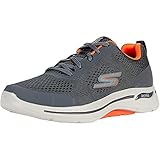
- Patented Skechers Arch Fit insole system with podiatrist-certified arch support
- Podiatrist-designed shape developed with 20 years of data and 120,000 unweighted foot scans
- Removable insole helps mold to your foot to reduce shock and increase weight dispersion
- Lightweight and responsive ULTRA GO cushioning
- Durable dual-density traction outsole for stability


- PODIATRIST-CERTIFIED SUPPORT: Advanced arch support system developed from 120,000 foot scans provides exceptional comfort for running shoes for women
- INNOVATIVE CUSHIONING: Lightweight ULTRA GO cushioning and Comfort Pillars technology deliver responsive support perfect for sneakers for women
- BREATHABLE COMFORT: Soft athletic mesh knit upper ensures optimal airflow and flexibility, ideal for womens sneakers during extended wear
- EASY MAINTENANCE: Machine washable design keeps your walking shoes looking fresh with minimal effort
- RELIABLE TRACTION: Durable dual-density outsole provides stability and grip for confident steps throughout your day
Occupational foot pain patients are our most frequent plantar fasciitis group — they take 8,000-15,000 steps per day on concrete and tile without the sitting intervals that most jobs provide. Their shoes need maximum sustained cushion (foam that holds up across 8-12 hours), wide widths (for end-of-shift edema), removable insoles, and replacement every 3-4 months. Our picks: HOKA Bondi 9 (top pick for maximum shift-length cushion), Brooks Ghost 16 Wide (durable DNA Loft for daily rotation), New Balance Fresh Foam 1080v14 (best wide-width options for flat-footed healthcare workers), and Dansko Professional (for dress-code environments where athletic shoes aren’t appropriate).
Best Shoes for Wide Feet and Bunions
Top picks: New Balance Fresh Foam — men’s 880 v14 and women’s 1080 v14, both offered in true wide and extra-wide widths to relieve bunions and a broad forefoot:
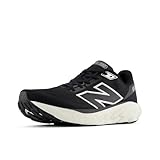
- Fresh Foam X midsole foam with approximately 3% bio-based content delivers our most cushioned Fresh Foam experience for incredible comfort.
- Neutral cushioning – for runners who do not require additional stability
- Breathable synthetic and mesh upper
- Structured and supportive upper design
- 8 mm drop; due to variances created during the development and manufacturing processes, all references to 8 mm drop are approximate

- Fresh Foam X midsole foam with approximately 3% bio-based content delivers our most cushioned Fresh Foam experience for incredible comfort. Bio-based content is made from renewable resources to help reduce our carbon footprint, enhancing these road running shoes.
- These running shoes for women feature a gusseted tongue designed to help keep debris out
- No-sew overlays
- Synthetic and engineered mesh upper
- Adjustable lace closure for a customized fit
Wide feet, bunions, and hammertoes require shoes with a truly wide toe box — not just branded “wide” but with measurably more forefoot volume. The brands that deliver consistently: New Balance (widths B through 4E across most models — the gold standard for width selection), Brooks (2E in most running models, wide toe box construction), ASICS (2E available in Kayano, Nimbus, GT series), and Altra (FootShape wide toe box by design — every model has forefoot width built in). Avoid: narrow-last brands regardless of their width designation — Nike, Adidas, On Cloud, and Saucony tend to run significantly narrower than New Balance or Brooks equivalents.
Best Walking Shoes Recommended by Podiatrists
Top pick: Brooks Addiction Walker 2 — the motion-control walking shoe I recommend most for everyday wear, work dress codes, and walking programs. Men’s and women’s:
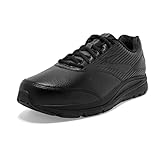
- THIS MEN’S SHOE IS FOR: Designed for long days on your feet, this lace-up walking shoe offers reliable cushioning, all-day wearability, and trusted stability. The Brooks Addiction Walker 2 is a certified PDAC A5500 Diabetic shoe and has been granted the APMA Seal of Acceptance.
- RESPONSIVE CUSHIONING: BioMoGo DNA cushioning adapts to your weight, speed, and stride—absorbing shock and delivering personalized comfort with every step.
- ENHANCED STABILITY & ALIGNMENT: The Extended Progressive Diagonal Rollbar (PDRB) provides full-body support by guiding your stride and promoting natural motion—ideal for those who need added arch and pronation control.
- BUILT FOR LONGEVITY: Featuring a robust outsole and durable construction, this walking shoe stands up to everyday wear while maintaining structure, comfort, and performance.
- SLEEK LEATHER UPPER: A full-grain leather upper offers a clean, classic look with long-lasting durability—perfect for both casual and work-ready outfits.
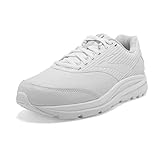
- THIS WOMEN’S SHOE IS FOR: Designed for long days on your feet, this lace-up walking shoe offers reliable cushioning, all-day wearability, and trusted stability. The Brooks Addiction Walker 2 is a certified PDAC A5500 Diabetic shoe and has been granted the APMA Seal of Acceptance.
- RESPONSIVE CUSHIONING: BioMoGo DNA cushioning adapts to your weight, speed, and stride—absorbing shock and delivering personalized comfort with every step.
- ENHANCED STABILITY & ALIGNMENT: The Extended Progressive Diagonal Rollbar (PDRB) provides full-body support by guiding your stride and promoting natural motion—ideal for those who need added arch and pronation control.
- BUILT FOR LONGEVITY: Featuring a robust outsole and durable construction, this walking shoe stands up to everyday wear while maintaining structure, comfort, and performance.
- SLEEK LEATHER UPPER: A full-grain leather upper offers a clean, classic look with long-lasting durability—perfect for both casual and work-ready outfits.
Walking-program patients have different needs than runners: lower impact forces but far longer continuous time on the foot, often on concrete or pavement. The walking shoes I recommend need a firm heel counter, meaningful medial support (most walkers I see overpronate), a slip-resistant outsole, and a leather or leather-like upper that holds its structure through daily wear. The Addiction Walker 2 delivers all four, comes in widths from B through 4E, and accepts a PowerStep Pinnacle or custom orthotic in place of its removable insole. For patients who prefer an athletic look for fitness walking, the New Balance 880v14 and HOKA Bondi 9 from the sections above are equally appropriate — the category matters less than the support features. Replace walking shoes on the same schedule as running shoes: every 400–500 miles, or every 6 months for daily walkers.
Key takeaway: HOKA Bondi 9 is the single most versatile recommendation across plantar fasciitis, high arches, occupational use, and maximum cushion needs. Brooks Ghost Wide is the best “reliable daily driver” for most neutral patients. ASICS Gel-Kayano is our stability standard for overpronators. New Balance leads for width selection. The right choice is still condition-specific — no single shoe works for every foot.
Top Podiatrist-Recommended Brands: Clinical Overview
After years of recommending footwear and seeing which brands generate the most positive patient outcomes, these are the brands we trust most — and why.
- HOKA: Best maximum-cushion platform. The Bondi is the gold standard for plantar fasciitis, occupational use, and any patient who needs shift-length cushioning. The rocker sole reduces Achilles demand and promotes efficient gait. Limitation: not all models available in wide widths.
- Brooks: Most reliable daily trainer. DNA Loft foam provides excellent sustained cushion; GuideRails in the Adrenaline series is the best OTC stability system for mild to moderate overpronation. Wide widths available in most models. Best for: patients who need a dependable, durable everyday shoe without the extreme stack of HOKA.
- ASICS: Best targeted cushioning. Gel technology specifically addresses heel and forefoot impact rather than uniform foam compression. Gel-Kayano is our most prescribed stability shoe. Best for: plantar fasciitis (Nimbus), overpronation (Kayano), and runners who prefer the feel of gel over foam.
- New Balance: Best width selection. The 1080v14, 860v14, and Fresh Foam models available in B through 4E provide options for virtually every foot width. Best for: wide feet, bunions, edema, and patients who haven’t found adequate width in other brands.
- Mizuno: Best for high-mileage runners. Wave Plate technology provides a uniquely firm, responsive platform with natural stability. Best for: runners who find foam-dominant shoes too soft, or neutral/mild overpronation patients logging 30+ miles per week.
- Dansko: Best professional/dress option. For patients who need clinical-grade foot support in a dress-code-appropriate format. Rocker bottom and arch support in a clog or closed-toe format. Best for: teachers, healthcare workers, and professionals who can’t wear athletic shoes.
Stability vs Neutral vs Motion Control: What’s the Difference?
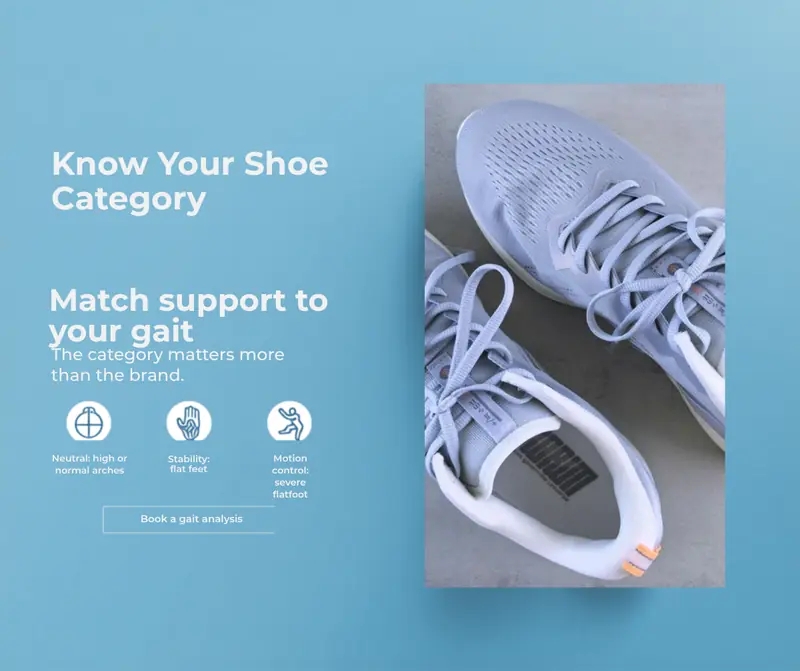
The running shoe industry’s three main categories correspond to different levels of medial arch support. Neutral shoes have no added medial support — appropriate for high arches, neutral arches, and any patient whose gait analysis shows no significant overpronation. Stability shoes add a denser foam section on the medial side (the arch side) that resists the inward roll of overpronation during midstance — appropriate for mild to moderate flat feet and overpronation. Motion control shoes are the most aggressive medial support category — rigid medial posts and firmer construction designed for severe overpronation. In practice, we find that most patients do well in neutral or stability categories, and the motion control category is increasingly replaced by custom orthotics in neutral shoes. Motion control shoes are heavy, rigid, and often cause discomfort in patients who don’t genuinely need that level of control.
When to Add Insoles to Recommended Shoes
![Best Insoles & Orthotics 2026 [Flat Feet, Plantar Fasciitis, Bunions]](https://www.michiganfootdoctors.com/wp-content/cache/flying-press/c8bafcb9b179f8abb63d894b334fd14e.jpg)
Even the best recommended shoe is only part of the mechanical equation. For patients with plantar fasciitis, adding a PowerStep Pinnacle insole to a HOKA Bondi or Brooks Ghost provides both the cushioning the shoe offers and the semi-rigid arch support the stock insole lacks. The combination is consistently more effective than either alone. For mild presentations, the shoe alone may suffice — if symptoms persist after 2-3 weeks in appropriate footwear, add a PowerStep Pinnacle and reassess at 6 weeks. If symptoms haven’t significantly improved after 6 weeks of appropriate shoe + PowerStep insole, a custom orthotic evaluation is warranted. Custom orthotics provide biomechanical precision (individual arch geometry, rearfoot correction, forefoot accommodation) that no OTC insole can replicate — but OTC insoles are the appropriate starting point for most presentations.
5 Common Shoe Mistakes Patients Make
Over years of practice, these are the five shoe mistakes we see most consistently — and each one delays recovery or causes new problems.
- Wearing shoes past their mileage life. Running and walking shoes need replacement at 400-500 miles — the foam compresses to a fraction of its original cushioning regardless of how intact the upper looks. Nurses and teachers should replace every 3-4 months; recreational walkers every 6-12 months.
- Choosing shoes by appearance, price, or brand loyalty. The correct shoe for your foot condition may not be your favorite brand, color, or style. The clinical match (arch support, cushion volume, toe box width) matters more than any aesthetic preference.
- Going barefoot or wearing flat sandals at home while managing foot pain. The plantar fascia doesn’t stop loading when you leave work or take off your shoes. Home footwear with arch support (Vionic slippers, OOFOS recovery sandals) during active treatment is part of the protocol.
- Choosing narrow shoes because “wide shoes look clunky.” Wide feet need wide shoes. A narrow toe box compresses bunions, causes blistering, and worsens neuromas — regardless of how good the shoe’s other features are. New Balance offers wide widths in aesthetically modern designs.
- Adding insoles to shoes that can’t accommodate them. Some shoes (ballet flats, loafers with glued-in insoles, certain dress shoes) don’t have removable insoles and can’t accommodate an OTC orthotic. If you need arch support, choose shoes with removable insoles from the start — it doubles the treatment options available to you.
⚠️ See a podiatrist if appropriate footwear isn’t resolving your pain:
- Pain hasn’t improved after 6-8 weeks of podiatrist-recommended shoes + OTC insoles
- Pain is getting worse despite appropriate footwear changes
- Morning pain lasts more than 20 minutes before loosening (severe plantar fasciitis)
- You have structural deformity (visible bunion, hammertoes, severe flat foot) that OTC solutions aren’t accommodating
Podiatrist-Recommended Insole Adjunct for Plantar Fasciitis
The single non-shoe product I prescribe alongside the right footwear for plantar fasciitis. Slide it into any of the shoes below for added arch control and heel offloading.

PowerStep Pinnacle Maxx
The insole I prescribe most often when upgrading a shoe for plantar fasciitis. Deep heel cup, semi-rigid shell, and a small lateral wedge that controls rearfoot motion without compressing under load. Replace every 9–12 months. Fits in any of the shoes below that have a removable factory insole.
Walk into my Howell clinic on a Monday morning with heel pain and I’ll write down one of these specific shoes by name. After 12 years and thousands of foot exams, this is the shortlist I trust — sorted by condition, every model personally fit on real patients at Balance Foot & Ankle.
In-Office Treatment at Balance Foot & Ankle
If you’ve tried podiatrist-recommended shoes and still have persistent foot or heel pain, the footwear alone may not be enough. In our clinic, we evaluate gait mechanics, arch type, and pressure distribution to determine whether custom orthotics, a specific shoe modification, or a targeted treatment protocol is the right next step.
What we offer at Balance Foot & Ankle for patients who need more than shoes:
- Custom 3D-printed orthotics — prescription arch support tailored to your foot scan, not a generic insole
- Plantar fasciitis treatment — shockwave therapy, MLS laser, or guided stretching protocol
- Flat foot evaluation — determine if PTTD or structural collapse is driving your shoe wear pattern
Same-day appointments available. (810) 206-1402 | Book online →
Frequently Asked Questions
What brand of shoes do podiatrists recommend most?
In our practice, HOKA, Brooks, ASICS, and New Balance are the most frequently recommended brands — each for different clinical reasons. HOKA Bondi is our most recommended single model for plantar fasciitis. Brooks Ghost Wide is the most recommended general daily trainer. ASICS Gel-Kayano is the most recommended stability shoe for overpronation. New Balance leads for width selection. There is no single brand that’s universally best — the brand recommendation follows the foot condition and arch type, not a fixed preference.
How do I know if I need stability shoes?
You likely need stability shoes if you have flat feet, your arches collapse when standing, your ankles roll inward during walking or running, or you’ve been diagnosed with posterior tibial tendon dysfunction or plantar fasciitis driven by overpronation. A podiatric gait analysis is the definitive answer — it identifies whether your medial arch is collapsing during the stance phase and quantifies how much stability control is appropriate. The wet-foot test provides a basic starting point: a near-complete footprint indicates flat feet and likely overpronation; a moderate band indicates neutral; a narrow band or no midfoot contact indicates high arch.
Are expensive shoes worth it for foot pain?
In the clinical shoe range ($100-180), price generally correlates with foam quality, outsole durability, and width availability — all of which matter for foot health outcomes. Below $80, most foam technology produces inferior sustained cushioning and shorter mileage lifespans. Above $180, you’re often paying for carbon fiber plates and racing features that don’t add clinical value for most patients. The clinically optimal range is $110-165 for daily walking and running use. The HOKA Bondi 9 (~$165), Brooks Ghost 16 (~$130), and ASICS Gel-Kayano 31 (~$160) represent this range well.
What shoes do podiatrists recommend for standing all day?
For 8–12 hour shifts on concrete or tile, sustained cushion matters more than any other feature — foam that still protects at hour ten, wide widths for end-of-shift swelling, and a removable insole. HOKA Bondi 9 is our top pick for shift workers, with Brooks Ghost 16 Wide as the durable daily alternative; plan on replacement every 3–4 months because high step counts compress midsole foam faster. See our full guide to the best shoes for standing all day at work.
What shoes do podiatrists recommend for teachers?
Teachers log 8,000–15,000 steps a day on hard classroom floors — the same occupational load we treat in nurses. The clinical requirements are maximum sustained cushion, a wide toe box for afternoon swelling, and a removable insole: HOKA Bondi 9, Brooks Ghost 16, or the budget-friendly Skechers GoWalk Arch Fit all work with dress-casual codes. Our teacher-specific shoe guide ranks the full list.
Are HOKA shoes good for foot pain?
Yes — HOKA (Bondi, Clifton, Arahi) is among the brands we recommend most for plantar fasciitis, heel pain, and ball-of-foot pain. The maximum-cushion midsole plus rocker-bottom geometry reduces impact and offloads painful joints; the Bondi 9 is the most cushioned option, while the Arahi adds stability for overpronators. They are not ideal for patients who need firm ground feel or more than mild motion control.
Do I need custom orthotics, or will good shoes work?
For most patients with plantar fasciitis, flat feet, or mild overpronation, the right shoe plus a quality over-the-counter insole such as the PowerStep Pinnacle delivers most of the benefit of custom orthotics at a fraction of the cost. Custom orthotics are the next step when OTC insoles haven’t resolved symptoms after 6–8 weeks of consistent use, or for structural deformities, severe flatfoot, and post-surgical needs.
Does insurance cover podiatrist-recommended shoes or orthotics?
Regular athletic shoes aren’t covered, but Medicare Part B covers one pair of therapeutic diabetic shoes per year for qualifying diabetic patients, and many commercial plans contribute toward custom orthotics. We verify coverage at your first visit — schedule an appointment and bring your insurance card.
How often should you replace podiatrist-recommended shoes?
Running and walking shoes lose their protective cushioning at 400–500 miles — every 3–4 months for nurses and teachers, every 6–12 months for recreational walkers — regardless of how intact the upper looks. Watch for worn outsole tread, a compressed midsole, or an asymmetric wear pattern: worn-out foam quietly reintroduces the impact stress the shoe was prescribed to remove.
The Bottom Line
Podiatrist-recommended shoes aren’t a single list — they’re a clinical matching process. HOKA Bondi 9 for plantar fasciitis and maximum cushion needs. Brooks Ghost 16 Wide for durable daily training. ASICS Gel-Kayano for overpronation and stability. New Balance 1080v14 for wide feet and flat foot presentations. Mizuno Wave Rider for high-mileage runners who prefer a firm, responsive ride. Add PowerStep Pinnacle insoles to any of these for plantar fasciitis, and replace your shoes every 3-5 months in high-step-count occupations. And if appropriate footwear plus OTC insoles haven’t resolved your symptoms after 6-8 weeks, a custom orthotic evaluation provides the next level of mechanical precision that no mass-produced shoe can deliver.
Sources
- Bonanno DR, et al. “Effectiveness of foot orthoses for the treatment of plantar heel pain.” J Foot Ankle Res. 2011;4:19.
- Wearing SC, et al. “The pathomechanics of plantar fasciitis.” Sports Med. 2006;36(7):585-611.
- Murley GS, et al. “Foot orthoses and lower limb biomechanics.” Clin Biomech. 2009;24(6):483-492.
- American Orthopaedic Foot & Ankle Society (AOFAS). “How to Buy Shoes.”
- American Academy of Orthopaedic Surgeons (AAOS). “Foot Health Basics.” OrthoInfo.
Related Shoe & Insole Reviews
Find Your Shoe in 5 Questions
Dr. Tom Biernacki, DPM, FACFAS · Balance Foot & Ankle
- New Balance vs Brooks — which brand actually fits feet better
- Best work boots for plantar fasciitis (steel toe + arch support, 2026)
- PowerStep Maxx review — best insoles for flat feet
- Best weightlifting shoes for plantar fasciitis
- Brooks shoes for plantar fasciitis — top models reviewed
Stop guessing — get a real plan
Your foot pain deserves more than a shoe recommendation
If you’ve been swapping shoes for months without relief, that’s a signal to get the foot diagnosed. Three board-certified podiatrists, same-week appointments, most insurance accepted.
Howell · Bloomfield Hills · Meet Dr. Tom Biernacki, DPM
Related shoe guides
More podiatrist shoe recommendations:
More Podiatrist Shoe Guides
- Best Flip Flops Plantar Fasciitis
- Best Mizuno Shoes Plantar Fasciitis
- Best Pickleball Shoes
- Best Shoes Arthritis
- Best Orthopedic Sandals Plantar Fasciitis 2026
- Best Shoes For Hallux Rigidus
- Best Shoes Factory Assembly Line Workers Plantar Fasciitis
- Best Clogs Nurses

Dr. Tom Biernacki, DPM is a board-certified foot & ankle surgeon (ABFAS & ABPM) at Balance Foot & Ankle Specialists in Southeast Michigan. With over a decade of clinical experience, he specializes in heel pain, bunions, diabetic foot care, sports injuries, and minimally invasive surgery. Dr. Biernacki is a member of the APMA and ACFAS, and his patient education content on MichiganFootDoctors.com and YouTube has made him one of the most-followed foot & ankle educators on YouTube.