
Quick answer: Best Slippers Arch Support Plantar Fasciitis Indoor is a common foot/ankle topic that affects many patients. Effective treatment starts with a targeted diagnosis, conservative-first treatment, and escalation only when needed. We treat this regularly at our Howell and Bloomfield Township practices. Call (810) 206-1402.
Medically reviewed by Dr. Tom Biernacki, DPM
Board-certified podiatric surgeon | Balance Foot & Ankle | Last reviewed: May 2026
The most important clinical decision with Best Slippers Arch Support Plantar Fasciitis Indoor isn't which treatment to start with — it's which subtype or underlying cause you actually have. Our podiatrists regularly see patients who've been treated for months for the wrong diagnosis. The correct identification changes the entire treatment path. Call (810) 206-1402 — Dr. Tom evaluates this condition at both Howell and Bloomfield Township locations.

Watch: How To Cure Plantar Fasciitis FAST & FOREVER [Heel Pain & Heel Spurs] — MichiganFootDoctors YouTube
You spend all day in supportive shoes, then kick them off at the door and walk barefoot — or in flat slippers — for the next several hours. For patients with plantar fasciitis, flat feet, or heel pain, those barefoot hours at home can undo much of the progress made by wearing good footwear during the day. The right pair of arch-support slippers keeps your fascia supported around the clock, and it can make a real difference in morning symptoms.
The most important clinical decision with Best Slippers Arch Support Plantar Fasciitis Indoor isn’t which treatment to start with — it’s identifying the correct subtype. That changes everything. Call (810) 206-1402 or book online.
Why Indoor Arch Support Matters
Plantar fasciitis is significantly aggravated by walking barefoot on hard floors. Hard surfaces with no cushioning or arch support cause the plantar fascia to absorb maximum impact with each step, maintaining the cycle of micro-tears and inflammation. Research shows that patients who wear supportive footwear even at home — not just outdoors — recover from plantar fasciitis significantly faster than those who go barefoot indoors.
The ideal indoor slipper has three features: a contoured arch support (not just a flat foam footbed), a firm enough midsole that doesn’t bottom out under body weight, and a closed toe or heel strap to keep the foot from sliding forward and loading the plantar fascia during push-off. Open-back “scuff” slippers are the worst option — they cause abnormal toe-gripping that worsens hammer toe formation and increases forefoot strain.
Best Arch Support Slippers (2026)
Top arch-support house slippers, both built for plantar fasciitis and verified in stock — ERGOfoot orthotic (unisex) and Litfun orthopedic (women’s):
No products found.
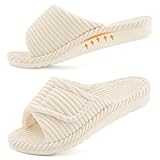
- 【Orthopedic Slippers】 Featured ergonomic footbed and soft memory foam cushioning, these orthotic house slippers deliver superior arch support and evenly distribute pressure to relieve foot pain, specifically designed for people with plantar fasciitis, and swollen feet.
- 【Ultimate Comfort】 These open toe slippers boast a breathable corduroy upper that enhances airflow, while the velvet terry cloth lining wicks away moisture for summer freshness and winter warmth. The adjustable straps ensure a snug and customized fit, offering effortless flexibility with every step.
- 【Timeless Style】 The classic design of these ladies' slippers brings effortless versatility, their ribbed corduroy texture offers a refined appearance while exuding warmth and comfort. Experience the perfect blend of practicality and elegance as you move around in these chic slippers.
- 【Indoor & Outdoor】 The lightweight rubber sole provides excellent traction, ensuring secure and confident steps whether you're taking out the trash, walking the dog, or quickly outdoors. It also helps protect floors from scratches and allows for quiet, noiseless steps.
- 【Easy Care】 Machine wash on a gentle cycle with cold water and air dry flat in shade, These Litfun summer slippers will be as fresh as new. Slight adhesive overflow is normal, if you have any questions, please contact us!
As an Amazon Associate, Balance Foot and Ankle earns from qualifying purchases. Product links are affiliate links and we may earn a commission at no extra cost to you. This does not influence our clinical recommendations. Last update on 2026-08-06 / Images from Amazon Product Advertising API
1. Vionic Gemma Slipper — Best Overall for Plantar Fasciitis
Vionic’s footwear is built around a biomechanical orthotic foundation developed by podiatrists, and the Gemma is our most-recommended slipper for plantar fasciitis patients. The EVA midsole has a built-in deep heel cup and medial arch support that keeps the foot in a neutral position. The microsuede upper is durable and machine-washable. APMA Seal of Acceptance. Around $100. Best for: plantar fasciitis, flat feet, patients who need proven biomechanical support indoors.
2. Oofos OOahh Slide Sandal — Best for Active Recovery
The Oofos OOahh isn’t a traditional slipper, but it’s become one of the most popular at-home recovery options for our patients with plantar fasciitis and post-surgical recovery needs. The patented OOfoam absorbs 37% more impact energy than traditional EVA foam, and the footbed arch contour significantly reduces strain on the plantar fascia with every step. While it’s an open-toe slide, the deep arch contour keeps the foot stable. Around $60. Best for: post-activity recovery, Achilles tendinopathy, post-surgical recovery, patients on hard floors all day.
3. Birkenstock Boston Clog — Best Durable All-Day Indoor Option
Birkenstock’s contoured cork-latex footbed provides genuine anatomical arch support that molds to your foot over time. The Boston’s closed-toe, backless design keeps the foot aligned better than open-toe slippers. The footbed supports the medial arch, the metatarsal arch, and provides a deep heel cup. Extremely durable — a quality pair lasts 3–5 years with regular use. Around $130. Best for: patients who need all-day indoor footwear, home office workers, high-arch patients who prefer custom contouring.
Key takeaway: For plantar fasciitis recovery, wearing supportive slippers indoors is as important as wearing good shoes outdoors. Even 2–3 hours of barefoot time on hard floors each evening can undermine the healing progress from daytime footwear. Don’t skip indoor support.
⚠️ When slippers aren’t enough — see a podiatrist if:
- Heel pain hasn’t improved after 8 weeks of supportive footwear indoors and outdoors plus stretching
- Morning first-step pain is severe enough to affect your gait
- Pain returns immediately when you try to transition to regular shoes
- Numbness or tingling in the heel — may indicate nerve involvement, not typical plantar fasciitis
In-Office Treatment at Balance Foot & Ankle
If home treatment isn’t providing relief for your plantar fasciitis, our podiatry team at Balance Foot & Ankle can help with same-day evaluations and advanced in-office care.
Same-day appointments available. (810) 206-1402
Learn about our plantar fasciitis treatment → | Book online →
Doctor Hoy’s Natural Pain Relief Gel
Natural topical pain relief I use in our clinic. Arnica + camphor formula — apply directly to the area 3–4x daily. ($20–25)
Shop Doctor Hoy’s →Frequently Asked Questions
Can I wear Crocs as arch support slippers? Standard Crocs have very flat footbeds and minimal arch support — they’re not appropriate for plantar fasciitis management. Crocs with a Jibbitz Luxe footbed or the Crocs LiteRide Clog are better options, but still below Vionic or Birkenstock quality for therapeutic use.
How often should I replace supportive slippers? Every 12–18 months for regular use. The midsole foam compresses and loses arch support well before the outer material shows significant wear. If you press your thumb into the heel and the foam bottoms out easily, it’s time to replace them.
The Bottom Line
Arch support slippers are a simple, underused part of plantar fasciitis and flat foot management. Vionic Gemma is our top clinical pick; Oofos OOahh is the best for active recovery use; Birkenstock Boston is the premium all-day option. Don’t underestimate the impact of your indoor footwear — for many patients, switching to supportive slippers at home is the change that breaks a months-long stalemate with heel pain.
Sources
- Irving DB, et al. “Footwear characteristics and foot pain in older people with first-time plantar heel pain.” Rheumatology. 2007;46(12):1842–1847.
- Rome K, et al. “Shoe inserts and orthotics for plantar heel pain.” Cochrane Database Syst Rev. 2010.
- Landorf KB, Menz HB. “Plantar heel pain and fasciitis.” BMJ Clin Evid. 2008.
- American Podiatric Medical Association. “Plantar Fasciitis.” 2023. https://www.apma.org
Ready to Get Relief?
Same-day appointments available in Howell & Bloomfield Township, MI
4.9★ | 1,123 Reviews | 3,000+ Surgeries
Or call: (810) 206-1402
Frequently Asked Questions
When should I see a podiatrist?
If symptoms persist past 2 weeks, affect your normal activity, or are accompanied by red-flag symptoms (warmth, redness, swelling, inability to bear weight).
What does treatment cost?
Most diagnostic visits and conservative treatments are covered by Medicare and major insurers. Out-of-pocket costs vary by your specific plan.
How quickly can I get an appointment?
Most non-urgent cases see us within 5 business days. Urgent cases (sudden pain, possible fracture) typically same or next business day.
What is Plantar fasciitis?
Plantar fasciitis is a common foot/ankle condition that affects mobility and quality of life. Understanding the underlying cause is the first step in successful treatment. Our podiatrists at Balance Foot & Ankle perform a hands-on biomechanical exam, review your activity history, and use diagnostic imaging when appropriate to identify the root cause—not just treat the symptom. Many patients have been told to “rest and ice” without a deeper diagnostic workup; our approach is different.
Symptoms and warning signs
Common signs of plantar fasciitis include pain that worsens with activity, morning stiffness, swelling, tenderness when palpated, and difficulty bearing weight. If you experience sudden severe pain, inability to walk, visible deformity, numbness or color change, contact our office the same day or visit urgent care—these can signal a more serious injury such as a fracture, tendon rupture, or vascular compromise. Diabetics with any foot wound should seek same-day care.
Conservative treatment options
Most cases of plantar fasciitis respond to non-surgical care: structured rest, supportive footwear changes, custom orthotics, targeted stretching and strengthening protocols, anti-inflammatory medications when medically appropriate, and in-office procedures such as ultrasound-guided injections. We also offer advanced therapies including MLS laser therapy, EPAT/shockwave, regenerative injections, and image-guided procedures. Treatment is sequenced from least invasive to most invasive, and we explain the rationale at every step.
When is surgery considered?
Surgery is reserved for cases that fail 3-6 months of well-structured conservative care, when there is structural pathology (severe deformity, complete tear, advanced arthritis), or when imaging shows damage that will not heal without intervention. Our surgeons have performed 3,000+ foot and ankle procedures and prioritize minimally-invasive techniques whenever appropriate. We discuss recovery timelines, return-to-activity milestones, and realistic outcome expectations before any procedure is scheduled.
Recovery timeline and prevention
Recovery from plantar fasciitis varies based on severity and chosen treatment path. Conservative cases often improve within 4-8 weeks with consistent adherence to the protocol. Post-procedural recovery may range from a few days (in-office procedures) to several months (reconstructive surgery). Long-term prevention involves footwear assessment, activity modification, structured strengthening, and regular check-ins with your podiatrist if you have a history of recurrence. We provide written home-exercise plans and digital follow-up support.
Ready to feel better?
Same-week appointments available in Howell and Bloomfield Township, Michigan.
Book Your VisitSame-Week Appointments in Howell & Bloomfield Township
Three board-certified podiatric surgeons. 1,123+ five-star reviews. Most insurance accepted.
Podiatrist guide: Plantar Fasciitis Treatment (podiatrist guide). Book at Balance Foot & Ankle in Howell or Bloomfield Township.

Dr. Tom Biernacki, DPM is a board-certified foot & ankle surgeon (ABFAS & ABPM) at Balance Foot & Ankle Specialists in Southeast Michigan. With over a decade of clinical experience, he specializes in heel pain, bunions, diabetic foot care, sports injuries, and minimally invasive surgery. Dr. Biernacki is a member of the APMA and ACFAS, and his patient education content on MichiganFootDoctors.com and YouTube has made him one of the most-followed foot & ankle educators on YouTube.
More questions patients ask
What causes heel pain?
Heel pain most commonly results from plantar fasciitis (inflammation of the plantar fascia ligament), which accounts for approximately 80% of cases. Other causes include Achilles tendinitis, heel spurs, stress fractures, Baxter's nerve entrapment, and fat pad atrophy. Dr. Biernacki performs a thorough biomechanical evaluation to identify the precise cause. Call 810-206-1402 for a same-day appointment.
How long does plantar fasciitis take to heal?
With proper treatment, most plantar fasciitis cases improve within 6-12 weeks. Conservative treatments include custom orthotics, stretching protocols, physical therapy, and corticosteroid injections. For persistent cases beyond 6 months, Dr. Biernacki offers advanced options including shockwave therapy and minimally invasive procedures with 90%+ success rates.
Should I see a podiatrist for heel pain?
Yes. A board-certified podiatrist like Dr. Biernacki can accurately diagnose the cause of heel pain using X-rays and diagnostic ultrasound, ruling out stress fractures and other serious conditions. Self-treatment with over-the-counter insoles often delays proper treatment and can worsen the condition. Early intervention leads to faster recovery.
Still have a question about coverage or cost? Book online and we will check your benefits before your visit: Book in Howell · Book in Bloomfield Township. Prefer to talk it through first? Call (810) 206-1402.