
Start here: our podiatrist-recommended running shoe guide is our current, fully updated pick list — this page is kept for reference.
Medically Reviewed by Dr. Tom Biernacki, DPM
Board-Certified Podiatric Surgeon | Balance Foot & Ankle
Last reviewed: May 2026
Trail running is one of the fastest-growing endurance sports in North America — and it produces a distinct set of injuries that we see more and more in our Michigan podiatry practice. Ankle inversions (lateral ankle sprains), metatarsal stress fractures from rocky terrain, black toenails from technical downhills, and exertional compartment syndrome from the variable intensity of trail running are all conditions that proper footwear significantly mitigates. This guide gives you the clinical framework for choosing trail running shoes that protect your feet across Michigan’s trail systems — from the flat packed-dirt paths of Pinckney Recreation Area to the technical rocky trails of the Porcupine Mountains.
>Best Trail Running Shoes 2026
Top trail pick — the Salomon Speedcross, the benchmark aggressive-grip trail shoe (4.6 stars). Verified in stock:
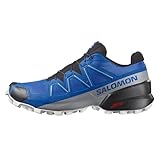
- BEST FOR: For the next-generation Speedcross men’s trail running shoes, we revisited the essence of what made the original Speedcross legendary. By enhancing its grip and introducing a more dynamic upper, we've set a new standard for performance and fit. With improved stability and a sleek, refined design, the Speedcross establishes a new benchmark in trail footwear. Ideal for trail running in mixed and muddy terrain.
- PROTECTIVE UPPER: Completely welded upper with disassociated Sensifit arms to move more naturally with your foot. Anti-debris mesh upper keeps trail debris and mud out. Highly durable ripstop fabric construction won’t tear or rip and is abrasion-resistant, ideal for use through varied and overgrown terrains.
- MUD CONTRAGRIP: Deep, sharp lugs and a high-adhesion compound deliver maximum grip on soft, loose, and rugged terrain for premium adhesion/traction with confidence. Ideal for navigating diverse terrain, including rocky trails, muddy paths, and loose gravel on a wide range of outdoor trail terrain.
- STABILITY: The Speedcross features a specialized heel unit that cradles your heel for optimal support, promoting a clean foot strike and enhancing stability throughout your stride for unmatched stability and reliability on any terrain.
- SECURE FIT: Featuring Sensifit construction and a Quicklace single pull and stowable closure for a precise optimal foothold, and welded, foot-hugging comfort.
As an Amazon Associate, Balance Foot and Ankle earns from qualifying purchases. Product links are affiliate links and we may earn a commission at no extra cost to you. This does not influence our clinical recommendations. Last update on 2026-11-02 / Images from Amazon Product Advertising API
1. HOKA Speedgoat 5 — Best Overall Trail Shoe
The HOKA Speedgoat 5 is our top overall recommendation for Michigan trail runners because it handles the variety of terrain most runners encounter — packed dirt, rooted forest paths, wet leaf cover, and moderate rock — better than any single competitor. The Vibram Megagrip outsole (rated at 72 Durometer hardness, optimal for wet and dry grip) provides confident footing on Michigan’s notoriously slippery wet root and clay surfaces. HOKA’s oversized midsole geometry cushions the variable impact forces of technical trail running while the 4mm heel-to-toe drop promotes a balanced, forward-leaning running posture. Wide toe box accommodates forefoot swelling over long distances. Retail price: $155–165.
2. Salomon Speedcross 6 — Best for Mud and Technical Terrain
The Salomon Speedcross 6 is the gold standard for aggressive, muddy, and highly technical trail running. The deep, widely-spaced chevron lugs (6mm lug depth) eject mud efficiently and bite hard into soft surfaces where other shoes slip. The Sensifit construction wraps the foot precisely, minimizing internal movement that causes blisters on technical descents. The quicklace system deploys in one pull and cinches uniformly across the entire lace zone — no pressure points, no mid-run adjustment needed. If you primarily run Michigan’s more technical trails (North Country Trail, Pictured Rocks), this is the shoe. On packed hardpack and road, the aggressive lugs are uncomfortable — this is a specialized tool. Retail price: $140–150.
3. Brooks Cascadia 17 — Best for Long-Distance Trail Running
The Brooks Cascadia 17 is our recommendation for runners doing half-marathon or marathon trail distances, or anyone doing back-to-back trail days. Its rock plate (TrailTack rubber construction) protects the metatarsals and plantar fascia from sharp rock impact across long distances — one of the most common causes of stress fractures we see in trail runners who underestimate cumulative terrain impact. The wider last compared to the Speedgoat accommodates more forefoot swelling over ultra distances, and the debris guard around the collar prevents trail material from entering the shoe during technical sections. Retail price: $130–140.
4. Altra Lone Peak 8 — Best Zero-Drop Trail Shoe
4. Altra Lone Peak 8 — Best Zero-Drop Trail Shoe
The Altra Lone Peak 8 is the only zero-drop trail shoe on this list — and we include it for a specific patient population: experienced trail runners who have completed a structured transition to zero-drop footwear and have the calf flexibility, Achilles tendon capacity, and intrinsic foot strength to run in it safely. Zero-drop shoes load the calf and Achilles significantly more than standard heel-elevated designs; the transition injury risk is real. For appropriately conditioned runners, the Lone Peak 8’s FootShape toe box allows complete toe splay on technical descents, improving proprioceptive feedback and reducing black toenail incidence. MaxTrac outsole handles varied Michigan trail surfaces well. Retail price: $145–155.
5. New Balance Fresh Foam X Hierro v8 — Best for Road-to-Trail Runners
The New Balance Fresh Foam X Hierro v8 is our recommendation for road runners transitioning to easier trail surfaces — the Pinckney rec trails, Kensington Metropark, or other Michigan trails with moderate technical demand. Its Fresh Foam X midsole feels familiar to road runners (similar to NB’s road models), and the trail outsole provides adequate grip on packed and lightly rooted terrain without the aggressive lug profile that feels intrusive on road segments. It handles mixed-surface running (road and light trail) better than any shoe on this list. Wide widths available. Retail price: $130–145.
Trail Running Shoes vs. Road Running Shoes
The decision to use road shoes on trail — or trail shoes on road — is one we get asked about constantly. Here is the clinical breakdown of when each is appropriate:
| Feature | Trail Shoe | Road Shoe |
|---|---|---|
| Outsole | Lugged rubber for grip on variable terrain | Flat or lightly textured smooth rubber |
| Rock plate | Present in most — protects against sharp rocks | Absent — unnecessary on smooth surfaces |
| Midsole | Firmer for stability on uneven terrain | Softer for energy return on flat surface |
| Upper | Reinforced, debris guard, durable | Breathable mesh, weight-optimized |
| Toe bumper | Reinforced rubber cap — protects from rocks/roots | Minimal or absent |
| Heel-to-toe drop | 0–8mm (lower on average than road) | 4–12mm |
| Weight | Heavier (300–400g) due to protection features | Lighter (230–300g) |
| Durability | 300–500 miles on trail | 300–500 miles on road |
Using a road shoe on technical trail: the primary risks are ankle inversion injuries (no lateral stability), metatarsal bruising from rock impact (no rock plate), and toe injuries from root strikes (no reinforced toe bumper). For easy, well-maintained trails, road shoes are adequate. For anything technical, wet, or rocky — use a trail shoe.
Choosing a Trail Shoe by Terrain Type
| Terrain Type | Recommended Shoe | Key Feature |
|---|---|---|
| Packed dirt, light root | NB Fresh Foam Hierro v8 or HOKA Speedgoat 5 | Moderate lug, cushion |
| Muddy, soft technical | Salomon Speedcross 6 | Deep 6mm lug, mud ejection |
| Rocky, technical | HOKA Speedgoat 5 or Brooks Cascadia 17 | Rock plate, Vibram grip |
| Long distance / ultras | Brooks Cascadia 17 or Altra Lone Peak 8 | Rock plate, wide toe box |
| Mixed road and trail | NB Fresh Foam Hierro v8 | Versatile outsole |
| Flat to rolling Michigan trails | HOKA Speedgoat 5 or NB Hierro v8 | Cushion + versatility |
| North Country Trail / Porcupines | Salomon Speedcross 6 or Brooks Cascadia 17 | Technical protection |
Common Trail Running Injuries and How Shoes Prevent Them
Lateral Ankle Sprain
Ankle sprains are the most common trail running injury — accounting for 15–25% of all trail running injuries in epidemiological studies. The mechanism: foot landing on uneven terrain (root, rock, camber) with the ankle in slight inversion, the peroneal tendons unable to compensate quickly enough, and the lateral ligament complex (ATFL, CFL) overstretched or torn. Prevention: wider midsole geometry (HOKA’s platform, Salomon’s Sensifit) provides better lateral stability than narrow road shoes; trail-specific outsoles prevent the initial slip that precedes many inversion injuries. If you have a history of ankle sprains, consider adding a lace-up ankle brace to your trail running kit for technical terrain.
Metatarsal Stress Fractures
Rocky trail surfaces create repetitive point loading on the metatarsal shafts that flat-surface road running does not. Without a rock plate, each sharp rock contact concentrates force at a small metatarsal area. Metatarsal stress fractures present as progressive forefoot pain that develops during a run and worsens with each subsequent run — they are X-ray negative for 2–3 weeks. Prevention: rock plate shoes (Cascadia 17, Speedgoat 5) distribute point loading across the entire forefoot. If you transition from road to technical rocky trail, allow 4–6 weeks of gradual exposure for bone remodeling before high-volume trail running.
Black Toenail (Subungual Hematoma) on Downhills
Technical trail descents require the foot to decelerate and brake actively, driving the toes forward into the toe box with each stride. Without adequate toe box space and a reinforced toe bumper, the toenail bed takes cumulative impact that produces subungual hematoma (black toenail). Prevention: size up a full size from your everyday shoe for trail shoes (same as road running — the dynamic demands are similar). Choose trail shoes with a reinforced toe bumper (Speedcross 6, Speedgoat 5, Cascadia 17). After a downhill-heavy trail race or training run, inspect nails and apply Nexcare bandaging to any nail that feels sore.
⚠ Trail Running Injuries That Need Prompt Evaluation
- Ankle swelling after a trail run that doesn’t improve with 48 hours of RICE — may be a Grade 2–3 lateral ankle sprain or peroneal tendon tear requiring imaging and structured rehabilitation.
- Forefoot pain that intensifies progressively run-over-run — classic metatarsal stress fracture pattern. Do not continue running; X-ray (and MRI if negative) is needed. Running through a stress fracture risks complete fracture displacement.
- Calf tightness that develops acutely during a run and doesn’t resolve within 24 hours — may be exertional compartment syndrome, a condition that requires pressure measurement testing to diagnose and may require fasciotomy for definitive treatment.
- Plantar heel pain that begins after increasing trail mileage — the variable terrain of trail running changes plantar fascia loading significantly; early treatment prevents progression to chronic PF.
How Trail Running Shoes Should Fit
Trail running shoes should be sized up a full size from your everyday shoe — the same rule as road running shoes. This is non-negotiable for technical trails with significant descents. The toe box should feel genuinely spacious — you need room for toe splay on uneven terrain and forward slide on descents. The midfoot and heel should feel locked in — more secure than a road shoe, with the lacing system pulled firm to prevent internal foot movement that causes blistering on technical terrain.
Width selection for trail shoes: trail running generates higher lateral forces than road running, particularly on cambered terrain and during ankle inversion events. A slightly wider shoe improves lateral stability. If you have been wearing narrow trail shoes and experiencing ankle instability or lateral foot pain, try a wide (2E) option from HOKA or NB before attributing the problem to weak ankles.
Frequently Asked Questions
Can I run trails in road running shoes?
On well-maintained, flat, packed-dirt trails — yes, road shoes are adequate and many runners do this without injury. On anything technical (roots, rocks, significant camber, mud, or steep descents), road shoes increase injury risk meaningfully: no grip on wet surfaces, no rock plate protection, no reinforced toe bumper, no lateral stability. Use trail-specific shoes whenever the terrain has significant technical demands, wet conditions, or rocky surfaces.
How long do trail running shoes last?
Trail running shoes typically last 300–500 miles — similar to road shoes in midsole life, but the lugged outsole may show significant wear sooner on rocky terrain. Aggressive trail conditions (rocky, technical) wear outsoles faster than packed-dirt trails. Replace when lug depth is reduced to less than 50% of original, when the midsole shows visible compression lines, or when ankle stability decreases during technical running — which suggests midsole breakdown even if the upper looks intact.
Do I need a rock plate for Michigan trails?
For most Michigan trail running, a rock plate is beneficial but not essential on the softer, packed-dirt trails of the lower peninsula. For the rocky technical trails of the upper peninsula (Pictured Rocks, Porcupine Mountains, North Country Trail), a rock plate (Cascadia 17, Speedgoat 5) is strongly recommended. If you run technical terrain and experience plantar soreness during or after runs that doesn’t match a plantar fasciitis pattern, insufficient rock plate protection is a likely contributor.
Are minimalist trail shoes good for beginners?
No — not for trail running beginners. Zero-drop and minimalist trail shoes require progressive adaptation of the calf, Achilles, and intrinsic foot musculature. The injury risk during the adaptation period (typically 3–6 months) is high, particularly on technical terrain where the proprioceptive demands are already elevated. Begin trail running in a shoe with 4–8mm drop, adequate cushioning, and a rock plate. Consider a structured transition to lower-drop shoes after 6–12 months of consistent trail running with a healthy injury record.

Dr. Tom Biernacki, DPM is a board-certified foot & ankle surgeon (ABFAS & ABPM) at Balance Foot & Ankle Specialists in Southeast Michigan. With over a decade of clinical experience, he specializes in heel pain, bunions, diabetic foot care, sports injuries, and minimally invasive surgery. Dr. Biernacki is a member of the APMA and ACFAS, and his patient education content on MichiganFootDoctors.com and YouTube has made him one of the most-followed foot & ankle educators on YouTube.