

Quick answer: Foot Arch Pain has multiple potential causes including mechanical, neurological, vascular, and inflammatory. The patterns we see most often are overuse, poorly-fitted shoes, and biomechanical imbalance. Red flags requiring urgent evaluation: warmth/redness (infection), inability to bear weight (fracture), and unilateral swelling without injury (DVT). Call (810) 206-1402.
✅ Medically reviewed by Dr. Tom Biernacki, DPM — Board-Certified Podiatrist · Last updated April 6, 2026
Say Goodbye to Arch Pain.Foot Arch Pain Causes, Symptoms & Best Home Treatment
Foot Arch Pain: Plantar fasciitis & heel pain is experienced by up to 44% of people worldwide. Find the causes, symptoms & best home treatment!- The bottom of the heel pain can be improved with a few simple treatment changes.
- We are foot doctors & we see this problem get better almost every day.
- The goal is to solve this problem without medication or surgery if possible.
Tired of Living with Foot Arch Pain? Get the Relief You Deserve
Foot arch pain can sneak up slowly or strike suddenly, making every step uncomfortable. Whether caused by flat feet, plantar fasciitis, overuse, or injury, foot arch pain shouldn’t be ignored. At Balance Foot & Ankle Specialist in Michigan, we’ve helped thousands of patients find long-term relief with plan tailored to your foot types. Keep reading to discover the top causes, proven remedies, and when to seek professional help for your aching arches.
Understanding Foot Arch Pain: Why It Happens & What You Can Do
Your foot arch plays a critical role in absorbing shock and supporting your body’s weight. When stressed or injured, the arch can become inflamed or misaligned—leading to pain that worsens with activity. Common culprits include flat feet, high arches, plantar fasciitis, posterior tibial tendon dysfunction, and even unsupportive footwear. Early diagnosis and proper treatment are key to preventing long-term issues.
Don’t Let Arch Pain Hold You Back — Get Expert Relief Today
At Balance Foot & Ankle Specialist in Howell and Bloomfield Township, Michigan, our experienced podiatrists specialize in diagnosing and treating foot arch pain with advanced, personalized solutions. Whether you need custom orthotics, laser therapy, or physical rehab, we’re here to help you move pain-free again.
BOOK NOWWhat Is Foot Arch Pain?
There are many theories to the causes of foot arch pain:- But essentially, all are related to inflammation.
- This is just like muscle back pain or a sore pitching arm.
- The pain is most obvious on your foot because it supports your entire body!
- Decreasing inflammation will affect compartment pressure & nerve irritation.
- There are many theories, but research shows treatment is 99% effective!
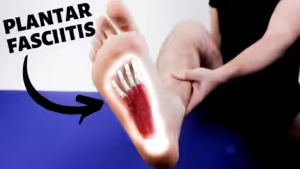
Inflammation Of The Foot Arch Or Heel:
Inflammation of the arch, heel, and bottom of the foot is plantar fasciitis.- The ligament across the bottom of your foot is the plantar fascia.
- If this ligament becomes irritated, it will swell and become sore.
- Think of it like an old elastic that cracks as it stretches.
- This stretching causes pain but can not heal in time for you to start walking again.
- This happens for years, and eventually, your plantar fascia is stiff, scarred, and stiff.

Causes Of Severe Foot Arch Pain:
These are all inter-related to inflammation: 1. Sore Foot Arch In The Morning- If you have a sore foot arch in the morning, it is inflammation.
- It is also after sitting, resting, or sleeping.
- Your body is attempting to heal the arch at night but can’t do it in time.
- This is one of the hallmark features of plantar fasciitis.
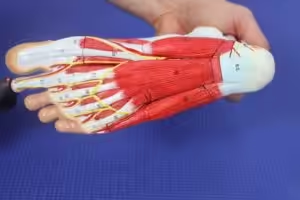
- Inner arch foot pain is the most common attack site of inflammation.
- This is still essentially guaranteed to be plantar fasciitis.
- This is a site of high tension on foot.
- This is the 2nd most common site of pain.
- This is the site of the famous bone spur.
- The bone spur is just proof of years of arch pain!
- A bone spur on the bottom of the foot is proof of chronic stretching
- The fascia, not the spur has been proven to cause the pain.
- If you treat the inflammation, the heel spur should not cause pain.
- High arches will lead to altered foot mechanics.
- This will present a different strain across the bottom of your foot.
- This might not always be inflammation pain.
- This is one of the biggest causes of foot arch pain.
- This leads to chronic stretching of the plantar fascia.
- The plantar fascia will become highly inflamed.
- Sharp pain in the foot arch usually means nerve irritation.
- This can also cause numbness, burning, tingling, and inflammation.
- Running increases your body weight 2-3x with each step.
- This is exactly like standing or walking but puts more strain across the bottom of your foot.
- The arch will be hurting running and walking before just during rest.
Foot Arch Pain Treatment:
This is a 4 stage guide:- Stage 1 decreases pain and achieves 50-60% success.
- Stage 2 focuses on exercises and achieves 70-80% success.
- Stage 3 focuses on support & shoes and achieves 80-85% success.
- Stage 4 focuses on invasive treatment and achieves 99% success.
1. Foot Arch Pain Relief:
- This stage alone gives 50-60% relief!
- This is the stage that focuses on decreasing the pain!
- It will take a couple of days or weeks to decrease the pain.
- This is when the plantar fasciitis is most painful.
- It hurts for 15-20 minutes until your blood starts flowing.
- Massage, icing & stretching all work great!
- Bend the big toe up to stretch out the fascia.
- Any massage will work! Repeat. All of these methods will be effective!
- Use your hands.
- Use a tennis ball.
- Use a rolling pin.
- Use a frozen water bottle.
- After 5-10 minutes, it will start feeling better.
- Do this 2-3x a day for 1-2 weeks.
- It takes this long for the inflammation to die down.
- Icing 2-3x per day for about 15-20 minutes will decrease the flow of inflammatory cells into the muscle.
- Afterward, the arteries will vasodilate, further flushing out inflammatory cells from the region.
- Ice has deeper penetrating power than heat.
- These can be over the counter or podiatrist prescribed.
- These are the equivalent of Aspirin or Ibuprofen but in topical form.
- Apply them to the arch to decrease inflammation in the area.
- These include Ibuprofen & Aspirin.
- This can be over the counter or prescription.
- Do not take these unless instructed to do so by your physician or podiatrist.
- Take a 1-2 week course to attempt to decrease the inflammation and speed up
- Just be careful with any medication. They will not truly cure your condition.
- If it is still too painful for stretching.
- See a podiatrist.
- Stronger medication or further diagnosis is necessary.
- If this did work, move onto step 2!
2. Foot Arch Pain Exercises & Stretches:
- This stage gives 70-80% relief!
- Once the pain is gone, you can start performing stretching and exercising!
- This is the most important part of keeping the pain away.
- The foot is like a piece of wood that bears weight.
- With central force, the bottom elongates, and the top compresses.
- This happens in the foot with push-off.
- The Achilles tendon and the foot are pushing up on the edges.
- And your body weight is pushing down in the middle.
- Tension can be decrease through decreasing force on the Achilles and the ball of the foot.
- Hamstring, calf & plantar fascia stretching takes stress off your plantar fascia.
- This is the main principle behind barefoot running.
- Studies show that with bare feet, we push off less.
- This means less plantar fascia pain.
- But we will stick to just the stretching!
- Any stretches to the hamstring, calf, and plantar fascia will decrease toe-off.
- Less plantar fascia tension.
- Less toe-off.
- All stretches should be for 15-30 seconds until tightness, 2-3x for the plantar fascia.
- Pick either the stair stretch or the towel stretch.
- There is no secret to stretching.
- All stretching is good.
- Just don’t bounce, and if there is pain, don’t push it!
- Stretching will take a long time, weeks and months!
- This will keep your pain away and make you feel more athletic than ever!
- Studies show stretching is the single most important thing to keeping the pain away.
- Stretch your calf muscle as well as the plantar fascia.
- Most stretches work both the plantar fascia and the Achilles tendon.
- All stretches should be for 15-30 seconds until tightness, 2-3x for the calf.
- Stretching will take a long time, weeks and months!
- This will keep your pain away and make you feel more athletic than ever!
- Studies show stretching is the single most important thing to keeping the pain away.
- It is also imperative to stretch out your hamstring.
- All stretches should be for 15-30 seconds until tightness, 2-3x for the plantar fascia.
- You can also do the hamstring stretch without a towel:
- My personal favorite hamstring stretch.
- Pick one plantar fascia, one calf, and one hamstring stretch.
- Stretch each muscle for about 1 minute per day (2-3x 15-30 seconds)
- In a couple of weeks, you will feel extremely flexible.
- This will take pressure off your plantar fascia and joints.
- This will help you walk much easier.
- Stretching is the secret to great walking biomechanics and foot or leg pain!
- A night splint is something you wear at night.
- This will keep your calf, and plantar fascia gently stretched while you sleep.
- If you prefer to spend money rather than stretching 3 minutes per day, it works very well!
3. Foot Arch Pain Support & Shoes:
- This stage gives 80-95% treatment!
- Once you regain some flexibility, support is needed!
- This means good over-the-counter arch supports.
- It also means a proper pair of shoes to keep the pain away.
- Get a good running shoe.
- Make sure it has a stiff base.
- Make sure it is not too flexible.
- Make sure there is enough room for your big toe and pinky toes.
- The heel counter should be rigid.
- Fit your shoes in the evening.
- Your feet are the most swollen at night.
- Use a Brannock device to measure your size properly.
- Measure your foot length.
- Measure your arch length.
- Measure your foot width length.
- Get A good rigid over-the-counter foot orthotic.
- There are many crummy brands out there.
- Get a rigid pair that supports the arch.
- This is extremely important.
4. Foot Arch Surgery:
- The remaining 5-10% or so of people may need invasive workup.
- At this point, it may be more than plantar fasciitis.
- There might be plantar fascia degeneration or nerve damage.
Book Your Appointment Today—Relief Starts with One Call
Fast, Friendly, and Professional Treatment You Can Trust
(810) 206-1402 BOOK A SCHEDULEFrequently Asked Questions About Foot Arch Pain
What causes foot arch pain?Common causes include flat feet, plantar fasciitis, tendon strain, overuse, or improper footwear.
When should I see a doctor for arch pain?If the pain lasts more than a week or interferes with walking, seek evaluation by a podiatrist.
Can foot arch pain go away on its own?Mild cases may improve with rest, ice, and stretching—but recurring pain should be examined.
What type of shoes help with arch pain?Supportive shoes with arch support and cushioning are best. Avoid flip-flops or worn-out shoes.
Are orthotics useful for arch pain?Yes, custom or over-the-counter orthotics can correct alignment and relieve pressure on the arch.
Is arch pain related to flat feet?Often, yes. Flat feet can lead to excess stress on tendons and ligaments in the arch.
How is foot arch pain diagnosed?Through physical exam, gait analysis, and sometimes imaging like X-rays or ultrasound.
Can physical therapy help foot arch pain?Absolutely. Stretching, strengthening, and balance exercises can ease symptoms and prevent recurrence.
Should I stop exercising if I have arch pain?Pause high-impact activities and consult a podiatrist before resuming or modifying your workout.
Is surgery ever needed for foot arch pain?Surgery is rare and usually only recommended for chronic, severe conditions unresponsive to conservative care.
Podiatrist-Recommended Products for Foot Arch Pain
These products can help manage plantar fasciitis and arch pain between appointments. They work best alongside professional treatment — custom orthotics, physical therapy, and proper diagnosis remain the gold standard for lasting relief.
Heated Foot Spa Massager — Heat & Massage for Arch Pain
Soaking in warm water with massage jets before stretching helps loosen a tight plantar fascia and reduces morning pain. Most effective when combined with calf stretches immediately after the soak.
Plantar Fasciitis Compression Support — All-Day Arch Relief
Compression sleeves that target the arch and heel provide constant fascia support during activity. Ideal for those who spend long hours on their feet or are managing arch pain during recovery.


👉 Browse our full list of podiatrist-recommended orthotics and plantar fasciitis socks.
Related Treatment Guides
- Plantar Fasciitis & Heel Pain Treatment
- Custom Orthotics for Flat Feet
- Sports Foot & Ankle Injury Treatment
- Bunion Treatment
In-Office Treatment at Balance Foot & Ankle
If home treatment isn’t providing relief for your foot and ankle conditions, our podiatry team at Balance Foot & Ankle can help with same-week evaluations and advanced in-office care.
Medical References & Sources
- American Podiatric Medical Association — Patient Education
- American Orthopaedic Foot & Ankle Society — Foot Conditions
👟 Dr. Tom Also Recommends
Podiatrist Recommended Shoes 2026: Dr. Tom’s Top Picks for Every Condition
The right footwear can make or break your recovery. Dr. Tom’s complete guide to the best shoes for plantar fasciitis, flat feet, neuropathy, bunions & more — with clinical picks for every foot type.
See Dr. Tom’s Top Shoe Picks →📍 Located in Michigan?
Our board-certified podiatrists treat this condition at two convenient locations. Most new patients are seen the same week.
Struggling With Arch Pain?
Our board-certified podiatrists treat all causes of arch pain — from plantar fasciitis to posterior tibial tendon dysfunction. Custom orthotics and targeted treatment get you walking comfortably again.
📞 Or call us directly: (810) 206-1402
Clinical References
- Riddle DL, et al. Risk factors for plantar fasciitis. J Bone Joint Surg Am. 2003;85(5):872-877.
- Lee SY, et al. Posterior tibial tendon dysfunction: diagnosis and treatment. J Am Acad Orthop Surg. 2019;27(7):e321-e330.
- Cornwall MW, McPoil TG. Relationship between static foot posture and foot mobility. J Foot Ankle Res. 2011;4:4.
Insurance Accepted
BCBS · Medicare · Aetna · Cigna · United Healthcare · HAP · Priority Health · Humana · View All →
Howell Office
4330 E Grand River Ave
Howell, MI 48843
Get Directions →
Bloomfield Township Office
43494 Woodward Ave, #208
Bloomfield Township, MI 48302
Get Directions →
Your Board-Certified Podiatrists



Ready to Get Back on Your Feet?
Same-week appointments available at both locations.
Book Your AppointmentMore Podiatrist-Recommended Plantar Fasciitis Essentials
Best Night Splint

Keeps fascia stretched overnight — the #1 intervention for morning heel pain.
Top Podiatrist-Recommended Insole
Deep heel cup + arch support unloads the plantar fascia all day.
Plantar Fasciitis Compression Sock

Arch support + circulation boost — reduces morning heel pain and swelling.
As an Amazon Associate, Balance Foot & Ankle earns from qualifying purchases. Product recommendations are based on clinical experience; prices and availability shown above update live from Amazon.

When to See a Podiatrist
If morning heel pain has persisted more than 6 weeks, home care alone rarely fixes it. At Balance Foot & Ankle, we combine in-office ultrasound diagnostics, custom orthotics, and — when needed — shockwave or PRP to resolve plantar fasciitis that hasn’t responded to stretching and inserts. Most patients are walking pain-free within 4-8 weeks of starting a structured plan.
Call Balance Foot & Ankle: (810) 206-1402 · Book online · Offices in Howell & Bloomfield Township
⚕ Doctor Recommended
Doctor Hoy’s Natural Pain ReliefTopical relief for foot & ankle pain
View Product →
Dr. Tom Biernacki, DPM is a board-certified foot & ankle surgeon (ABFAS & ABPM) at Balance Foot & Ankle Specialists in Southeast Michigan. With over a decade of clinical experience, he specializes in heel pain, bunions, diabetic foot care, sports injuries, and minimally invasive surgery. Dr. Biernacki is a member of the APMA and ACFAS, and his patient education content on MichiganFootDoctors.com and YouTube has made him one of the most-followed foot & ankle educators on YouTube.