
Medically reviewed by Dr. Tom Biernacki, DPM
Board-certified podiatric surgeon | Balance Foot & Ankle
Last reviewed: May 2026

You are in the right place. Dr. Tom Biernacki, DPM, FACFAS — board-certified foot & ankle surgeon with 3,000+ surgeries — explains exactly what foot corn removal surgery means and what works. Call (810) 206-1402 for same-day appointment at Howell or Bloomfield Hills.
Quick answer: Foot Corn Removal Surgery affects roughly 1 in 4 adults in our practice. Effective treatment starts with a targeted diagnosis, conservative-first treatment, and escalation only when needed. We treat this regularly at our Howell and Bloomfield Hills practices. Call (810) 206-1402.
✅ Medically reviewed by Dr. Tom Biernacki, DPM — Board-Certified Podiatrist · Last updated April 7, 2026
What Is a Foot Corn?
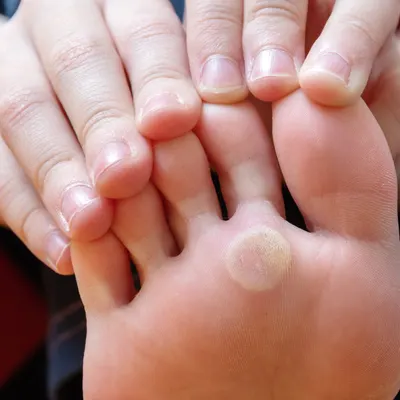
A foot corn (heloma) is a localized area of thickened, hardened skin that develops in response to repeated friction or pressure. Unlike calluses (which are broader and more diffuse), corns are small, well-defined, and have a central core or nucleus that extends into the deeper skin layers. This cone-shaped core is what makes corns painful — it acts like a small pebble pressing into the underlying tissue with every step or shoe contact.
Corns are your skin’s protective response to chronic pressure. The body builds up layers of keratin to shield the underlying tissue from damage — essentially creating armor over a vulnerable spot. The problem is that this armor becomes a source of pain itself when the central core compresses nerve endings and soft tissue.
Types of Corns
- Hard corn (heloma durum): The most common type. Found on the tops of toes (usually over the proximal interphalangeal joint of a hammertoe) or on the outer edge of the small toe. Hard, dry, well-defined with a visible central core.
- Soft corn (heloma molle): Found between toes, most commonly between the fourth and fifth toes. The moisture between toes keeps the corn soft and white/macerated. Often more painful than hard corns because of the constant moisture and friction between adjacent toe bones.
- Seed corn (heloma millare): Tiny, discrete corns that appear on the sole of the foot, often in clusters. They’re caused by plugged sweat glands or minimal pressure points. Usually less painful than hard or soft corns.
Why Corns Form: The Root Cause
Understanding why corns form is the key to effective treatment. A corn is always a symptom — not the disease itself. There is always an underlying source of pressure creating the corn, and until that pressure is addressed, the corn will keep returning no matter how many times it’s trimmed, filed, or medicated.
- Hammertoe deformity: The most common structural cause. When a toe bends at the PIP joint, the prominent dorsal knuckle rubs against the shoe’s upper, creating a hard corn on top of the toe.
- Bone spur or exostosis: An abnormal bony prominence on a toe bone or metatarsal head creates a focal pressure point that the skin responds to by forming a corn.
- Tight or narrow shoes: Shoes that compress the toes together or against the shoe upper create friction points that drive corn formation.
- Toe alignment issues: Rotated toes, overlapping toes, or malaligned phalanges create bony prominences that rub against shoes or adjacent toes.
- Prominent condyle: The knobby ends of the phalangeal bones can be naturally prominent, creating a pressure point without any deformity present.
Conservative Treatment: Managing Corns Without Surgery
For many patients, conservative measures provide adequate pain relief and reduce corn recurrence — especially when combined with proper footwear.
- Professional debridement: A podiatrist can painlessly trim the corn and its central core using a scalpel. This provides immediate relief that lasts 4–8 weeks before the corn rebuilds. Regular debridement every 6–8 weeks is a reasonable long-term management strategy for patients who prefer to avoid surgery.
- Protective padding: Gel toe caps, silicone sleeves, or donut-shaped pads placed over the corn protect it from shoe friction. Lamb’s wool between toes cushions soft corns. Moleskin applied to the shoe where it contacts the corn reduces friction.
- Wider shoes with a deeper toe box: Eliminating the shoe-on-corn friction often eliminates the pain and can slow or stop corn formation.
- Toe spacers and separators: For soft corns between toes, silicone spacers keep the toe bones from pressing against each other.
- Salicylic acid pads: OTC corn pads containing salicylic acid dissolve the thickened skin. Use with caution — they can damage surrounding healthy skin. Never use on diabetic feet or if you have poor circulation.
⚠️ Never Do These Things
- Cut corns with a razor blade, knife, or scissors at home — risk of infection, especially with diabetes
- Use medicated corn pads if you have diabetes, neuropathy, or poor circulation
- Ignore a corn that’s draining, red, or warm — signs of infection
- Use “bathroom surgery” to dig out a corn’s root — this can cause deep wounds
When Corn Removal Surgery Is Needed
Surgery is recommended when the corn is painful enough to limit your daily activities, returns repeatedly despite conservative treatment (recurring within 4–6 weeks of debridement), is caused by a structural deformity like a hammertoe or bone spur that won’t resolve on its own, or when conservative measures can’t be maintained (for example, patients who must wear specific footwear for work).
The decision for surgery is based on your symptoms — not just the presence of a corn. Some patients manage well with periodic debridement and padding; others find the corn significantly impacts their quality of life and prefer a permanent solution.
The Surgical Procedure
Corn removal surgery addresses the root cause — the bony prominence — not just the skin. The specific procedure depends on what’s causing the corn.
Condylectomy (Bone Shaving)
For corns caused by a prominent condyle or small bone spur without significant toe deformity, a condylectomy shaves down the bony prominence through a small incision. This eliminates the pressure point that caused the corn. The procedure is done under local anesthesia in our office, takes about 15–20 minutes, and allows immediate weight-bearing in a surgical shoe.
Hammertoe Correction (Arthroplasty)
When a hammertoe deformity is causing the corn, the surgical correction involves straightening the toe. A PIP joint arthroplasty removes a small section of bone from the proximal phalanx, allowing the toe to straighten. A temporary pin or internal fixation holds the toe in position during healing. Once the toe is straight, the dorsal prominence is eliminated and the corn has no reason to recur.
Soft Corn Surgery
Soft corns between toes are caused by the condyles (bony projections) of adjacent toe bones pressing against each other. The surgical correction involves shaving the prominent condyle from one or both adjacent phalanges through a small incision. This creates enough space between the toes that the friction-driven corn no longer forms.
Recovery Timeline After Corn Surgery
- Day 1–3: Mild swelling and discomfort controlled with OTC pain medication. Weight-bearing in a surgical shoe or postoperative boot.
- Week 1–2: First follow-up visit. Dressings changed, sutures checked. Continue surgical shoe.
- Week 2–4: Sutures removed (if non-dissolvable). Transition to a wide, supportive shoe. If a pin was placed for hammertoe correction, it’s removed at 3–4 weeks.
- Week 4–6: Most patients are in regular shoes and returning to normal activities. Mild swelling may persist but shouldn’t limit function.
- Month 2–3: Full healing complete. The corn site has remodeled with normal, non-thickened skin. If the bony cause was adequately addressed, the corn does not recur.
Podiatrist-Recommended Products
These products are recommended by our podiatrists at Balance Foot & Ankle for corn management.
- Gel Toe Caps — Silicone caps that protect corn-prone toes from shoe friction. Washable and reusable. The most effective OTC corn prevention product.
- Correct Toes Toe Spacers — Medical-grade silicone spacers that separate toes, ideal for soft corn prevention between the fourth and fifth toes.
- 40% Urea Cream — Softens thick corn tissue for easier professional debridement. Also helps with calluses and dry, cracked heels.
- Altra Paradigm — Foot-shaped toe box eliminates the lateral compression that drives fifth-toe corns and bunionette corns.
- New Balance 990v6 — Available in extra-wide (4E) width for maximum toe room. Deep toe box accommodates hammertoe deformities.
Affiliate disclosure: We may earn a commission at no extra cost to you. Every product listed is tested or recommended in our clinic.
More Podiatrist-Recommended Surgery Essentials
OOFOS Recovery Slide

- The Original Recovery Footwear.
- Finding Your Size – For your perfect fit, consult the “size chart” link above. Wear a half size? In general, we recommend that women who wear a ½ size size UP, and men who wear a ½ size size DOWN
- OOahh – An evolution of the OOriginal, the OOahh slide features our proven foundation of OOfoam technology + patented footbed design with a slide-style strap that has become a best-seller in the OOFOS line
- OOfoam Technology – Our revolutionary OOfoam technology absorbs 37% more impact than traditional footwear foams to reduce the stress on your feet, joints & back. Plus, the closed-cell foam is machine washable and designed to minimize odor
- Patented Footbed – Our patented footbed cradles and supports arches to reduce energy exertion in the ankles by up to 47% compared to competitors’ footwear. So walking is easier. Recovery is faster. And yOO feel better
Post-op approved — impact-absorbing slide for early recovery.
HOKA Ora 3 Recovery Slide

- Model ID: 1135061-BTRT
Max-cushion recovery sandal — comfort for post-surgical swelling.
Hoka Bondi 9

Max-cushion walking shoe — ease into return-to-walking post-surgery.
As an Amazon Associate, Balance Foot & Ankle earns from qualifying purchases. Product recommendations are based on clinical experience; prices and availability shown above update live from Amazon.
When to See a Podiatrist
Foot and ankle surgery in 2026 is dramatically different than a decade ago — most procedures are now minimally-invasive, outpatient, and allow weight-bearing within days. Balance Foot & Ankle surgeons have performed 3,000+ foot/ankle surgeries with modern techniques. If another surgeon has recommended a traditional open procedure, a second opinion may reveal a faster, less-invasive option.
Call Balance Foot & Ankle: (810) 206-1402 · Book online · Offices in Howell & Bloomfield Hills
Frequently Asked Questions
Will a corn come back after surgery?
If the surgery adequately addresses the bony cause, the corn should not recur. Recurrence rates for properly performed corn surgery are low — under 10%. Recurrence can happen if the bone wasn’t shaved enough, if the hammertoe correction shifts over time, or if a new pressure point develops from altered mechanics. Wearing proper shoes after surgery helps maintain the surgical result long-term.
Is corn removal surgery painful?
The surgery itself is painless because it’s performed under local anesthesia. Post-surgical discomfort is typically mild — most patients describe it as less painful than the corn itself was. Over-the-counter pain medication (acetaminophen or ibuprofen) usually provides adequate relief. The worst discomfort is in the first 24–48 hours and improves rapidly after that.
Can I walk after corn surgery?
Yes. Most corn surgeries allow immediate weight-bearing in a surgical shoe or postoperative boot. You’ll walk with a modified gait for the first 1–2 weeks due to the dressing and surgical shoe, but crutches are rarely needed. Most patients drive and perform desk work within a few days. Return to regular shoes typically happens at 2–4 weeks.
What’s the difference between a corn and a callus?
Corns are small, well-defined areas of thickened skin with a central core (nucleus), typically found on the tops or sides of toes or between toes. They’re caused by focal, concentrated pressure. Calluses are broader, diffuse areas of thickened skin without a central core, typically found on the ball of the foot or heel. They’re caused by distributed pressure over a larger area. Corns are more painful because of the cone-shaped core pressing into deeper tissue.
The Bottom Line
Corns are a symptom of underlying pressure — usually from a bony prominence, hammertoe, or tight shoes. Conservative management with padding, wider shoes, and periodic debridement works well for many patients. When corns are recurrent and painful, surgery that addresses the bony cause provides a permanent solution with straightforward recovery. If you’re tired of dealing with a corn that keeps coming back, a podiatric evaluation can determine the root cause and whether a simple procedure can eliminate it for good.
Considering Foot Corn Removal Surgery?
When painful corns do not respond to conservative care, surgical correction addresses the underlying bone problem causing the corn. Our podiatrists offer minimally invasive corn removal procedures.
📞 Or call us directly: (810) 206-1402
Clinical References
- Grady JF, et al. Surgical management of heloma durum. Clinics in Podiatric Medicine and Surgery. 2012;29(4):561-571.
- Singh D, et al. Fortnightly review: plantar fasciitis and other causes of heel pain. BMJ. 1997;315(7099):172-175.
- Freeman DB. Corns and calluses resulting from mechanical hyperkeratosis. American Family Physician. 2002;65(11):2277-2280.
In-Office Treatment at Balance Foot & Ankle
When conservative care isn’t enough, Dr. Tom Biernacki and the team at Balance Foot & Ankle offer advanced, same-day options — including Corn & Callus Treatment Michigan at our Howell and Bloomfield Hills clinics.
Same-day appointments available. Call (810) 206-1402 or book online.
In-Office Treatment at Balance Foot & Ankle
If home treatment isn’t providing relief for your foot and ankle conditions, our podiatry team at Balance Foot & Ankle can help with same-day evaluations and advanced in-office care.
When should I see a podiatrist?
If symptoms persist past 2 weeks, affect your normal activity, or are accompanied by red-flag symptoms (warmth, redness, swelling, inability to bear weight).
What does treatment cost?
Most diagnostic visits and conservative treatments are covered by Medicare and major insurers. Out-of-pocket costs vary by your specific plan.
How quickly can I get an appointment?
Most non-urgent cases see us within 5 business days. Urgent cases (sudden pain, possible fracture) typically same or next business day.
What is Corns and calluses?
Corns and calluses is a common foot/ankle condition that affects mobility and quality of life. Understanding the underlying cause is the first step in successful treatment. Our podiatrists at Balance Foot & Ankle perform a hands-on biomechanical exam, review your activity history, and use diagnostic imaging when appropriate to identify the root cause—not just treat the symptom. Many patients have been told to “rest and ice” without a deeper diagnostic workup; our approach is different.
Symptoms and warning signs
Common signs of corns and calluses include pain that worsens with activity, morning stiffness, swelling, tenderness when palpated, and difficulty bearing weight. If you experience sudden severe pain, inability to walk, visible deformity, numbness or color change, contact our office the same day or visit urgent care—these can signal a more serious injury such as a fracture, tendon rupture, or vascular compromise. Diabetics with any foot wound should seek same-day care.
Conservative treatment options
Most cases of corns and calluses respond to non-surgical care: structured rest, supportive footwear changes, custom orthotics, targeted stretching and strengthening protocols, anti-inflammatory medications when medically appropriate, and in-office procedures such as ultrasound-guided injections. We also offer advanced therapies including MLS laser therapy, EPAT/shockwave, regenerative injections, and image-guided procedures. Treatment is sequenced from least invasive to most invasive, and we explain the rationale at every step.
When is surgery considered?
Surgery is reserved for cases that fail 3-6 months of well-structured conservative care, when there is structural pathology (severe deformity, complete tear, advanced arthritis), or when imaging shows damage that will not heal without intervention. Our surgeons have performed 3,000+ foot and ankle procedures and prioritize minimally-invasive techniques whenever appropriate. We discuss recovery timelines, return-to-activity milestones, and realistic outcome expectations before any procedure is scheduled.
Recovery timeline and prevention
Recovery from corns and calluses varies based on severity and chosen treatment path. Conservative cases often improve within 4-8 weeks with consistent adherence to the protocol. Post-procedural recovery may range from a few days (in-office procedures) to several months (reconstructive surgery). Long-term prevention involves footwear assessment, activity modification, structured strengthening, and regular check-ins with your podiatrist if you have a history of recurrence. We provide written home-exercise plans and digital follow-up support.
Ready to fix this for good?
Reading goes so far. The fastest path is a 30-minute office visit. Same-day Howell or Bloomfield Hills. Call (810) 206-1402.
Ready to Get Relief?
Same-day appointments available in Howell & Bloomfield Hills, MI
4.9★ | 1,123 Reviews | 3,000+ Surgeries
Or call: (810) 206-1402

Dr. Tom Biernacki, DPM is a board-certified foot & ankle surgeon (ABFAS & ABPM) at Balance Foot & Ankle Specialists in Southeast Michigan. With over a decade of clinical experience, he specializes in heel pain, bunions, diabetic foot care, sports injuries, and minimally invasive surgery. Dr. Biernacki is a member of the APMA and ACFAS, and his patient education content on MichiganFootDoctors.com and YouTube has made him one of the most-followed foot & ankle educators on YouTube.