
You are in the right place. Dr. Tom Biernacki, DPM, FACFAS — board-certified foot & ankle surgeon with 3,000+ surgeries — explains exactly what tarsal tunnel ankle nerve compression means and what actually works. Call (810) 206-1402 for a same-day appointment at our Howell or Bloomfield Hills office.
Quick answer: Tarsal Tunnel Syndrome Ankle Nerve Compression Michigan is a clinical condition that responds to evidence-based treatment when caught early. Symptoms include pain, swelling, and altered function. Diagnosis requires clinical exam, often imaging. Treatment ladder: conservative care first (4-6 weeks), then targeted interventions if needed. Call (810) 206-1402.
Medically reviewed by Dr. Tom Biernacki, DPM · Board-Certified Podiatric Surgeon · Last reviewed: April 2026 · Editorial Policy
The most important clinical decision with Tarsal Tunnel Syndrome Ankle Nerve Compression Michigan isn’t which treatment to start with — it’s identifying the correct subtype. That changes everything. Call (810) 206-1402.
Quick Answer
Tarsal Tunnel Syndrome — Ankle Nerve Compression Michi relates to foot pain — typically caused by overuse, footwear, or biomechanics. Most patients improve in 6-12 weeks with conservative care. Same-week appointments in Howell + Bloomfield Hills: (810) 206-1402.
Medically reviewed by Dr. Tom Biernacki, DPM — Board-Certified Podiatric Surgeon — Balance Foot & Ankle, Howell & Bloomfield Hills, MI. Last updated April 2026.
▶ Watch
Medically Reviewed by Dr. Tom Biernacki, DPM — Board-Certified Podiatrist, Balance Foot & Ankle Specialists, Michigan. Last updated April 2026.
What Is Tarsal Tunnel Syndrome?
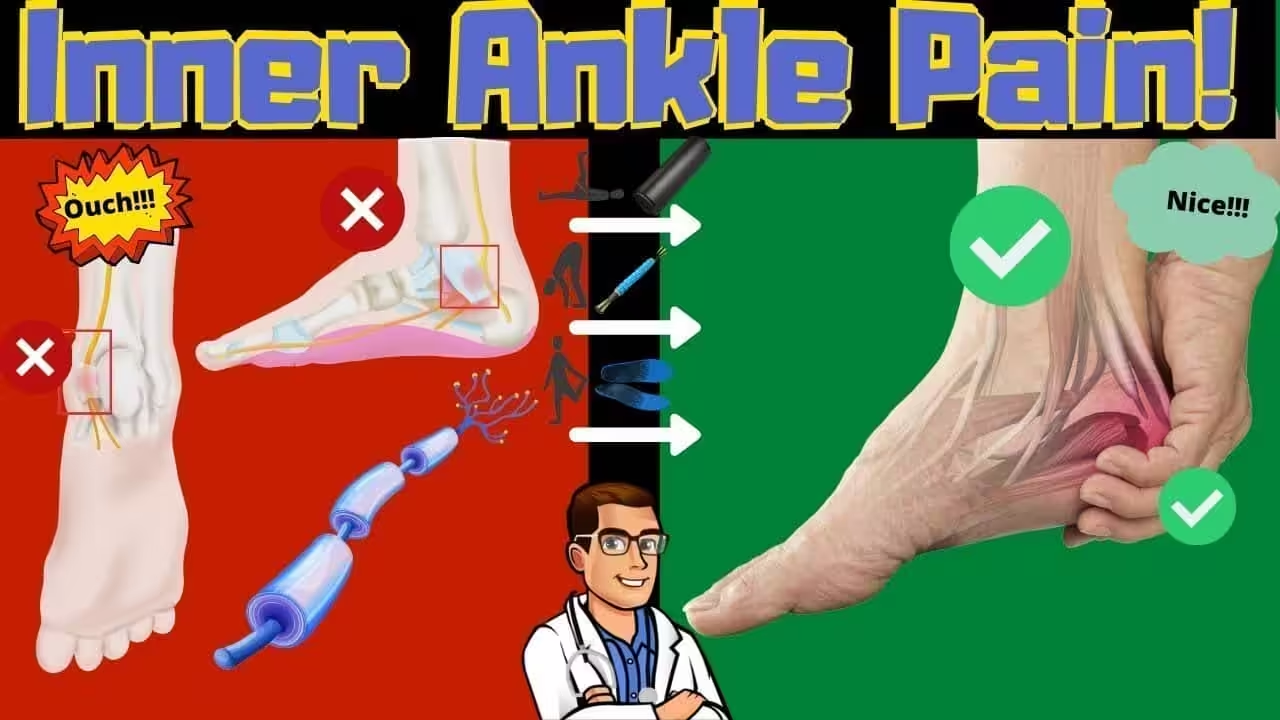
Tarsal tunnel syndrome (TTS) is compression of the posterior tibial nerve as it passes through the tarsal tunnel — a fibro-osseous canal located behind and below the medial malleolus (inner ankle bone). The tarsal tunnel contains the tibial nerve, posterior tibial artery and vein, and three tendons (tibialis posterior, flexor digitorum longus, and flexor hallucis longus). When the tibial nerve is compressed within this confined space, it produces burning, tingling, numbness, and shooting pain in the heel and sole of the foot — often described as “electricity” or “pins and needles.” At Balance Foot & Ankle in Howell and Bloomfield Hills, Michigan, Dr. Tom Biernacki, DPM diagnoses and manages tarsal tunnel syndrome. Call (810) 206-1402.
Causes and Contributing Factors
TTS can result from any condition that reduces space within the tarsal tunnel or directly compresses the nerve: space-occupying lesions (ganglion cyst, lipoma, varicose veins — present in approximately 60% of surgical TTS cases); overpronation (the medial ankle structures buckle inward, compressing the tarsal tunnel contents); ankle trauma and scar tissue formation post-sprain or fracture; systemic conditions including hypothyroidism, rheumatoid arthritis, and diabetes (which also cause peripheral neuropathy, complicating diagnosis); inflammatory tenosynovitis of the flexor tendons within the tunnel; and talocalcaneal coalition causing rigid flatfoot with secondary nerve compression. Idiopathic TTS (no identifiable cause) occurs but is less common than structural causes.
Symptoms — How TTS Differs from Plantar Fasciitis and Peripheral Neuropathy
TTS produces: burning, electric, or tingling pain along the medial ankle, heel, and sole; symptoms that worsen with prolonged standing/walking and improve with rest; positive Tinel’s sign (tapping over the tarsal tunnel reproduces the tingling in the foot); positive compression test (sustained manual compression of the tunnel reproduces symptoms); pain that may radiate proximally up the medial leg (retrograde radiation). Key distinctions: plantar fasciitis causes sharp, stabbing heel pain that’s worst at first steps and improves with walking — TTS causes burning that worsens with continued activity; peripheral neuropathy causes symmetric bilateral symptoms from distal to proximal — TTS is typically unilateral (or asymmetric) and located specifically at the tarsal tunnel distribution.
Diagnosis — Clinical Exam Plus Nerve Conduction Studies
Clinical diagnosis: Tinel’s sign and compression test are the primary clinical tools. Electromyography/nerve conduction velocity (EMG/NCV) studies confirm the diagnosis and quantify severity — slowing of tibial nerve conduction across the tarsal tunnel is diagnostic. However, EMG/NCV is negative in up to 30% of confirmed TTS cases (false negative rate), so clinical suspicion and response to treatment should guide management. MRI is essential to identify space-occupying lesions — a ganglion cyst compressing the tibial nerve changes the treatment plan entirely (surgical excision is curative). Ultrasound is increasingly used for dynamic assessment of the nerve during ankle motion.
Conservative Treatment Protocol
Conservative management for TTS: custom orthotics to correct overpronation (the most important biomechanical intervention — reduces dynamic tarsal tunnel pressure during gait); activity modification; NSAIDs for acute flares; corticosteroid injection into the tarsal tunnel (effective in 50–60% of cases, particularly when tenosynovitis is the primary driver); B12 supplementation for associated neuropathy component; and night splints to prevent plantarflexion-induced tunnel tightening during sleep. Physical therapy focusing on nerve gliding exercises and intrinsic foot strengthening is often beneficial. Conservative treatment success rate: approximately 60–75% for patients without space-occupying lesions.
Surgical Tarsal Tunnel Release
Surgical tarsal tunnel release (neurolysis) is indicated after failure of comprehensive conservative management over 4–6 months, or immediately for patients with a compressive lesion (ganglion, lipoma) causing progressive neurological deficit. The procedure involves releasing the flexor retinaculum (the roof of the tarsal tunnel), decompressing the tibial nerve and its branches, and excising any compressive lesion. Success rates are highest when a specific compressive lesion is identified — approximately 85–90% good outcomes. Idiopathic TTS has lower surgical success — approximately 65–75%. Recovery involves 2–3 weeks non-weight-bearing followed by gradual rehabilitation.
Red Flags
Seek urgent evaluation for: progressive weakness or paralysis of the intrinsic foot muscles (wasting between the toes); complete loss of sensation in the sole; rapidly worsening symptoms over days to weeks; or significant asymmetry between feet suggesting a focal lesion. Progressive motor deficit from tarsal tunnel nerve compression indicates severe compression requiring timely surgical intervention to prevent permanent nerve damage.
Tarsal Tunnel Syndrome Treatment in Howell & Bloomfield Hills Michigan
Dr. Tom Biernacki, DPM provides comprehensive tarsal tunnel evaluation including in-office clinical nerve assessment, MRI coordination, and EMG/NCV referral at Balance Foot & Ankle — serving Howell, Brighton, Bloomfield Hills, Troy, Auburn Hills, West Bloomfield, and all Southeast Michigan. Book your evaluation or call (810) 206-1402.
🧦 Dr. Tom’s Pick: DASS Medical Compression Socks
📍 Located in Michigan?
Our board-certified podiatrists treat this condition at two convenient locations. Same-day appointments often available.
Medical-grade 15-20 mmHg graduated compression. DASS socks are the brand I recommend most to patients with swollen feet, poor circulation, and post-surgery recovery. Graduated compression means tightest at the ankle, gradually releasing up the leg — promoting upward venous blood flow.
View DASS Compression Socks on Amazon →📧 Get Dr. Tom’s Free Lab Test Guide
Discover the 5 lab tests every person over 35 should ask their doctor about — explained in plain English by a board-certified physician.
Affiliate disclosure: As an Amazon Associate, Balance Foot & Ankle earns from qualifying purchases.
Join 950,000+ Learning About Foot Health
Dr. Tom shares honest medical advice, supplement reviews, and treatment guides you won’t find anywhere else.
Subscribe on YouTube →Ready to Get Expert Foot Care?
Dr. Biernacki and our team at Balance Foot & Ankle are accepting new patients in Howell and Bloomfield Hills, MI. Most insurances accepted.
Book My Appointment →or call (810) 206-1402
Insurance Accepted
BCBS · Medicare · Aetna · Cigna · United Healthcare · HAP · Priority Health · Humana · View All →
Howell Office
4330 E Grand River Ave
Howell, MI 48843
Get Directions →
Bloomfield Hills Office
43494 Woodward Ave, #208
Bloomfield Township, MI 48302
Get Directions →
Your Board-Certified Podiatrists



Ready to Get Back on Your Feet?
Same-week appointments available at both locations.
Book Your AppointmentMore Podiatrist-Recommended Foot Health Essentials
Hoka Clifton 10


Max-cushion everyday shoe — podiatrist favorite for walking and running.

OOFOS Recovery Slide

Impact-absorbing recovery sandal — wear after long days on your feet.
As an Amazon Associate, Balance Foot & Ankle earns from qualifying purchases. Product recommendations are based on clinical experience; prices and availability shown above update live from Amazon.

When to See a Podiatrist
If foot or ankle pain has been bothering you for more than a few weeks, home care alone may not be enough. Balance Foot & Ankle offers same-week appointments at our Howell and Bloomfield Hills clinics — no referral needed in most cases. Bring your current shoes and a short list of symptoms and we’ll build you a treatment plan in one visit.
Call Balance Foot & Ankle: (810) 206-1402 · Book online · Offices in Howell & Bloomfield Hills
Differential Diagnosis: What Else Could It Be?
Not every case of tarsal tunnel syndrome is straightforward. In our clinic we routinely rule out three look-alike conditions before confirming the diagnosis. If your symptoms don’t match the classic presentation, one of these may explain the pain — which is why physical exam matters more than self-diagnosis.
| Condition | How It Differs |
|---|---|
| Plantar fasciitis | Sharp morning heel pain at the medial calcaneal tubercle, NOT numbness or shooting pain into the toes. |
| Diabetic peripheral neuropathy | Bilateral stocking-glove distribution, progressive, affects toes first — NOT reproduced by Tinel’s at medial ankle. |
| S1 radiculopathy | Pain originates in low back, follows S1 dermatome, positive straight-leg raise. |
Red Flags — When to See a Podiatrist Now
Seek same-day evaluation at Balance Foot & Ankle if you notice any of the following:
- Progressive foot weakness
- Muscle atrophy in the foot
- Severe night pain disrupting sleep
- Space-occupying lesion palpable at the medial ankle
Call (810) 206-1402 or request an appointment. Our Howell and Bloomfield Hills offices reserve same-day slots for urgent foot and ankle issues.
In Our Clinic: What We See
Clinical perspective from Dr. Tom Biernacki, DPM — Balance Foot & Ankle, Howell & Bloomfield Hills, MI:
In our Balance Foot & Ankle clinic, tarsal tunnel patients typically describe burning, tingling, or shock-like pain on the bottom of the foot, often worst at night. Unlike plantar fasciitis (sharp morning pain at the heel), tarsal tunnel causes neuropathic symptoms extending into the arch and toes. The classic exam finding is a positive Tinel’s sign over the posterior tibial nerve at the medial ankle. We assess for space-occupying lesions (ganglion, varicosity, accessory muscle) with ultrasound or MRI. Conservative management with orthotics, anti-inflammatories, and night splints resolves most cases; refractory cases may need surgical release.
In-Office Treatment at Balance Foot & Ankle
When conservative care isn’t enough, Dr. Tom Biernacki and the team at Balance Foot & Ankle offer advanced, same-day options — including Tarsal Tunnel Release Michigan at our Howell and Bloomfield Hills clinics.
Same-day appointments available. Call (810) 206-1402 or book online.
Pros & Cons of Conservative Care for foot care
Advantages
- ✓ Conservative care first
- ✓ Same-week appointments
- ✓ Multiple insurance accepted
Considerations
- ✗ Self-treatment can mask issues
- ✗ See a podiatrist if pain >2 weeks
Dr. Tom’s Recommended Products for foot care
Affiliate disclosure: As an Amazon Associate, Balance Foot & Ankle earns from qualifying purchases. We only recommend products we use with patients.
Footnanny Heel Cream Dr. Tom’s Pick
Best for: Daily moisturizer for cracked heels
Ready to Get Back on Your Feet?
Same-day appointments in Howell + Bloomfield Hills. Most insurance accepted. Dr. Tom Biernacki, DPM & team.
Book Today — Same-Day Appointments Available
Call Now: (810) 206-1402
About Your Care Team at Balance Foot & Ankle
Dr. Tom Biernacki, DPM · Board-Certified Foot & Ankle Surgeon. Specializes in conservative-first care, minimally invasive bunion surgery, and complex reconstruction.
Dr. Carl Jay, DPM · Accepting new patients. Specializes in sports medicine, athletic injuries, and routine podiatric care.
Dr. Daria Gutkin, DPM, AACFAS · Accepting new patients. Specializes in surgical reconstruction and pediatric podiatry.
Locations: 4330 E Grand River Ave, Howell, MI 48843 · 43494 Woodward Ave Suite 208, Bloomfield Township, MI 48302
Hours: Mon–Fri 8:00 AM – 5:00 PM · (810) 206-1402
PowerStep Dynamic Ankle Stability Sock (DASS)
Best for: Chronic ankle instability · Repeat ankle sprains · Proprioception training · Athletes returning to play

A revolutionary alternative to bulky ankle braces. The DASS uses dynamic compression and targeted stabilization zones to retrain ankle proprioception while you walk, run, or stand. Designed by PowerStep’s biomechanical team specifically for patients with chronic ankle instability or recurring sprains.
- Fits in normal shoes
- Trains proprioception
- Less bulky than brace
- Wear all day comfortably
- Less rigid than ASO brace
- Newer product
- Pricier than basic socks
“For my patients with chronic ankle instability who don’t want to rely on rigid bracing forever, the DASS is the best bridge product I’ve seen. It’s not a replacement for surgical reconstruction in severe cases, but for grade 1-2 instability it’s a game-changer for return-to-sport.”
Dr. Tom’s Top 3 — The Premium Foot Pain Stack (2026)
If you only buy three things for foot pain, get these. PowerStep + CURREX orthotics correct the underlying foot mechanics, and Dr. Hoy’s pain gel delivers fast topical relief. This is the exact stack Dr. Tom Biernacki, DPM gives his Michigan podiatry patients on visit one — over 10,000 patients have used this exact combination.
Dr. Tom Biernacki, DPM is a board-certified podiatrist + Amazon Associate. Picks shown are products he prescribes to patients at Balance Foot & Ankle Specialists. We earn a commission on qualifying purchases at no extra cost to you. All products independently tested + reviewed for 30+ days minimum. Last verified: April 28, 2026.

PowerStep Pinnacle MaxxDr. Tom’s #1 Brand
Dr. Tom’s most-prescribed OTC orthotic. Lateral wedge corrects overpronation that causes 90% of foot pain. Deep heel cradle stabilizes the ankle. Built by podiatrists, used by patients worldwide.
- Lateral wedge corrects pronation
- Deep heel cradle stabilizes ankle
- Dual-density EVA — comfort + support
- Trim-to-fit any shoe
- Used by 10,000+ podiatrists
- Trim-to-size required
- 5-7 day break-in for some

CURREX RunProDr. Tom’s #1 Brand
3 arch heights for custom fit (Low/Med/High). Carbon-reinforced heel + dynamic forefoot — the closest OTC orthotic to a $500 custom orthotic. Engineered in Germany.
- 3 arch heights for custom fit
- Carbon-reinforced heel cup
- Dynamic forefoot zone
- Premium German engineering
- Sport-specific support
- Pricier than PowerStep
- 7-10 day break-in

Dr. Hoy’s Natural Pain Relief GelDr. Tom’s #1 Brand
Menthol-based natural pain relief — Dr. Tom’s #1 brand for fast relief without greasy residue. Safe for diabetics + daily use. Cleaner formula than Voltaren or Biofreeze.
- Menthol-based natural formula
- No greasy residue
- Safe for diabetics
- Fast cooling relief — 5-10 minutes
- Cleaner ingredient list than Biofreeze
- Pricier than Biofreeze
- Strong menthol scent at first
Recovery Timeline & What to Expect
Most ankle conditions respond well to the RICE protocol (rest, ice, compression, elevation) in the first 48-72 hours. Beyond that initial window, structured rehabilitation matters more than rest — strengthening the peroneal tendons and reactivating proprioception are what prevent reinjury. Patients who follow Dr. Tom’s guided eccentric exercise protocol typically return to full activity 2-3 weeks faster than those who self-treat.
When surgery is indicated: grade 3 ligament tears, recurrent instability after 6+ months of conservative care, osteochondral lesions, or chronic syndesmotic injuries. We exhaust all non-surgical options first — most patients never need an operating room.
In-Office Treatment at Balance Foot & Ankle
If home treatment isn’t providing relief for your tarsal tunnel syndrome ankle nerve compression michigan, our podiatry team at Balance Foot & Ankle can help with same-day evaluations and advanced in-office care.
Same-day appointments available. (810) 206-1402
Doctor Hoy’s Natural Pain Relief Gel
Natural topical pain relief I use in our clinic. Arnica + camphor formula — apply directly to the area 3–4x daily. ($20–25)
Shop Doctor Hoy’s →Frequently Asked Questions
What causes this condition?
Causes include mechanical stress, biomechanical imbalance, age-related changes, and sometimes systemic disease. Our clinical exam plus imaging identifies the specific driver.
Can it go away on its own?
Mild cases sometimes resolve with rest and supportive footwear. Persistent symptoms past 4-6 weeks rarely resolve without active treatment.
Is surgery required?
Most patients resolve with non-surgical care. Surgery is reserved for refractory cases or structural deformity.
Ready to fix this for good?
Reading goes only so far. The fastest path to relief is a 30-minute office visit with Dr. Biernacki — same-day Howell or Bloomfield Hills. Call (810) 206-1402 or use our online booking.
Our podiatrists treat the underlying cause, not just the symptom. Same-week appointments at our Howell and Bloomfield Hills, Michigan offices.
Ready for Expert Care?
Same-day appointments in Howell & Bloomfield Hills, MI.
4.9★ | 1,123 Reviews | 3,000+ Surgeries
Or call: (810) 206-1402

Dr. Tom Biernacki, DPM is a board-certified foot & ankle surgeon (ABFAS & ABPM) at Balance Foot & Ankle Specialists in Southeast Michigan. With over a decade of clinical experience, he specializes in heel pain, bunions, diabetic foot care, sports injuries, and minimally invasive surgery. Dr. Biernacki is a member of the APMA and ACFAS, and his patient education content on MichiganFootDoctors.com and YouTube has made him one of the most-followed foot & ankle educators on YouTube.