

Quick Answer
Most foot and ankle problems respond to conservative care — proper footwear, supportive inserts, activity modification, and targeted stretching — within 4-8 weeks. Persistent pain beyond that window, or any symptom that prevents walking, warrants a podiatric evaluation to rule out fracture, tendon tear, or systemic cause.
Watch: Dr. Tom Biernacki, DPM
Best ankle braces 2026: The McDavid 195 Lace-Up Ankle Brace is our #1 podiatrist pick for ankle sprain recovery and prevention — it combines medial and lateral support with spring steel stays for structured stability. For chronic instability or high-risk sports, the McDavid 197 with flexible hinges provides the next level of protection. All picks are evaluated for support grade, fit, and evidence-based performance.
When to Use an Ankle Brace: The Clinical Indication
Ankle braces serve two distinct clinical purposes: acute sprain management (protecting a recently injured ankle during healing) and chronic instability prevention (supporting an ankle with compromised ligaments during athletic activity). The brace type appropriate for each purpose differs significantly.
For acute sprains: a lace-up brace with stays provides compression, reduces swelling, and protects healing ligaments while allowing enough mobility for controlled rehabilitation. For chronic instability: a hinged or strapping brace that specifically limits inversion (the rolling-out motion that causes lateral ankle sprains) during sport is more appropriate.
Best Ankle Braces 2026: Podiatrist Top Picks
🥇 #1 Overall: McDavid 195 Lace-Up Ankle Brace
The McDavid 195 is the most widely used lace-up ankle brace in sports medicine and podiatric practice. Its spring steel medial and lateral stays provide structured lateral and medial support without rigid immobilization — the right balance for most ankle sprain presentations. The lace-up closure allows precise fit adjustment around swelling, and the breathable two-layer polyester mesh manages moisture during rehabilitation. Used by collegiate and professional athletes across all sports. Our first recommendation for Grade 1 and Grade 2 lateral ankle sprains and for high-ankle-sprain prevention in returning athletes.
#2 Best for Chronic Instability: McDavid Ankle Brace with Stabilising Straps
For patients with chronic lateral ankle instability — multiple prior sprains, persistent giving-way sensation, or post-surgical rehabilitation — the figure-8 strap system of this brace adds targeted inversion control beyond what a lace-up alone provides. The strap pattern replicates athletic taping technique mechanically, limiting the excessive inversion that recurrent lateral ankle sprains require. A significant upgrade over the standard lace-up for patients with documented instability or who participate in court sports (basketball, volleyball) with high ankle-sprain risk.
#3 Best Rigid Support: Mueller THE ONE Ankle Brace
The Mueller THE ONE uses a rigid plastic shell with a soft inner liner — providing the highest level of mechanical support available in a non-custom ankle brace. Best for patients with severe Grade 2 or Grade 3 sprains who need near-immobilization level protection during early recovery, or for high-level athletes returning to sport with significant residual instability. The rigid shell eliminates virtually all inversion, making it the most protective option but also the most limiting for dynamic athletic movement.
#4 Best Hinged: McDavid 197 V-Brace with Flexible Hinge
The McDavid 197 uses a flexible hinged design that allows physiologic plantarflexion and dorsiflexion (up and down motion) while resisting inversion. This makes it ideal for athletes who need full range of motion for sport performance but specific inversion protection for instability management. Particularly well-suited for basketball, soccer, and volleyball players who cannot tolerate the motion restriction of a rigid brace during competition but still require meaningful lateral support.
#5 Best Post-Brace Compression: Ankle Compression Sleeve
Once acute swelling has resolved and the patient transitions out of structured bracing, a graduated compression sleeve maintains proprioceptive feedback, reduces residual swelling, and supports return to daily activity. Compression sleeves are not substitutes for ankle braces in acute instability — but they’re the correct step-down device as recovery progresses. We recommend transitioning from a rigid or lace-up brace → compression sleeve with activity → no support as proprioception and strength normalize.
Ankle Sprain Grade Guide
| Grade | Ligament Status | Clinical Signs | Brace Recommendation |
|---|---|---|---|
| Grade 1 | Stretched (intact) | Mild swelling, full weight-bearing | Lace-up (McDavid 195) |
| Grade 2 | Partial tear | Moderate swelling, limited WB | Lace-up + X-ray to rule fracture |
| Grade 3 | Complete tear | Severe swelling, instability | See podiatrist immediately |
More Podiatrist-Recommended Foot Health Essentials
Hoka Clifton 10

Max-cushion everyday shoe — podiatrist favorite for walking and running.

OOFOS Recovery Slide

Impact-absorbing recovery sandal — wear after long days on your feet.
As an Amazon Associate, Balance Foot & Ankle earns from qualifying purchases. Product recommendations are based on clinical experience; prices and availability shown above update live from Amazon.

When to See a Podiatrist
If foot or ankle pain has been bothering you for more than a few weeks, home care alone may not be enough. Balance Foot & Ankle offers same-week appointments at our Howell and Bloomfield Township clinics — no referral needed in most cases. Bring your current shoes and a short list of symptoms and we’ll build you a treatment plan in one visit.
Call Balance Foot & Ankle: (810) 206-1402 · Book online · Offices in Howell & Bloomfield Township
In-Office Treatment at Balance Foot & Ankle
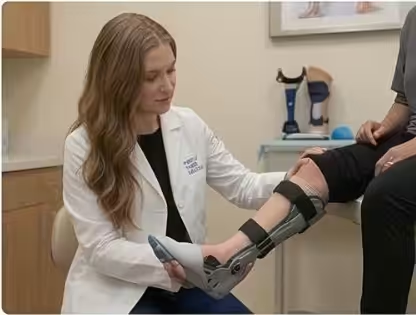
When conservative care isn’t enough, Dr. Tom Biernacki and the team at Balance Foot & Ankle offer advanced, same-day options — including Foot Bracing Howell at our Howell and Bloomfield Township clinics.
Same-day appointments available. Call (810) 206-1402 or book online.
FAQ
How long should I wear an ankle brace after a sprain?
Grade 1 sprains: 1–2 weeks of bracing during weight-bearing activity, then transition to compression sleeve. Grade 2 sprains: 3–6 weeks of structured bracing followed by functional rehabilitation. Grade 3 sprains require professional evaluation for treatment planning — some require surgical repair, others achieve adequate stability with extended conservative management.
Can I wear an ankle brace preventively in sports?
Yes — and the evidence strongly supports it. Meta-analyses show ankle bracing reduces ankle sprain incidence in basketball players by 50–60%. Players with a history of ankle sprain benefit most from prophylactic bracing, but even players without prior sprains show meaningful risk reduction. The McDavid 195 or a figure-8 strap brace is appropriate for ongoing prophylactic use in high-risk sports.
Ankle Sprain or Chronic Instability?
Dr. Tom evaluates and treats ankle sprains and chronic instability at our Howell and Bloomfield Township offices — from imaging to rehabilitation planning.
Book Your Evaluation →⭐⭐⭐⭐⭐ 4.9 Stars · 1,100+ Reviews
Most Common Mistake We See
The most common mistake we see is: Waiting too long before seeking care. Fix: any foot pain lasting more than 4 weeks, or any sudden severe symptom, deserves a professional evaluation rather than more rest.
Warning Signs That Need Same-Day Care
Seek immediate evaluation at Balance Foot & Ankle if you experience any of the following:
- Unable to bear weight
- Severe swelling with skin colour change
- Fever with foot pain (possible infection)
- Diabetes plus any new foot symptom
Call (810) 206-1402 — same-day and next-day appointments at our Howell and Bloomfield Township offices.
Dr. Tom’s Ankle Brace + Support Stack
- DASS Medical Compression Socks — Ankle swelling that persists even when braced: graduated compression worn at night (when the brace is off) provides 24-hour edema control that a brace alone cannot deliver.
- Doctor Hoy’s Natural Pain Relief Gel — Ankle pain and periligamentous inflammation inside a brace: arnica + camphor gel applied to the malleolar region before brace application reduces brace-induced compression irritation and joint inflammation.
- PowerStep Pinnacle — Pair any ankle brace with arch support: PowerStep Pinnacle inside the braced shoe corrects the arch collapse that ankle braces don’t address — hyperpronation is the primary driver of lateral ankle instability.
Ankle requiring a brace for more than 3 months or giving way despite bracing? Lateral ligament reconstruction evaluation at Balance Foot & Ankle. Balance Foot & Ankle → (810) 206-1402
In-Office Treatment at Balance Foot & Ankle
If home treatment isn’t providing relief for your ankle instability, our podiatry team at Balance Foot & Ankle can help with same-day evaluations and advanced in-office care.
Same-day appointments available. (810) 206-1402
Frequently Asked Questions
When should I see a podiatrist?
If symptoms persist past 2 weeks, affect your normal activity, or are accompanied by red-flag symptoms (warmth, redness, swelling, inability to bear weight).
What does treatment cost?
Most diagnostic visits and conservative treatments are covered by Medicare and major insurers. Out-of-pocket costs vary by your specific plan.
How quickly can I get an appointment?
Most non-urgent cases see us within 5 business days. Urgent cases (sudden pain, possible fracture) typically same or next business day.
What is Foot pain?
Foot pain is a common foot/ankle condition that affects mobility and quality of life. Understanding the underlying cause is the first step in successful treatment. Our podiatrists at Balance Foot & Ankle perform a hands-on biomechanical exam, review your activity history, and use diagnostic imaging when appropriate to identify the root cause—not just treat the symptom. Many patients have been told to “rest and ice” without a deeper diagnostic workup; our approach is different.
Symptoms and warning signs
Common signs of foot pain include pain that worsens with activity, morning stiffness, swelling, tenderness when palpated, and difficulty bearing weight. If you experience sudden severe pain, inability to walk, visible deformity, numbness or color change, contact our office the same day or visit urgent care—these can signal a more serious injury such as a fracture, tendon rupture, or vascular compromise. Diabetics with any foot wound should seek same-day care.
Conservative treatment options
Most cases of foot pain respond to non-surgical care: structured rest, supportive footwear changes, custom orthotics, targeted stretching and strengthening protocols, anti-inflammatory medications when medically appropriate, and in-office procedures such as ultrasound-guided injections. We also offer advanced therapies including MLS laser therapy, EPAT/shockwave, regenerative injections, and image-guided procedures. Treatment is sequenced from least invasive to most invasive, and we explain the rationale at every step.
When is surgery considered?
Surgery is reserved for cases that fail 3-6 months of well-structured conservative care, when there is structural pathology (severe deformity, complete tear, advanced arthritis), or when imaging shows damage that will not heal without intervention. Our surgeons have performed 3,000+ foot and ankle procedures and prioritize minimally-invasive techniques whenever appropriate. We discuss recovery timelines, return-to-activity milestones, and realistic outcome expectations before any procedure is scheduled.
American Academy of Orthopaedic Surgeons: Ankle Sprains
Recovery timeline and prevention
Recovery from foot pain varies based on severity and chosen treatment path. Conservative cases often improve within 4-8 weeks with consistent adherence to the protocol. Post-procedural recovery may range from a few days (in-office procedures) to several months (reconstructive surgery). Long-term prevention involves footwear assessment, activity modification, structured strengthening, and regular check-ins with your podiatrist if you have a history of recurrence. We provide written home-exercise plans and digital follow-up support.
Ready to feel better?
Same-week appointments available in Howell and Bloomfield Township, Michigan.
Book Your VisitGet Expert Care at Balance Foot & Ankle
Same-week appointments at our Howell and Bloomfield Township offices. Board-certified podiatric surgeons. Most insurance accepted.

Dr. Tom Biernacki, DPM is a board-certified foot & ankle surgeon (ABFAS & ABPM) at Balance Foot & Ankle Specialists in Southeast Michigan. With over a decade of clinical experience, he specializes in heel pain, bunions, diabetic foot care, sports injuries, and minimally invasive surgery. Dr. Biernacki is a member of the APMA and ACFAS, and his patient education content on MichiganFootDoctors.com and YouTube has made him one of the most-followed foot & ankle educators on YouTube.