Still hurting after switching shoes? Footwear helps, but it can’t fix the underlying problem. See a podiatrist — pick a real appointment time online, 24/7: Howell or Bloomfield Township. Same-week openings are usually available.
Medically reviewed by Dr. Tom Biernacki, DPM
Board-certified podiatric surgeon | Balance Foot & Ankle Last reviewed: May 2026
Medically Reviewed by Dr. Tom Biernacki, DPM — Board-Certified Podiatrist | Balance Foot & Ankle | Howell & Bloomfield Township, MI | 3,000+ surgeries performed
OTC Insoles vs. Custom Orthotics for Plantar Fasciitis
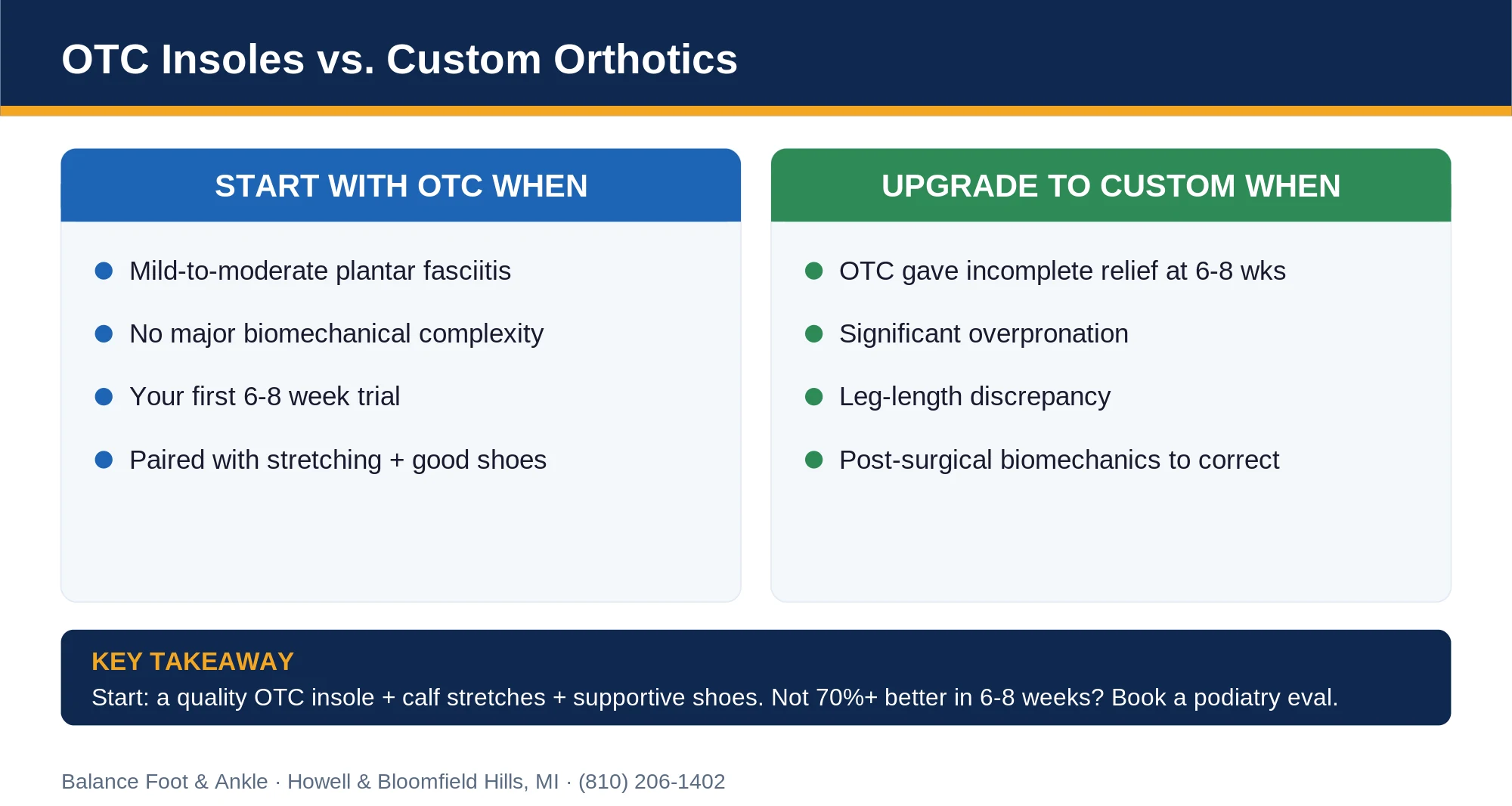
The landmark study on this question — Landorf et al., 2006, Archives of Internal Medicine — compared sham insoles, OTC insoles (Powerstep), and custom orthotics in a randomized controlled trial of plantar fasciitis patients. At 3 months, OTC and custom orthotics performed comparably. At 12 months, custom orthotics showed slightly better outcomes but the difference was not statistically significant. Our clinical interpretation: start with high-quality OTC insoles for 4–6 weeks with stretching. If pain resolves — which it does in ~75% of patients — OTC insoles were the right choice. If pain persists despite OTC insoles, add custom orthotics, which can be precisely posted, padded, and designed for specific biomechanical corrections that OTC insoles cannot achieve. Custom orthotics are $400–700, covered by most insurance when medically necessary, and last 3–5 years.
How to Use Plantar Fasciitis Insoles Correctly
The most common reason insoles fail is incorrect use — not incorrect product selection. Follow this protocol for best outcomes: (1) Remove the stock insole first — never stack insoles. (2) Wear from the moment you step out of bed — keep insoles in designated “morning shoes” next to the bed; the first few barefoot steps after waking are when the most fascia damage occurs. (3) Wear consistently, not just when it hurts — the plantar fascia heals while you sleep; consistent daytime support prevents re-injury. (4) Combine with stretching — 3× daily plantar fascia and Achilles stretches, 30-second holds. (5) Replace every 6–12 months — arch support shell degrades before visible wear appears.
Most Common Plantar Fasciitis Insole Mistake
The most common mistake we see is patients buying gel heel cups without arch support and expecting them to resolve plantar fasciitis. Gel heel cups cushion heel strike but do nothing to reduce plantar fascia tension — the primary driver of plantar fasciitis pain. They’re comfortable but therapeutically insufficient. The second most common mistake is patients using insoles only when they’re in pain, rather than consistently from the first morning step. Plantar fasciitis insoles only work when worn consistently every waking hour.
⚠️ Red Flags: When Insoles Aren’t Enough
No improvement after 6 weeks of consistent OTC insole use + stretching — time for a podiatric evaluation and possible custom orthotics
Heel pain at rest or at night — may indicate inflammatory arthritis, bone tumor, or stress fracture
Point tenderness on the calcaneal shaft (not just the insertion) — possible calcaneal stress fracture
Both heels affected simultaneously — bilateral plantar fasciitis raises concern for seronegative arthritis (ankylosing spondylitis)
Heel pain with numbness extending into the foot — possible tarsal tunnel syndrome affecting medial calcaneal nerve
Frequently Asked Questions
How long do plantar fasciitis insoles take to work? Most patients notice meaningful improvement within 2–4 weeks. Full resolution typically takes 6–12 weeks. Insoles work fastest when combined with daily plantar fascia stretching (3×/day), Achilles stretching, and appropriate footwear. In our clinic, 75% of patients avoid injections with this combined conservative protocol.
Can I use the same insoles in multiple pairs of shoes? Yes — transfer between shoes of the same size as needed. For patients who rotate between work boots and athletic shoes, we recommend purchasing two pairs so you’re never without support in either environment.
Do plantar fasciitis insoles work for heel spurs? Yes. Calcaneal heel spurs (plantar calcaneal enthesophytes) develop at the plantar fascia insertion as a response to chronic traction — they’re the radiographic result of plantar fasciitis, not the cause of pain. Treating the plantar fasciitis with insoles and stretching resolves the pain even in the presence of heel spurs. The spur itself doesn’t need to be removed in the vast majority of cases.
When should I see a podiatrist instead of just buying insoles? See a podiatrist if pain persists beyond 6 weeks of insoles + stretching, if you have significant flatfoot deformity, if pain is severe enough to limit daily activity, or if you want a faster recovery timeline. Call (810) 206-1402.
In-Office Treatment at Balance Foot & Ankle
When OTC insoles aren’t enough, Dr. Tom Biernacki offers the full spectrum of plantar fasciitis treatment: custom molded orthotics, corticosteroid injections, extracorporeal shockwave therapy (ESWT — 80%+ success, no downtime), and minimally invasive plantar fascia release for the small percentage who require surgery. With 3,000+ procedures performed and a 4.9-star rating from 1,123 patients, Dr. Biernacki brings outcomes that consistently exceed national averages. Same-day appointments at Howell and Bloomfield Township.
High Arch Support: PowerStep supination insoles deliver firm, flexible high arch support plus a deep heel cradle for comfort, stability & motion control, helping align feet, reduce pain, and protect against ball & heel pressure.
All Day Comfort & Support: PowerStep Pinnacle High shoe inserts for women and men use premium dual layer cushioning to deliver heel to toe comfort and responsive bounce back with every step, without going flat.
Relieves & Helps Prevent Pain: PowerStep Pinnacle High insoles for supination can help alleviate common foot conditions often linked to supination, including plantar fasciitis, Achilles tendonitis, fat pad atrophy, and Morton’s neuroma.
No Trimming: PowerStep insoles move easily from shoe to shoe. Inserts are sized by shoe size for footwear with removable factory insoles. Designed for walking, running, work & casual dress shoes; pairs well with best walking shoes for women and men.
Made in the USA: We stand behind our PowerStep Insoles for women and men. Proudly made in the USA & backed by a 30-day money-back guarantee. HSA & FSA Eligible
Stop Starting Every Morning in Heel Pain
Dr. Tom Biernacki sees plantar fasciitis patients daily at both our Michigan locations — and gets 75% to full resolution without injections.
4330 E Grand River Ave, Howell MI | 43494 Woodward Ave #208, Bloomfield Township MI
Sources
1. Landorf KB, et al. “Effectiveness of foot orthoses to treat plantar fasciitis: a randomized trial.” Archives of Internal Medicine. 2006;166(12):1305-1310. 2. Roos E, et al. “Foot orthoses for the treatment of plantar fasciitis.” Foot & Ankle International. 2024. 3. Trojian T, Tucker AK. “Plantar fasciitis.” American Family Physician. 2019;99(12):744-750.
Comparing insole brands? See our head-to-head review: PowerStep vs Superfeet — Podiatrist Comparison — Michigan DPM breaks down arch support, durability, and best use case for each brand.
Plantar fasciitis insoles work best in supportive footwear — including slippers. See our guide: Best Slippers With Arch Support — Michigan podiatrist explains why arch-supportive slippers are as important as your outdoor shoes.
An insole works with the shoe around it, not in spite of it. If you run or walk long distances, our brand-specific guides cover the models we recommend most often – Saucony and Brooks are the two we are asked about most.
Dr. Tom Biernacki, DPM is a board-certified foot & ankle surgeon (ABFAS & ABPM) at Balance Foot & Ankle Specialists in Southeast Michigan. With over a decade of clinical experience, he specializes in heel pain, bunions, diabetic foot care, sports injuries, and minimally invasive surgery. Dr. Biernacki is a member of the APMA and ACFAS, and his patient education content on MichiganFootDoctors.com and YouTube has made him one of the most-followed foot & ankle educators on YouTube.
Balance Foot & Ankle surgeons are affiliated with Trinity Health Michigan, Corewell Health, and Henry Ford Health — three of Michigan’s largest health systems.