

Medically reviewed by Dr. Tom Biernacki, DPM
Board-certified podiatric surgeon | Balance Foot & Ankle
Last reviewed: May 2026
Quick answer: Burning feet syndrome (Grierson-Gopalan syndrome) is a symptom, not a diagnosis — the burning, heat, and night-time tingling almost always trace to a nerve or metabolic cause: most often peripheral neuropathy from diabetes, a B-vitamin deficiency, tarsal tunnel compression, or small-fiber neuropathy. See a podiatrist if it’s persistent, worsening, or comes with numbness, because treatment depends entirely on the underlying cause.
Ready to be seen? Book a real appointment time online, 24/7 — Howell or Bloomfield Township. Takes about a minute, 24/7.
Waking up at 2 AM with your feet feeling like they are on fire — the soles burning, sometimes tingling, sometimes throbbing — is one of the most miserable and underdiagnosed experiences in medicine. Patients often suffer for years attributing it to “bad circulation” or “tired feet,” when in fact there is almost always a specific, diagnosable, and often treatable cause. In our Howell and Bloomfield Hills clinics, a systematic workup identifies the culprit in the vast majority of patients with chronic burning feet.
Burning feet that won’t quit? Persistent burning deserves a proper workup. A foot & ankle specialist can pinpoint the cause — neuropathy, a vitamin deficiency, or circulation — and start the right treatment. Balance Foot & Ankle offers same-week visits in Howell and Bloomfield Hills, MI.
The most important clinical decision with Grierson Gopalan Syndrome isn’t which treatment to start with — it’s identifying the correct subtype. That changes everything. Call (810) 206-1402.
What Is Burning Feet Syndrome?
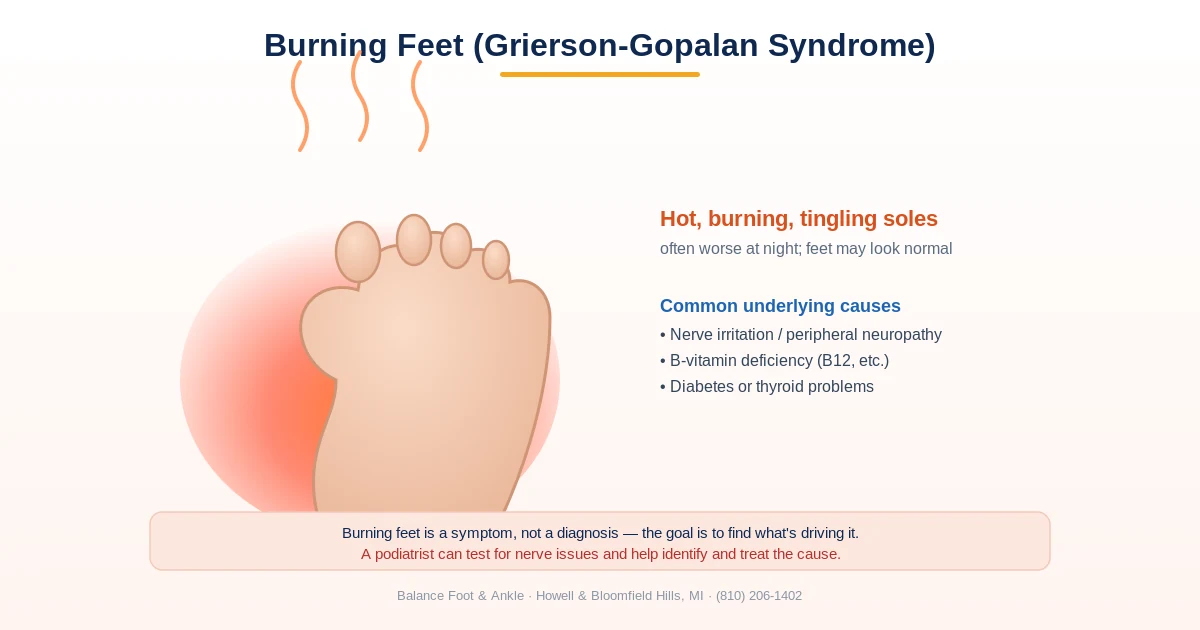
Burning feet syndrome — formally called Grierson-Gopalan syndrome after the physicians who first described it — refers to a constellation of symptoms: persistent burning, heat, and sometimes tingling or aching in the feet, characteristically worse at night and partially relieved by cool surfaces or cold water. It is not a single disease but a clinical syndrome that can result from numerous underlying pathologies affecting the peripheral nerves of the feet.
The burning sensation reflects abnormal electrical activity in damaged, compressed, or inflamed nerve fibers — a phenomenon called ectopic discharge. Normal nerve fibers conduct impulses only when stimulated by an appropriate stimulus. Damaged nerve fibers fire spontaneously and excessively, generating the constant burning sensation even in the absence of any actual heat or injury. This is neuropathic pain — pain generated by the nervous system itself rather than by tissue damage.
Key takeaway: Burning feet that are worst at night and affect both feet simultaneously are the hallmark of length-dependent peripheral neuropathy — the longest nerves in the body (those supplying the feet) are affected first and most severely. The bilateral symmetric pattern, combined with the nocturnal worsening (less competing sensory input at rest), is highly characteristic. Single-foot burning or asymmetric distribution points toward a local compression cause like tarsal tunnel syndrome.
Cause 1: Peripheral Neuropathy — Diabetic and Otherwise
Diabetic peripheral neuropathy is the single most common cause of burning feet syndrome worldwide, affecting 50% of people with diabetes after 10+ years of disease. Chronic hyperglycemia damages the small blood vessels supplying peripheral nerves (vasa nervorum), creating ischemic nerve injury that begins in the longest nerves first — those reaching the toes — and gradually spreads proximally in a “stocking-glove” distribution.
The burning in diabetic neuropathy is characteristically bilateral, symmetric, begins at the toes and ball of foot, and is worst at night when activity-generated sensory input stops competing with the pain signal. It may be accompanied by numbness (sensory loss) — the paradox of painful-yet-numb feet that patients find confusing but that reflects simultaneous loss of protective sensation and gain of abnormal pain firing.
The only disease-modifying treatment for diabetic neuropathy is glycemic control — tight A1c management slows progression and in early stages allows partial nerve recovery. Symptomatic treatments (gabapentin, pregabalin, duloxetine, tricyclics) improve quality of life but do not affect the underlying nerve damage. In our diabetic population, we also focus intensively on foot protection: appropriate diabetic footwear, regular monofilament testing, and patient education to prevent the ulcers and infections that a numb, burning foot is susceptible to. Monofilament testing takes about a minute and answers the question that most changes your risk, which is whether protective sensation is still intact, and plenty of people with years of burning feet have never had it done. Book a neuropathy evaluation online.
Key takeaway: Vitamin B12 deficiency is one of the most treatable and most commonly missed causes of burning feet. It is particularly prevalent in patients taking metformin (which blocks B12 absorption), vegetarians and vegans, patients with atrophic gastritis or prior gastric surgery, and older adults with reduced intrinsic factor production. A simple serum B12 and methylmalonic acid level confirms the diagnosis — and supplementation reverses the neuropathy if caught before permanent nerve damage occurs.
Cause 2: Vitamin Deficiency Neuropathy
Vitamin B12 deficiency causes burning feet by demyelinating the peripheral nerves — B12 is essential for myelin synthesis (the protective sheath around nerve fibers), and deficiency leads to progressive nerve dysfunction. The burning feet presentation is indistinguishable from diabetic neuropathy, which is why all patients presenting with burning feet should have B12 levels checked, regardless of diabetes status.
Critical subgroups at high B12 deficiency risk: patients on metformin (the most prescribed diabetes drug, which blocks B12 absorption in the gut — up to 30% of long-term metformin users become B12 deficient); vegetarians and vegans; patients with autoimmune gastritis or pernicious anemia; post-bariatric surgery patients; older adults with reduced gastric acid production.
B12 replacement (oral cyanocobalamin 1,000 mcg daily for deficiency without neurological symptoms; intramuscular B12 for confirmed neurological involvement) reverses the neuropathy if started before permanent axonal damage occurs. This is one of the most satisfying diagnoses to make — a fully reversible cause of burning feet that a simple blood test identifies.
Vitamin B1 (thiamine) deficiency — associated with chronic alcohol use, malnutrition, bariatric surgery, and prolonged IV nutrition — also produces burning, aching foot pain (part of “burning feet” syndrome originally described in malnourished populations). Thiamine replacement is the treatment.
Cause 3: Tarsal Tunnel Syndrome
Tarsal tunnel syndrome is compression of the posterior tibial nerve (or its branches) as it passes through the tarsal tunnel — the fibro-osseous canal behind the medial ankle. Unlike diffuse peripheral neuropathy, tarsal tunnel syndrome produces unilateral burning, tingling, and numbness across the sole and toes that radiates from behind the ankle. It is the foot’s equivalent of carpal tunnel syndrome.
Tinel’s sign (reproduction of the burning/tingling by tapping over the tarsal tunnel) is the most useful clinical test. Nerve conduction studies can confirm the diagnosis, though they are not always positive in early or mild compression. Overpronation and flat feet are major risk factors by stretching the tibial nerve as the arch collapses. Treatment: custom orthotics to control pronation, night splints, corticosteroid injection, and surgical decompression for confirmed cases failing conservative care.
Cause 4: Small Fiber Neuropathy
Key takeaway: Small fiber neuropathy (SFN) is a distinct condition that affects only the small unmyelinated C-fibers responsible for pain and temperature sensation — leaving the large fibers (responsible for vibration, proprioception, and nerve conduction velocity) completely intact. This means standard nerve conduction velocity (NCV) testing is normal in SFN. The diagnosis requires skin punch biopsy with intraepidermal nerve fiber density counting — a test many patients with burning feet never receive.
Small fiber neuropathy produces intense burning foot pain — often with allodynia (normal skin touch feels painful) — with a completely normal standard neurological exam and normal nerve conduction studies. It is frequently dismissed as “anxiety” or “functional” because the standard workup is negative. The correct diagnostic test is skin punch biopsy of the distal leg, measuring intraepidermal nerve fiber density — a reduced density confirms SFN definitively.
Causes of small fiber neuropathy include idiopathic (30% of cases — no identifiable cause), diabetes and pre-diabetes (impaired glucose tolerance), autoimmune diseases (Sjogren’s syndrome, celiac disease, lupus), genetic causes (sodium channel gene mutations — SCN9A, SCN10A), and sarcoidosis. A systematic workup is warranted for all confirmed SFN cases.
Cause 5: Erythromelalgia
Erythromelalgia is a distinct and dramatic burning feet syndrome — episodic attacks of intense burning pain, redness, and warmth in the feet, triggered by warmth and relieved by cold. Patients characteristically sleep with feet uncovered, hold feet against cold floors, or immerse feet in ice water during attacks. The burning and redness are simultaneous hallmarks — distinguishing erythromelalgia from other burning feet causes where redness is absent.
Erythromelalgia can be primary (often a sodium channel gene mutation — SCN9A — with onset in adolescence or young adulthood) or secondary to myeloproliferative disorders, particularly polycythemia vera and essential thrombocythemia. Any patient with erythromelalgia requires a complete blood count to screen for underlying hematologic disease. Secondary erythromelalgia from polycythemia vera responds dramatically to low-dose aspirin — in some cases providing complete symptom relief.
Cause 6: Medication-Induced Neuropathy
A significant number of burning feet cases are iatrogenic — caused by medications. The most important drug classes to review in any burning feet workup:
- Chemotherapy agents: Taxanes (paclitaxel, docetaxel), platinum compounds (cisplatin, oxaliplatin), and vincristine produce chemotherapy-induced peripheral neuropathy (CIPN) in 30–40% of treated patients
- Fluoroquinolone antibiotics: Ciprofloxacin, levofloxacin — FDA black box warning for peripheral neuropathy that may be permanent
- Metronidazole: Prolonged use associated with peripheral neuropathy
- Statins: Rare but documented association with peripheral neuropathy in some patients
- Metformin: Indirectly via B12 depletion (see above)
- Amiodarone, isoniazid, thalidomide: Additional agents with established neuropathy risk
⚠️ Burning feet symptoms requiring urgent evaluation
- New or worsening burning feet in a diabetic patient — neuropathy progression, needs A1c optimization and ulcer risk assessment
- Burning feet with systemic symptoms: weight loss, fatigue, night sweats — possible malignancy or systemic disease
- Rapidly progressive bilateral burning with leg weakness — Guillain-Barré syndrome or other acute neuropathy, emergency evaluation
- Burning feet with episodes of red, hot, swollen feet relieved by cold — erythromelalgia, needs hematologic workup
- Burning feet plus balance problems or falls — large fiber neuropathy or CNS cause, neurology referral warranted
Diagnosis: The Workup We Run
Our standard evaluation for burning feet syndrome in the podiatric setting: detailed history (diabetes status, medications, alcohol use, diet, B12 risk factors, symptom distribution and timing); neurological examination (10-g monofilament, light touch, temperature, vibration, ankle reflexes); vascular assessment; and laboratory panel (fasting glucose and HbA1c, serum B12 and methylmalonic acid, CBC, comprehensive metabolic panel, TSH). For cases not explained by the initial workup, we refer to neurology for NCV/EMG and, when indicated, skin punch biopsy for small fiber neuropathy.
MOST COMMON MISTAKE WE SEE
Burning feet are almost universally attributed to “neuropathy” and treated with gabapentin — but neuropathy itself has multiple subtypes requiring different treatments. Prescribing a nerve-calming medication without identifying the root cause (diabetes, vitamin B12 deficiency, tarsal tunnel compression, small fiber neuropathy, or erythromelalgia) delays the correct intervention. The workup matters: HbA1c, B12, CBC, TSH, and nerve conduction studies together change the diagnosis in a significant percentage of burning feet cases.
DIFFERENTIAL DIAGNOSIS — CONDITIONS THAT CAUSE BURNING FEET
- Diabetic peripheral neuropathy — most common cause; symmetric stocking-glove distribution; diagnosed by HbA1c and nerve conduction studies
- Vitamin B12 deficiency neuropathy — burning/tingling that worsens at night; common in metformin users, vegans, and elderly patients; serum B12 is the test
- Tarsal tunnel syndrome — burning that is localized to the plantar foot; positive Tinel’s sign at the tarsal tunnel; NCV shows entrapment
- Small fiber neuropathy — burning without weakness or sensory loss on standard NCV; diagnosed by skin punch biopsy for intraepidermal nerve fiber density
- Erythromelalgia — burning with visible redness and warmth, triggered by heat or exercise, relieved by cold; can be primary or secondary (polycythemia vera, essential thrombocythemia)
- Medication-induced neuropathy — statins, metronidazole, isoniazid, chemotherapy agents; burning onset correlates with drug initiation
RED FLAGS — SEE A PODIATRIST OR NEUROLOGIST URGENTLY
- Burning feet with visible redness and skin color changes that fluctuate with temperature
- Rapid progression of burning from feet to legs over weeks
- Accompanying muscle weakness or tripping/falls
- Burning feet in a known diabetic with non-healing wound or skin breakdown
- Burning with night sweats, unexplained weight loss, or lymph node enlargement
- Severe burning at rest unresponsive to any position change
Call (810) 206-1402 or book online — most urgent presentations seen same or next business day.
Treating Burning Feet, in the Order We Actually Try Things
Burning feet is a symptom, not a diagnosis, and treatment always runs on two tracks at once: correct whatever is driving it, and quiet the nerve down while that correction takes effect. Both halves matter. Treating only the sensation is how people end up years into escalating medication with the underlying cause never addressed.
The reversible causes come first, because timing matters
Several of the causes above have specific fixes, and in most of them how long the burning has been going on predicts how much of it goes away. That is the honest reason we push for blood work early rather than starting with a prescription.
- B12 and folate. Replacement can produce substantial improvement, and the recovery is more complete the earlier it starts. Long-standing deficiency can leave permanent damage behind, which is exactly why this is not a test to skip.
- Thyroid function. An underactive thyroid is easy to miss and easy to treat, and correcting it often improves the nerve symptoms along with everything else.
- Blood sugar. In prediabetes and early diabetes, burning feet is frequently the first symptom to appear — sometimes before the diagnosis is even made. Tightening glucose control is the single most effective thing anyone has for slowing progression. Nerve damage already present may not reverse, but the trajectory is genuinely modifiable, and that is worth knowing before assuming nothing can be done.
- Alcohol intake, which causes neuropathy both directly and through the nutritional deficiencies that accompany it.
- A medication review. If a drug is contributing, there is often an alternative. This is a conversation with the prescribing physician rather than something to change on your own.
- Mechanical nerve compression such as tarsal tunnel, which is the one cause on the list with a direct procedural answer.
Quieting the nerve while the cause is worked on
Symptom control is legitimate treatment, not a consolation prize — burning feet wrecks sleep, and poor sleep makes nerve pain worse, so breaking that loop is worth doing properly.
Topical agents are usually where we start. Capsaicin preparations, compounded topical formulations and lidocaine act where they are applied and largely avoid whole-body side effects, which matters a great deal for older patients and anyone already taking several medications.
Oral medications for nerve pain are a different class from ordinary painkillers. Gabapentin, pregabalin, duloxetine and amitriptyline are the agents most often used; they are prescribed and monitored, started at low doses and increased slowly, and drowsiness in the first couple of weeks is common and usually settles. They dampen the pain signalling rather than repair the nerve, so they work alongside the first list, not instead of it.
Here is the expectation-setter almost nobody is given: ibuprofen, naproxen and acetaminophen work poorly for nerve pain. If you have been taking anti-inflammatories for months and concluded that nothing helps, the more likely explanation is that you have been using the wrong category of medicine for the problem — not that your case is untreatable.
Alpha-lipoic acid comes up frequently and has some supportive evidence in diabetic neuropathy, though the results across studies are mixed. It is reasonable to discuss; it is not a substitute for identifying the cause.
What helps at night, when it is always worst
- Cool, not cold. A cool foot bath or a fan helps. Do not put ice directly against a foot that has reduced sensation — you will not feel the damage being done.
- Get the bedding off your feet. Sheet weight on hypersensitive skin is a common reason people cannot fall asleep. A blanket lift, or simply untucking the bottom of the bed, solves it cheaply.
- Keep the feet dry and treat any skin infection — see the section below, which catches more people than expected.
- Skip alcohol in the evening, which reliably amplifies night-time burning.
- Note what position helps. This is diagnostic. If elevating the feet eases the burning, that is consistent with a nerve or swelling problem. If elevation makes it worse and hanging the foot over the side of the bed makes it better, that pattern points toward arterial circulation rather than nerve — and it changes the workup completely. Mention it, because it is one of the most useful things you can tell us.
The cause people forget, because it is not neurological at all
Before assuming a nerve problem, it is worth ruling out athlete’s foot. Fungal skin infection burns, stings and itches, and in an otherwise healthy person it is one of the more common reasons a foot feels like it is on fire. It favours the web spaces between the toes and can spread across the sole and up the sides in a pattern that looks like a slipper, often with fine scaling that gets dismissed as dry skin for years. It is inexpensive to treat and immediately satisfying when it turns out to be the answer.
The same goes for contact dermatitis from the shoe itself — reactions to rubber accelerators, adhesives and the chromium used in tanning leather are well described. The giveaway is burning and redness across the top of the foot in roughly the shape of the shoe, improving on days off and returning with a particular pair.
When Burning Feet Needs Attention Today Rather Than Next Month
Most burning feet develops gradually over months and is not an emergency. These patterns are the exceptions, and they are worth knowing:
- Rapid onset over hours or days, particularly with numbness or weakness climbing up from the feet toward the legs.
- New weakness — catching your toes, tripping, or difficulty lifting the front of the foot.
- A cold, pale or dusky foot, absent pulses, or pain that improves only when the leg hangs down. That combination is about blood supply, and it is time-critical.
- Fever, spreading redness, or any open sore on the foot in someone with diabetes or neuropathy. Same-day, without exception.
- Burning that began shortly after a new medication was started — contact whoever prescribed it rather than waiting for the next review.
Frequently Asked Questions
Why are my feet burning at night but not during the day? Neuropathic burning is amplified at night because the brain’s descending pain inhibition system is less active during quiet rest, and there is no competing sensory input from activity to dampen the pain signal. Additionally, peripheral blood flow patterns change with recumbency, altering the thermal environment at the nerve endings. Most neuropathic burning feet conditions follow this nocturnal pattern — it is the hallmark, not the exception.
Can burning feet be cured? It depends on the cause. B12 deficiency neuropathy caught before permanent axonal damage: yes, essentially curable with replacement. Tarsal tunnel syndrome: yes, with surgery or conservative care depending on severity. Diabetic neuropathy: not curable, but progression stops and symptoms may improve with excellent glycemic control. Small fiber neuropathy from treatable causes (celiac disease, Sjogren’s): partially reversible with disease treatment. Idiopathic SFN: managed rather than cured, with symptom control medications.
What is the best medication for burning feet? First-line medications with the strongest evidence: duloxetine (60–120mg daily — FDA-approved for diabetic peripheral neuropathic pain; also the first-line choice per ADA guidelines), gabapentin (300–1,200mg three times daily — widely used, generally well-tolerated), and pregabalin (75–150mg twice daily). Topical agents — capsaicin cream, lidocaine patches — are useful for localized pain without systemic side effects. None of these address the underlying cause.
The Bottom Line
Burning feet syndrome almost always has a diagnosable cause — and the workup to find it is straightforward. B12 deficiency, pre-diabetes, and tarsal tunnel syndrome are three common, treatable, and frequently missed causes that a simple blood draw and clinical exam can identify. If you have been told your burning feet are “just part of aging” or attributed to stress without a proper diagnostic evaluation, that evaluation is the most important next step.
Our Howell and Bloomfield Hills podiatric teams run a systematic burning feet workup at every relevant visit. For the subset of patients requiring neurology collaboration (skin biopsy for SFN, complex medication-induced neuropathy), we coordinate directly. Most patients leave their first evaluation with both a suspected diagnosis and a treatment plan.
Get to the Root Cause of Your Burning Feet
Same-day appointments available in Howell & Bloomfield Hills, MI
4.9★ | 1,123 Reviews | 3,000+ Surgeries Performed
Or call: (810) 206-1402
Sources
- Callaghan BC, Cheng HT, Stables CL, et al. Diabetic neuropathy: clinical manifestations and current treatments. Lancet Neurol. 2012;11(6):521-534.
- Devigili G, Tugnoli V, Penza P, et al. The diagnostic criteria for small fibre neuropathy: from symptoms to neuropathology.
- Pop-Busui R, Boulton AJ, Feldman EL, et al. Diabetic neuropathy: a position statement by the American Diabetes Association. Diabetes Care. 2017;40(1):136-154.
- Rajabally YA, Martey J. Neuropathy in hypothyroidism: no joking matter. J Neurol. 2011;258(12):2127-2133.
- Toth C. Medications and substances as a cause of neuropathy: a review of current literature. Drug Healthc Patient Saf. 2010;2:145-162.
What causes Grierson-Gopalan syndrome (burning feet)?
Grierson-Gopalan syndrome is caused by nutritional deficiencies (B vitamins, pantothenic acid), peripheral neuropathy from diabetes, thyroid disorders, or idiopathic nerve dysfunction. A podiatrist or neurologist can identify the underlying cause.
How is burning feet syndrome treated?
Treatment depends on the cause: vitamin B supplementation for deficiency, blood sugar control for diabetic neuropathy, cooling foot soaks, and appropriate footwear. Medications like gabapentin may help in severe nerve pain cases.
When should I see a podiatrist for burning feet?
See a podiatrist if burning feet persist more than 2 weeks, worsen at night, are accompanied by numbness or tingling, or if you have diabetes or another condition affecting circulation.
For a complete clinical overview: best shoes for neuropathy and nerve pain — Dr. Biernacki’s 2026 guide to footwear that reduces burning, pressure & pain from peripheral neuropathy.

Dr. Tom Biernacki, DPM is a double board-certified podiatrist and foot & ankle surgeon at Balance Foot & Ankle Specialists in Southeast Michigan. With over a decade of clinical experience, he specializes in heel pain, bunions, diabetic foot care, sports injuries, and minimally invasive surgery. Dr. Biernacki is a member of the APMA and ACFAS, and his patient education content on MichiganFootDoctors.com and YouTube has reached over one million views.
- Diagnosis and Treatment of Plantar Fasciitis (PubMed / AAFP)
- Heel Pain (APMA)
- Hallux Valgus (Bunions): Evaluation and Management (PubMed)
- Bunions (Mayo Clinic)
Treatment Options Available at Our Office
📋 Dr. Tom Biernacki, DPM, FACFAS answers:
Burning feet that worsen at night — classic Grierson-Gopalan syndrome — are most commonly caused by peripheral neuropathy from diabetes, vitamin B12 or B1 deficiency, or chronic alcohol use. Other causes include hypothyroidism, kidney disease, Charcot-Marie-Tooth disease, and tarsal tunnel syndrome. The burning sensation occurs because damaged nerves fire abnormally, especially without the competing sensations of daytime activity. First-line investigations: fasting glucose, HbA1c, B12, B1 (thiamine), TSH, and BMP. Treatment depends on the cause: B12 injections can dramatically improve deficiency-related burning; diabetic neuropathy management requires glucose control plus medications like gabapentin or duloxetine for symptom relief. Soaking in cool (not cold) water, elevating the feet, and avoiding alcohol temporarily reduce symptoms while the underlying cause is addressed.
Footwear & Orthotics for Burning Feet
Burning feet often ease with breathable, cushioned shoes and supportive orthotics that reduce pressure. See our podiatrist-recommended shoes, and see a podiatrist to rule out nerve causes.
Related burning-feet & nerve guides
Burning feet often ties to nerve health — read more:
When burning feet should be investigated further
Grierson-Gopalan syndrome describes the symptom — burning feet — rather than the cause, and the cause is what determines treatment. Worth an in-person workup: burning that is worse at night, burning accompanied by numbness or by loss of the ability to feel a light touch, burning in one foot only, or burning in anyone with diabetes, thyroid disease, prior chemotherapy, bariatric surgery or heavy alcohol use. B12, folate, thyroid function and glucose are the usual first bloods, because deficiency-driven and metabolic causes are both common and treatable. Small-fibre neuropathy, tarsal tunnel compression and lumbar radiculopathy each produce burning that feels identical to the patient but responds to completely different treatment. Persistent nocturnal foot pain with any sensory change deserves an exam rather than another cooling gel, and patients with diabetes should be under regular diabetic foot care review.
Balance Foot & Ankle sees patients at two Michigan offices: our Howell podiatry office, serving Livingston County, and our Bloomfield Township podiatry office, serving Bloomfield Hills, Birmingham, Pontiac and the rest of Oakland County. Dr. Tom Biernacki sees patients at both. Call (810) 206-1402 to book an appointment.
Dr. Tom Biernacki, DPM is a board-certified foot & ankle surgeon (ABFAS & ABPM) at Balance Foot & Ankle Specialists in Southeast Michigan. With over a decade of clinical experience, he specializes in heel pain, bunions, diabetic foot care, sports injuries, and minimally invasive surgery. Dr. Biernacki is a member of the APMA and ACFAS, and his patient education content on MichiganFootDoctors.com and YouTube has made him one of the most-followed foot & ankle educators on YouTube.
More questions patients ask
What is Grierson-Gopalan syndrome?
Grierson-Gopalan syndrome, also called burning feet syndrome, is a condition characterized by severe burning, tingling, and heaviness in the feet — especially at night. It is caused by peripheral neuropathy, nutritional deficiencies (B vitamins), thyroid disorders, kidney disease, or idiopathic nerve dysfunction.
What causes burning feet at night?
Burning feet at night are most commonly caused by peripheral neuropathy (often from diabetes), B12 or B6 deficiency, hypothyroidism, chronic kidney disease, athlete's foot, or tarsal tunnel syndrome. A podiatrist and/or primary care physician can run tests to identify the underlying cause.
What is Grierson-Gopalan syndrome (burning feet syndrome)?
Grierson-Gopalan syndrome, also called burning feet syndrome, is a condition characterized by severe burning, heat, and pain in the feet, often worse at night. It was originally described in nutritionally deficient populations but is now understood to have multiple causes including peripheral neuropathy, vitamin deficiencies, and vascular disease. Balance Foot & Ankle evaluates and treats burning foot conditions comprehensively.
Are burning feet worse at night because of neuropathy?
Yes, neuropathic burning feet are often worse at night due to the absence of competing sensory stimuli that distract from the pain during the day, as well as changes in skin temperature. Lying down also changes blood flow patterns. At Balance Foot & Ankle, patients with nocturnal burning feet receive thorough neurological evaluation to guide the most effective treatment plan.
When should burning feet syndrome be evaluated by a specialist?
Burning feet that are persistent, severe, affecting sleep or quality of life, or accompanied by other neurological symptoms should be promptly evaluated. If you have diabetes, kidney disease, or a nutritional condition associated with burning feet, call Balance Foot & Ankle at (810) 206-1402. Our podiatrists at the Howell (4330 E Grand River) and Bloomfield Township (43494 Woodward Ave #208) offices provide expert neuropathy care.
How is Grierson-Gopalan syndrome treated?
Treatment: B-vitamin supplementation (B5/pantothenic acid 100mg, B6 50mg, B12 1000mcg daily), nutritional repletion if malabsorption, cool foot soaks for symptom relief, gabapentin or duloxetine for severe nerve pain, address underlying cause (alcoholism, malabsorption, dietary deficiency). Most cases improve within 3-6 weeks of vitamin therapy.
Is burning feet syndrome the same as neuropathy?
Burning feet syndrome (Grierson-Gopalan) is a specific subtype of small fiber peripheral neuropathy, classically nutritional. Diabetic peripheral neuropathy is the most common burning feet cause overall. Other causes: alcohol, chemotherapy, hypothyroidism, kidney failure, autoimmune disease. We test for the underlying cause through blood work and nerve conduction.
Still have a question about coverage or cost? Book online and we will check your benefits before your visit: Book in Howell · Book in Bloomfield Township. Prefer to talk it through first? Call (810) 206-1402.