
Quick answer: Heels Hurt has multiple potential causes including mechanical, neurological, vascular, and inflammatory. The patterns we see most often are overuse, poorly-fitted shoes, and biomechanical imbalance. Red flags requiring urgent evaluation: warmth/redness (infection), inability to bear weight (fracture), and unilateral swelling without injury (DVT). Call (810) 206-1402.
✅ Medically reviewed by Dr. Tom Biernacki, DPM — Board-Certified Podiatrist · Last updated April 6, 2026
Why Do My Heels Hurt?
Causes, Symptoms & Best Treatment!
Are your heels hurting when you wake up in the morning or after a long day on your feet? You’re not alone—heel pain is one of the most common foot problems people experience, and understanding the cause is the first step to long-lasting relief.
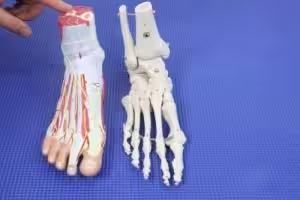
There are three major reasons why your heels might hurt, and the most common of all is plantar fasciitis—a condition caused by inflammation of the thick band of tissue (plantar fascia) that supports your arch and connects your heel bone to your toes. When this ligament becomes strained, tiny tears can develop, leading to sharp or aching pain, especially with your first steps in the morning.
Don’t let heel pain hold you back—take the first step toward relief today!
Schedule Your Consultation Today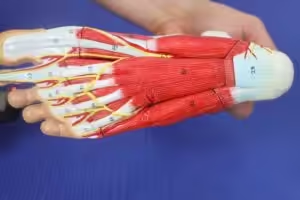
Heel Pain Causes:
Diagnosis requires asking a couple questions:
Question #1) Do Your Heels Hurt In The Morning?
- If No: Jump to Question #2.
- If Yes: Continue reading.
If you do have morning foot pain consider:
Pain that is worst after resting, sitting or sleeping is always due to inflammation:
- Inflammation is your body trying to remodel itself or protect itself.
- It is triggered due to overuse or too much stress on your muscles in this case.
- The ligaments on your foot can become tight & painful after a full day off walking.
- Then as you rest or go to bed, your body tries to remodel them.
- This pain usually takes years to get to the point where it causes severe pain.
- It can even cause a heel spur to form on your foot!
How Common Is Plantar Fascia Heel Pain?
- This is the most common source of heel pain in the world.
- 15% of people around the world suffer from this medical problem.
- That means almost 1 billion people in the world will have this.
- This pain is due to inability to heal the strained ligaments across the bottom of the foot.
Symptoms of Plantar Fasciitis:
- Heel pain after resting .
- Heel pain after sitting.
- Heel pain after sleeping.
- Pain gets better after walking around for 15-20 minutes.
- No history of severe trauma.
- Pain gets better with anti-inflammatory medication or icing.
- Massaging the arches makes the pain feel better.
Question #2: Do You Have A Lump Or Bump On The Heel?
- If No: Jump to Question #4.
- If Yes: Continue reading.
- A plantar fibroma is a relatively non-dangerous condition; but it can become extremely painful.
- It feels like a “pebble” or hard nodule of connective tissue in your sole.
- It could even feel like a much larger thickening of the cords at the bottom of your foot.
- It could be one nodule or many.

How Did This Foot Or Heel Lump Develop?
- These nodules are extremely slow growing.
- It could take months to years before they even begin to irritate you.
- They eventually lead to more and more irritation.
- Eventually causing your toes to bend and stiffen because you adapt your biomechanics and walk improperly.
- Eventually this irritation becomes to much to bear and your heel hurts.
Question #3: Is It The Back Of The Heel That Hurts?
- If No: Jump to Question #4.
- If Yes: Continue reading.

Consider Pain In The Back Of The Heel:
This can be due to:
- This is likely the most common source of pain in the back of the heel.
- It is not at the bottom but the back.
- This can be a hard bone bump at the back of the heel.
- This is usually on the inside of the heel.
- It can cause numbness, burning or tingling.
D) Posterior Tibial Nerve Entrapment.
- This is usually on the inside of the heel.
- It can cause numbness, burning or tingling.
Question #4: Does The Outside Of My Heels Hurt?
- If No: Jump to Question #5.
- If Yes: Continue reading.
Possibilities:
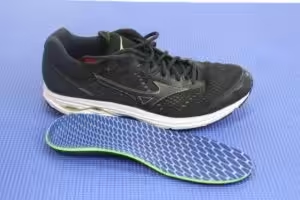
Question #5: Do My Heels Hurt After Run Training.
Consider:
Related Treatment Guides
Are Your Heels Hurting?
Heel pain is the most common reason patients visit a podiatrist. Our specialists treat plantar fasciitis, heel spurs, and all causes of heel pain with proven, effective therapies.
📞 Or call us directly: (810) 206-1402
Clinical References
- Riddle DL, et al. Risk factors for plantar fasciitis. J Bone Joint Surg Am. 2003;85(5):872-877.
- League AC. Current concepts review: plantar fasciitis. Foot Ankle Int. 2008;29(3):358-366.
- Thomas JL, et al. The diagnosis and treatment of heel pain: a clinical practice guideline. J Foot Ankle Surg. 2010;49(3):S1-S19.
Insurance Accepted
BCBS · Medicare · Aetna · Cigna · United Healthcare · HAP · Priority Health · Humana · View All →
Howell Office
4330 E Grand River Ave
Howell, MI 48843
Get Directions →
Bloomfield Township Office
43494 Woodward Ave, #208
Bloomfield Township, MI 48302
Get Directions →
Your Board-Certified Podiatrists



Ready to Get Back on Your Feet?
Same-week appointments available at both locations.
Book Your AppointmentMore Podiatrist-Recommended Foot Health Essentials
Hoka Clifton 10
No products found.
Max-cushion everyday shoe — podiatrist favorite for walking and running.
PowerStep Pinnacle Insole

- #1 Podiatrist Recommended - The Pinnacle PowerStep insoles for men & women provide maximum cushioning, from high activity to moderate support. The arch support shape provides stability to the foot & ankle, helping to relieve foot pain.
- When you spend all day on your feet, every step counts. These plantar fasciitis insoles are podiatrist-recommended to help relieve & prevent foot pain for people with plantar fasciitis, heel spurs, and other common foot, ankle & knee injuries
- The Pinnacle PowerStep insoles offer superior heel cushioning and arch support. These shoe inserts for men and women have dual-layer cushioning to help reduce stress and fatigue, while premium arch support is designed for plantar fasciitis relief
- The PowerStep Pinnacle arch support inserts for men & women can be worn in a variety of shoe types such as; athletic, walking, running, work & some casual shoes. Orthotic Inserts are ordered by shoe size, no trimming required.
- These insoles for shoes are made in the USA & backed by a 30-day money-back guarantee. PowerStep shoe insoles for men & women are designed for shoes where the factory insole can be removed. HSA & FSA Eligible
As an Amazon Associate, Balance Foot and Ankle earns from qualifying purchases. Product links are affiliate links and we may earn a commission at no extra cost to you. This does not influence our clinical recommendations. Last update on 2026-10-11 / Images from Amazon Product Advertising API
The podiatrist-recommended over-the-counter orthotic.
OOFOS Recovery Slide
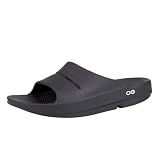
- The Original Recovery Footwear.
- Finding Your Size - For your perfect fit, consult the “size chart” link above. Wear a half size? In general, we recommend that women who wear a ½ size size UP, and men who wear a ½ size size DOWN
- OOahh - An evolution of the OOriginal, the OOahh slide features our proven foundation of OOfoam technology + patented footbed design with a slide-style strap that has become a best-seller in the OOFOS line
- OOfoam Technology - Our revolutionary OOfoam technology absorbs 37% more impact than traditional footwear foams to reduce the stress on your feet, joints & back. Plus, the closed-cell foam is machine washable and designed to minimize odor
- Patented Footbed - Our patented footbed cradles and supports arches to reduce energy exertion in the ankles by up to 47% compared to competitors’ footwear. So walking is easier. Recovery is faster. And yOO feel better
As an Amazon Associate, Balance Foot and Ankle earns from qualifying purchases. Product links are affiliate links and we may earn a commission at no extra cost to you. This does not influence our clinical recommendations. Last update on 2026-10-11 / Images from Amazon Product Advertising API
Impact-absorbing recovery sandal — wear after long days on your feet.
As an Amazon Associate, Balance Foot & Ankle earns from qualifying purchases. Product recommendations are based on clinical experience; prices and availability shown above update live from Amazon.


When to See a Podiatrist
If foot or ankle pain has been bothering you for more than a few weeks, home care alone may not be enough. Balance Foot & Ankle offers same-week appointments at our Howell and Bloomfield Township clinics — no referral needed in most cases. Bring your current shoes and a short list of symptoms and we’ll build you a treatment plan in one visit.
Call Balance Foot & Ankle: (810) 206-1402 · Book online · Offices in Howell & Bloomfield Township
In-Office Treatment at Balance Foot & Ankle
If home treatment isn’t providing relief for your foot and ankle conditions, our podiatry team at Balance Foot & Ankle can help with same-week evaluations and advanced in-office care.
Doctor Hoy’s Natural Pain Relief Gel
Natural topical pain relief I use in our clinic. Arnica + camphor formula — apply directly to the area 3–4x daily. ($20–25)
Shop Doctor Hoy’s →Frequently Asked Questions
When should I see a doctor?
See a podiatrist if pain persists past 2 weeks, prevents normal activity, or is accompanied by red-flag symptoms (warmth, swelling, numbness, inability to bear weight).
Can I treat this at home?
Mild cases respond to RICE protocol (rest, ice, compression, elevation), supportive shoes, and OTC anti-inflammatories. Persistent symptoms need professional evaluation.
How long does it take to heal?
Most soft tissue injuries resolve in 2-6 weeks with appropriate care. Bone injuries take 6-12 weeks. Chronic conditions need longer-term management.

Dr. Tom Biernacki, DPM is a board-certified foot & ankle surgeon (ABFAS & ABPM) at Balance Foot & Ankle Specialists in Southeast Michigan. With over a decade of clinical experience, he specializes in heel pain, bunions, diabetic foot care, sports injuries, and minimally invasive surgery. Dr. Biernacki is a member of the APMA and ACFAS, and his patient education content on MichiganFootDoctors.com and YouTube has made him one of the most-followed foot & ankle educators on YouTube.