


Quick answer: How to measure your shoe size at home the right way: 1) prepare the area properly, 2) use the correct technique demonstrated by a podiatrist, 3) avoid the common mistakes that worsen the problem. We see complications in clinic from improper home care. The full step-by-step guide below shows the right method. Call (810) 206-1402.
✅ Medically reviewed by Dr. Tom Biernacki, DPM — Board-Certified Podiatrist · Last updated April 6, 2026
How To Measure Your Shoe Size and Width at Home: [Best Length & FIT]
Find out how to measure your shoe size at home in length and width at home: This guide works 95% of the time, and we show you what to do the remaining 5%! How do you measure real shoe size at home.- You would need to get a couple pieces of equipment. First:
- The first thing you need is some tape and a large piece of paper which is bigger than your foot.

- Take a piece of paper down to the floor.
- You will then prepare to draw a trace outline of your foot.
- So avoid putting this on carpet or any other soft surface.
- Make sure to even flat surface.
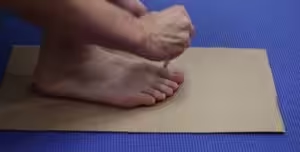
- Place your foot on top of the paper.
- This should be a firm flat piece of paper on a firm flat piece of floor.
- Try to put your foot on the paper the long ways.
- Grab a piece of paper and draw an outline around your foot trying to keep the pen vertical or the pencil vertical.
- Draw the outline of your foot all the way around your foot.
- Drawing this line is okay around the sock, but don’t actually be wearing shoe.
 Step four:
- Draw a rectangle around the foot.
- This is the width and the length of the foot.
- Measure the length, and measure the width.
- This is the length and width of your foot.
- Subtract 3/16 of an inch from each number.
- This is accommodate the small space between the line made by the pencil in your actual foot.
- Use Google define the sizing chart for your foot. Depending on the country or in can use European sizes or American sizes. Make sure you’re using the appropriate one for your order.
- It is possible to order off Amazon from Europe or from another country. So just be aware of your ordering the right size.
- Make sure if you are woman, you are using woman sizes and if you are a man you are using men sizes.
- This one gets me all the time in the clinic when I am grabbing inserts for somebody!
- It’s always possible that your shoe size all that big or little bit small.
- At this point you can use our guide for making sure they shoe fit smaller or smaller shoe fits bigger.
Shoe Size Calculator & Conversion Chart
Enter the tracing measurements from the steps above. This converts your foot length and width into US, UK and EU sizing, plus the width letter to ask for.
Measure standing, at the end of the day, in the socks you will wear. Your arch flattens under body weight, so a seated tracing reads short. Feet swell through the day. Always fit the larger foot — most people have one foot up to a half size bigger.
| Foot length (cm) | Inches | US men | US women | UK | EU |
|---|---|---|---|---|---|
| 22.0 | 8.66″ | 3.5 | 5 | 3 | 35 |
| 22.5 | 8.86″ | 4 | 5.5 | 3.5 | 36 |
| 23.0 | 9.06″ | 5 | 6.5 | 4.5 | 37 |
| 23.5 | 9.25″ | 5.5 | 7 | 5 | 37.5 |
| 24.0 | 9.45″ | 6 | 7.5 | 5.5 | 38.5 |
| 24.5 | 9.65″ | 6.5 | 8 | 6 | 39 |
| 25.0 | 9.84″ | 7 | 8.5 | 6.5 | 40 |
| 25.5 | 10.04″ | 8 | 9.5 | 7.5 | 41 |
| 26.0 | 10.24″ | 8.5 | 10 | 8 | 41.5 |
| 26.5 | 10.43″ | 9 | 10.5 | 8.5 | 42.5 |
| 27.0 | 10.63″ | 9.5 | 11 | 9 | 43 |
| 27.5 | 10.83″ | 10 | 11.5 | 9.5 | 44 |
| 28.0 | 11.02″ | 10.5 | 12 | 10 | 44.5 |
| 28.5 | 11.22″ | 11 | 12.5 | 10.5 | 45 |
| 29.0 | 11.42″ | 11.5 | 13 | 11 | 45.5 |
| 29.5 | 11.61″ | 12 | 13.5 | 11.5 | 46.5 |
| 30.0 | 11.81″ | 13 | 14.5 | 12.5 | 47.5 |
| 30.5 | 12.01″ | 13.5 | — | 13 | 48 |
| 31.0 | 12.20″ | 14 | — | 13.5 | 48.5 |
Shoe Fit and Foot Health in Michigan: Podiatric Footwear Guidance
Proper shoe fit is one of the most important factors in foot health — the wrong shoes cause or worsen bunions, hammer toes, neuromas, plantar fasciitis, and stress fractures, while the right shoes prevent progression of structural deformities and reduce foot pain during daily activity. Michigan podiatrists at Balance Foot & Ankle provide evidence-based footwear guidance for patients with specific foot conditions: extra-depth shoes with wide toe boxes for bunions and hammer toes; rocker-sole shoes for hallux rigidus and metatarsalgia; motion-control or stability shoes for overpronation; neutral-cushioned shoes for high arch deformity; and diabetic therapeutic footwear with soft insoles and no interior seams for diabetic patients. For patients requiring therapeutic footwear covered by Medicare (the Therapeutic Shoe Benefit for qualifying diabetic patients), we dispense and fit approved therapeutic shoes at our practice. Michigan patients with shoe fit questions for specific foot conditions can call Balance Foot & Ankle at (810) 206-1402 to schedule at our Howell or Bloomfield Township office.
Expert Podiatric Care in Michigan: Balance Foot & Ankle
Related Treatment Guides
- Plantar Fasciitis & Heel Pain Treatment
- Custom 3D Orthotics
- Sports Foot & Ankle Injury Treatment
- Bunion Treatment
Michigan patients with foot or ankle concerns — whether they involve acute injuries, chronic pain patterns, structural deformities, nail problems, or diabetic complications — can access expert fellowship-trained podiatric care at Balance Foot & Ankle. We serve Livingston County patients from our Howell office at 4330 E Grand River and Oakland County patients from our Bloomfield Township office at 43494 Woodward Ave #208. Same-week new patient appointments are available; we accept Blue Cross Blue Shield of Michigan, Aetna, UnitedHealthcare, Cigna, Medicare, and most Medicare Advantage plans. In-office digital X-ray and musculoskeletal ultrasound are available at both locations for same-visit diagnostic imaging. Michigan patients ready for expert foot care can call Balance Foot & Ankle at (810) 206-1402.
In-Office Treatment at Balance Foot & Ankle
If home treatment isn’t providing relief for your foot and ankle conditions, our podiatry team at Balance Foot & Ankle can help with same-week evaluations and advanced in-office care.
Medical References & Sources
- American Podiatric Medical Association — Patient Education
- American Orthopaedic Foot & Ankle Society — Foot Conditions
📍 Located in Michigan?
Our board-certified podiatrists treat this condition at two convenient locations. Most new patients are seen the same week.
Need Help Finding the Right Shoe Fit?
Poorly fitting shoes contribute to bunions, hammertoes, neuromas, and plantar fasciitis. Our podiatrists provide professional foot measurements and biomechanical assessments to recommend the ideal footwear for your foot type.
References
- Buldt AK, Menz HB. Incorrectly fitted footwear, foot pain and foot disorders: a systematic review. J Foot Ankle Res. 2018;11:43.
- Menz HB, et al. Footwear characteristics and foot problems in older people. Gerontology. 2005;51(5):346-351.
- Branthwaite H, et al. The effect of shoe fit on gait and plantar pressure. Footwear Sci. 2013;5(sup1):S10-S11.
📋 Dr. Tom Also Recommends
Podiatrist Recommended Orthotics 2026: Dr. Tom’s Top 10 Insoles & Arch Supports
A podiatrist’s complete clinical guide to the best insoles — custom orthotics, OTC picks, and what actually works for plantar fasciitis, flat feet, neuropathy & more.
Read the Full Guide →Insurance Accepted
BCBS · Medicare · Aetna · Cigna · United Healthcare · HAP · Priority Health · Humana · View All →
Howell Office
4330 E Grand River Ave
Howell, MI 48843
Get Directions →
Bloomfield Township Office
43494 Woodward Ave, #208
Bloomfield Township, MI 48302
Get Directions →
Your Board-Certified Podiatrists



Ready to Get Back on Your Feet?
Same-week appointments available at both locations.
Book Your Appointment👟 Dr. Tom’s Complete Footwear Library
Podiatrist-Approved Guides for Every Foot Type & Condition
Clinically reviewed by Dr. Tom Biernacki, DPM — Board-Certified Podiatrist
All guides are written and reviewed by licensed podiatrists. Schedule an appointment →
Podiatrist-Recommended Products
🏆 PowerStep Pinnacle Orthotic Insoles — The most-recommended OTC insole in our clinic. Physician-grade arch support.
CURREX RunPro Insoles — Dynamic arch support for active patients. Three arch profiles.
Doctor Hoy’s Natural Pain Relief Gel — Apply to sore feet after long days.
More Podiatrist-Recommended Shoes Essentials
Hoka Clifton 10

Max-cushion neutral runner — podiatrist favorite for all-day comfort.
Brooks Adrenaline GTS 25
Stability runner for overpronators — great for flat feet and bunions.
New Balance 990v6
Premium walking shoe with wide toe box — bunion and flat-foot friendly.
As an Amazon Associate, Balance Foot & Ankle earns from qualifying purchases. Product recommendations are based on clinical experience; prices and availability shown above update live from Amazon.
 Diabetic Shoes 8 – Balance Foot & Ankle” class=”wp-image-44762″ loading=”lazy” decoding=”async”>
When to See a Podiatrist
The right shoe shape, last, and stability category is more important than brand. Balance Foot & Ankle evaluates your foot type (neutral, pronator, supinator, high-arched) and recommends specific shoe models that match. Bringing in your current pair lets us spot wear patterns that reveal gait issues — a free 5-minute assessment that can prevent years of foot pain.
Call Balance Foot & Ankle: (810) 206-1402 · Book online · Offices in Howell & Bloomfield Township

Dr. Tom Biernacki, DPM is a board-certified foot & ankle surgeon (ABFAS & ABPM) at Balance Foot & Ankle Specialists in Southeast Michigan. With over a decade of clinical experience, he specializes in heel pain, bunions, diabetic foot care, sports injuries, and minimally invasive surgery. Dr. Biernacki is a member of the APMA and ACFAS, and his patient education content on MichiganFootDoctors.com and YouTube has made him one of the most-followed foot & ankle educators on YouTube.