
In This Guide
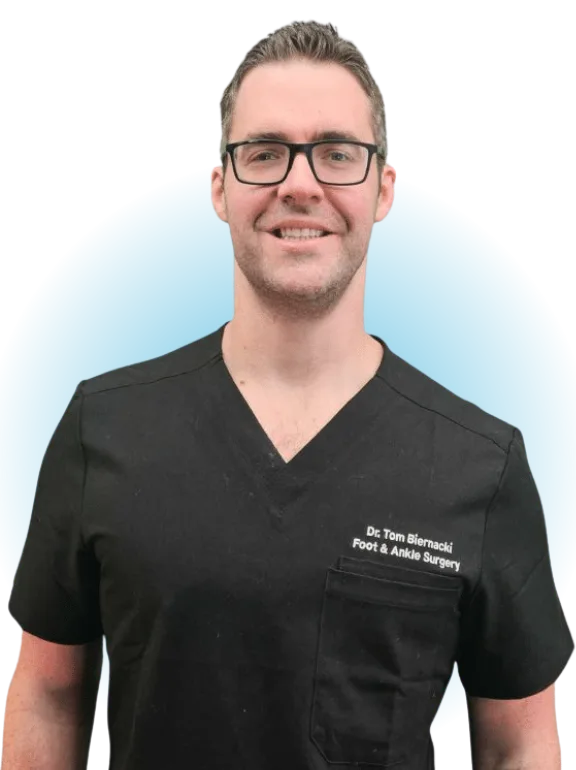
Medically reviewed by Dr. Tom Biernacki, DPM
▶ Watch
Board-certified podiatric surgeon | Balance Foot & Ankle
Last reviewed: April 2026
When to seek evaluation for Achilles tendon reconstruction:
- Persistent weakness pushing off when walking or climbing stairs months after a rupture
- Visible gap or defect in the Achilles tendon area
- Chronic Achilles pain that has failed conservative treatment for 6+ months
- Prior Achilles repair that has re-ruptured
- Inability to perform a single-leg heel raise on the affected side
March 2026 |
When Primary Repair Is Not Possible
 Achilles tendon reconstruction surgery – tendon transfer chronic rupture, Balance Foot & Ankle Howell MI” class=”wp-image-57389″ width=”1200″ height=”630″ loading=”eager” fetchpriority=”high” decoding=”async”/>
Watch: Achilles Tendonitis & Back of Heel Pain [BEST Home Treatments 2024!] — MichiganFootDoctors YouTube
Acute Achilles tendon ruptures diagnosed and treated within the first weeks of injury can typically be repaired by reapproximating the ruptured tendon ends. However, patients who present late — weeks to months after rupture without diagnosis or treatment — develop a chronic rupture with significant tendon retraction, scar tissue filling the gap, and degeneration of the tendon stumps that precludes simple end-to-end repair. These chronic ruptures, along with large defects following debridement of severely degenerate tissue in insertional tendinopathy, require reconstructive techniques using tendon transfers or grafts to restore plantarflexion strength and functional push-off.
Flexor Hallucis Longus Transfer
 tendon transfer for Achilles reconstruction – surgical technique podiatrist Michigan” class=”wp-image-57391″ width=”800″ height=”450″ loading=”lazy” decoding=”async”/>
The flexor hallucis longus (FHL) tendon — which runs behind the ankle and is the primary flexor of the hallux — is the most commonly used transfer for Achilles tendon augmentation and reconstruction. The FHL has several anatomical advantages: it lies immediately adjacent to the Achilles in the posterior ankle, its fiber orientation parallels the Achilles, it is in phase with the Achilles during gait (both are active during propulsion), and its harvest produces minimal donor site morbidity because the intrinsic foot muscles compensate for the lost hallux flexor strength in most patients.
FHL transfer for chronic Achilles rupture involves harvesting the tendon from the posterior ankle or midfoot depending on the length required, passing it through a bone tunnel in the calcaneus at the Achilles insertion, and securing it under physiological tension. The existing Achilles tendon stumps are incorporated into the reconstruction to add bulk and biological stimulation. For gaps of 3 to 5 centimeters, FHL transfer alone typically suffices. For larger defects, the transfer may be combined with a V-Y advancement of the gastrocnemius aponeurosis or supplemented with allograft tissue.
 V-Y advancement Achilles repair – allograft reconstruction chronic rupture Michigan” class=”wp-image-57388″ width=”800″ height=”450″ loading=”lazy” decoding=”async”/>
V-Y advancement and allograft options for large Achilles tendon defects
The V-Y advancement technique lengthens the gastrocnemius-soleus musculotendinous unit by making a V-shaped incision in the aponeurosis that, when closed as a Y, advances the muscle-tendon junction distally to bridge a moderate gap without compromising the intrinsic strength of the muscle. This technique is frequently combined with FHL transfer for gaps of 4 to 6 centimeters. For the largest defects, Achilles tendon allograft — processed cadaveric Achilles tissue — can reconstruct the entire tendon and restore structural continuity when insufficient native tissue remains. Recovery from Achilles reconstruction requires a longer non-weight-bearing period than primary repair — typically 8 to 12 weeks — followed by graduated functional rehabilitation with return to sport at 9 to 18 months depending on the reconstruction used.
Recovery Products After Achilles Reconstruction
Recovery from Achilles tendon reconstruction is demanding. These products support each phase of rehabilitation from immobilization through return to activity.
BraceAbility Walking Boot provides controlled weight-bearing during the critical transition from cast immobilization. A rocker-bottom walking boot reduces strain on the reconstructed tendon while allowing progressive loading. Check price on Amazon
PowerStep Pinnacle Arch Supports are essential once patients transition to regular footwear. Proper arch support offloads the Achilles during the final healing phase and prevents compensatory injuries from altered gait mechanics. Check price
SB SOX Compression Socks manage the persistent ankle swelling that accompanies Achilles reconstruction recovery. Graduated compression improves venous return and reduces the edema that limits range of motion during rehabilitation. Check price
Affiliate disclosure: We may earn a small commission on qualifying purchases at no cost to you. We only recommend products we use in our clinic.
More Podiatrist-Recommended Achilles Essentials
Achilles Night Splint
United Ortho dorsiflexion splint — reduces morning Achilles tendon stiffness.
Cushioned Running Shoe

Hoka Clifton 10 — max-heel-cushion offloads the Achilles with every step.
Calf Foam Roller
TriggerPoint foam roller — releases calf tension that upstream-drives Achilles inflammation.
As an Amazon Associate, Balance Foot & Ankle earns from qualifying purchases. Product recommendations are based on clinical experience; prices and availability shown above update live from Amazon.

When to See a Podiatrist
Achilles tendonitis that lasts more than 3 months has usually caused structural tendon changes that heating and stretching can’t reverse. Balance Foot & Ankle offers shockwave therapy and ultrasound-guided PRP for chronic Achilles pain — both treatments rebuild tendon tissue without surgery. If you’ve been icing, stretching, and modifying activity without improvement, it’s time for an in-office evaluation.
Call Balance Foot & Ankle: (810) 206-1402 · Book online · Offices in Howell & Bloomfield Township
Frequently Asked Questions About Achilles Reconstruction
How long does recovery take after Achilles tendon reconstruction?
Recovery from Achilles reconstruction with tendon transfer typically takes 6 to 12 months. The first 6 to 8 weeks involve non-weight-bearing in a cast, followed by progressive weight-bearing in a walking boot. Physical therapy begins at 8 to 12 weeks, with return to full activity between 9 and 12 months depending on the reconstruction technique used.
Will I lose toe strength after FHL tendon transfer?
The flexor hallucis longus tendon powers big toe push-off, and its transfer to the calcaneus does reduce isolated big toe flexion strength. However, most patients compensate well because the other toe flexors share the workload. The trade-off — restoring powerful ankle push-off at the cost of some toe grip strength — is favorable for the majority of patients.
Can a chronically ruptured Achilles tendon heal without surgery?
Chronic Achilles ruptures with significant retraction and tendon gap rarely heal to functional strength without surgical reconstruction. While the body forms scar tissue in the gap, this tissue lacks the organized collagen structure needed for effective push-off. Patients with chronic ruptures typically experience persistent weakness and altered gait without surgical intervention.
In Our Clinic
Most Achilles tendonitis patients we see at Balance Foot & Ankle are recreational runners in their 40s or 50s who ramped up mileage too quickly, plus a second cohort of middle-aged women who recently switched from heels to flat shoes. The first question we ask is whether the pain is at the insertion on the heel bone versus 2–6 cm up the mid-substance — the treatment ladder is genuinely different. Eccentric heel-drops, heel lifts, and a soft-strike gait retraining pass resolve ~80 % of cases. The ones who aren’t improving by week 8 usually have an unrecognized Haglund’s deformity or insertional calcific tendinosis that needs imaging.
The Bottom Line
Achilles tendon reconstruction with tendon transfer, V-Y advancement, or allograft provides a path back to functional walking and activity when primary repair is not possible. The choice of surgical technique depends on defect size, tendon quality, and patient goals. If you have a chronic Achilles rupture or failed prior repair in Howell or Bloomfield Township, Michigan, a consultation with our board-certified podiatric surgeon can determine the best reconstruction strategy for your situation.
Ready to Get Relief?
Book online 24/7 in Howell & Bloomfield Township, MI
4.9★ | 1,200+ Reviews | 3,000+ Surgeries
Or call: (810) 206-1402
Insurance Accepted
BCBS · Medicare · Aetna · Cigna · United Healthcare · HAP · Priority Health · Humana · View All →
Howell Office
4330 E Grand River Ave
Howell, MI 48843
Get Directions →
Bloomfield Township Office
43494 Woodward Ave, Suite 208
Bloomfield Township, MI 48302
Get Directions →
Ready to Get Back on Your Feet?
Book online 24/7 at either office.
Watch: Achilles Reconstruction & Tendon Transfer
Dr. Tom on chronic Achilles rupture — FHL tendon transfer, Achilles V-Y advancement, turn-down flap, defect-size decision algorithm, recovery (6-12 months), outcomes.
Achilles Recon Recovery Kit
Long recovery, structured kit. Dr. Tom’s kit:
As an Amazon Associate, Balance Foot & Ankle earns from qualifying purchases. This supports our free patient education content.
Weeks 1-12 plantarflexion.
Weeks 12-26 return-to-shoe.
Tendon healing support.
Topical posterior relief.
Related: Achilles Tendonitis · Acute Rupture · Book Chronic Achilles Eval
In-Office Treatment at Balance Foot & Ankle
If home treatment isn’t providing relief for your Achilles tendon, our podiatry team at Balance Foot & Ankle can help with expert evaluations and advanced in-office care.
Book online 24/7. (810) 206-1402
Learn about our heel and Achilles treatment → | Book online →

Dr. Tom Biernacki, DPM is a board-certified foot & ankle surgeon (ABFAS & ABPM) at Balance Foot & Ankle Specialists in Southeast Michigan. With over a decade of clinical experience, he specializes in heel pain, bunions, diabetic foot care, sports injuries, and minimally invasive surgery. Dr. Biernacki is a member of the APMA and ACFAS, and his patient education content on MichiganFootDoctors.com and YouTube has made him one of the most-followed foot & ankle educators on YouTube.
More questions patients ask
How long does an ankle sprain take to heal?
Recovery time depends on severity: Grade 1 (mild stretching) typically heals in 1-3 weeks, Grade 2 (partial tear) in 3-6 weeks, and Grade 3 (complete tear) in 6-12 weeks or longer. Proper rehabilitation is critical to prevent chronic ankle instability, which affects up to 40% of patients who don't receive adequate treatment. Dr. Biernacki creates customized recovery plans.
When should I see a doctor for a sprained ankle?
Seek professional evaluation if you can't bear weight, notice significant swelling or bruising, hear a pop at the time of injury, have numbness, or if pain hasn't improved after 5-7 days of RICE treatment. X-rays or MRI may be needed to rule out fractures. Dr. Biernacki sees urgent problems. Call 810-206-1402 and we’ll find the soonest opening.
Can a sprained ankle heal without treatment?
While mild sprains may heal with rest and home care, undiagnosed ligament tears and improperly rehabilitated sprains frequently lead to chronic ankle instability, recurrent sprains, and early-onset arthritis. A proper evaluation ensures appropriate treatment and reduces your risk of long-term complications significantly.
Still have a question about coverage or cost? Book online and we will check your benefits before your visit: Book in Howell · Book in Bloomfield Township. Prefer to talk it through first? Call (810) 206-1402.