
Affiliate disclosure: Some product links on this page go to Amazon. As an Amazon Associate, Balance Foot & Ankle earns from qualifying purchases, at no extra cost to you.
Medically reviewed by Dr. Tom Biernacki, DPM
Still hurting after switching shoes? Footwear helps, but it can’t fix the underlying problem. See a podiatrist — pick a real appointment time online, 24/7: Howell or Bloomfield Township. Takes about a minute, 24/7.
Board-certified podiatric surgeon | Balance Foot & Ankle
Last reviewed: May 2026
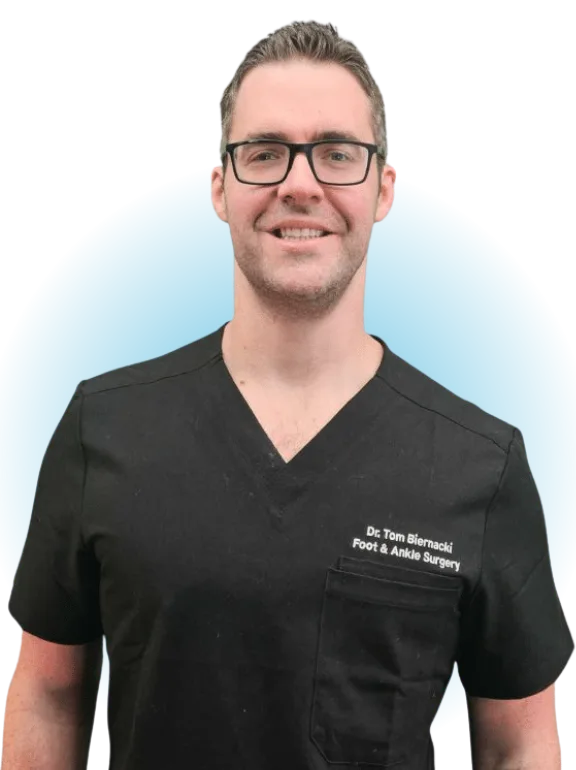
Medically Reviewed by Dr. Tom Biernacki, DPM — Board-Certified Podiatrist, Balance Foot & Ankle | Howell & Bloomfield Township, MI | 4.9 ★ (1,200+ reviews) | 3,000+ surgeries performed
Quick Answer: Best Shoes for High Arches
The best shoes for high arches (cavus foot) provide cushioning under the heel and ball of the foot, a neutral or slight supination correction, and flexible midsoles that allow the rigid high arch to absorb shock. Unlike flat feet, high arches don’t need arch fill — they need impact absorption and lateral stability to prevent ankle sprains. Our top picks balance cushioning with the structural support high-arch patients need to avoid plantar fasciitis, stress fractures, and lateral ankle instability.
Table of Contents
- What Is a High Arch (Cavus Foot)
- Top Shoes for High Arches — Podiatrist Ranked
- Key Features for High-Arch Footwear
- The CURREX Advantage for High Arches
- Best Running Shoes for High Arches
- Conditions High Arches Cause
- Most Common High-Arch Shoe Mistake
- Red Flags: When to See a Podiatrist
- Frequently Asked Questions
- High Arch Treatment in Michigan
- Sources
High arches (pes cavus) are the opposite biomechanical problem from flat feet — but they’re just as clinically significant. In our practice, high-arch patients present most frequently with lateral ankle sprains, plantar fasciitis, metatarsalgia, stress fractures of the metatarsals and lateral foot, peroneal tendinopathy, and Achilles tendinitis. The high arch creates a rigid lever that cannot absorb ground reaction forces properly, transferring them to the plantar fascia, lateral column, and ankle — and most standard shoes are designed for normal to low arches and make high-arch mechanics worse. Here’s exactly what the foot needs.
What Is a High Arch (Cavus Foot)
A cavus foot has an abnormally high medial longitudinal arch that doesn’t flatten appropriately during the loading phase of gait. This rigidity has two major consequences: first, the arch cannot function as a shock absorber, so impact forces are transmitted undamped to the heel, metatarsals, and lateral ankle; second, the foot tends to supinate (roll outward) during gait rather than pronating, concentrating loading on the lateral border of the foot. Because this outward roll is the same mechanic behind underpronation, many cavus-foot patients also benefit from our podiatrist’s guide to the best shoes for supination. Cavus foot is idiopathic in many patients but can also indicate underlying neurological conditions (Charcot-Marie-Tooth disease, Friedrich’s ataxia) — progressive cavus should always be evaluated for neurological cause.
Top Shoes for High Arches — Podiatrist Ranked
These picks are selected for their cushioning depth, lateral stability, and neutral or supination-correction geometry — the specific features that benefit cavus foot biomechanics. I’ve ranked these based on patient outcomes in our clinic, not brand affiliation.
Key Features for High-Arch Footwear
High arches need the opposite of what flat feet need. Avoid motion-control and stability shoes designed for overpronators — these push a high-arch foot into further supination. Here’s what actually works for cavus foot biomechanics.
- Neutral or cushioned category (not stability): Stability shoes have medial posts that prevent arch collapse — exactly the wrong intervention for a high arch that doesn’t collapse. Neutral cushioned shoes allow the foot’s natural motion pattern without adding corrective forces in the wrong direction.
- Maximum cushioning midsole: Because the cavus foot can’t absorb shock through arch flattening, the shoe must compensate with midsole cushioning. HOKA’s thick EVA midsole, Brooks Glycerin, and Asics Gel-Nimbus excel here.
- Wide base for lateral stability: High arches supinate, shifting body weight toward the lateral border of the foot. A wide outsole base reduces lateral instability and ankle sprain risk — particularly important in running shoes for high-arch patients.
- Flexible forefoot: A stiff forefoot amplifies propulsive force transfer to already-stressed metatarsals. Look for shoes that flex easily at the ball of the foot.
- Cushioned heel collar: Achilles tendinitis is extremely common in cavus foot patients due to the foot’s rigid equinus component. A cushioned heel counter and 8–12mm heel drop reduces Achilles tension.
- Removable insole: Standard arch-support insoles are wrong for high arches — but metatarsal pads and lateral wedge insoles can be very helpful. A removable insole allows customization.
CURREX RunPro — The High-Arch Profile Advantage
Unlike standard orthotics, CURREX insoles come in three arch profiles (low, medium, high) — making the high-profile CURREX RunPro specifically designed for cavus foot biomechanics. Rather than pushing arch support into a foot that doesn’t need it, the high-profile CURREX provides forefoot cushioning, metatarsal support, and the specific support geometry a high arch actually requires. For active patients with high arches, the combination of a neutral cushioned shoe plus CURREX RunPro (high profile) is our clinical first-line recommendation.
CURREX RunPro (High Profile) — For High Arches
- High arch profile — designed specifically for cavus foot geometry
- Dynamic TPU shell — supports without overcorrecting supination
- Forefoot cushioning pod — addresses metatarsal stress in high-arch gait
- Works with neutral cushioned shoes — HOKA, Brooks Glycerin, Asics Nimbus
- Not Ideal For: low or flat arches, motion-control shoes, stability footwear
Best Running Shoes for High Arches
Running with high arches dramatically amplifies ground reaction forces and lateral loading. The ideal running shoe for cavus foot combines maximum cushioning (HOKA or Brooks Glycerin thickness), a wide outsole for lateral stability, and a neutral category with no medial posting. Avoid racing flats and minimalist shoes — zero-drop footwear removes the heel lift that partially compensates for cavus foot’s Achilles component.
| Runner Type | Best Pick | Why It Works |
|---|---|---|
| Daily training, high mileage | HOKA Clifton or Bondi (neutral) | Maximum cushion, meta-rocker, wide base |
| Speed work / racing | Brooks Ghost (neutral) | Responsive cushion, flexible forefoot |
| Trail running | HOKA Speedgoat (neutral) | Wide lugged outsole for lateral stability on uneven terrain |
| Treadmill / gym | Asics Gel-Nimbus (neutral) | Gel heel pod + GEL forefoot for dual-zone cushioning |
Conditions High Arches Cause
Understanding your injury risk profile helps you choose footwear that specifically addresses your vulnerability. High-arch patients cluster predictably into these diagnoses.
- Plantar fasciitis: The plantar fascia in a cavus foot is chronically under high tension — any additional stress can trigger inflammation. The fascia in high-arch patients rarely has the stress-relief of arch flattening that helps prevent fasciitis in other foot types.
- Metatarsal stress fractures: Lateral loading concentration in cavus foot puts the 4th and 5th metatarsals at high stress fracture risk, particularly in runners and active military personnel.
- Lateral ankle sprains: Chronic supination means the lateral ligaments (ATFL, CFL) are constantly under stress — and the foot is biomechanically positioned to invert easily. High-arch patients have some of the highest ankle sprain rates of any foot type.
- Peroneal tendinopathy: The peroneal tendons work overtime trying to prevent inversion in cavus foot patients — leading to tendinopathy and occasional longitudinal peroneal tendon tears.
- Achilles tendinitis: The rigid equinus component of many cavus feet keeps the Achilles under chronic tension, predisposing to insertional and mid-substance tendinopathy.
Most Common High-Arch Shoe Mistake
The most common mistake I see with high-arch patients is buying stability or motion-control shoes because they have good arch support. High arches don’t need arch support — they need cushioning and lateral stability. Putting a medial-posted stability shoe on a cavus foot pushes the supinating foot further into inversion, increasing lateral ankle sprain risk and metatarsal stress. Always buy neutral-category shoes for high arches, and add CURREX (high profile) if you need insole support.
Red Flags: When to See a Podiatrist for High Arches
⚠️ See a Podiatrist If You Have High Arches and:
- Progressive increase in arch height over time (may indicate neurological cause — Charcot-Marie-Tooth)
- Recurrent lateral ankle sprains (3+ sprains indicate lateral ligament insufficiency requiring intervention)
- Localized bone pain in the lateral foot with activity (stress fracture must be ruled out)
- New foot drop, toe weakness, or balance problems with cavus foot (neurological workup needed)
- Plantar fasciitis that fails to respond to 6 weeks of neutral shoes and stretching
- Muscle weakness or atrophy in the lower leg accompanying the high arch
Frequently Asked Questions
What type of shoe is best for high arches?
Neutral cushioned shoes with maximum midsole cushioning and wide bases are best for high arches. HOKA, Brooks Glycerin, and Asics Gel-Nimbus consistently perform well. Avoid stability and motion-control shoes — these have medial posts that push a supinating foot further into inversion.
Do people with high arches need arch support?
Generally no — high arches have too much arch, not too little. Standard arch-support insoles that fill the arch cavity can actually increase stress in a cavus foot by reducing the foot’s ability to flex. Instead, high-arch patients benefit from forefoot cushioning, metatarsal support, and lateral wedging to correct supination — available in the CURREX high-profile insole.
Are HOKA shoes good for high arches?
Yes — HOKA’s thick EVA midsole and meta-rocker geometry are well-suited for high arches. The rocker design promotes forward roll without requiring the cavus foot to flatten, and the wide outsole provides lateral stability. Stick to neutral HOKA models (Clifton, Bondi, Mach) — not the stability models (Arahi) which add unwanted medial posting.
Can high arches cause plantar fasciitis?
Yes — high arches create chronically elevated plantar fascia tension. Unlike flat-arch plantar fasciitis (driven by arch collapse), high-arch plantar fasciitis is driven by the fascia being under constant high strain without the stress-relief of arch flattening. Treatment approach differs: cushioning and flexibility exercises are more important than arch support.
When should I see a podiatrist for high arches?
See a podiatrist if your high arches are causing recurrent ankle sprains, stress fractures, persistent plantar fasciitis, or any progressive worsening. Progressive cavus foot — high arch that’s getting higher — needs neurological evaluation. We offer gait analysis and custom high-arch orthotic fabrication at both our Howell and Bloomfield Township locations.
High Arch Evaluation at Balance Foot & Ankle
We offer comprehensive cavus foot evaluation including weight-bearing X-rays, gait analysis, peroneal and Achilles tendon ultrasound when indicated, and custom orthotic fabrication for high-arch patients. Dr. Tom Biernacki has treated hundreds of cavus foot patients — from recreational runners with recurrent sprains to athletes with complex peroneal tendon pathology. Book online 24/7 at both locations.
High Arch Evaluation & Custom Orthotics
Appointments · Dr. Tom Biernacki DPM · 4.9 ★ (1,200+ reviews)
Book Your AppointmentOr call: (810) 206-1402
Howell: 4330 E Grand River Ave · Bloomfield Township: 43494 Woodward Ave #208
Sources
- Burns J, Crosbie J, Hunt A, Ouvrier R. “The effect of pes cavus on foot pain and plantar pressure.” Clinical Biomechanics. 2005;20(9):877-882.
- Manoli A 2nd, Graham B. “The supinated foot types.” Foot & Ankle International. 2005;26(10):874-877.
- Zifchock RA, Davis I, Hillstrom H, Song J. “The effect of gender, age, and lateral dominance on arch height and arch stiffness.” Foot & Ankle International. 2006;27(5):367-372.
- Mayich DJ, Novak A, Vena D, Daniels TR, Brodsky J. “Gait analysis in orthopedic foot and ankle surgery — topical review.” Foot & Ankle International. 2014;35(1):80-90.
Related Conditions & Resources
For more on related conditions and treatments:
- High arch foot causes: pes cavus
- Plantar fasciitis complete guide
- Metatarsalgia: ball of foot pain causes
- Podiatrist-recommended orthotics
- Foot stress fracture treatment
- Howell podiatrist office
- Bloomfield Township podiatrist office
Need to see a podiatrist? Call (810) 206-1402 or book online. Book online 24/7.
Ready to feel better?
Appointments available in Howell and Bloomfield Township, Michigan.
Book Your VisitVitaMedica Arnica Gel
Natural topical relief I recommend for sore feet: an arnica gel with 15 homeopathic ingredients and soothing aloe. Massage a thin layer into the sore area.
Shop VitaMedica Arnica Gel →PowerStep Pinnacle Insoles
Medical-grade arch support. The OTC insole I recommend most in our clinic. Reduces stress on the foot with every step. ($25–35)
Shop PowerStep →In-Office Treatment at Balance Foot & Ankle
If home treatment isn’t providing relief for your high-arch foot pain, our podiatry team at Balance Foot & Ankle can help with expert evaluations and advanced in-office care.

- High Arch Support: PowerStep supination insoles deliver firm, flexible high arch support plus a deep heel cradle for comfort, stability & motion control, helping align feet, reduce pain, and protect against ball & heel pressure.
- All Day Comfort & Support: PowerStep Pinnacle High shoe inserts for women and men use premium dual layer cushioning to deliver heel to toe comfort and responsive bounce back with every step, without going flat.
- Relieves & Helps Prevent Pain: PowerStep Pinnacle High insoles for supination can help alleviate common foot conditions often linked to supination, including plantar fasciitis, Achilles tendonitis, fat pad atrophy, and Morton’s neuroma.
- No Trimming: PowerStep insoles move easily from shoe to shoe. Inserts are sized by shoe size for footwear with removable factory insoles. Designed for walking, running, work & casual dress shoes; pairs well with best walking shoes for women and men.
- Made in the USA: We stand behind our PowerStep Insoles for women and men. Proudly made in the USA & backed by a 30-day money-back guarantee. HSA & FSA Eligible
Book online 24/7. (810) 206-1402
Related Conditions
Appointments in Howell & Bloomfield Township
Three board-certified podiatric surgeons. 1,200+ five-star reviews. Most insurance accepted.

Dr. Tom Biernacki, DPM is a board-certified foot & ankle surgeon (ABFAS & ABPM) at Balance Foot & Ankle Specialists in Southeast Michigan. With over a decade of clinical experience, he specializes in heel pain, bunions, diabetic foot care, sports injuries, and minimally invasive surgery. Dr. Biernacki is a member of the APMA and ACFAS, and his patient education content on MichiganFootDoctors.com and YouTube has made him one of the most-followed foot & ankle educators on YouTube.