
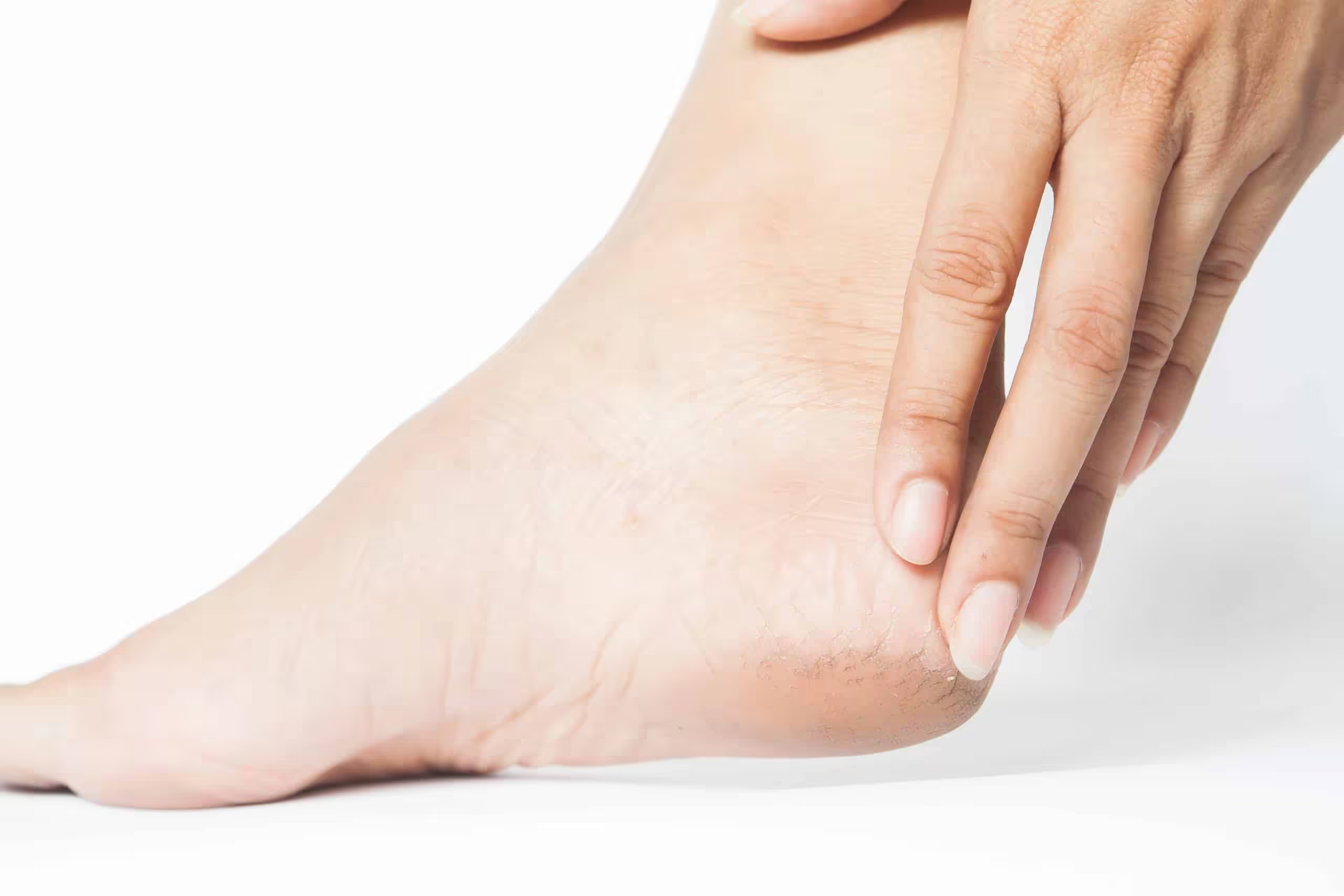
Quick answer: High Heels Foot Health Damage Guide is a common foot/ankle topic that affects many patients. Effective treatment starts with a targeted diagnosis, conservative-first treatment, and escalation only when needed. We treat this regularly at our Howell and Bloomfield Township practices. Call (810) 206-1402.
Medically reviewed by Dr. Tom Biernacki, DPM · Board-Certified Podiatric Surgeon · Last reviewed: April 2026 · Editorial Policy
The most important clinical decision with High Heels Foot Health Damage Guide isn’t which treatment to start with — it’s identifying the correct subtype. That changes everything. Call (810) 206-1402.
Quick Answer
High Heels & Foot Health: What Heels Actually Do to You relates to plantar fasciitis — typically caused by tight calves and arch overload. Most patients improve in 6-12 weeks with conservative care. Same-week appointments in Howell + Bloomfield Township: (810) 206-1402.
Medically reviewed by Dr. Tom Biernacki, DPM — Board-Certified Podiatric Surgeon — Balance Foot & Ankle, Howell & Bloomfield Township, MI. Last updated April 2026.
▶ Watch
Medically Reviewed by Dr. Tom Biernacki, DPM — Board-Certified Podiatrist, Balance Foot & Ankle Specialists, Michigan. Last updated April 2026.
High heels are the most biomechanically harmful footwear regularly worn in Western culture — and they are responsible for a substantial proportion of the forefoot pain, bunion deformity, Achilles pathology, and metatarsalgia seen at Balance Foot & Ankle in Southeast Michigan. This is not a lecture on shoe choice; it is an evidence-based explanation of the specific mechanical effects of elevated heel footwear, what chronic exposure does to foot structure over years, and practical strategies for patients who choose to wear heels while minimizing long-term damage.
Biomechanical Effects of High Heels
Weight transfer to the forefoot: at 3-inch heel height, approximately 76% of body weight is transferred to the forefoot (metatarsal heads and toes) compared to roughly 50% in flat shoes. This dramatic forefoot overloading drives metatarsalgia, sesamoiditis, stress fractures of the metatarsals, and Morton’s neuroma from chronic forefoot compression. First MTP joint loading and bunion progression: the pointed, narrow toe boxes typical of high heels compress the hallux into abduction, accelerating metatarsus primus varus and bunion deformity. High heel wear is the primary environmental driver of bunion progression in patients with a genetic predisposition. The hallux valgus angle increases approximately 1 degree per year of daily heel wearing in susceptible patients. Achilles tendon and calf shortening: a 2-inch heel holds the ankle in approximately 20–25° of plantarflexion. Worn daily for years, this shortens the musculotendinous unit — the Achilles tendon, gastrocnemius, and soleus. Shortened Achilles → increased plantar fascia tension → plantar fasciitis risk; switching from regular heel wearing to flat shoes or barefoot causes sudden Achilles stretching → acute Achilles tendinitis or plantar fasciitis flare. Knee valgus moment increase: high heels increase the valgus (inward collapse) moment at the knee by approximately 25%, which contributes to medial knee osteoarthritis over years. Lumbar lordosis increase: the forward-lean of the torso in high heels increases lumbar extension and paraspinal muscle load, contributing to low back pain in frequent heel wearers.
Practical Harm Reduction Strategies
Heel height reduction: the biomechanical damage scales roughly linearly with heel height; reducing from 3-inch to 1.5-inch reduces forefoot load by approximately 30%. Block heels reduce torsional ankle instability compared to stilettos at the same height. Heel width: wider heels (block or wedge) distribute load more evenly and reduce the forefoot compression of pointed stilettos. Toe box width: the most important single modification — a wide or round toe box eliminates the lateral compression of the hallux even in elevated heel shoes. Wide-toe-box heeled shoes exist and eliminate the bunion and neuromatous component of narrow-toe heel damage. Wearing duration: limiting daily heel-wearing time to <4 hours and alternating with supportive flat shoes reduces cumulative Achilles shortening and forefoot loading. Daily calf stretching: patients who wear heels regularly should perform daily eccentric heel drops (3 × 15 reps on a step) to maintain Achilles and gastrocnemius length. Metatarsal pads: placed just behind the metatarsal heads inside heeled shoes, these provide meaningful reduction of metatarsal head pressure — available at pharmacies and from podiatrists.
More Podiatrist-Recommended Foot Health Essentials
Hoka Clifton 10


Watch: Best Insoles Orthotics 2026 Flat Feet Plantar Fasciitis Bunions — MichiganFootDoctors YouTube
Max-cushion everyday shoe — podiatrist favorite for walking and running.

OOFOS Recovery Slide

Impact-absorbing recovery sandal — wear after long days on your feet.
As an Amazon Associate, Balance Foot & Ankle earns from qualifying purchases. Product recommendations are based on clinical experience; prices and availability shown above update live from Amazon.
When to See a Podiatrist
If foot or ankle pain has been bothering you for more than a few weeks, home care alone may not be enough. Balance Foot & Ankle offers same-week appointments at our Howell and Bloomfield Township clinics — no referral needed in most cases. Bring your current shoes and a short list of symptoms and we’ll build you a treatment plan in one visit.
Call Balance Foot & Ankle: (810) 206-1402 · Book online · Offices in Howell & Bloomfield Township
Frequently Asked Questions
Can wearing high heels cause permanent foot damage?
Yes — chronic daily high heel wearing causes structural changes that can be permanent: bunion deformity (bony change in metatarsal position); Achilles and calf muscle shortening (which persists unless actively reversed with stretching); and in severe cases, hammertoe deformities from chronic toe compression. Metatarsalgia, plantar fasciitis, Morton’s neuroma, and sesamoiditis from heel wear typically resolve when footwear is changed — these are reversible with appropriate treatment. The bony changes (bunion progression, hallux valgus angle) are permanent without surgery. The earlier footwear modification begins, the less structural damage is incurred.
I wear heels every day for work. What can I do to protect my feet?
The most impactful interventions for daily professional heel wearers: (1) switch to the lowest heel height professionally acceptable (1–1.5 inch vs. 3+ inch makes a significant biomechanical difference); (2) insist on wide or round toe box — this single change eliminates 80% of the bunion and neuroma risk of narrow-toe heels; (3) carry flat supportive shoes for walking long distances and change at your desk or in the car; (4) daily calf stretching program (3 × 30 sec per leg, every morning and evening); (5) gel metatarsal pads inside heeled shoes to reduce forefoot pressure; (6) annual podiatric evaluation to monitor for early bunion or neuroma development.
Can I wear heels after bunion surgery?
Low heels (under 1.5 inches) are generally cleared at 3–4 months after bunion surgery (Chevron/MICA) or 5–6 months after Lapidus. Higher heels should be avoided indefinitely because they recreate the biomechanical environment that caused the original bunion — and regular high heel wear after bunionectomy significantly increases recurrence risk. Patients who intend to return to regular high heel wearing after bunion surgery should discuss this expectation with their surgeon before proceeding — the choice of procedure may be affected by anticipated post-operative footwear, and realistic recurrence expectations must be established.
Foot pain from regular heel wearing? Conservative treatment works before structural damage sets in. Contact Balance Foot & Ankle in Southeast Michigan for evaluation with Dr. Biernacki.
Dr. Tom’s Pick: Women’s Shoe Comfort Inserts
📍 Located in Michigan?
Our board-certified podiatrists treat this condition at two convenient locations. Same-day appointments often available.
For women who want comfort without giving up their shoes — Foot Petals cushions work in heels, flats, and sandals.
- Foot Petals Heavenly Heelz — Cushioned heel insert for pumps and heels — eliminates slipping and ball-of-foot pain in dress shoes.
- Foot Petals Tip Toes — Metatarsal cushion for the toe box — stops forefoot pain in heels and narrow shoes.
📧 Get Dr. Tom’s Free Lab Test Guide
Discover the 5 lab tests every person over 35 should ask their doctor about — explained in plain English by a board-certified physician.
Affiliate disclosure: As an Amazon Associate, Balance Foot & Ankle earns from qualifying purchases.
Join 950,000+ Learning About Foot Health
Dr. Tom shares honest medical advice, supplement reviews, and treatment guides you won’t find anywhere else.
Subscribe on YouTube →Insurance Accepted
BCBS · Medicare · Aetna · Cigna · United Healthcare · HAP · Priority Health · Humana · View All →
Howell Office
4330 E Grand River Ave
Howell, MI 48843
Get Directions →
Bloomfield Township Office
43494 Woodward Ave, #208
Bloomfield Township, MI 48302
Get Directions →
Your Board-Certified Podiatrists



Ready to Get Back on Your Feet?
Same-week appointments available at both locations.
Book Your AppointmentWatch: Dr. Tom explains
Podiatrist-recommended products
As an Amazon Associate, Dr. Tom earns from qualifying purchases.
Offload ball-of-foot pressure in high heels and pumps.
View on Amazon →Low-profile arch support for stylish heels and flats.
View on Amazon →End-of-day relief for women in heels all day.
View on Amazon →Evening cryotherapy for forefoot recovery.
View on Amazon →Related resources
Ready to solve this? Book today.
Same-week appointments · Howell & Bloomfield Township · 4.9★ (1,123+ reviews)
☎ (810) 206-1402Book Online →Pros & Cons of Conservative Care for foot care
Advantages
- ✓ Conservative care first
- ✓ Same-week appointments
- ✓ Multiple insurance accepted
Considerations
- ✗ Self-treatment can mask issues
- ✗ See a podiatrist if pain >2 weeks
Dr. Tom’s Recommended Products for foot care
Affiliate disclosure: As an Amazon Associate, Balance Foot & Ankle earns from qualifying purchases. We only recommend products we use with patients.
Footnanny Heel Cream Dr. Tom’s Pick
Best for: Daily moisturizer for cracked heels
Ready to Get Back on Your Feet?
Same-day appointments in Howell + Bloomfield Township. Most insurance accepted. Dr. Tom Biernacki, DPM & team.
Book Today — Same-Day Appointments Available
Call Now: (810) 206-1402
About Your Care Team at Balance Foot & Ankle
Dr. Tom Biernacki, DPM · Board-Certified Foot & Ankle Surgeon. Specializes in conservative-first care, minimally invasive bunion surgery, and complex reconstruction.
Dr. Carl Jay, DPM · Accepting new patients. Specializes in sports medicine, athletic injuries, and routine podiatric care.
Dr. Daria Gutkin, DPM, AACFAS · Accepting new patients. Specializes in surgical reconstruction and pediatric podiatry.
Locations: 4330 E Grand River Ave, Howell, MI 48843 · 43494 Woodward Ave Suite 208, Bloomfield Township, MI 48302
Hours: Mon–Fri 8:00 AM – 5:00 PM · (810) 206-1402
In-Office Treatment at Balance Foot & Ankle
If home treatment isn’t providing relief for your foot and ankle conditions, our podiatry team at Balance Foot & Ankle can help with same-day evaluations and advanced in-office care.
Same-day appointments available. (810) 206-1402
Frequently Asked Questions
When should I see a podiatrist?
If symptoms persist past 2 weeks, affect your normal activity, or are accompanied by red-flag symptoms (warmth, redness, swelling, inability to bear weight).
What does treatment cost?
Most diagnostic visits and conservative treatments are covered by Medicare and major insurers. Out-of-pocket costs vary by your specific plan.
How quickly can I get an appointment?
Most non-urgent cases see us within 5 business days. Urgent cases (sudden pain, possible fracture) typically same or next business day.

Dr. Tom Biernacki, DPM is a board-certified foot & ankle surgeon (ABFAS & ABPM) at Balance Foot & Ankle Specialists in Southeast Michigan. With over a decade of clinical experience, he specializes in heel pain, bunions, diabetic foot care, sports injuries, and minimally invasive surgery. Dr. Biernacki is a member of the APMA and ACFAS, and his patient education content on MichiganFootDoctors.com and YouTube has made him one of the most-followed foot & ankle educators on YouTube.