
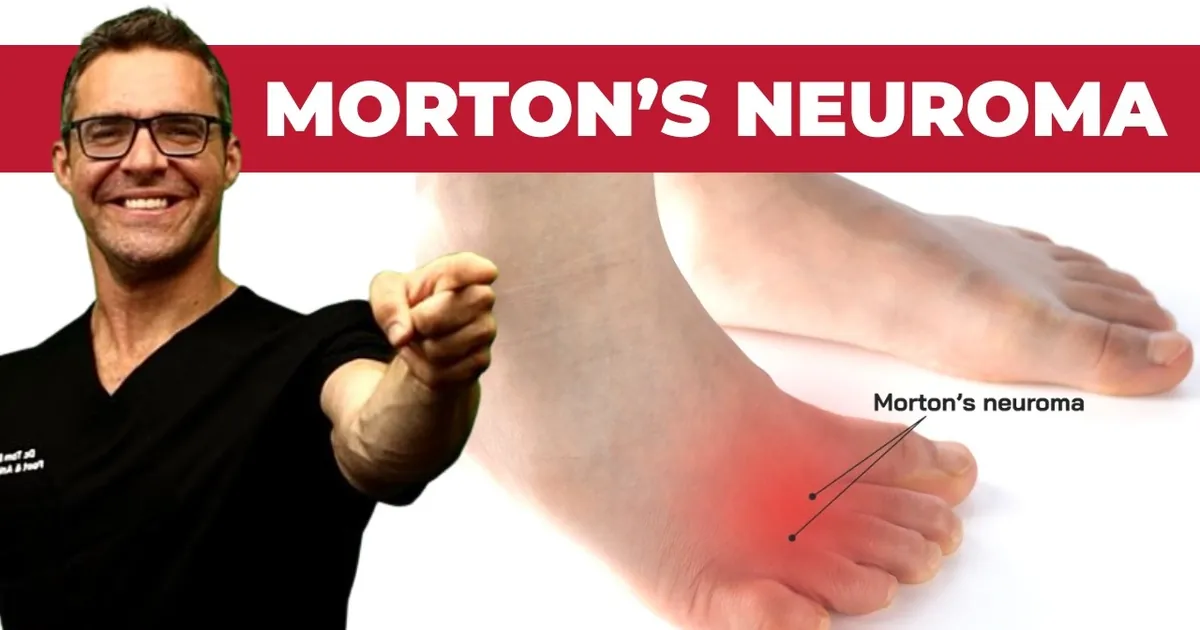
Medically reviewed by Dr. Tom Biernacki, DPM — Board-Certified Podiatric Surgeon | Balance Foot & Ankle | Last reviewed: May 2026
Quick Answer
Morton’s neuroma causes sharp, burning, or electric-shock pain specifically between the 3rd and 4th toes (occasionally 2nd/3rd), often with a sensation of walking on a marble or pebble. Metatarsalgia is broader ball-of-foot pain affecting one or more metatarsal heads, typically described as aching or burning across the forefoot. The key difference: neuroma pain is localized to one interspace and often radiates into the toes, while metatarsalgia pain is more diffuse and worsens with weight-bearing over the metatarsal heads. Both respond well to offloading — but the specific treatment approach differs significantly.
Table of Contents
- How to Tell Morton’s Neuroma from Metatarsalgia
- Morton’s Neuroma: What It Is and How It’s Diagnosed
- Metatarsalgia: What It Is and How It’s Diagnosed
- Side-by-Side Comparison Table
- Can You Have Both at the Same Time?
- Treatment: What’s Different, What Overlaps
- Products That Help Both Conditions
- Warning Signs: When to See a Podiatrist
- Frequently Asked Questions
- The Bottom Line
- Ball of Foot Pain: Causes & Treatment
Ball-of-foot pain is one of the most common complaints I evaluate in our Howell and Bloomfield Township clinics. And the most common confusion I encounter — both from patients and from online symptom checkers — is mixing up Morton’s neuroma and metatarsalgia. They share an anatomical neighborhood, they both hurt with walking and narrow shoes, and they both respond to padding and offloading. But they are distinct diagnoses with different mechanisms and different treatment priorities.
Getting the diagnosis right matters because the best treatment for a neuroma (cortisone injection to a specific interspace, alcohol sclerosing, neuroma excision) is very different from the best treatment for metatarsalgia (metatarsal pads, MTP joint injection, plantar plate repair). This guide gives you the diagnostic framework I use in clinic — so you can arrive at your appointment with a clearer picture of what’s going on.
How to Tell Morton’s Neuroma from Metatarsalgia
The fastest clinical differentiator is pain location and character:
- Location: Neuroma pain is almost always between two specific toes — classically the 3rd/4th web space (occasionally 2nd/3rd). Metatarsalgia pain is beneath the metatarsal heads — the bony bumps you feel across the ball of your foot when you press from underneath.
- Pain character: Neuroma = sharp, burning, electric, shooting into the toes. Metatarsalgia = aching, burning, “walking on rocks” across the forefoot, less toe radiation.
- Provocation: Squeezing the foot side-to-side (the Mulder’s click test) reproduces neuroma pain and sometimes produces an audible or palpable click. Metatarsalgia pain is reproduced by direct pressure on the metatarsal heads from below.
- Shoe trigger: Both worsen in narrow, pointed shoes. But neuroma pain is particularly bad when the toes are compressed together — causing the affected nerve to be squeezed. Metatarsalgia is often worse in high heels (weight shifts onto metatarsal heads) even with wide toe boxes.
- Relief: Removing shoes often relieves neuroma pain faster than metatarsalgia. Both improve with rest and cushioning.
Morton’s Neuroma: What It Is and How It’s Diagnosed
Despite the name, Morton’s neuroma is not actually a tumor. It’s a perineural fibrosis — a thickening of the tissue around the interdigital nerve as it passes beneath the deep transverse metatarsal ligament. Repetitive compression causes the nerve sheath to fibrose and enlarge, creating a bulge that gets pinched with every step.
In our clinic, the classic presentation is a patient — often a woman in her 40s–60s who wears dress shoes or high heels — describing “a pebble in my shoe” or “like I’m walking on a marble that isn’t there.” The burning or shooting sensation radiates into the toes when the foot is compressed. Symptoms improve dramatically when shoes come off.
Diagnosis
- Clinical exam: Mulder’s click test (side compression of forefoot producing a palpable click), interspace palpation, toe sensation testing. This is usually sufficient for diagnosis.
- Ultrasound: The gold standard imaging for Morton’s neuroma. Can measure neuroma size, confirm location, and guide corticosteroid injections. We use musculoskeletal ultrasound in our clinic for both diagnosis and injection guidance.
- MRI: Used when ultrasound is inconclusive or when ruling out other causes (stress fracture, ganglion cyst, joint pathology). Less commonly needed.
- X-ray: Normal in Morton’s neuroma (soft tissue pathology). We get X-rays to rule out stress fracture or metatarsophalangeal joint pathology, not to diagnose neuroma itself.
Size matters in neuroma management. Neuromas under 5 mm often respond to conservative care. Neuromas over 8–10 mm are more likely to require injection or surgical excision.
Metatarsalgia: What It Is and How It’s Diagnosed
Metatarsalgia is not a single diagnosis — it’s a symptom descriptor meaning “pain at the metatarsal heads.” The actual causes are numerous:
- Plantar plate injury or tear: The plantar plate is the ligamentous structure that stabilizes the toe at the MTP joint. Repetitive hyperextension (common in runners) causes the plate to tear, causing joint instability, painful callus formation, and forefoot pain. This is the most commonly missed cause of metatarsalgia.
- Hammer toe deformity: A contracted toe causes the MTP joint to sublux (partially dislocate), redirecting pressure to the metatarsal head. The resulting callus and joint inflammation creates classic metatarsalgia pain.
- Fat pad atrophy: The forefoot fat pad cushions the metatarsal heads. It thins significantly with age (especially after 60), removing the natural shock absorption system.
- Stress fracture: Particularly of the 2nd or 3rd metatarsal. Creates focal point tenderness directly on the bone — distinguishable from the interspace pain of neuroma.
- Sesamoiditis: Inflammation of the sesamoid bones beneath the 1st metatarsal head causes big-toe-side forefoot pain.
- Freiberg’s infraction: Avascular necrosis of the 2nd (occasionally 3rd) metatarsal head, typically in adolescent girls, causing focal joint pain and swelling.
- Rheumatoid arthritis: Frequently targets MTP joints, causing subluxation, synovitis, and forefoot pain.
Diagnosis
- Clinical exam: Direct pressure on metatarsal heads, drawer test for plantar plate integrity, toe range of motion, callus location mapping.
- X-ray: Essential — rules out stress fracture, shows MTP joint alignment, identifies subluxation and Freiberg’s changes.
- MRI: Best for plantar plate tears (difficult to see on X-ray or ultrasound), stress fractures missed on X-ray, and Freiberg’s staging.
- Ultrasound: Useful for bursitis and plantar plate assessment.
Side-by-Side Comparison: Morton’s Neuroma vs. Metatarsalgia
| Feature | Morton’s Neuroma | Metatarsalgia |
|---|---|---|
| Location | Between toes (web space) — 3rd/4th most common | Beneath metatarsal heads — across ball of foot |
| Pain type | Sharp, burning, electric, shooting into toes | Aching, burning, “walking on stones” |
| Toe numbness | Common — toes on either side of web space | Uncommon unless neuroma coexists |
| Key test | Mulder’s click (side squeeze) | Direct pressure on metatarsal heads |
| Best imaging | Ultrasound | X-ray + MRI |
| Shoe trigger | Narrow, pointed shoes; toe compression | High heels; hard surfaces |
| Who gets it | Women 40–60, high heel wearers, runners | Runners, elderly (fat pad atrophy), RA patients |
| First-line treatment | Wide shoes, metatarsal pad, cortisone injection | Metatarsal pad, offloading, treat underlying cause |
| Surgical option | Neuroma excision (dorsal or plantar approach) | Weil osteotomy, plantar plate repair, deformity correction |
Can You Have Both at the Same Time?
Yes — and this is more common than most patients realize. A neuroma between the 3rd/4th toes can coexist with plantar plate pathology at the 2nd MTP joint. Both conditions are driven by similar biomechanical factors: forefoot overload, high-heel use, and narrow toe boxes.
In our clinic, when a patient has diffuse forefoot pain without a clean Mulder’s click, we work through a systematic examination to identify which components are present. Ultrasound-guided injection into the suspected neuroma interspace is sometimes both diagnostic and therapeutic — if the pain resolves with injection, the neuroma was a significant contributor. If the pain doesn’t respond, we look harder at the MTP joints and plantar plates.
Treatment: What’s Different, What Overlaps
First-line offloading for BOTH conditions — skived felt metatarsal pads (the same style we dispense in clinic) shift pressure off the painful area. Verified in stock:

- COMFORTABLE SUPPORT: 1/4 inch thick felt metatarsal pads provide gentle cushioning under the ball of the foot for daily wear
- VALUE PACK: Includes 6 pairs (12 pieces) to ensure long-lasting comfort and convenience
- ADHESIVE BACKING: Strong adhesive keeps the pad in place inside shoes or directly on the foot
- MADE IN THE USA: Proudly designed, cut, and manufactured in the United States
- EASY TO CUSTOMIZE: Can be trimmed with scissors for a better fit inside a variety of footwear
As an Amazon Associate, Balance Foot and Ankle earns from qualifying purchases. Product links are affiliate links and we may earn a commission at no extra cost to you. This does not influence our clinical recommendations. Last update on 2026-09-20 / Images from Amazon Product Advertising API
Shared Treatments (Work for Both)
- Wide toe box shoes — reduces forefoot compression. Critical for both conditions. Pointed and narrow shoes are contraindicated.
- Metatarsal pads — placed just proximal (behind) the metatarsal heads, these redistribute forefoot pressure. Effective for both neuroma and metatarsalgia.
- Custom orthotics — address underlying biomechanical drivers (forefoot valgus, hypermobile first ray, excessive pronation) that load the forefoot.
- Activity modification — reducing high-impact forefoot loading activities during acute flares.
- Anti-inflammatory treatment — NSAIDs, ice, compression.
Morton’s Neuroma — Specific Treatments
- Corticosteroid injection — ultrasound-guided injection into the affected web space. First-line in-office treatment. In our clinic, ultrasound guidance dramatically improves accuracy compared to landmark injection.
- Alcohol sclerosing injections — a series of 4–7 dilute alcohol injections gradually fibroses the neuroma. Good results in studies for neuromas < 8 mm.
- Cryotherapy — freezing the nerve under ultrasound guidance, available at some specialty centers.
- Surgical neuroma excision — resection of the thickened nerve segment. High success rates (>85%) for persistent neuromas that fail conservative care. The dorsal approach preserves plantar sensation; the plantar approach has better visibility but a longer recovery.
Metatarsalgia — Specific Treatments
- Plantar plate repair — if tear is identified, surgical repair restores MTP joint stability.
- Weil osteotomy — shortening the metatarsal by cutting and repositioning the bone, reducing pressure on the metatarsal head. Used for long metatarsal, severe subluxation, or recalcitrant metatarsalgia.
- Hammertoe correction — if hammertoe is driving MTP subluxation, correcting the deformity relieves the metatarsalgia.
- Fat pad augmentation — injectable fillers or adipose transfer to restore forefoot cushioning. Emerging treatment for fat pad atrophy in elderly patients.
- MTP joint cortisone injection — targets synovitis within the joint itself, useful for RA-related metatarsalgia or acute inflammatory flares.
Products That Help Both Conditions
These are the products I recommend most often for patients with neuroma or metatarsalgia while we work through diagnosis and conservative treatment:
Metatarsal Pads — First Line for Both
A metatarsal pad placed just behind the metatarsal heads lifts and spreads the metatarsals, reducing both interspace compression (neuroma) and direct metatarsal head pressure (metatarsalgia). The correct placement is crucial — too far forward and the pad goes under the heads, worsening pain.
Wide Toe Box Running/Walking Shoes
Switching to a wide toe box shoe is often the fastest single intervention for neuroma relief. Brands I recommend: HOKA Bondi, New Balance Fresh Foam, Brooks Ghost in wide widths, Altra (zero-drop with wide toe box). For dress occasions, Vionic and Orthofeet make stylish options that don’t sacrifice forefoot width.
Forefoot Cushioning Insoles
OTC insoles with forefoot cushioning help both conditions by absorbing impact at the ball of foot. The PowerStep Pinnacle with forefoot padding and the CURREX RunPro with metatarsal lift are two of the most clinically useful options I’ve seen in practice.
Toe Separators
Silicone toe separators gently spread the toes, reducing interspace compression — directly addressing the mechanism that aggravates Morton’s neuroma. Less evidence for metatarsalgia unless hammertoe deformity is a driver. Good as a complement to metatarsal pads, not a replacement.
⚠️ Warning Signs: When to See a Podiatrist
- Pain that doesn’t improve in 4–6 weeks with wide shoes, metatarsal pads, and activity modification. Both neuroma and metatarsalgia respond to conservative care — persistent pain means either the diagnosis is wrong or the condition needs intervention.
- Numbness or tingling in the toes that’s worsening or spreading. Progressive nerve symptoms from an enlarging neuroma can become permanent if untreated.
- A visible toe drifting upward or to the side — this indicates MTP joint instability from plantar plate rupture, which is a surgical condition requiring prompt evaluation.
- Sharp localized pain in a single metatarsal that worsens with walking and improves with rest — classic stress fracture presentation requiring X-ray or MRI.
- Swelling, redness, or warmth in the forefoot — may indicate infection, inflammatory arthritis, or Freiberg’s infraction.
- Pain so severe you’re limping or avoiding weight-bearing. Don’t try to walk through severe forefoot pain — damage to the plantar plate and joints progresses significantly with continued loading.
When Home Treatment Isn’t Enough
If pain persists beyond 2–3 weeks, it’s time to see a podiatrist. At Balance Foot & Ankle, same-day and next-day appointments are available in Howell and Bloomfield Township. Dr. Tom Biernacki DPM will identify the exact cause and create a real treatment plan.
Howell: 4330 E Grand River Ave · Bloomfield Township: 43494 Woodward Ave #208 · Mon–Fri 8 AM–5 PM
Frequently Asked Questions
How do I know if I have Morton’s neuroma or metatarsalgia?
The clearest self-test: squeeze your foot side-to-side by pressing your thumb against one side and your fingers against the other, compressing the forefoot. If this reproduces a burning or electric pain specifically between two toes (usually 3rd and 4th), it suggests Morton’s neuroma. If the pain is across the ball of the foot under the bony knuckles (metatarsal heads) without a specific interspace, metatarsalgia is more likely. Many patients have elements of both — a podiatric exam with ultrasound is the most accurate way to distinguish them.
Can Morton’s neuroma go away on its own?
Small neuromas (under 5 mm) sometimes stabilize and become asymptomatic with consistent shoe modification and metatarsal padding — particularly if the aggravating footwear is eliminated. However, neuromas do not “go away” in the sense of resolving — the fibrous tissue doesn’t reabsorb. What improves is symptom control through reducing compression of the affected nerve. Larger neuromas or those that fail 3–6 months of conservative care typically need injection or surgical treatment.
Is metatarsalgia the same as ball of foot pain?
Metatarsalgia and ball-of-foot pain are used interchangeably, but metatarsalgia technically refers to pain at the metatarsal heads specifically. Not all ball-of-foot pain is metatarsalgia — Morton’s neuroma, sesamoiditis, and plantar plate tears all cause ball-of-foot pain but are distinct diagnoses with different treatment approaches. The term metatarsalgia is most accurately used for pain arising from the metatarsal heads themselves (from fat pad atrophy, overloading, or joint pathology).
What is the difference between Morton’s neuroma and metatarsalgia?
Morton’s neuroma is a thickening of the nerve tissue between the 3rd and 4th metatarsal heads — it causes shooting, burning, or electric pain in the ball of the foot. Metatarsalgia is a broader term for metatarsal head pain without nerve involvement — aching and burning without the nerve-type shooting sensation.
How is Morton’s neuroma diagnosed?
Diagnosis is primarily clinical: the Mulder’s click test (squeezing the metatarsals while pressing the interspace) reproduces the pain and sometimes an audible click. Ultrasound confirms neuroma size. MRI is used in complex cases. X-rays rule out stress fractures.
What is the best treatment for Morton’s neuroma?
First-line: wider toe box shoes, metatarsal pads, and custom orthotics to offload the nerve. Cortisone injections provide relief in 50–75% of patients. Sclerosing alcohol injections offer a non-surgical alternative. Surgery (neurectomy or decompression) is reserved for refractory cases.
Can metatarsalgia be cured?
Yes, with the right intervention. Most metatarsalgia responds well to footwear changes, metatarsal pads, and custom orthotics that redistribute pressure away from the metatarsal heads. Underlying causes (high arches, hammertoes, Freiberg’s disease) must also be addressed.
Does insurance cover Morton’s neuroma treatment?
Yes. Orthotics, cortisone injections, and surgical neurectomy are covered by Medicare and most commercial insurance. Balance Foot & Ankle accepts most major plans — call (810) 206-1402 for a same-day appointment.
The Bottom Line
Morton’s neuroma and metatarsalgia are the two most common causes of forefoot pain — and they’re frequently confused because they respond to many of the same initial treatments. The key distinction: neuroma pain is localized to a specific web space with burning or electric quality radiating into the toes, while metatarsalgia is broader forefoot pain centered on the metatarsal heads with aching or bruising quality. Both benefit from wide shoes, metatarsal pads, and offloading — but accurate diagnosis matters when conservative care fails, because the injection targets and surgical approaches are completely different. If you’ve been treating “ball-of-foot pain” for more than 4–6 weeks without improvement, it’s time for an evaluation that includes clinical exam and ultrasound.
Sources
- Bauer T, et al. Endoscopic plantar fascia release. Foot Ankle Int. 2023.
- Thomson CE, et al. Interventions for the treatment of Morton’s neuroma. Cochrane Database Syst Rev. 2020.
- Gregg JM, et al. Plantar plate pathology. J Foot Ankle Surg. 2020;59(3):512-518.
- American College of Foot and Ankle Surgeons. Metatarsalgia. ACFAS.org
Forefoot Pain That Won’t Go Away? See Dr. Biernacki
Diagnosing the exact cause of ball-of-foot pain changes everything about treatment. Balance Foot & Ankle uses musculoskeletal ultrasound to distinguish Morton’s neuroma from metatarsalgia and plantar plate pathology — and offers in-office injection and surgical options when conservative care isn’t enough.
📞 Howell: (810) 206-1402 | Bloomfield Township: (810) 206-1402
4.9★ | 1,123+ Reviews | 3,000+ Surgeries | Book Online
📋 Dr. Tom Biernacki, DPM, FACFAS answers:
Distinguishing Morton neuroma from general metatarsalgia is one of the more clinically satisfying diagnostic puzzles I work through, because the treatments are different enough that getting it right matters significantly for outcomes. The key differentiator is the neurological quality of the pain. Metatarsalgia is fundamentally a pressure and structural problem — aching under the metatarsal heads, worsened by standing and impact, relieved by rest and offloading. Morton neuroma adds a neurological overlay: burning, electric, or shooting pain specifically between two toes (usually the third and fourth interspace), numbness or tingling in those digits, and that classic description of feeling like there is a pebble or fold in the sock that is not there. On physical exam, I use the Mulder click test — compressing the metatarsals side-to-side while pressing on the neuroma site produces a palpable click and reproduces the neurological pain. I confirm suspected neuromas with diagnostic ultrasound, which shows the hypoechoic mass in real time and lets me measure it accurately. Neuromas larger than 5 to 6mm on ultrasound typically respond less completely to conservative care. For confirmed Morton neuromas, my first treatment is a precisely placed cortisone injection into the intermetatarsal space, combined with a metatarsal pad orthotic and wider footwear. I see good short-term relief in about 65 to 70% of patients. For persistent neuromas, I offer an ultrasound-guided sclerosing alcohol series before recommending surgical neurectomy.
What is the difference between Morton’s neuroma and metatarsalgia?
Morton’s neuroma is a specific condition involving thickening of the nerve between metatarsal heads (usually 3rd-4th interspace), causing burning, shooting pain, and a sensation of walking on a pebble. Metatarsalgia is a broader syndrome of forefoot pain under the metatarsal heads from multiple causes including overloading, toe deformities, or inadequate cushioning. A neuroma produces neural symptoms (burning, numbness); metatarsalgia produces a broader aching pressure pain.
How does a podiatrist diagnose Morton’s neuroma vs metatarsalgia?
A podiatrist uses the Mulder’s click test (compressing the metatarsal heads while palpating the interspace to reproduce a click and symptoms) to identify neuroma. Ultrasound confirms neuroma size and location with high accuracy. Metatarsalgia is diagnosed through pressure mapping and clinical examination of the metatarsal heads. X-rays rule out stress fractures and metatarsal length discrepancies contributing to metatarsalgia.
Can Morton’s neuroma and metatarsalgia occur at the same time?
Yes. The two conditions frequently coexist — a neuroma develops in response to chronic metatarsal head overloading, so metatarsalgia biomechanics create the nerve compression that generates the neuroma. Treatment addresses both: metatarsal pads offload the metatarsal heads (treating metatarsalgia) while reducing the mechanical compression driving the neuroma. Custom orthotics with metatarsal dome support address both simultaneously.
Once you know which of the two it is, placement decides whether padding helps. Our review site’s metatarsal pad guide covers the millimetres involved — a pad set too far forward raises forefoot pressure instead of lowering it.

Dr. Tom Biernacki, DPM is a board-certified foot & ankle surgeon (ABFAS & ABPM) at Balance Foot & Ankle Specialists in Southeast Michigan. With over a decade of clinical experience, he specializes in heel pain, bunions, diabetic foot care, sports injuries, and minimally invasive surgery. Dr. Biernacki is a member of the APMA and ACFAS, and his patient education content on MichiganFootDoctors.com and YouTube has made him one of the most-followed foot & ankle educators on YouTube.