

Quick answer: Peripheral Arterial Disease Feet Michigan is a clinical condition that responds to evidence-based treatment when caught early. Symptoms include pain, swelling, and altered function. Diagnosis requires clinical exam, often imaging. Treatment ladder: conservative care first (4-6 weeks), then targeted interventions if needed. Book online or call (810) 206-1402.
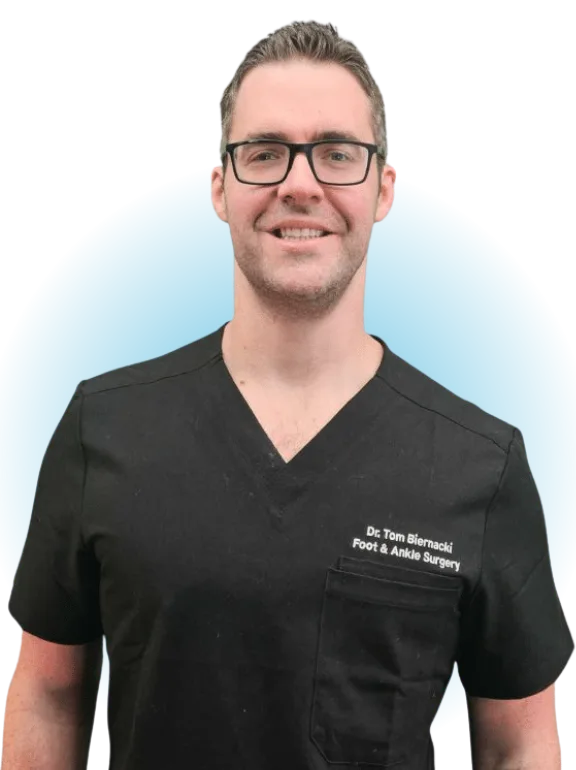
Medically reviewed by Dr. Tom Biernacki, DPM · Board-Certified Podiatric Surgeon · Last reviewed: April 2026 · Editorial Policy
Related Conditions
Quick Answer
Peripheral arterial disease narrows the arteries supplying the legs and feet. It matters for foot health because reduced perfusion turns minor wounds into serious ones, so early detection and vascular referral are the priority. Appointments in Howell + Bloomfield Township: (810) 206-1402.
Peripheral Arterial Disease & Your Feet — What Every Michigan Patient Should Know
What Is Peripheral Arterial Disease?
Peripheral arterial disease (PAD) is a narrowing of the arteries that carry blood from the heart to the legs and feet. It’s caused by the same process of plaque buildup (atherosclerosis) that causes heart attacks and strokes — but the consequences show up first in your feet. At Balance Foot & Ankle in Howell and Bloomfield Township, PAD management is a critical part of the high-risk foot care we provide to Michigan patients.
How Common Is PAD?
PAD affects approximately 8–12 million Americans, with millions more undiagnosed. It becomes significantly more common with age — affecting roughly 1 in 5 adults over age 70. Despite its prevalence, many patients have never discussed PAD with their doctor or podiatrist.
PAD Warning Signs in the Feet
The feet and legs are often the first place PAD becomes noticeable. Warning signs include: leg pain or cramping when walking that goes away with rest (claudication), cold or numb feet, wounds or sores on the feet or toes that won’t heal, changes in foot color (pale or bluish), shiny skin on the legs or feet, slow toenail growth, and hair loss on the legs.
In severe cases, patients experience rest pain — burning or aching in the feet at night, often relieved by hanging the leg off the bed (gravity helps blood flow). This is a sign of critical limb ischemia and requires urgent evaluation.
PAD Risk Factors
The most significant risk factors for PAD are smoking (the #1 modifiable cause — smokers have 2-4 times the risk of non-smokers), diabetes, high blood pressure, high cholesterol, age over 50, family history of heart disease or stroke, and being overweight or sedentary.
PAD and Diabetes: A Dangerous Combination
Diabetes and PAD together dramatically increase the risk of foot complications. Diabetes causes neuropathy (loss of sensation) while PAD reduces healing capacity. A patient with both conditions may injure their foot without feeling it, and then lack the circulation needed to heal — creating the perfect conditions for a serious infection or ulcer.
Our Howell office works closely with Vassallo Medical Group (3399 E Grand River Ave — just minutes away on the same road) for patients with diabetes, vascular disease, and other systemic conditions. Dr. John Vassallo, MD, board-certified internist and past president of the Livingston County Medical Society, coordinates the medical side while we protect your feet.
📞 (810) 206-1402 | 4330 E Grand River Ave, Howell
✅ REMY Class IV Laser — FDA-cleared
✅ EPAT Shockwave Therapy — non-surgical, in-office
✅ 3D-Scanned Custom Orthotics
✅ Toenail Fungus Laser
✅ In-Office X-Ray & Ultrasound
📞 (810) 206-1402 | Howell & Bloomfield Township
Get Evaluated Before a Problem Develops
If you have risk factors for PAD — especially diabetes, smoking history, or vascular disease — a podiatric vascular evaluation can identify problems before they become emergencies. Call Balance Foot & Ankle: (810) 206-1402. We serve Livingston County from our Howell office and Oakland County from Bloomfield Township.
Professional Podiatric Care in Michigan: Balance Foot & Ankle’s Comprehensive Services
At Balance Foot & Ankle, Michigan patients receive comprehensive podiatric care across the full spectrum of foot and ankle conditions. Our fellowship-trained podiatrists provide conservative and surgical treatment for all foot and ankle pathology — from plantar fasciitis, bunions, and nail disorders to complex reconstructive surgery, diabetic foot care, and sports injuries. Our clinical approach prioritizes accurate diagnosis, evidence-based treatment selection, and honest communication with patients about realistic outcomes.
We serve patients in Livingston and Oakland counties from two convenient Michigan locations: our Howell office at 4330 E Grand River (serving Brighton, Hartland, Pinckney, Howell, and all of Livingston County) and our Bloomfield Township office at 43494 Woodward Ave #208 (serving Troy, Birmingham, West Bloomfield, Farmington Hills, and all of Oakland County). Both offices offer in-office X-ray, new patient appointments, and a full range of diagnostic and treatment services. We accept Blue Cross Blue Shield, Aetna, UnitedHealthcare, Cigna, Medicare, and most Michigan insurance plans. Call Balance Foot & Ankle at (810) 206-1402 to schedule your appointment.
Related Treatment Guides
- Peripheral Arterial Disease Foot Care
- Plantar Fasciitis & Heel Pain Treatment
- Custom 3D Orthotics
- Sports Foot & Ankle Injury Treatment
Michigan patients from throughout the region — Livingston County communities including Howell, Brighton, Hartland, Pinckney, and Fowlerville, and Oakland County communities including Bloomfield Township, Troy, Birmingham, West Bloomfield, Farmington Hills, Pontiac, and Rochester — can access expert podiatric care at Balance Foot & Ankle. Our clinical team is committed to providing the highest standard of foot and ankle care available in Southeast Michigan, from routine preventive care to complex surgical intervention. Call (810) 206-1402 to schedule — we look forward to serving you at our Howell or Bloomfield Township location.
Medical References & Sources
- American Podiatric Medical Association — Patient Education
- American Orthopaedic Foot & Ankle Society — Foot Conditions
Join 950,000+ Learning About Foot Health
Dr. Tom shares honest medical advice, supplement reviews, and treatment guides you won’t find anywhere else.
Subscribe on YouTube →📍 Located in Michigan?
Our board-certified podiatrists treat this condition at two convenient locations. Book online 24/7 at either office.
Insurance Accepted
BCBS · Medicare · Aetna · Cigna · United Healthcare · HAP · Priority Health · Humana · View All →
Howell Office
4330 E Grand River Ave
Howell, MI 48843
Get Directions →
Bloomfield Township Office
43494 Woodward Ave, #208
Bloomfield Township, MI 48302
Get Directions →
In-Office Treatment at Balance Foot & Ankle
When conservative care isn’t enough, Dr. Tom Biernacki and the team at Balance Foot & Ankle offer advanced treatment options — including Peripheral Arterial Disease (PAD) Foot Care in Michigan at our Howell and Bloomfield Township clinics.
Book online 24/7. Book online or call (810) 206-1402 or book online.
Pros & Cons of Conservative Care for foot care
Advantages
- ✓ Conservative care first
- ✓ Book online 24/7
- ✓ Multiple insurance accepted
Considerations
- ✗ Self-treatment can mask issues
- ✗ See a podiatrist if pain >2 weeks
Dr. Tom’s Recommended Products for foot care
Affiliate disclosure: As an Amazon Associate, Balance Foot & Ankle earns from qualifying purchases. We only recommend products we use with patients.
Footnanny Heel Cream Dr. Tom’s Pick
Best for: Daily moisturizer for cracked heels
Ready to Get Back on Your Feet?
Appointments in Howell + Bloomfield Township. Most insurance accepted. Dr. Tom Biernacki, DPM & team.
Call Now: (810) 206-1402
Ready for Expert Care?
Appointments in Howell & Bloomfield Township, MI.
4.9★ | 1,200+ Reviews | 3,000+ Surgeries
Or call: (810) 206-1402
