

✅ Medically reviewed by Dr. Thomas Biernacki, DPM — Board-Certified Podiatrist · Last updated April 7, 2026
Medically reviewed by Dr. Tom Biernacki, DPM
Board-certified podiatric surgeon | Balance Foot & Ankle
Last reviewed: April 2, 2026
Treatment at Balance Foot & Ankle: EPAT Shockwave for Heel Pain →
Quick answer: A plantar fascia strain is an acute tear or overstretch of the plantar fascia ligament, distinct from chronic plantar fasciitis. Grade 1 strains heal in 2-4 weeks with rest and ice, while Grade 2-3 strains may take 6-12 weeks. See a podiatrist if you felt a pop, cannot bear weight, or pain persists beyond two weeks of home treatment.

What Is a Plantar Fascia Strain?
The plantar fascia is a thick band of connective tissue that spans the entire sole of the foot, from the calcaneus (heel bone) to the metatarsal heads (ball of the foot). It functions as a spring-like mechanism during gait — storing and releasing energy with each step through the “windlass mechanism.”
A plantar fascia strain occurs when this tissue is stretched beyond its capacity, causing partial tearing of the collagen fibers. The injury typically happens at or near the origin — where the fascia attaches to the heel bone — because this is where mechanical stress is highest.
Strain vs. Plantar Fasciitis — Key Differences
| Feature | Plantar Fascia Strain | Plantar Fasciitis |
|---|---|---|
| Onset | Sudden, during activity | Gradual, over weeks |
| Cause | Acute trauma/overload | Repetitive microtrauma |
| Bruising | Often present | Rare |
| Swelling | Yes, in acute phase | Minimal |
| Morning pain | Constant (not just first steps) | Worst first steps, then improves |
| Recovery time | 2–6 weeks (mild–moderate) | 3–12 months |
Strain Grades
Grade I — Mild
Micro-tears in fascia fibers. Pain during activity but able to walk. Minimal swelling. Recovery: 1–3 weeks.
Grade II — Moderate
Partial tear of fascia. Significant pain, difficulty walking normally. Bruising possible. Recovery: 3–6 weeks.
Grade III — Severe
Complete or near-complete rupture. Unable to walk without severe pain. Visible bruising, swelling. Recovery: 6–12+ weeks.
Symptoms & How to Tell If It’s a Strain
See a podiatrist immediately if you experience:
- Sudden sharp pain with a popping sensation in the arch
- Inability to bear weight on the affected foot
- Significant bruising along the bottom of the foot
- Swelling that does not improve with ice and elevation after 48 hours
- Pain that worsens despite 2 weeks of rest and home treatment
- Sudden onset of pain during a specific activity (the moment you felt it “go”)
- Pain in the heel or arch that is immediate, not gradual
- Bruising on the bottom of the foot (heel or arch area) — a key differentiator from fasciitis
- Swelling at the plantar fascia origin or along the arch
- Pain with all weight-bearing, not just first steps
- Difficulty pushing off the affected foot during walking
- In severe cases, a palpable “gap” or defect in the fascia
Common Causes
Plantar fascia strains typically occur during high-impact activities that place sudden, extreme demand on the fascia:
- Sprinting or jumping — basketball, tennis, volleyball, track and field
- Running on uneven terrain — trail running, hiking
- Stepping on an object — rock, curb, uneven ground
- Sudden change of direction — court sports, soccer
- High-impact landing — jumping down from a height
- Pre-existing weakened fascia — chronic plantar fasciitis that suddenly worsens (the fascia was already damaged and finally gives way)

How We Diagnose It
Clinical diagnosis is based on the sudden onset of symptoms, point tenderness along the plantar fascia, and visible bruising. We use diagnostic ultrasound in-office to visualize the fascia in real-time — it clearly shows partial tears, thickening, and the exact location of the injury. Normal plantar fascia thickness is less than 4mm; a strained fascia typically measures 5–8mm+ and may show hypoechoic (dark) areas indicating tearing.
MRI is reserved for cases where a complete rupture is suspected or when the ultrasound findings are inconclusive.
Treatment by Phase
Acute Phase (Days 1–14): Protect & Reduce Inflammation
- RICE protocol — Rest, Ice (15 min every 2–3 hours), Compression (arch wrap), Elevation
- Immobilization — walking boot for Grade II–III strains to protect the fascia during healing
- No stretching in the first week — unlike chronic fasciitis, aggressive stretching can worsen an acute tear
- Crutches or reduced weight-bearing if pain prevents normal gait
- NSAIDs (ibuprofen or naproxen) — 7–10 days for inflammation control
Subacute Phase (Weeks 2–4): Gradual Loading
- Transition to supportive shoe with orthotic insole (wean off boot for Grade II)
- Gentle calf stretching — begin at week 2 if pain allows
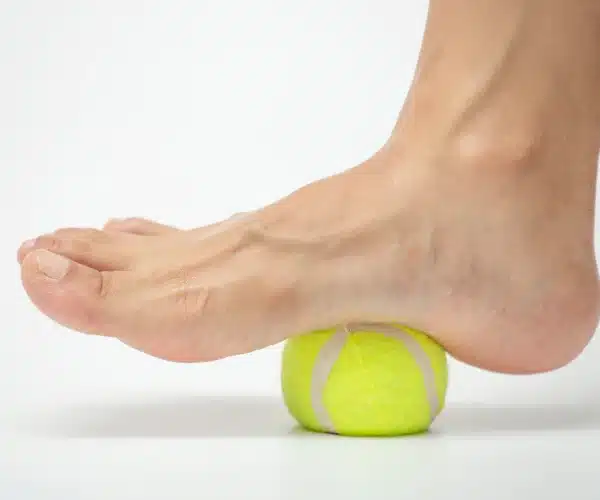
- Plantar fascia massage — rolling a lacrosse ball or frozen water bottle under the arch
- Taping — low-dye taping supports the arch and reduces fascia strain
- Pool walking — maintains fitness without impact
Return-to-Activity Phase (Weeks 4–8+)
- Progressive loading — walking → fast walking → light jogging → sport-specific drills
- Intrinsic foot strengthening — towel scrunches, marble pickups, short foot exercises
- Eccentric calf strengthening — reduces future injury risk
- Continue wearing orthotics during all activity
 heel pain” class=”wp-image-57391″ width=”800″ height=”450″ loading=”lazy” decoding=”async”/>
![Diabetic Foot Care 101 [Diabetic Foot Pain: Podiatrist TREATMENT]](https://www.michiganfootdoctors.com/wp-content/cache/flying-press/a386d125d030385b9d7b05fcf4b12e37.jpg)
Best Products for Plantar Fascia Strain
We recommend these products to our plantar fascia strain patients for faster recovery:
Powerstep Pinnacle Insoles — Our top pick for arch support during plantar fascia strain recovery. The semi-rigid shell supports the fascia while the cushioned top layer reduces impact.
BraceAbility Dorsal Night Splint — Maintains a gentle stretch on the plantar fascia overnight. Patients who use night splints consistently report less morning pain during the first step.
TheraBand Foot Roller — Roll under your arch for 5 minutes, 3 times daily. This targeted massage releases tension in the plantar fascia and promotes blood flow for healing.
Rester’s Choice Ankle Ice Wrap — Cold therapy is critical in the first 72 hours after a strain. This wrap provides compression and ice simultaneously for maximum anti-inflammatory benefit.
OOFOS OOahh Recovery Slides — Wear these around the house during recovery. The OOfoam absorbs 37% more impact than standard foam, reducing stress on the healing fascia.
🏆 #1 Pick — Best Orthotic Insole
PowerStep Pinnacle Orthotic Insole
Essential for both treatment and prevention. The semi-rigid arch shell directly offloads the plantar fascia, reducing strain at the calcaneal origin. Start wearing these once you transition out of a walking boot (or immediately for Grade I strains). Leave them in your shoes at all times — don’t go back to stock insoles.
Best Shoe for Recovery
Hoka Bondi 8
Maximum cushioning protects the healing fascia during the recovery phase. The meta-rocker geometry reduces the demand on the plantar fascia during push-off — exactly what you need when returning to walking after a strain. Removable insole allows insertion of your PowerStep orthotic.
Best for Return to Running
Brooks Ghost 15
When you’re ready to return to running, the Ghost provides the ideal balance of cushioning and responsiveness. 12mm heel drop reduces fascia strain. DNA LOFT midsole absorbs impact. Smooth transitions prevent jarring the healing tissue. Our top pick for post-strain return-to-sport.
Best Night Stretching Device
Strassburg Sock
Begin using at week 2–3 (not during acute phase). Maintains gentle dorsiflexion during sleep to prevent the fascia from contracting overnight. Prevents the “starting over” sensation each morning. Much more comfortable for sleeping than rigid night splints.
Best Recovery Slide
OOFOS OOahh Recovery Slide
Keep these by your bed during recovery. OOfoam absorbs 37% more impact than EVA. Built-in arch support protects the healing fascia when walking around the house. Never go barefoot on hard floors while recovering from a plantar fascia strain.
Rehab Exercises (Start at Week 2+)
1. Calf Stretch (Wall Lean) — Week 2+
Face a wall, one foot forward, one back. Keep back knee straight, heel down. Lean forward gently until you feel a calf stretch. Hold 30 seconds, 3 reps. Repeat with bent knee. Start gently — a 5/10 stretch intensity is sufficient. No sharp pain.
2. Frozen Bottle Roll — Week 1+
Roll a frozen water bottle under your arch for 10 minutes. This provides simultaneous ice therapy and gentle fascia mobilization. Use light pressure — this is for ice and massage, not aggressive stretching of the injured tissue.
3. Towel Scrunches — Week 3+
Place a towel on the floor. Use your toes to scrunch it toward you. 3 sets of 15 reps. This strengthens the intrinsic foot muscles that support the plantar fascia, reducing re-injury risk during return to activity.
4. Single-Leg Balance — Week 4+
Stand on the affected foot with eyes open, then progress to eyes closed. Hold 30 seconds. This rebuilds proprioception and foot-ankle stability. Progress to wobble board when stable on flat ground.
⚠️ Warning Signs — Possible Complete Rupture
See a podiatrist immediately if you experienced: an audible “pop” at the time of injury, rapid onset of significant bruising and swelling, complete inability to push off the foot, a palpable gap or defect in the plantar fascia, or pain so severe that you cannot bear any weight. A complete plantar fascia rupture requires immobilization and may need surgical consultation.
More Podiatrist-Recommended Foot Health Essentials
Hoka Clifton 10

Max-cushion everyday shoe — podiatrist favorite for walking and running.

OOFOS Recovery Slide

Impact-absorbing recovery sandal — wear after long days on your feet.
As an Amazon Associate, Balance Foot & Ankle earns from qualifying purchases. Product recommendations are based on clinical experience; prices and availability shown above update live from Amazon.
When to See a Podiatrist
If foot or ankle pain has been bothering you for more than a few weeks, home care alone may not be enough. Balance Foot & Ankle offers same-week appointments at our Howell and Bloomfield Hills clinics — no referral needed in most cases. Bring your current shoes and a short list of symptoms and we’ll build you a treatment plan in one visit.
Call Balance Foot & Ankle: (810) 206-1402 · Book online · Offices in Howell & Bloomfield Hills
Frequently Asked Questions
The Bottom Line
A plantar fascia strain requires a phased approach: protect the injury in the first 2 weeks, gradually reload with supportive cushioned footwear and arch-supporting orthotics, then strengthen and return to activity. Don’t rush it — returning too soon is the #1 cause of strain recurrence and progression to chronic fasciitis.
Suspected Plantar Fascia Strain?
Our podiatrists use in-office ultrasound to diagnose the exact grade and location of your injury. Same-week appointments available.
📞 (810) 206-1402 · Howell & Bloomfield Hills, MI
Dealing With a Plantar Fascia Strain?
A plantar fascia strain can cause sudden, sharp heel or arch pain. Our podiatrists provide accurate diagnosis and a comprehensive treatment plan to help you recover quickly and prevent recurrence.
📞 Or call us directly: (810) 206-1402
Clinical References
- Stecco C, et al. Plantar fascia anatomy and its relationship with Achilles tendon and paratenon. Journal of Anatomy. 2013;223(6):665-676.
- Wearing SC, et al. The pathomechanics of plantar fasciitis. Sports Medicine. 2006;36(7):585-611.
- Rathleff MS, et al. High-load strength training improves outcome in patients with plantar fasciitis. Scandinavian Journal of Medicine & Science in Sports. 2015;25(3):e292-e300.
Insurance Accepted
BCBS · Medicare · Aetna · Cigna · United Healthcare · HAP · Priority Health · Humana · View All →

Howell Office
3980 E Grand River Ave, Suite 140
Howell, MI 48843
Get Directions →
Bloomfield Hills Office
43700 Woodward Ave, Suite 207
Bloomfield Hills, MI 48302
Get Directions →
Your Board-Certified Podiatrists



Ready to Get Back on Your Feet?
Same-week appointments available at both locations.
Book Your AppointmentIn-Office Treatment at Balance Foot & Ankle
When conservative care isn’t enough, Dr. Tom Biernacki and the team at Balance Foot & Ankle offer advanced, same-day options — including Plantar Fasciitis Surgery Bloomfield Hills at our Howell and Bloomfield Hills clinics.
Same-day appointments available. Call (810) 206-1402 or book online.

Dr. Tom Biernacki, DPM is a double board-certified podiatrist and foot & ankle surgeon at Balance Foot & Ankle Specialists in Southeast Michigan. With over a decade of clinical experience, he specializes in heel pain, bunions, diabetic foot care, sports injuries, and minimally invasive surgery. Dr. Biernacki is a member of the APMA and ACFAS, and his patient education content on MichiganFootDoctors.com and YouTube has reached over one million views.
- Plantar Fasciitis: Diagnosis and Conservative Management (PubMed)
- Plantar Fasciitis (APMA)
- Diagnosis and Treatment of Plantar Fasciitis (PubMed / AAFP)
- Heel Pain (APMA)
Recommended Products from Dr. Tom