


Quick answer: A second toe longer than the big toe is a normal anatomical variant, not a deformity, and most people never have trouble from it. It does shift pressure toward the ball of the foot, so when it causes problems they usually show up as calluses under the second metatarsal, forefoot pain, or occasionally a stress fracture. Call (810) 206-1402.
Foot or ankle pain that isn’t getting better? A podiatrist can diagnose it in one visit — pick a real appointment time online, 24/7: Howell or Bloomfield Township. Takes about a minute, 24/7.
Second Toe Longer Than Big Toe Pain [Causes & Best Treatment]
Second Toe Longer Than Big Toe: Top causes are #1) Metatarsalgia #2) Capsulitis, #3) Plantar plate injury #4) 2nd Metatarsal Stress Fractures: Learn how to FIX IT NOW!
https://youtu.be/E2Pr3vocIB8
Second Toe Longer Than Big Toe:
- This is known as the “Greek” Foot Type.
- A longer big toe is known as the “Egyptian” foot type.
- In most cases the toe length is not the problem, but the joint positioning.
- It the second toe joint is further ahead than the big toe joint, this may lead to chronic foot pain.
- This is a condition called Morton’s toe or Morton’s syndrome.
- This is when the big toe bears less pressure due to a slightly shorter length.
- This will eventually cause metatarsalgia foot pain.
- Metatarsalgia is related to 2nd toe capsulitis, 2nd toe plantar plate injury and even a stress fracture!
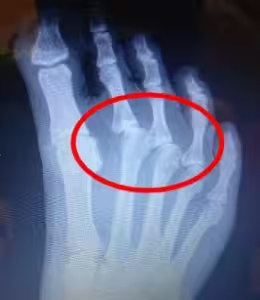
Second Toe Longer Than Big Toe Symptoms:
- This will lead to a more flat foot.
- A flat foot occurs because the foot turns out more to be able to push off with the big toe.
- This leads to hyper mobility of the 1st metatarsal.
- This can lead to bunion formation.
- This is also also leads to knee, hip and back pain.
- Your knee and hip will bend slightly more.
- This can lead to eventual back pain.
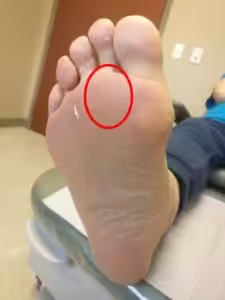
Second Toe Bigger Than Big Toe Causes:
- This is most likely genetic.
- The #1 most common cause is a bunion.
- This is less pressure onto the big toe joint and now more pressure onto the 2nd toe.
- It can also due to a condition called brachymetatarsia.
- This simply means a shorter developed toe.
Specific Causes:
Click on the following links to get more pain and pressure relief.
Middle Toe Bigger Than Big Toe Imaging:
- The 1st metatarsal should be between 2mm longer or 2mm shorter than the 2nd metatarsal.
- If it is longer, this can lead to lack of big toe joint motion.
- This will lead to hallux rigidus.
- If it is shorter than 2mm, this is morton’s toe.
- This will lead to eventual metatarsalgia pain.
Big Toe Shorter Than Second Toe Treatment:
- Conservative treatment is very effective for a second toe longer than the big toe.
- The goal is to control the hyypermobile 1st metatarsal.
- This is done through over the counter orthotics with a lift for the 1st metatarsal.
- This helps the 1st metatarsal contact the ground easier, preventing outward rotation of the foot.
- This lift is up to 1/4″ of an inch.
- Studies show this alone is extremely effective in relieving the pain within a few weeks.
Second Toe Longer Than Big Toe Surgery:
- This is usually not needed unless conservative treatment has failed.
- This is a quick procedure that shortens the 2nd metatarsal.
- 1 screw is then used to fixate the bone.
- If there is a hammer toe present, hammer toe correction is achieved as well.
- This surgery is usually done if there are other foot problems as well.
- These include hammer, claw or mallet toes.
Second Toe Longer Than Big Toe Meaning and Myths:
Some Second Toe Longer Than Big Toe Meaning and Myths include:
- AKA Royal Toe.
- AKA Lamay’s Toe.
- It is genetic, called the “Greek foot type”.
- The genetic long 1st toe is called the “Egyptian” foot type.
- Some say it signifies increased intelligence.
Expert Podiatric Care for Michigan Patients: Balance Foot & Ankle
Related Treatment Guides
Michigan patients with any foot or ankle condition — whether a first-time acute problem or a chronic issue that has not responded to self-care — can access expert podiatric evaluation and treatment at Balance Foot & Ankle. Our fellowship-trained podiatric surgeons provide thorough diagnostic evaluation using weight-bearing digital X-rays and musculoskeletal ultrasound, followed by targeted conservative or surgical treatment appropriate to the specific diagnosis. We treat the full spectrum of podiatric conditions: plantar fasciitis, Achilles tendinopathy and rupture, Haglund’s deformity, bunions, hammertoes, neuromas, peripheral neuropathy, diabetic foot complications, toenail fungus, ankle instability, stress fractures, and more. Balance Foot & Ankle accepts Blue Cross Blue Shield of Michigan, Aetna, UnitedHealthcare, Cigna, Medicare, and most Medicare Advantage plans. Same-week new patient appointments are available at our Howell (4330 E Grand River, serving Livingston County) and Bloomfield Township (43494 Woodward Ave #208, serving Oakland County) offices. Call (810) 206-1402 to schedule.
Medical References & Sources
- American Podiatric Medical Association — Patient Education
- American Orthopaedic Foot & Ankle Society — Foot Conditions
📍 Located in Michigan?
Our board-certified podiatrists treat this condition at two convenient locations. Most new patients are seen the same week.
Concerned About Your Toe Length?
A longer second toe (Morton’s toe) can cause metatarsalgia, calluses, and balance issues. Our podiatrists provide custom solutions for comfortable, pain-free walking.
📞 Or call us directly: (810) 206-1402
Clinical References
- Morton DJ. The Human Foot. Columbia University Press. 1935.
- Glasoe WM, et al. First ray kinematics in Morton’s foot. Foot Ankle Int. 2010;31(11):1034-1038.
- Rodríguez-Sanz D, et al. Foot disorders in older adults. J Am Podiatr Med Assoc. 2013;103(5):352-356.
Insurance Accepted
BCBS · Medicare · Aetna · Cigna · United Healthcare · HAP · Priority Health · Humana · View All →
Howell Office
4330 E Grand River Ave
Howell, MI 48843
Get Directions →
Bloomfield Township Office
43494 Woodward Ave, #208
Bloomfield Township, MI 48302
Get Directions →
Your Board-Certified Podiatrists



Ready to Get Back on Your Feet?
Same-week appointments available at both locations.
Book Your AppointmentMorton's Neuroma & Forefoot Pain Resources
Dr. Tom’s Morton’s Toe Management Protocol
- PowerStep Pinnacle — Morton’s toe with metatarsalgia: metatarsal dome support redistributes pressure away from the 2nd MTP joint — the primary OTC intervention for Morton’s toe-related ball-of-foot pain.
- Doctor Hoy’s Natural Pain Relief Gel — 2nd MTP joint pain from Morton’s toe: arnica + camphor gel applied to the ball of foot 3-4x daily reduces periarticular inflammation at the overstressed 2nd metatarsal head.
- FLAT SOCKS No-Sock Insoles — Morton’s toe in dress shoes: FLAT SOCKS inserts with metatarsal cushion provide relief inside shoes where full insoles don’t fit.
Morton’s toe causing progressive 2nd toe crossover or joint instability? Capsulitis evaluation and 2nd toe stabilization may be needed. Balance Foot & Ankle → (810) 206-1402
In-Office Treatment at Balance Foot & Ankle
If home treatment isn’t providing relief for your foot and ankle conditions, our podiatry team at Balance Foot & Ankle can help with same-week evaluations and advanced in-office care.

Dr. Tom Biernacki, DPM is a board-certified foot & ankle surgeon (ABFAS & ABPM) at Balance Foot & Ankle Specialists in Southeast Michigan. With over a decade of clinical experience, he specializes in heel pain, bunions, diabetic foot care, sports injuries, and minimally invasive surgery. Dr. Biernacki is a member of the APMA and ACFAS, and his patient education content on MichiganFootDoctors.com and YouTube has made him one of the most-followed foot & ankle educators on YouTube.