
Quick answer: Mulder’s click test is the most widely used Morton’s neuroma test: the examiner squeezes the forefoot side-to-side while pressing between the metatarsal heads, and a palpable or audible click with pain suggests a neuroma. It’s a useful bedside sign, but ultrasound or MRI confirms the diagnosis.
Ready to be seen? Book a real appointment time online, 24/7 — Howell or Bloomfield Township. Takes about a minute, 24/7.
Medically reviewed by Dr. Tom Biernacki, DPM
Board-certified podiatric surgeon | Balance Foot & Ankle
Last reviewed: May 2026
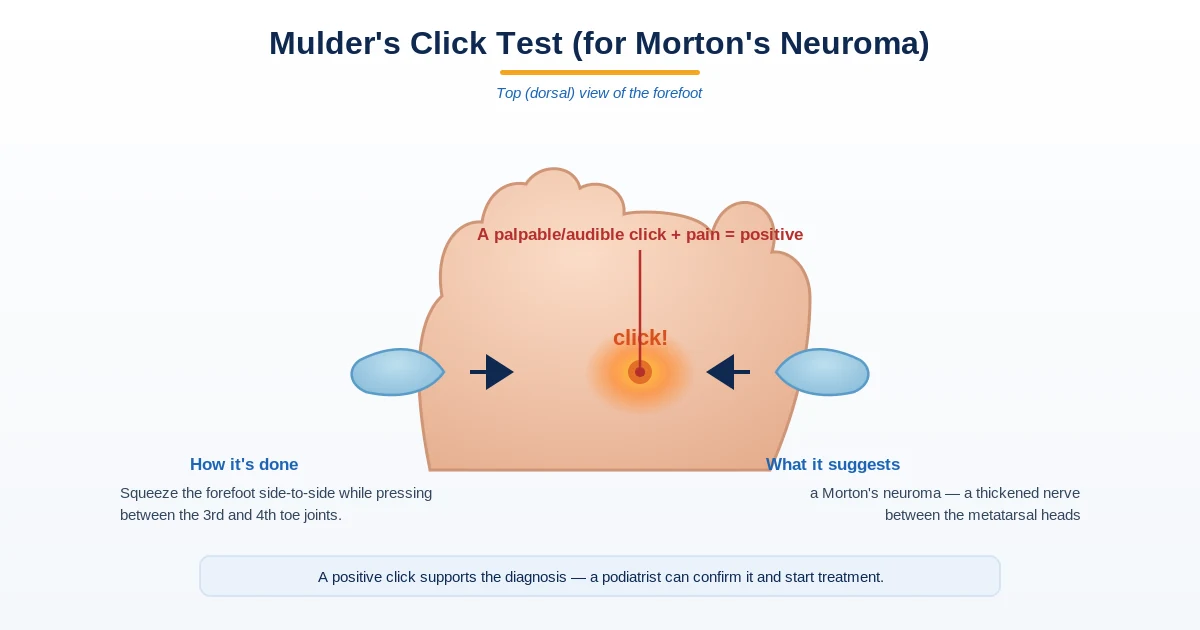

The Mulder’s click test is the in-office maneuver podiatrists use to diagnose Morton’s neuroma — when the click happens, you usually feel exactly the same pain you have been experiencing for months.
You’ve come to the right podiatry team. Dr. Tom Biernacki, DPM, FACFAS — board-certified foot & ankle surgeon with 3,000+ surgeries — explains exactly what the Mulder’s click test for Morton’s neuroma means and what works. Call (810) 206-1402 for same-day appointment at Howell or Bloomfield Township.
Mulder’s click test is the clinical gold standard for diagnosing Morton’s neuroma — but a positive test doesn’t tell you which treatment you need. A neuroma confirmed by Mulder’s click can range from a 3mm thickening that responds to a corticosteroid injection to a 9mm mass that requires surgical excision, and the size changes the entire treatment path. Most patients with a positive Mulder’s click don’t know which end of that spectrum they’re on. Call (810) 206-1402 or book online — we perform Mulder’s test and ultrasound confirmation on the same visit.
Watch: Morton’s Neuroma Diagnosis & Treatment
Dr. Tom demonstrates Mulder’s click test and the best treatments for Morton’s neuroma:
Forefoot pain or tingling? Book an evaluation · (810) 206-1402
Quick Answer
Mulder’s click test is the #1 physical exam test for diagnosing Morton’s neuroma. Your podiatrist squeezes the forefoot from the sides while pressing upward on the intermetatarsal space. A positive test produces an audible or palpable “click” — the swollen nerve subluxating (popping) between the metatarsal heads — often accompanied by the patient’s typical pain and tingling. The test has a sensitivity of 61–98% and is the fastest, most reliable way to identify a neuroma in the office without imaging.
In This Article
If you have been dealing with pain, burning, or a strange bunched-up feeling in the ball of your foot, your podiatrist will likely perform Mulder’s click test during your evaluation. Named after Dr. J.D. Mulder, this quick, in-office examination is the gold standard physical exam maneuver for identifying Morton’s neuroma — and it takes less than 30 seconds to perform.
What Is Mulder’s Click Test?
Mulder’s click test (also called the transverse forefoot compression test or Mulder’s sign) is a clinical examination technique specifically designed to detect Morton’s neuroma. When positive, the examiner can feel and often hear the swollen nerve pop (subluxate) between the metatarsal heads as the forefoot is compressed.
The “click” is produced by the thickened nerve displacing from the intermetatarsal space toward the plantar (bottom) surface of the foot when pressure is applied. A normal nerve is too small to produce this sensation — only an enlarged, fibrotic nerve generates the characteristic click. This is what makes the test so specific for Morton’s neuroma.
How the Test Is Performed (Step-by-Step)
The test is painless to set up and takes less than 30 seconds. Here is exactly what your podiatrist will do.
Step 1: You sit or lie down with your foot relaxed. The podiatrist holds the forefoot with one hand wrapped around the metatarsal heads (the widest part of the foot).
Step 2: With the other hand, the podiatrist places a thumb on the plantar (bottom) surface and an index finger on the dorsal (top) surface of the suspect intermetatarsal space — most commonly between the third and fourth metatarsals.
Step 3: The hand wrapped around the forefoot squeezes the metatarsals together (transverse compression) while the other hand simultaneously presses upward from the bottom.
Step 4: If a neuroma is present, the examiner will feel (and sometimes hear) a distinct click or pop as the enlarged nerve subluxates dorsally between the compressed metatarsal heads. The patient typically reports their familiar pain, burning, or tingling at this moment.
A positive Mulder’s click is one of the most satisfying clinical findings in podiatry — both the examiner and patient know immediately what is causing the problem.
What a Positive Mulder’s Click Means
A positive result strongly suggests Morton’s neuroma in the tested intermetatarsal space. The test is considered positive when the examiner palpates the characteristic click AND the patient reports reproduction of their symptoms (pain, burning, tingling, or the feeling of a “bunched-up sock”).
It is important to note that pain alone without the click is not a positive Mulder’s sign — it may indicate metatarsalgia, bursitis, or stress injury instead. The click specifically indicates the presence of a mass (the enlarged nerve) displacing between the metatarsals.
How Accurate Is Mulder’s Click Test?
| Diagnostic Measure | Mulder’s Click Test | Ultrasound | MRI |
|---|---|---|---|
| Sensitivity | 61–98% | 79–95% | 83–93% |
| Specificity | 95–100% | 88–100% | 86–99% |
| Cost | $0 (included in exam) | $200–$500 | $500–$1,500 |
| Time to result | 30 seconds | 15–20 minutes | 30–45 minutes |
| Best use | First-line screening | Confirming size, guiding injections | Ruling out other pathology |
The wide sensitivity range (61–98%) reflects variations in examiner experience and neuroma size. Larger neuromas (>5mm) produce more prominent clicks and higher sensitivity. The specificity is consistently high — when a true click is present, it almost always indicates a neuroma.
Other Physical Tests for Morton’s Neuroma
Sullivan’s Sign (Thumb Index Finger Squeeze Test). The examiner directly compresses the intermetatarsal space from plantar to dorsal. A positive result reproduces the patient’s radiating toe symptoms. This is considered the #2 most useful clinical test after Mulder’s click.
Foot Squeeze Test. The forefoot is compressed side-to-side. A positive result produces pain localized to the suspect intermetatarsal space. Less specific than Mulder’s click because metatarsalgia and bursitis can also produce pain with this maneuver.
Toe tip sensation test. Light touch or pinprick testing of the third and fourth toes. Decreased sensation compared to the unaffected side supports the diagnosis by confirming nerve involvement.
Can You Try Mulder’s Click Test at Home?
You can perform a simplified version at home to get a preliminary idea, though it is not a substitute for professional evaluation.
Sit down and cross the affected foot over your opposite knee. Wrap one hand around the front of your foot (around the metatarsal heads) and squeeze firmly from the sides. With the other hand, press upward on the space between the third and fourth toes from the bottom. If you feel a click or pop accompanied by your typical pain/tingling, that is suggestive of a neuroma.
Even if your home test is positive, see a podiatrist to confirm the diagnosis and rule out other conditions. Several other forefoot problems can mimic Morton’s neuroma symptoms, including stress fractures, metatarsophalangeal joint capsulitis, and intermetatarsal bursitis.
Morton’s Neuroma Treatment Overview
Once diagnosed, Morton’s neuroma treatment follows a stepwise approach starting with the least invasive options.
First line: Offloading. Switch to shoes with a wide toe box and add metatarsal pads positioned just behind the metatarsal heads. This single change resolves symptoms in approximately 40% of patients. The pad spreads the metatarsals apart, decompressing the nerve.
Second line: Orthotics and toe spacers. Custom orthotics with a built-in neuroma accommodation pad provide sustained offloading. Toe spacers (like Correct Toes) worn between the affected toes reduce nerve compression during activity.
Third line: Injection therapy. A corticosteroid injection under ultrasound guidance reduces perineural inflammation and can provide weeks to months of relief. Some podiatrists offer alcohol sclerosing injections — a series of 4–7 injections that chemically shrink the nerve tissue.
Fourth line: Surgery (neurectomy). For the approximately 20% of patients who do not respond to conservative care, surgical removal of the affected nerve segment is effective, with success rates of approximately 85%. Recovery takes 3–4 weeks.
Best Products for Morton’s Neuroma
OUR #1 PICK
Metatarsal Pads
Adhesive gel pads placed just behind the metatarsal heads inside your shoe. They spread the metatarsals apart, taking pressure off the compressed nerve. The single most effective non-prescription treatment — reduces symptoms in approximately 40% of patients as a standalone intervention.
Best for: Morton’s neuroma, first-line conservative treatment
Correct Toes Toe Spacers
Podiatrist-designed silicone spacers that restore natural toe spacing and decompress the interdigital nerve. Can be worn inside wide shoes during daily activity for sustained neuroma relief.
Best for: Ongoing nerve decompression, toe realignment
New Balance 990v6 (Wide)
Available in wide and extra-wide, the 990 has a generous toe box that eliminates metatarsal compression. Premium cushioning reduces impact loading on the forefoot. One of the top shoes prescribed for Morton’s neuroma patients.
Best for: Wide toe box, all-day forefoot comfort
Affiliate disclosure: We may earn a small commission from qualifying purchases at no extra cost to you. This supports our educational content.
⚠ See a Podiatrist If You Notice
- Forefoot pain or numbness that persists despite wide shoes and metatarsal pads for 4 weeks
- Constant numbness (not just with certain shoes)
- Pain that wakes you at night (unusual for neuroma — rule out other pathology)
- Swelling or visible deformity in the forefoot
- Symptoms worsening despite conservative treatment
- Pain in the ball of the foot following an injury (possible stress fracture)
MOST COMMON MISTAKE WE SEE
Many patients spend months treating ball-of-foot pain as metatarsalgia — padding, wider shoes, metatarsal insoles — when the actual diagnosis is Morton’s neuroma. The key differentiator is symptom character: metatarsalgia is an aching pressure pain, while Morton’s neuroma produces burning, electric, or tingling pain that radiates into the toes. If padding and shoe changes haven’t resolved forefoot pain in 6–8 weeks, ask for a Mulder’s click test. A positive result means steroid injection or radio-frequency ablation, not more padding.
DIFFERENTIAL DIAGNOSIS — CONDITIONS THAT MIMIC MORTON’S NEUROMA
- Metatarsalgia — aching pressure pain under the metatarsal heads; no burning or radiation; Mulder’s test negative; responds to offloading pads
- Plantar plate tear — pain under the 2nd MTP joint; toe floats or deviates; positive drawer test at the 2nd MTP; requires MRI to confirm
- Stress fracture of the metatarsal — focal bone tenderness; pain worsens with activity over weeks; X-ray may be negative early; MRI is definitive
- Intermetatarsal bursitis — similar location to neuroma but Mulder’s test negative; bursa is fluid-filled (ultrasound shows anechoic sac); responds to steroid injection
- Tarsal tunnel syndrome — burning and tingling but in the entire plantar foot, not localized to one web space; positive Tinel’s at the tarsal tunnel
RED FLAGS — SEE A PODIATRIST URGENTLY
- Constant burning pain in the foot even at rest (may indicate tarsal tunnel or vascular cause)
- Numbness or weakness spreading beyond the ball of the foot
- Pain in multiple web spaces simultaneously
- A palpable lump in the foot that is growing rapidly or feels hard
- Symptoms accompanied by skin color changes, temperature differences, or hair loss on the foot (vascular or neurological cause)
- Diabetic patient with any new burning foot pain
Call (810) 206-1402 or book online — most urgent presentations seen same or next business day.
Frequently Asked Questions
Does Mulder’s click test hurt?
The test may briefly reproduce your symptoms — a momentary pinch, burn, or tingling — but it is not performed with excessive force. Your podiatrist applies enough pressure to elicit the click and your typical symptoms, then releases. The discomfort lasts only a few seconds and tells both you and the doctor exactly what is causing your foot pain.
Can you have a neuroma without a positive Mulder’s click?
Yes. Small neuromas (under 5mm) may not produce a palpable click even though they are symptomatic. In these cases, ultrasound or MRI can confirm the diagnosis. Conversely, a positive click with reproduction of symptoms is considered highly reliable — further imaging may not even be necessary before starting treatment.
Which intermetatarsal space is most commonly affected?
The third intermetatarsal space (between the third and fourth toes) accounts for approximately 65–70% of Morton’s neuromas. The second intermetatarsal space (between the second and third toes) accounts for most of the remainder. First and fourth space neuromas are rare.
Do I need an MRI if Mulder’s click is positive?
Not necessarily. If the clinical presentation is classic (positive click, typical symptoms, pain relieved by removing shoes) and you respond to initial conservative treatment, imaging is often unnecessary. Your podiatrist may order an ultrasound or MRI if the diagnosis is uncertain, if surgery is being considered, or if there is concern for other pathology like a stress fracture or capsulitis.
The Bottom Line
Mulder’s click test is the fastest, most cost-effective way to diagnose Morton’s neuroma. A positive click combined with reproduction of your symptoms gives your podiatrist a confident diagnosis in under 30 seconds — often without the need for expensive imaging. Once diagnosed, most neuromas respond well to simple conservative measures: wider shoes, metatarsal pads, and toe spacers. If those changes alone don’t resolve your symptoms within 4–6 weeks, a cortisone injection or custom orthotics usually will.
Sources
- Thomson CE, Gibson JNA, Martin D. Interventions for the Treatment of Morton’s Neuroma. Cochrane Database Syst Rev. 2004;(3):CD003118.
- Bencardino J, Rosenberg ZS, Beltran J, et al. Morton’s Neuroma: Is It Always Symptomatic? AJR Am J Roentgenol. 2000;175(3):649-653.
- Thomas JL, et al. Diagnosis and treatment of forefoot disorders. Section 3. Morton’s intermetatarsal neuroma. J Foot Ankle Surg. 2009;48(2):251-256.
Think You Have Morton’s Neuroma?
Our podiatrists can diagnose and start treating your neuroma in a single visit — no waiting for MRI results needed.
Balance Foot & Ankle · Howell & Bloomfield Township · (810) 206-1402
Understanding Mulder’s Click Test for Morton’s Neuroma
Mulder’s click test is a key diagnostic tool for Morton’s neuroma. Our podiatrists use this and advanced imaging to accurately diagnose and treat intermetatarsal nerve conditions.
📞 Or call us directly: (810) 206-1402
Clinical References
- Mahadevan D, Venkatesan M, Bhatt R, Bhatia M. Diagnostic accuracy of clinical tests for Morton’s neuroma compared with ultrasonography. Journal of Foot and Ankle Surgery. 2015;54(4):549-553.
- Owens R, Gougoulias N, Guthrie H, Sakellariou A. Morton’s neuroma: clinical testing and imaging in 76 feet, compared to a control group. Foot and Ankle Surgery. 2011;17(3):197-200.
- Sharp RJ, Wade CM, Hennessy MS, Saxby TS. The role of MRI and ultrasound imaging in Morton’s neuroma and the effect of size of lesion on symptoms. Journal of Bone and Joint Surgery British Volume. 2003;85(7):999-1005.
Insurance Accepted
BCBS · Medicare · Aetna · Cigna · United Healthcare · HAP · Priority Health · Humana · View All →
Howell Office
4330 E Grand River Ave
Howell, MI 48843
Get Directions →
Bloomfield Township Office
43494 Woodward Ave, #208
Bloomfield Township, MI 48302
Get Directions →
Your Board-Certified Podiatrists



Ready to Get Back on Your Feet?
Same-week appointments available at both locations.
Book Your AppointmentMorton’s Neuroma & Forefoot Pain Resources
After a Positive Mulder’s Click — First Steps
- PowerStep Pinnacle — Metatarsal dome support is the first OTC intervention after a positive Mulder’s test — reduces 3rd interspace compression that provokes neuroma symptoms.
- Doctor Hoy’s Natural Pain Relief Gel — 3rd interspace burning pain after Mulder’s testing: arnica + camphor gel applied to the ball of foot 3-4x daily reduces perilesional inflammation.
- FLAT SOCKS No-Sock Insoles — Shoe environment: FLAT SOCKS moisture-wicking inserts reduce forefoot compression and friction inside shoes for daily neuroma symptom management.
Positive Mulder’s test confirmed? Our in-office evaluation includes ultrasound and alcohol injection therapy. Balance Foot & Ankle → (810) 206-1402
In-Office Treatment at Balance Foot & Ankle
If home treatment isn’t providing relief for your Morton’s neuroma, our podiatry team at Balance Foot & Ankle can help with same-day evaluations and advanced in-office care.

- COMFORTABLE SUPPORT: 1/4 inch thick felt metatarsal pads provide gentle cushioning under the ball of the foot for daily wear
- VALUE PACK: Includes 6 pairs (12 pieces) to ensure long-lasting comfort and convenience
- ADHESIVE BACKING: Strong adhesive keeps the pad in place inside shoes or directly on the foot
- MADE IN THE USA: Proudly designed, cut, and manufactured in the United States
- EASY TO CUSTOMIZE: Can be trimmed with scissors for a better fit inside a variety of footwear
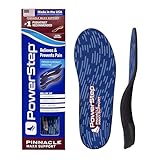
- Slightly Angled Heel Post: PowerStep Pinnacle Maxx insoles for men & women keep the feet from rolling inward, improve stability, and prevent problems caused by overpronation including flat feet and plantar fasciitis.
- Firm But Flexible Design: Our orthotics Pinnacle PowerStep insoles for overpronation are equipped with a deep heel insert cradle for increased comfort, stability, and motion control for standard arch support and immediate heel pain relief.
- Premium Dual Layer Cushioning: For enhanced comfort from heel to toe. As the thickest of our Pinnacle PowerStep orthotics, these need to be worn in shoes where the factory insole can be removed. HSA & FSA Eligible. Made in the USA
- The Perfect Balance of Comfort and Support: These PowerStep Pinnacle arch support inserts for men & women are unlike most other orthotics as they help to correct over-pronation which can cause ankle, knee, and hip pain in your daily routine
- No Trimming: Our arch support PowerStep insoles men & women can use can be worn in a variety of shoe styles & fit in any type with no trimming required! Unlike most insoles for flat feet and other heel pain relief products, these come ready to wear.

- ENGINEERED MESH
- Lining Textile
As an Amazon Associate, Balance Foot and Ankle earns from qualifying purchases. Product links are affiliate links and we may earn a commission at no extra cost to you. This does not influence our clinical recommendations. Last update on 2026-09-26 / Images from Amazon Product Advertising API
Footwear & Orthotics for Morton’s Neuroma
A positive Mulder’s click often points to Morton’s neuroma, which responds well to a wide toe box and metatarsal-pad orthotics. See our podiatrist-recommended shoes, and see a podiatrist for persistent forefoot pain.
Sharp, burning pain between your toes?
A positive Mulder’s click often points to a Morton’s neuroma — very treatable when caught early. In Michigan? our podiatrists can confirm it and relieve it. Same-week visits in Howell & Bloomfield Township, most insurance accepted.
📅 Book an Appointment 📞 (810) 206-1402★ 4.9 from 1,123+ Google reviews · Same-week visits · We verify your insurance free — most visits are just a copay.
Related: If a positive Mulder’s click points to a neuroma, footwear matters most — see a podiatrist’s picks for the best shoes for Morton’s neuroma.
Book an appointment with a podiatrist
A positive click at home is suggestive, not conclusive, and a Morton’s neuroma is treated far more easily when it is confirmed and measured early with an ultrasound in the office. Balance Foot & Ankle sees patients at two offices — Howell in Livingston County, and Bloomfield Township in Oakland County.
Call (810) 206-1402 or use the form below and our team will find you an appointment time.

Dr. Tom Biernacki, DPM is a board-certified foot & ankle surgeon (ABFAS & ABPM) at Balance Foot & Ankle Specialists in Southeast Michigan. With over a decade of clinical experience, he specializes in heel pain, bunions, diabetic foot care, sports injuries, and minimally invasive surgery. Dr. Biernacki is a member of the APMA and ACFAS, and his patient education content on MichiganFootDoctors.com and YouTube has made him one of the most-followed foot & ankle educators on YouTube.
More questions patients ask
How accurate is Mulder's click test for Morton's neuroma?
Mulder's click test has a sensitivity of approximately 60–70% and specificity of around 90% for Morton's neuroma. A positive test combined with patient history and ultrasound confirmation provides high diagnostic accuracy. False negatives can occur with small neuromas or in the early stages.
What happens after a positive Mulder's click test?
A positive Mulder's sign typically leads to ultrasound or MRI confirmation, followed by a treatment plan. Conservative options include metatarsal pads, wider footwear, custom orthotics, and corticosteroid injections. Surgical neuroma excision is considered when conservative treatment fails after 3–6 months.
Still have a question about coverage or cost? Book online and we will check your benefits before your visit: Book in Howell · Book in Bloomfield Township. Prefer to talk it through first? Call (810) 206-1402.