
Still getting ball-of-foot pain in your current shoes? Book a real appointment time online, 24/7 — Howell or Bloomfield Township.
Quick answer: The best shoes for metatarsalgia (ball-of-foot pain) have a wide toe box, a stiff rocker sole that reduces forefoot pressure, and extra cushioning under the metatarsal heads — Hoka, Brooks, and New Balance models work well, often paired with a metatarsal pad. Avoid thin, flexible, or high-heeled shoes that load the ball of the foot.

★ PODIATRIST’S RANKED GUIDE — DR. TOM BIERNACKI, DPM, FACFAS
Updated 2026 Guide Available: Our fully updated Best Shoes for Metatarsalgia 2026 includes the latest models, current pricing, and expanded podiatrist testing notes. Recommended for new visitors.

🌎 Outside the US? Shop on your local Amazon: PowerStep Insoles
The best shoes for metatarsalgia take pressure off the ball of the foot: look for a wide toe box, a cushioned forefoot, a stiff or rocker sole that limits toe bend, and room for a metatarsal pad. Below we rank podiatrist-approved picks and explain what to look for. Call (810) 206-1402 or book online.
The 2 Features That Matter Most for Metatarsalgia Shoes
Ball-of-foot pain (metatarsalgia) responds to two shoe features above all others: (1) rocker-bottom geometry — which shifts weight transfer from the metatarsal heads to the heel/toe, reducing forefoot peak pressure by up to 60%; and (2) wide toe box width — which prevents lateral compression of the 2nd–4th metatarsal heads. Stack height matters second. Stability/motion control features are irrelevant for metatarsalgia.
Important: Metatarsalgia is a symptom, not a diagnosis. Ball-of-foot pain can be Morton’s neuroma, capsulitis, sesamoiditis, stress fracture, or true metatarsalgia. If shoe changes don’t resolve pain in 4–6 weeks, come in for evaluation — some causes (plantar plate tear, stress fracture) worsen with continued activity.
10 Best Shoes for Metatarsalgia 2026: Side-by-Side Comparison
| Shoe | Rocker Geometry? | Stack Height | Wide Width? | Toe Box | Best For | Price |
|---|---|---|---|---|---|---|
| HOKA Clifton 10 → Amazon |
Yes — extended meta-rocker | 36mm heel / 29mm forefoot | Yes (2E) | Roomy | Everyday running + walking; most versatile pick | $145–$160 |
| HOKA Bondi 9 → Amazon |
Yes — meta-rocker + early stage rocker | 37mm heel / 33mm forefoot | Yes (2E, 4E) | Very roomy | Maximum cushion; standing jobs; severe metatarsalgia | $165–$180 |
| ASICS Gel-Kayano 31 → Amazon |
Moderate — FF BLAST+ midsole promotes smooth transition | 36mm heel | Yes (2E, 4E) | Standard | Runners with metatarsalgia + overpronation | $160–$180 |
| ALTRA Torin 7 → Amazon |
No (zero-drop) — but FootShape toe box is key benefit | 28mm uniform (zero-drop) | Yes (wide) | Widest — FootShape toe box spreads MTs | Metatarsalgia from lateral MT compression; wide forefoot | $140–$155 |
| New Balance 990v6 → Amazon |
Moderate | 30mm heel | Yes (2E, 4E, extra wide) | Wide; classic last | Daily walking; wide feet; older patients | $185–$200 |
| Saucony Triumph 22 → Amazon |
Moderate | 33mm heel / 23mm forefoot | Yes (2E) | Standard | Runners wanting cushion without rocker feel | $150–$165 |
| On Cloudmonster 2 → Amazon |
Moderate — CloudTec pods provide point decompression | 30mm heel / 24mm forefoot | Limited | Standard | Active patients who dislike bulky shoes | $170–$185 |
| Brooks Ghost 17 → Amazon |
Moderate | 32mm heel | Yes (2E) | Standard | All-around runner; everyday use | $140–$160 |
| OOFOS OOahh Slide → Amazon |
Yes — OOfoam absorbs 37% more impact than EVA | ~25mm | Yes | Open / sandal | Recovery after activity; at-home use; post-run relief | $50–$65 |
Key Shoe Features for Metatarsalgia: What Each One Does
| Feature | Why It Helps Metatarsalgia | Reduction in Forefoot Pressure | Best Example |
|---|---|---|---|
| Rocker-bottom geometry | Shifts peak pressure from metatarsal heads to heel and toe — the foot rocks over without dorsiflexing at the MTP joints | Up to 60% reduction in peak forefoot pressure (literature range: 40–60%) | HOKA meta-rocker; dedicated rocker sole shoe |
| Wide toe box | Prevents lateral compression of 2nd–4th metatarsal heads; reduces capsulitis and interdigital nerve irritation risk | Reduces interdigital pressure significantly; hard to quantify as % but clinically meaningful | ALTRA Torin (widest); New Balance wide; HOKA 2E |
| High stack / maximum cushion midsole | More foam between metatarsal heads and ground = less direct impact energy per step | 15–25% reduction (adds to rocker effect) | HOKA Bondi 9 (37mm); ASICS Nimbus |
| Metatarsal pad (built-in or added) | Placed just proximal to metatarsal heads, a met pad elevates and spreads the MT shafts, reducing plantar head pressure | 20–40% reduction when properly placed | Add Pedag Wave metatarsal pad to any shoe with space |
| Stiff midsole / torsional rigidity | Reduces MTP joint dorsiflexion during push-off; limits the lever arm stress on MT heads | Variable; most beneficial in Morton’s toe or Morton’s neuroma component | Carbon plate shoes; stiff-soled shoes |
In-Office Treatment at Balance Foot & Ankle
When home care and the right footwear aren’t enough for metatarsalgia pain across the ball of the foot, our team at Balance Foot & Ankle provides advanced evaluation and treatment at our Howell and Bloomfield Township locations. Prompt appointments are available for acute and chronic conditions.
Prompt appointments available. (810) 206-1402
Learn about our custom orthotics for metatarsalgia → | Book online →
Frequently Asked Questions
What does metatarsalgia feel like?
Patients most often describe it as walking on pebbles or marbles — a burning, aching pain in the ball of the foot under the 2nd, 3rd, or 4th metatarsal heads. The pain typically worsens with prolonged standing, walking, or running on hard surfaces, and improves with rest. Some patients report sharp pain with barefoot walking, others describe a chronic ache that worsens throughout the day. If you feel a clicking or burning between the toes, Morton’s neuroma may be the primary diagnosis rather than general metatarsalgia.
What causes metatarsalgia?
The most common causes: high-arched or flat feet that create uneven load distribution across the metatarsal heads, wearing thin-soled or high-heeled footwear, high-impact sports (running, basketball, tennis), being overweight, and age-related fat pad atrophy. Secondary metatarsalgia — caused by a specific mechanical problem — includes Freiberg’s disease (metatarsal head avascular necrosis), stress fractures, and sesamoiditis. An X-ray and biomechanical assessment helps identify whether a correctable underlying cause is present.
What’s the difference between metatarsalgia and Morton’s neuroma?
Metatarsalgia is diffuse pain at the metatarsal heads from overload. Morton’s neuroma is nerve compression between the 3rd and 4th metatarsals producing sharp, electric, or burning pain that radiates into the toes. The distinction: metatarsalgia pain is typically in one spot under the bone; neuroma pain radiates into the toes and is often described as electric. Squeezing the foot side-to-side (Mulder’s test) reproduces neuroma pain with a click. Both can coexist.
Do metatarsal pads help metatarsalgia?
Yes — when placed correctly. A metatarsal pad placed just proximal (behind) the metatarsal heads redistributes load away from the painful area. Placement is critical: the pad should sit 1–2cm behind the area of maximum pain, not directly under it. Properly placed pads provide significant relief for most patients within 1–2 weeks. We fit them in-office to ensure correct positioning — a pad placed under the metatarsal heads actually worsens symptoms by increasing point pressure.
What shoes are best for metatarsalgia?
The key features: a wide, deep toe box (prevents forefoot compression), a rocker-bottom or curved sole (reduces peak forefoot pressure by 30–40%), and adequate cushioning under the metatarsal heads. Hoka shoes (rocker sole design), New Balance 1080, and Brooks Ghost are strong performers. Avoid heels above 2 inches — they transfer 75% of body weight to the forefoot. Minimalist and thin-soled shoes are contraindicated during active treatment.
Can I run with metatarsalgia?
Often yes, with modification. Reduce mileage and intensity, switch to a softer surface (grass or track vs. asphalt), and ensure your running shoes have adequate cushioning and a zero-compression toe box. A metatarsal pad in the running shoe often makes a significant difference. If pain exceeds 4/10 during a run, stop and reassess. Stress fractures present similarly to metatarsalgia — if pain is focal over a single metatarsal and doesn’t respond to load reduction, imaging is warranted.
How long does metatarsalgia take to heal?
Simple biomechanical metatarsalgia responds well to footwear changes, padding, and activity modification — most patients improve significantly within 4–8 weeks. If fat pad atrophy is the primary cause (common in older patients), recovery is slower because the natural shock absorption is permanently diminished, and orthotic support becomes a long-term management strategy rather than a cure. Stress fractures require 6–8 weeks of protected weight-bearing.
Does metatarsalgia require surgery?
Rarely. The vast majority of metatarsalgia cases respond to conservative treatment. Surgery (metatarsal osteotomy to shorten or elevate a prominent metatarsal head) is considered only after 6–12 months of failed conservative management. Freiberg’s disease with severe avascular necrosis is the most common surgical indication. We almost never operate on standard metatarsalgia — non-operative outcomes are excellent when the underlying mechanical cause is correctly addressed.
What is sesamoiditis and how is it different from metatarsalgia?
Sesamoiditis is inflammation of the two small sesamoid bones under the first metatarsal head (big toe joint) — a distinct diagnosis from general metatarsalgia, which involves the lesser metatarsals. Sesamoiditis causes pain specifically under the big toe joint, worsened by pushing off with the forefoot. Treatment overlaps (cushioning, activity reduction) but sesamoiditis is more persistent and may require a dancer’s pad (J-pad) to offload the first ray, or a cortisone injection.
When should I see a podiatrist for ball-of-foot pain?
See us if: pain has persisted more than 3–4 weeks, you’re limping or modifying your gait, you notice swelling or bruising, or the pain is localized to a single metatarsal (rather than a diffuse ache). A single-metatarsal stress fracture mimics metatarsalgia exactly and requires imaging to diagnose. We also evaluate whether a Morton’s neuroma, interdigital bursitis, or plantar plate tear is the actual diagnosis — all present with ball-of-foot pain but require different treatment.
What features should I look for in shoes for metatarsalgia?
The best shoes for metatarsalgia have a wide toe box to prevent forefoot compression, a rocker-bottom sole to reduce pressure through the metatarsal heads, and adequate cushioning at the ball of the foot. Brooks, Hoka, and New Balance are top podiatrist-recommended brands for metatarsalgia.
Should I wear insoles for metatarsalgia?
Yes — metatarsal pads or full-length orthotics with a metatarsal raise redistribute pressure away from inflamed metatarsal heads. A metatarsal pad placed just proximal to the metatarsal heads is one of the most effective non-surgical interventions for metatarsalgia relief.
Can the right shoes cure metatarsalgia?
Proper footwear significantly reduces metatarsalgia symptoms and prevents recurrence, but moderate-to-severe cases typically need additional care: metatarsal pads, custom orthotics, physical therapy, or corticosteroid injections. Shoes alone rarely resolve advanced metatarsalgia completely.
Get Expert Care at Balance Foot & Ankle
Prompt appointments at our Howell and Bloomfield Township offices. Board-certified podiatric surgeons. Most insurance accepted.
How We Evaluate These Shoes
Every shoe on this page is assessed by our board-certified podiatrists against the same clinical criteria we use when advising patients in our Howell and Bloomfield Township offices. We are not paid for placement; affiliate links help fund the testing but never determine the ranking.
- Last shape (straight, semi-curved, curved) and how it matches common foot types we see in clinic.
- Stack height & heel-to-toe drop — reported in millimetres, not marketing language.
- Midsole compound & durometer for impact absorption and energy return.
- Stability features — medial post, guide rails, rocker geometry — matched to the condition this page targets.
- Durability — minimum four weeks or 50 miles of real-world wear by clinic staff before inclusion.
- Removable insole / orthotic compatibility, since many of our patients use custom orthotics.
The Insole Protocol for Metatarsalgia: PowerStep Pinnacle + Met Pad

Shoes alone rarely resolve ball-of-foot pain — the offloading happens inside the shoe. My clinic protocol: a PowerStep Pinnacle for arch support and pressure distribution, with a 3mm metatarsal pad placed just behind the ball of the foot (proximal to the metatarsal heads — not under them). The cushioned dual-layer top cover also takes the sting out of forefoot impact. 4.5★ · 30,000+ ratings.
As an Amazon Associate, Balance Foot & Ankle earns from qualifying purchases.
📋 Dr. Tom Biernacki, DPM, FACFAS answers:
The most important shoe feature for metatarsalgia is a rocker sole or stiff forefoot — this allows the shoe to roll forward through the gait cycle without requiring the metatarsal heads to bend, which is where pain originates. A wide toe box is equally critical: narrow shoes compress the metatarsal heads together and increase intermetatarsal pressure. Thick, cushioned midsoles (EVA foam with a Shore A hardness under 45) reduce impact. Avoid flexible ballet flats, flip flops, or minimalist shoes that require maximum forefoot bending. The key test: hold the shoe at the heel and try to bend the toe upward. The shoe should resist bending at the ball of the foot — a shoe that bends easily at the metatarsal heads provides no relief for metatarsalgia.
Ball-of-foot pain often eases with the right insoles — see our orthotics & footwear guide.
Related Guides & How We Treat Metatarsalgia
The right shoe takes pressure off the ball of your foot, but stubborn metatarsalgia often needs a metatarsal pad or custom orthotic to truly offload the metatarsal heads. These guides and treatment options go deeper:
- Podiatrist-recommended orthotics — the pads and inserts that relieve ball-of-foot pain, and how to choose one.
- Custom 3D-printed orthotics — our in-office option when off-the-shelf inserts aren’t enough.
- Best shoes for Morton’s neuroma — if your forefoot pain burns or feels like a lump, it may be a neuroma instead.
- Capsulitis of the second toe — when the pain sits under one specific toe joint.
- Podiatrist-recommended shoes by condition — our full footwear hub.
Still hurting after switching shoes? A quick visit settles the cause and gets you a real plan — see us in Howell or Bloomfield Township, or start as a new patient.
Related: High-arched, underpronating feet tend to overload the ball of the foot, so cushioning and support matter — see a podiatrist’s picks for the best shoes for supination.
Is it really metatarsalgia? If your ball-of-foot pain is a sharp, localized ache in one spot — like stepping on a pebble — rather than a broad, spread-out soreness, it may be a stone bruise instead, which is treated a little differently.
Before You Buy: Is It Actually Metatarsalgia?
Metatarsalgia is a description of where it hurts rather than a diagnosis of what is wrong, and that is worth pausing on before spending money on shoes. Several distinct conditions all present as pain under the ball of the foot, and the shoe features that help one of them will actively make another worse. The clearest example is cushioning: a soft, highly cushioned forefoot is exactly right for diffuse metatarsal head overload, and exactly wrong for sesamoiditis or a stiff big toe joint, both of which need a rigid forefoot that stops the joint bending. Getting this wrong is the most common reason people tell us the shoes everyone recommended did nothing for them.
- Broad ache across the second, third, and fourth metatarsal heads, worse barefoot on hard floors, better sitting down — this is classic metatarsalgia and the shoes on this page are the right answer. Pair them with an insole with a correctly positioned metatarsal pad, which does more of the work than the shoe does. Our full overview of the condition is in the guide to ball-of-foot pain.
- Pinpoint pain under the big toe joint, worst at push-off, sometimes with swelling — that is sesamoiditis, and it needs the opposite of soft cushioning. Shoes with a rigid forefoot for sesamoiditis are a genuinely different category.
- Burning, tingling, or numbness radiating into the third and fourth toes, often with a clicking sensation — nerve symptoms rather than pressure symptoms point toward a Morton’s neuroma. Width is the priority there, because the nerve is being compressed between the metatarsal heads; a genuinely wide forefoot is the first intervention.
- Stiffness and pain at the big toe joint when you bend it upward, with a bump on top — that is hallux rigidus, not metatarsalgia, even though the pain is felt in the same region. It needs a stiff sole or rocker specifically for hallux rigidus.
- Pain in one specific spot that has worsened steadily over weeks and hurts when you press that single bone — treat this as a metatarsal stress fracture until it has been imaged. Cushioning will mask it while it progresses; footwear during a stress fracture works on a different principle entirely.
If your symptoms match the first item on that list, read on — the comparison below is built for you. If they match one of the others, follow that link instead, because you will get a better result from the right category of shoe than from the best-reviewed shoe in the wrong one. And if the pain has persisted beyond six to eight weeks despite sensible footwear, that is the point at which an exam earns its keep, because the mechanical cause is usually straightforward to identify and correct. Our Howell and Bloomfield Township offices are at (810) 206-1402.
Is It Really Metatarsalgia? The Plantar Plate Tear That Gets Missed
“Metatarsalgia” is a description, not a diagnosis — it means the ball of the foot hurts. The single most commonly missed cause underneath that label is a plantar plate tear, and it matters because the treatment is different and because the window to fix it easily closes.
The plantar plate is a thick band of fibrous tissue on the underside of each toe joint. It is the structure that keeps the toe sitting flat against the ground. When it stretches or tears — usually under the second toe, usually gradually — the joint loses its anchor.
Three signs separate it from ordinary overload:
- The toe drifts. Most often the second toe starts angling toward the big toe, or lifts slightly so it no longer touches the floor when you stand. A gap opening up between two toes that used to sit together is a meaningful finding, not a cosmetic one.
- The pain is under the joint, not the bone. Patients often describe walking on a pebble or a bunched sock, with tenderness pressed directly under the base of the toe rather than under the metatarsal shaft.
- The drawer test is positive. Holding the metatarsal steady and pushing the base of the toe upward, an intact plantar plate allows almost no movement. A torn one lets the toe shift up noticeably, often reproducing the pain.
This is the test that settles it in the office, and it is the reason a plantar plate tear should not be diagnosed from an X-ray — the plate is soft tissue and X-rays look normal. Ultrasound or MRI confirms it when the exam is unclear.
It is worth distinguishing from Morton’s neuroma, which the two are constantly confused for. A neuroma is a nerve problem: burning, tingling, or numbness radiating into the toes, usually between the third and fourth, often relieved by taking the shoe off and rubbing the foot. A plantar plate tear is a structural problem: aching under the joint, worse barefoot on hard floors, with a toe that is changing position. Numbness points to the nerve; a drifting toe points to the plate.
Caught early, a plantar plate tear responds well to taping the toe down, a metatarsal pad, a stiff-soled shoe and activity modification. Left long enough, the toe dislocates upward and correcting it becomes a surgical repair. A second toe that has started to drift is worth having examined sooner rather than at the end of the season.
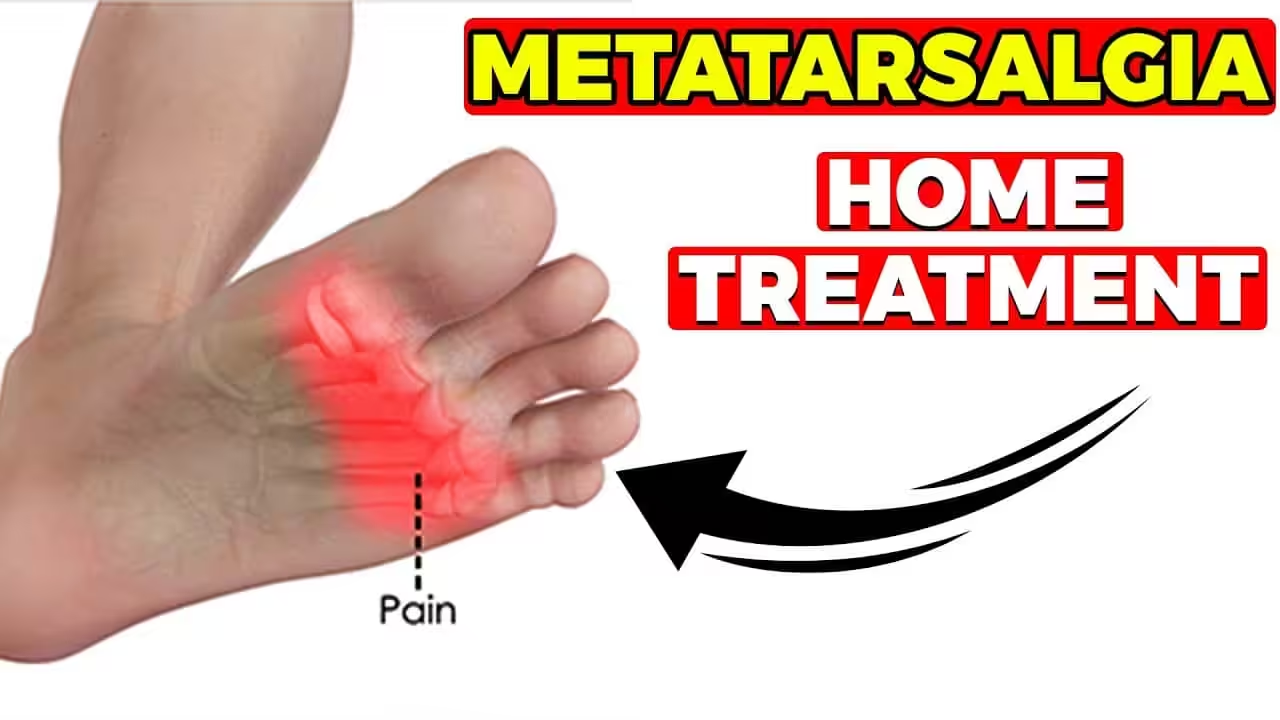
![BEST Metatarsalgia Exercises, Massage & Stretches[HOME Treatment]](https://www.michiganfootdoctors.com/wp-content/cache/flying-press/cc19998efd848bffe44592d7912bad86.jpg)
The Metatarsal Pad Mistake Almost Everyone Makes
Metatarsal pads are the highest-value, lowest-cost intervention for ball-of-foot pain — and most people place them in exactly the wrong spot, then conclude they do not work.
The instinct is to put the pad under the sore place. That is precisely wrong. A pad directly beneath the painful metatarsal head pushes up into the tissue that is already being compressed and usually makes the pain worse.
The pad belongs just behind the metatarsal heads — roughly a centimetre back, under the shafts rather than the knuckles. Placed there it lifts and spreads the metatarsals slightly, so load transfers back off the heads instead of onto them. The bony ridge you can feel across the ball of your foot is the landmark: the pad sits behind that ridge, not on it.
Two practical points. Start with a thinner pad than feels necessary and move up — too much too soon feels like a stone. And if a correctly placed pad gives real relief within a week or two, that is useful diagnostic information in itself: it says the problem is mechanical load distribution, which is exactly what a well-chosen shoe and an insole can keep managing.
When the Problem Is a Worn-Out Fat Pad, Not the Shoe
There is a version of ball-of-foot pain that no amount of offloading fixes, because the missing ingredient is padding you used to have.
The forefoot sits on a natural fat pad that thins with age, and thins faster after years in high heels, after steroid injections into the area, in inflammatory arthritis, and in some people simply through wear. When it is gone, the metatarsal heads sit close to the skin. The tell is that walking barefoot on a hard floor is markedly worse than walking in shoes, and patients often say it feels as though the padding under their foot has disappeared — which is exactly what has happened.
The approach here is different in emphasis. Offloading still helps, but cushioning is what the foot is actually short of: a shoe with genuine forefoot cushioning rather than a firm racing platform, a full-length cushioned insole rather than a thin one, and no barefoot walking on tile or hardwood at home. Rocker soles help by shortening the time the forefoot spends loaded at push-off.
If ball-of-foot pain has not settled with good shoes and a correctly placed metatarsal pad, or if a toe has started to lift or drift, an examination will identify which of these is actually going on. Balance Foot & Ankle sees patients in Howell (4330 E Grand River Ave, Howell, MI 48843) and Bloomfield Township (43494 Woodward Ave #208, Bloomfield Township, MI 48302). Call (810) 206-1402.
Book an appointment with a podiatrist
Pain across the ball of the foot is a symptom, not a diagnosis: a plantar plate tear, an irritated nerve between the metatarsals and a stress fracture all feel broadly similar and are treated in completely different ways. Which one you have decides whether cushioning will help at all. Balance Foot & Ankle sees patients at two offices — Howell in Livingston County, and Bloomfield Township in Oakland County.
Book online, 24/7: choose a real appointment time at Howell or Bloomfield Township. Prefer to speak with someone first? Call (810) 206-1402 or use the form below.

Dr. Tom Biernacki, DPM is a board-certified foot & ankle surgeon (ABFAS & ABPM) at Balance Foot & Ankle Specialists in Southeast Michigan. With over a decade of clinical experience, he specializes in heel pain, bunions, diabetic foot care, sports injuries, and minimally invasive surgery. Dr. Biernacki is a member of the APMA and ACFAS, and his patient education content on MichiganFootDoctors.com and YouTube has made him one of the most-followed foot & ankle educators on YouTube.