


Walking Shoes With Ankle Support: Quick Answer
The ankle support that works is under your foot, not around it. In a walking shoe, look for a firm heel counter, a wide and stable base, a midsole that is moderate in height and firm enough not to lean, and laces that lock your heel in place. A high collar adds surprisingly little: in a randomized trial of 622 basketball players, high-top shoes did not reduce ankle sprains compared with low-tops.
My 2026 picks: Brooks Adrenaline GTS 25 if your arches collapse inward, Brooks Ghost 18 if they don’t, New Balance Fresh Foam X 860v15 for wide feet, ASICS Gel-Kayano 32 for the broadest stable platform, and Brooks Addiction Walker 2 for long days on hard floors.
If your ankle has sprained more than once or gives way: wear a lace-up brace for sport, trails and the first months after a sprain, and do a few weeks of balance exercises. Both have better evidence for preventing the next sprain than any shoe collar.
In This Article
- What “ankle support” in a shoe really means
- Why high-tops do less than you think
- What to look for in a walking shoe
- Most people who want ankle support need width
- Where your ankle hurts changes the shoe
- Best walking shoes with ankle support in 2026
- The picks side by side
- Ankle braces: when a shoe isn’t enough
- Balance training: the support you build yourself
- When to see a podiatrist
What “Ankle Support” in a Shoe Really Means
A walking shoe that sits below the ankle bone cannot brace the ankle joint, and no amount of marketing changes that. What people describe as ankle support in a shoe is really three things working together: a firm heel counter that stops the rearfoot rolling, torsional rigidity through the midfoot so the shoe doesn’t wring out under load, and a wide, stable base that keeps your weight inside the footprint. Get those three right and the ankle is protected indirectly, which is what most people actually need.
Most ankle sprains are the same event: the foot lands on its outer edge and the ankle tips over it, stretching or tearing the ligaments on the outside of the joint. Those ligaments heal, but often a little looser and a little less responsive than before, which is why an ankle that has sprained once tends to sprain again. That pattern, called chronic ankle instability, is the most common reason people search for shoes with ankle support.
Why High-Tops Do Less Than You Think
The intuitive fix is to wrap something stiff around the joint. The evidence says otherwise. In a randomized study of 622 college basketball players, high-top shoes did not lower the ankle sprain rate compared with low-tops. A fabric or leather collar simply can’t resist the force of a body tipping over a foot.
What does work: in a randomized trial of 1,460 high school basketball players, lace-up ankle braces cut the rate of acute ankle injuries to roughly a third of the rate in players without braces, whether or not they had sprained before. And in a trial of 522 athletes who had recently sprained an ankle, an eight-week home balance-training program reduced repeat sprains by 35% over the following year. So buy a shoe for its base, and if your ankle is unreliable, add a brace and balance work.
What to Look For in a Walking Shoe
1. A base that won’t tip: moderate, wide, firm
A common footwear factor in rolled ankles is a tall, soft, narrow midsole. Land on its outer edge and the foam compresses on that side, the shoe leans, and the ankle follows it over. For an unstable ankle, choose a midsole that is moderate in height, firm enough not to lean, and wide under the heel as well as the toes.
2. A heel counter that holds, and a heel that sits deep
Squeeze the back of the shoe between your finger and thumb. If it folds, the heel inside can move, and a heel that moves is already partway to rolling. Lace to the top eyelet, and use the extra eyelet for a runner’s loop (heel lock) if your heel lifts.
3. An outsole that grips predictably
Sprains happen when the foot does something the brain didn’t plan. A flat rubber outsole with broad contact grips predictably on hard floors and sidewalks; smooth casual soles skate, and deep lugs can catch on hard surfaces.
4. A moderate heel, and no pronounced rocker for a wobbly ankle
A high heel or a steep drop raises the ankle further off the ground. A strongly curved rocker sole, which helps many other foot problems, puts an unstable surface under a foot that needs a flat one. If your ankle has rolled more than once, choose the flatter, firmer shoe.
5. Room for a brace or an orthotic
If you’ll wear a lace-up brace or a custom orthotic, you need a removable insole, a deep heel cup and an upper that laces open wide enough to take it.
Most People Who Want Ankle Support Actually Need Width
This is the correction I make most often. Men’s shoes run D for standard, 2E for wide and 4E for extra wide; women’s run B for standard, D for wide and 2E for extra wide. Many people walk in the standard width because that’s what the box said. A foot that is slightly too wide for its shoe slides sideways on every step, and the brain reads that sliding as instability, so the shopper goes looking for ankle support when the problem is width.
Two checks settle it. Stand up and look at the upper where it meets the sole: if it bulges out over the edge, the shoe is too narrow. Then walk a few steps: if your heel lifts away from the footbed, the shoe isn’t locked on, and no midsole can fix that. Our guide to shoes for wide feet lists genuinely wide options.
Men’s and women’s versions of the same model also differ beyond size. Men’s lasts are usually wider through the forefoot and heel with more volume over the instep, and many brands tune the foam for a heavier average wearer, so the men’s version often rides a little firmer, which suits a walking shoe. A heavier walker compresses soft foam faster: if a shoe felt wonderful in the store and vague underfoot two months later, that is the foam, not your foot.
Where Your Ankle Hurts Changes the Shoe
Inside of the ankle
Pain along the inside of the ankle and arch is most often posterior tibial tendonitis: the tendon that holds up the arch is overloaded, and over time the arch can flatten. It is usually worse after long walks and often comes with a foot that rolls inward (overpronation). A stability shoe and an arch-supporting orthotic take load off the tendon. Burning, tingling or numbness on the inside of the ankle and into the sole points instead to tarsal tunnel syndrome, a pinched nerve.
Outside of the ankle
Outer-ankle pain usually follows sprains. Repeated sprains with a feeling of giving way point to chronic ankle instability; aching along the tendons behind the outer ankle bone suggests peroneal tendonitis; and a deep ache in the small hollow in front of the outer ankle bone that lingers for months after a sprain is often sinus tarsi syndrome. Pain along the outer edge of the foot just below the ankle can be cuboid syndrome. A stable, wide base and a firm heel counter help all of these; repeated giving way needs a brace and balance work too.
Back of the ankle
Pain at the back of the ankle is usually the Achilles tendon. A cushioned heel and a moderate (not zero) drop take some load off the tendon; a bump on the back of the heel that rubs is often Haglund’s deformity, which needs a soft or low heel counter that doesn’t press on it. See our shoes for Achilles tendonitis.
Best Walking Shoes With Ankle Support in 2026
Every shoe here has a firm heel counter and a broad, stable base. Choose by what your foot does and how wide it is. Drop and width details are the brands’ own figures unless noted.
Affiliate disclosure: As an Amazon Associate, Balance Foot & Ankle earns from qualifying purchases. Each link opens the men’s or women’s product page on Amazon, where you choose your size, width and color.

1. Brooks Adrenaline GTS 25 — for ankles that roll because the arch collapses
Best for: flat or collapsing feet, inside-ankle pain, and walkers who overpronate. Type: stability (GuideRails). Drop: 10 mm. Widths: narrow, regular, wide and extra-wide.
Brooks builds this around raised foam walls on either side of the heel, called GuideRails, on a broad base. They limit excess side-to-side movement of the heel and give a deep, firm heel fit, and the shoe takes a brace or an orthotic. Skip it if your arches are high and rigid and you roll outward; the Ghost 18 suits that foot better.
Brooks Adrenaline GTS 25 on Amazon (men’s) · Brooks Adrenaline GTS 25 on Amazon (women’s)
2. Brooks Ghost 18 — the neutral, stable everyday shoe
Best for: an ankle that has sprained on a foot that doesn’t collapse inward. Type: neutral cushioned. Drop: 10 mm. Widths: narrow, regular, wide and extra-wide.
A moderate stack, a firm heel counter and a base wide enough to stay level: uncomplicated, stable and roomy enough for a brace. Skip it if your ankle rolls because your foot collapses inward; choose the Adrenaline GTS 25.
Brooks Ghost 18 on Amazon (men’s) · Brooks Ghost 18 on Amazon (women’s)
3. New Balance Fresh Foam X 860v15 — stability in real widths
Best for: wide feet that need stability. Type: stability (New Balance’s Stability Plane). Drop: about 8 mm (retailer figure; New Balance doesn’t publish one). Widths: men’s B, D, 2E and 4E; women’s 2A, B, D and 2E.
An ankle rolling off the edge of a shoe that is too narrow for the foot is one of the most common patterns I see, and this is a stability shoe offered in genuine widths. Skip it if you have a narrow heel that lifts in a roomy shoe.
New Balance 860v15 on Amazon (men’s) · New Balance 860v15 on Amazon (women’s)
4. ASICS Gel-Kayano 32 — the broadest, most held platform
Best for: walkers who want the most stable-feeling ride and don’t mind a bigger shoe. Type: stability (ASICS 4D Guidance System). Drop: 8 mm. Widths: medium, wide and extra-wide in men’s.
A broad platform and a heel counter that doesn’t fold. It is tall, but firm and wide enough that the height isn’t a liability on pavement. Skip it if you want a light shoe, or you walk mostly on trails.
ASICS Gel-Kayano 32 on Amazon (men’s) · ASICS Gel-Kayano 32 on Amazon (women’s)
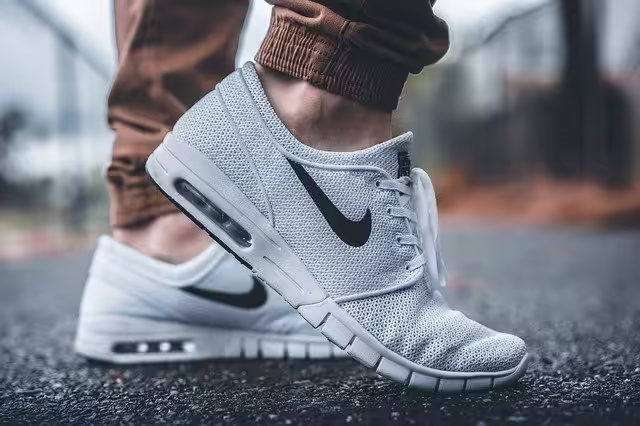
5. Brooks Addiction Walker 2 — for long days on hard floors
Best for: people on their feet at work whose ankles roll on hard floors, especially with flat feet. Type: leather motion-control walking shoe. Widths: narrow to extra-wide (4E) in men’s; women’s 2A to 2E.
A broad, flat base, a firm counter and a medial support Brooks calls an Extended Progressive Diagonal Rollbar make this one of the most planted walking shoes you can buy. It takes a brace and an orthotic. Brooks doesn’t publish a drop. Skip it if you walk long distances for exercise (it is heavy) or your arches are high.
Brooks Addiction Walker 2 on Amazon (men’s) · Brooks Addiction Walker 2 on Amazon (women’s)
The Picks Side by Side
| Shoe | Type | Drop | Widths | Choose it if |
|---|---|---|---|---|
| Brooks Adrenaline GTS 25 | Stability | 10 mm | Narrow to extra-wide | Your arches collapse inward |
| Brooks Ghost 18 | Neutral | 10 mm | Narrow to extra-wide | Your foot is neutral and you’ve sprained before |
| New Balance 860v15 | Stability | ~8 mm (retailer) | Men’s B–4E; women’s 2A–2E | You need stability in a wide width |
| ASICS Gel-Kayano 32 | Stability | 8 mm | Medium to extra-wide (men’s) | You want the broadest platform |
| Brooks Addiction Walker 2 | Motion control, leather | Not published | Men’s B–4E; women’s 2A–2E | You stand on hard floors all day |
Ankle Braces: When a Shoe Isn’t Enough
If your ankle gives way on flat ground, has sprained more than twice, or has ever felt loose, a lace-up or semi-rigid brace is the step with the best evidence for preventing the next sprain. Wear it for sport, trails and uneven ground, and for the first months after a sprain, not all day, every day: the ankle needs to work to rebuild its own reflexes. The ASO Ankle Stabilizer is a well-established lace-up design that fits inside most of the shoes above. See our guide to ankle braces for running, or ask us about bracing at our offices.
Orthotics help when the foot itself is driving the problem: an arch support orthotic for a collapsing arch and an overworked posterior tibial tendon, or a custom device when the foot has a deformity. A well-made custom orthotic from a podiatrist is the most precise option; a good over-the-counter insole is a reasonable first step. See podiatrist-recommended orthotics.
Balance Training: The Support You Build Yourself
- Single-leg balance: stand on the affected leg for 30 seconds, then progress to eyes closed, then to a folded towel or cushion. A few minutes a day for six to eight weeks retrains the reflexes a sprain dulled.
- Outer-ankle strength: with an exercise band around the forefoot, turn the foot outward against resistance. The peroneal muscles you strengthen this way are the ones that catch a rolling foot.
- Lace up properly: top eyelet, and a heel-lock loop if your heel lifts. The best heel counter can’t help in a loosely laced shoe.
For more on recovering from a sprain, see our ankle sprain guide.
When to See a Podiatrist
- you can’t take four steps on the ankle after an injury, or there is tenderness right on the ankle bones: you may need an X-ray
- the ankle gives way on flat ground, or is still unstable six weeks after a sprain
- it locks, catches or clicks painfully
- swelling or outer-ankle pain lingers for months after the sprain itself should have healed
- the arch is visibly flattening, or inside-ankle pain is getting worse
Ankle Keeps Rolling or Aching?
We examine the ankle, check the ligaments and tendons, and match shoes, bracing, orthotics or treatment to what we find. Bring the shoes you walk in most.
Book an appointment · Call (810) 206-1402 · Ankle sprain and instability treatment
Howell: 4330 E Grand River Ave, Howell MI 48843 · Bloomfield Township: 43494 Woodward Ave #208, Bloomfield Township MI 48302
More Guides for Ankle Pain and Instability
- Best shoes for ankle instability
- Best shoes for flat feet
- Best shoes for supination
- Best shoes for Achilles tendonitis
- How to KT tape an ankle
- Best shoes for wide feet
References
- Barrett JR, Tanji JL, Drake C, Fuller D, Kawasaki RI, Fenton RM. High- versus low-top shoes for the prevention of ankle sprains in basketball players: a prospective randomized study. American Journal of Sports Medicine. 1993;21(4):582–585.
- McGuine TA, Brooks A, Hetzel S. The effect of lace-up ankle braces on injury rates in high school basketball players. American Journal of Sports Medicine. 2011;39(9):1840–1848.
- Hupperets MDW, Verhagen EALM, van Mechelen W. Effect of unsupervised home based proprioceptive training on recurrences of ankle sprain: randomised controlled trial. BMJ. 2009;339:b2684. doi:10.1136/bmj.b2684

Dr. Tom Biernacki, DPM is a board-certified foot & ankle surgeon (ABFAS & ABPM) at Balance Foot & Ankle Specialists in Southeast Michigan. With over a decade of clinical experience, he specializes in heel pain, bunions, diabetic foot care, sports injuries, and minimally invasive surgery. Dr. Biernacki is a member of the APMA and ACFAS, and his patient education content on MichiganFootDoctors.com and YouTube has made him one of the most-followed foot & ankle educators on YouTube.
More questions patients ask
What walking shoes provide the best ankle support?
The best walking shoes for ankle support have a firm heel counter, a slightly elevated and well-cushioned heel, a supportive midsole, a wide base for stability, and ideally some lateral ankle support. Brands like New Balance, Brooks, Asics, Saucony, and Hoka offer excellent walking shoes with good ankle stability. Balance Foot & Ankle helps patients select walking shoes based on their foot type and ankle condition.
Can walking shoes prevent ankle injuries?
Supportive walking shoes reduce the risk of ankle sprains and chronic ankle pain by promoting proper foot alignment, providing a stable base, and offering lateral support. Combined with ankle-strengthening exercises, appropriate walking shoes are an important component of ankle injury prevention. Balance Foot & Ankle can evaluate your walking mechanics and recommend the most protective footwear for your needs.
Are there walking shoes specifically designed for people with ankle instability?
Yes, several shoe manufacturers offer walking shoes designed for ankle instability and overpronation, including motion-control and stability walking shoes. These feature medial arch support, firm midsoles, and enhanced heel control. At Balance Foot & Ankle, we evaluate your gait and recommend specific shoe models appropriate for your ankle stability issues, and can provide custom orthotics to further stabilize the ankle during walking.
Should I use an ankle brace inside my walking shoes?
Using an ankle brace inside walking shoes is recommended for patients with chronic ankle instability, a recent ankle sprain, or high-risk activities. Lace-up ankle braces can fit inside many athletic walking shoes. Balance Foot & Ankle provides ankle braces and can advise on which combination of brace and shoe is most effective for your specific ankle condition.
How do I find walking shoes that fit orthotics and provide ankle support?
Look for walking shoes with a removable insole and extra depth to accommodate your orthotics, combined with a firm heel counter and stable midsole for ankle support. Some shoe brands offer 'extra-depth' versions specifically designed for orthotic use. Balance Foot & Ankle can help you find the right shoe and ensure your custom orthotics work optimally within them. Call (810) 206-1402 for guidance.
Still have a question about coverage or cost? Book online and we will check your benefits before your visit: Book in Howell · Book in Bloomfield Township. Prefer to talk it through first? Call (810) 206-1402.