
Ready to be seen? Book a real appointment time online, 24/7 — Howell or Bloomfield Township. Takes about a minute, 24/7.
What Horizontal Ridges on a Toenail Actually Are
A horizontal ridge — a groove running side to side across the nail rather than lengthways — is called a Beau’s line. It is not a growth on the nail. It is a gap in one.
Nail grows continuously from the matrix, a strip of tissue tucked under the skin behind the base of the nail. If something interrupts that matrix, production pauses briefly and then resumes. The thinner section laid down during the pause travels forward as the nail grows, and what you see weeks or months later is a transverse dent marking the moment growth stopped. The depth of the groove reflects how severe the interruption was; the width reflects how long it lasted.
That is why a ridge is best read as a record of an event rather than a current disease. By the time it is visible, whatever caused it has usually already passed.
What Horizontal Ridges Actually Look Like
Most people reach this page after noticing something on one nail without having a name for it. Patients describe the same finding to me a dozen different ways, and nearly all of those descriptions point to one thing: a depression running side to side across the nail plate.
Here is how to confirm it at home. Put the toe under a lamp and tilt the nail so the light rakes across the surface instead of hitting it head on. A transverse ridge shows up as a shadowed band crossing from one side wall to the other, sitting parallel to the cuticle rather than pointing toward the tip. Then drag a fingertip over the dry nail: you should feel the surface drop away and rise again, like a shallow step. Nail polish hides a groove almost completely, so check a bare nail before you decide you do not have one.
One finding, a dozen different names. If any of these match what you are seeing, you are describing a transverse ridge:
- A dent or divot in the toenail — one depressed band, usually deepest in the middle of the nail and fading out toward the side walls
- A dip in the toenail — the same groove named by feel rather than by sight, most obvious when you drag a nail across it
- Ripples, or a wavy toenail — two or more grooves stacked one behind the other, which happens when the trigger repeated or dragged on for several weeks
- Lines across the toenail — a groove read as a line, because the shadow sitting inside it looks darker than the nail on either side
- A washboard or corrugated nail — many fine parallel grooves covering most of the plate, which points somewhere quite different (see habit tic deformity below)
What it is not. A ridge that runs from the cuticle toward the tip, in the same direction the nail grows, is a vertical ridge, and that is an ordinary aging change rather than a record of an event. There is a full comparison further down this page. A dark red or brown patch that also creeps toward the tip is bruising under the nail rather than a ridge; there you see color, but you feel no step.
Two different clocks. How long your groove takes to disappear is not the same question as how long the whole nail takes to replace itself. A ridge that formed halfway down the plate only has to cover the remaining half, so it can be gone in a matter of months, while a nail rebuilding from the matrix all the way out to the free edge is the longer figure. Rather than assuming either number applies to you, measure where your own groove sits and work forward from there.
The 5 Causes of Horizontal Ridges on Toenails
1. Pressure or injury from footwear
In a podiatry clinic this is by far the most common explanation, and it is the one most often missed because people are looking for a medical cause. Repeated pressure on the nail matrix from a shoe that is slightly too short or too shallow interrupts growth mechanically. A single stubbed toe or dropped object does the same thing in one moment. The giveaway is distribution — one or two toenails affected while the rest look normal. This is covered in more detail in the section below.
2. A systemic illness or high fever
Any illness severe enough to divert the body’s resources can pause nail growth: a high fever, a significant infection, pneumonia, a hospital admission, major surgery, or a severe viral illness. These are the classic Beau’s lines described in medical texts. The distinguishing feature is that they appear on all or most of the twenty nails at roughly the same height, because every matrix in the body paused at the same time.
3. Chemotherapy and certain medications
Chemotherapy is the most reliable producer of Beau’s lines there is, and it often creates a distinctive pattern: a series of parallel ridges spaced evenly apart, one for each treatment cycle. The nail effectively becomes a calendar of the course. Retinoids, some antibiotics, and occasionally other drugs that affect rapidly dividing cells can do the same on a smaller scale.
4. Nutritional and metabolic causes
Periods of significant undernutrition, rapid weight loss, protein deficiency or low zinc can interrupt matrix growth. So can poorly controlled diabetes, thyroid disease, and reduced circulation to the feet — the latter matters particularly in podiatry, because a foot with impaired arterial supply has less margin generally, and ridging in that context is worth mentioning to whoever manages your vascular health.
5. Skin or nail disease at the nail fold
Conditions affecting the skin immediately around the nail can disturb the matrix underneath it. Eczema or psoriasis at the nail fold, an episode of acute paronychia (an infected, swollen nail fold), or a severe Raynaud’s episode restricting blood flow to the toe will all show up later as a transverse groove. Here the ridging is a downstream sign, and treating the skin condition is what prevents the next one.
Horizontal Ridges vs. Vertical Ridges: Not the Same Thing
This distinction resolves most of the worry people arrive with, and the two are constantly confused.
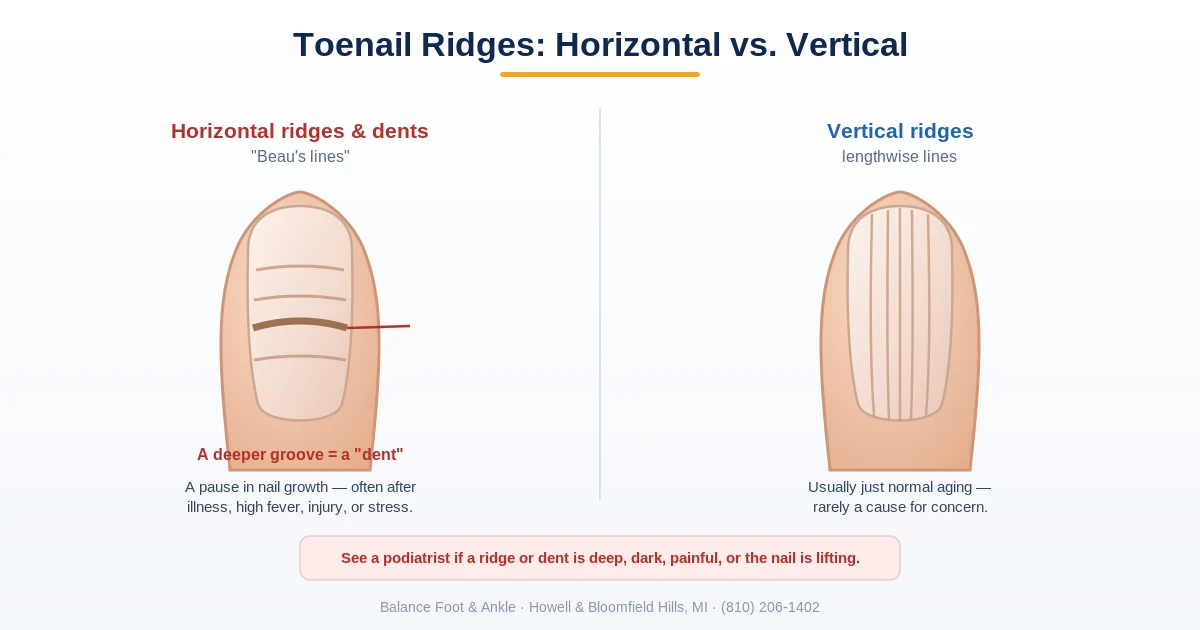
Vertical ridges — fine lines running from the base of the nail toward the tip, like the grain in wood — are a normal feature of ageing nails. Almost everyone develops them, they appear gradually on many nails at once, and on their own they mean nothing. They are the nail equivalent of wrinkles.
Horizontal ridges run the other way, across the nail, and are the ones that record a specific event. A single horizontal groove is worth a moment’s thought about what was happening three to six months earlier. Vertical lines are not.
The rare exception worth knowing: a single vertical ridge that is new, raised, splits the nail edge, or has a dark band running through it is a different matter and should be examined, since it can indicate a growth in the matrix.
Horizontal Ridges on Fingernails: What Changes on the Hands
A good share of the people reading this are looking at a hand rather than a foot. The mechanism is identical, because a fingernail matrix pauses for the same reasons a toenail matrix does. Three practical things are different, though, and they change both what the finding means and what you should do about it.
The clock runs about three times faster. A fingernail rebuilds itself completely in roughly four to six months. That is short enough that most people can still name the illness, the drug course, or the rough week the groove is recording, and short enough that watching it move out is a realistic way to confirm the cause has already passed.
The local causes are different. A toenail spends its day inside a shoe, so a single grooved toenail is usually mechanical. Fingernails are not compressed inside anything, which removes the easiest explanation and shifts attention to the skin immediately behind the nail. On the hands, the usual local culprits are:
- An aggressive manicure, particularly cuticle pushing or cutting that bruises the matrix underneath
- Repeated soak-off and re-application of gel or acrylic, which stresses the same fold every few weeks
- Eczema or psoriasis of the skin at the nail fold, where the inflammation sits directly over the matrix
- Chronic paronychia, the low-grade swelling and tenderness that follows heavy water exposure or nail biting
- A crush injury from a door, a drawer, or a dropped weight, which marks one nail and no others
And the temptation to fix it cosmetically is far stronger. A grooved thumbnail is visible every time you hand someone a card, so people sand it, fill it, or cover it over. The section on living with a ridged nail further down this page applies to hands and feet alike, and the short version is that sanding a groove flat is the one thing to avoid.
Everything else here transfers directly to fingernails: the list of causes, the way a whole-body event marks several nails at once, and the point at which a nail is worth having looked at rather than simply watched.
When Ridged Toenails Are Worth Having Examined
- All twenty nails are ridged at the same level and you cannot identify the illness or event that caused it.
- Ridges keep forming — a series of new grooves means something is still interrupting growth, rather than a single event that has passed.
- The nail is also thickened, discoloured or lifting, which points to a fungal infection or ongoing trauma rather than a simple Beau’s line.
- You have diabetes, neuropathy or circulation problems, where nail changes deserve a lower threshold for review and the pressure causing them may not be felt.
- The groove is deep enough that the nail has split across it, which can catch on socks and tear further.
Most ridged toenails need nothing but time and a better-fitting shoe — the marked section grows out and is trimmed away, which takes six to twelve months on a toenail. If yours falls into one of the categories above, or you simply want to know which of the five causes applies to you, we can usually tell from the pattern in a single visit.
Balance Foot & Ankle sees patients at our Howell podiatry office and our Bloomfield Township podiatry office. Book as a new patient or call (810) 206-1402. You can also schedule online now in Howell or Bloomfield Township. Bring the shoes you wear most — if the cause is mechanical, the shoe usually shows it.
Quick answer: Horizontal ridges or dents across a toenail (Beau’s lines) appear when nail growth briefly pauses — often after illness, an injury to the nail, or significant physical stress. A single ridge usually grows out over several months; multiple, recurring, or discolored ridges should be checked by a podiatrist. If your ridges run lengthwise from the cuticle to the tip, those are vertical ridges in toenails — a normal, harmless part of nail aging (see the comparison table below).
Ridges aren’t the only nail change worth watching. If a nail also loosens or starts to detach, here’s what to do when a toenail is falling off — including how to protect the nail bed while it heals.

Podiatrist’s Answer
Horizontal ridges — called Beau’s lines — form when nail growth temporarily stops due to a systemic stressor: high fever, surgery, chemotherapy, severe illness, or nutritional deficiency. A single ridge that grows out is usually benign. Multiple parallel ridges or ridges that don’t grow out warrant lab work to rule out thyroid disease or zinc deficiency.
— Dr. Tom Biernacki, DPM, Board-Certified Podiatric Surgeon, Balance Foot & Ankle
A single horizontal dent or groove across your toenail isn’t aging — it’s called a Beau’s line, and your body is essentially leaving you a 3-month-old receipt of something it went through (illness, stress, fever, even a medication change). After examining well over 15,000 toenails in my Michigan podiatry practice, here’s exactly what horizontal ridges and dents in toenails mean in 2026, when they’re harmless, and the four patterns that warrant a prompt appointment.
Board-certified podiatric surgeon | Balance Foot & Ankle
Last reviewed: May 2026
You look at your toenails and notice a groove — or several grooves — running side-to-side across the nail, like rings in a tree trunk. They were not there before. The nail looks otherwise normal, but those indentations are clearly something new.
In our clinic, horizontal ridges are one of the more diagnostically interesting nail findings we encounter, because they function as a timeline. Each groove represents a specific moment when the nail matrix — the tissue that manufactures the nail — hit pause. Understanding what caused that pause is the key to understanding what these lines mean for your health.
Most Common Mistake
Treating Beau’s lines with antifungal cream. Most patients assume horizontal ridges mean nail fungus and spend months applying OTC antifungal products — which do nothing for Beau’s lines because these are structural grooves from growth arrest, not an infection. The fix is identifying the underlying systemic trigger (illness, nutritional gap, medication), not antifungals. If the nail is also yellowing or thickening, see a podiatrist to confirm the diagnosis before treating.
What Are Beau’s Lines?
Beau’s lines are transverse (side-to-side) depressions or ridges in the nail plate, named after French physician Joseph Honore Simon Beau, who described them in 1846. They form when the nail matrix — the crescent of tissue beneath the proximal nail fold at the nail base — temporarily reduces or stops its normal production of nail cells.
The nail plate is manufactured continuously, advancing forward at approximately 1.5-2 mm per month for toenails. When matrix activity is disrupted, the emerging nail is thinner at that point, creating a transverse groove. The nail does not “know” it was disrupted — it simply records the event in its structure, much like a tree ring records a drought year. When the stressor resolves, normal production resumes and the groove grows forward toward the free edge.
This growth timeline means you can estimate when the disruption occurred. Measure the distance from the proximal nail fold (the base of the nail) to the center of the groove, then divide by the growth rate. A Beau’s line located 5 mm from the base of the great toenail occurred approximately 2-3 months ago. A line at 10 mm occurred 5-6 months ago. This dating is approximate but clinically useful.
Key takeaway: Beau’s lines are a timeline of past stressors. The position of the groove on the nail tells you roughly when the disruption occurred. A line at 5mm from base = approximately 2-3 months ago; at 10mm = 5-6 months ago.
What Causes Horizontal Ridges on Toenails?
Noticed ridges, dents, or unusual changes in your toenails?
Board-certified podiatric surgeons — prompt appointments in Howell & Bloomfield Hills, MI. Most insurance accepted.
Book an Appointment → ☎ (810) 206-1402Any physiological stress significant enough to temporarily suppress the nail matrix can produce Beau’s lines. The causes fall into several categories:
Acute systemic illness: High fever (above 39 degrees Celsius / 102 Fahrenheit), severe infections (pneumonia, COVID-19, sepsis), major surgery, and childbirth are among the most common causes. In our practice, we frequently see patients with Beau’s lines appearing 2-3 months after a major illness — the timing lines up perfectly with the nail growth math. COVID-19 in particular has been associated with prominent Beau’s lines observed at 1-3 months post-infection.
Nutritional deficiencies: Severe protein deficiency (hypoalbuminemia), zinc deficiency, and iron deficiency anemia can all produce Beau’s lines. Unlike leukonychia (white spots), which is usually benign, Beau’s lines are more reliably associated with genuine nutritional compromise. A full blood panel — albumin, zinc, iron studies, CBC — is reasonable if you have multiple deep Beau’s lines without an obvious past illness to explain them.
Chemotherapy: Many cytotoxic agents suppress rapidly dividing cells, including the nail matrix. Beau’s lines appearing predictably after chemotherapy cycles are a well-documented phenomenon. Paclitaxel, docetaxel, and fluorouracil are among the most commonly implicated agents.
Local trauma or nail procedure: A significant injury to the nail matrix area, aggressive nail surgery, or even very tight footwear causing chronic pressure on the matrix can produce localized Beau’s lines affecting one nail rather than all nails simultaneously.
Chronic systemic diseases: Peripheral vascular disease, Raynaud’s phenomenon, hypothyroidism, diabetes with poor glycemic control, and psoriasis affecting the nail matrix can all produce Beau’s lines — often multiple lines or continuous, irregular ridging reflecting ongoing matrix disruption rather than a single past event.
Key takeaway: A single Beau’s line on all nails simultaneously = a past systemic event (illness, surgery, fever). Multiple lines, lines progressing over months, or lines on only one nail = warrants evaluation for ongoing systemic disease, deficiency, or local cause.
Beau’s Lines vs. Other Toenail Ridges
| Ridge Type | Direction | Common Cause | Concern Level |
|---|---|---|---|
| Beau’s lines | Horizontal (side to side) | A temporary pause in nail growth from serious illness, high fever, injury, or chemotherapy | Usually grow out on their own; see a doctor if every nail is affected |
| Vertical ridges | Lengthwise (cuticle to tip) | Normal aging; very common and harmless | Rarely a concern |
| Nail pitting | Small pinpoint dents | Psoriasis, eczema, or alopecia areata | Worth having evaluated |
| Single deep groove | One horizontal dent | A localized injury to that nail or nail-base (matrix) | Grows out as the nail regrows |
Not all toenail ridges are Beau’s lines. The pattern and orientation of ridges carry distinct diagnostic meaning, and it is worth knowing the differences before assuming the worst.
Vertical (longitudinal) ridges: Fine lines running from the nail base to the tip, parallel to the long axis of the nail. These are almost universally benign and increase with age — they reflect the normal aging process of the nail matrix, similar to how skin develops fine lines over time. Longitudinal ridges are extremely common after age 50 and are not a cause for concern in the absence of other nail changes. These are the most common nail changes we see and the most commonly confused with Beau’s lines by patients.
Mees’ lines: Transverse white bands running across the full nail width — these differ from Beau’s lines in that Mees’ lines are a white discoloration within the nail plate, not a physical indentation. Mees’ lines are associated with arsenic poisoning, thallium toxicity, renal failure, and rarely, certain medications. Running a fingernail across the nail: Beau’s lines create a physical groove you can feel; Mees’ lines are flush with the nail surface.
Onychorrhexis: Multiple fine, irregular longitudinal ridges giving the nail a “corrugated tin” appearance. Associated with aging, trauma, lichen planus, and sometimes rheumatoid arthritis. Distinctly different from Beau’s lines — longitudinal, not transverse.
Onychoschisis: Horizontal splitting of the nail plate at the free edge — the nail separates in layers. Common in people who work with water frequently, use acetone nail products, or have thyroid disease. Easily distinguished from Beau’s lines by location (free edge splitting vs. proximal groove).
Other Nail Changes That Can Accompany Ridges
Ridges sometimes appear alongside other nail changes that point to a specific cause. If you notice any of these together with your ridges, it’s worth having a podiatrist take a look:
- Koilonychia (spoon nails) — nails that curve inward rather than outward; associated with iron-deficiency anemia.
- Pitting — small ice-pick depressions; a hallmark of nail psoriasis.
- Onycholysis — the nail lifting away from the nail bed; associated with psoriasis, thyroid disease, and fungal infection.
- Clubbing — nail curvature with soft-tissue enlargement of the fingertip; can signal pulmonary or cardiac conditions.
Diagnosis: How We Evaluate Horizontal Ridges in the Clinic
When a patient presents to Balance Foot & Ankle with horizontal nail ridges, our evaluation begins with a careful history. The most important question: “Did you have a significant illness, surgery, or health event 2-6 months ago?” When the answer is yes and the groove position matches the timing, we have our diagnosis. Most of these patients need nothing more than reassurance that the line will grow out over 6-12 months.
For multiple lines, bilateral lines without a clear precipitating event, or lines in combination with other nail changes, we examine: number and depth of lines, whether all nails are affected simultaneously (suggests systemic cause) or only one nail (suggests local cause), associated nail color changes (yellow, white, brown), nail texture (brittle, splitting, pitting), and surrounding skin changes (periungual erythema, swelling).
Laboratory evaluation may include: complete blood count (anemia, infection markers), metabolic panel (albumin, kidney function, glucose), thyroid function tests, zinc and iron studies, and inflammatory markers (ESR, CRP) if inflammatory disease is suspected. In patients with single-nail involvement and no systemic history, we consider local causes including past trauma or ill-fitting footwear causing matrix pressure.
⚠️ See a podiatrist or physician for horizontal nail ridges if you notice
- Multiple deep ridges appearing over weeks to months without a clear past illness to explain them
- Ridges affecting only one nail combined with nail discoloration, thickening, or separation from the nail bed
- Ridges accompanied by hair loss, fatigue, muscle weakness, or other systemic symptoms
- Very deep grooves that look like the nail might break at the groove
- Ridges in the context of known chronic disease (diabetes, thyroid disease, autoimmune conditions) that have been progressing
- New ridges appearing after starting a new medication — especially chemotherapy, retinoids, or antifungals
Treatment: Do Beau’s Lines Go Away?
For Beau’s lines caused by a single past event (illness, surgery, fever), the answer is yes — without any treatment. The groove grows forward at the toenail’s natural growth rate and is eventually trimmed off at the free edge. The entire process takes 6-12 months for a great toenail, less for smaller toes. There is nothing you can apply topically or take orally to speed this up. Biotin, nail hardeners, and other nail supplements do not affect Beau’s line resolution.
When Beau’s lines reflect an ongoing condition — an uncontrolled chronic disease, an active nutritional deficiency, or a medication effect — treatment is directed at the underlying cause. Correcting the deficiency or managing the disease will halt new line formation; existing lines will continue to grow out normally once the trigger is removed.
During the period while the line is growing out, the nail at the groove is structurally weaker than normal nail. You do not need to do anything specific, but avoid very aggressive trimming right at the groove and be cautious with the nail during that area’s growth. In rare cases where a groove is very deep, the nail can break at the groove; keeping nails trimmed at appropriate length (not too long) and wearing well-fitting footwear reduces this risk.
Key takeaway: Beau’s lines from a past single event: grow out on their own in 6-12 months, no treatment needed. Ongoing or recurrent Beau’s lines: identify and treat the underlying cause.
Frequently Asked Questions
Are horizontal ridges on toenails serious?
A single horizontal ridge appearing after a known illness, high fever, or surgery is not serious — it is a normal nail response to physiological stress that will grow out on its own. Multiple ridges without a clear cause, or ridges accompanied by other symptoms, are worth evaluating because they can indicate an underlying condition such as nutritional deficiency, thyroid disease, or circulatory problems.
What is the difference between Beau’s lines and vertical ridges?
Beau’s lines run side-to-side (transversely) across the nail and feel like grooves when you run your fingernail over them. Vertical ridges run lengthwise from base to tip of the nail and are almost always a normal part of aging. Vertical ridges are extremely common after 50 and rarely signify anything medically important. Horizontal ridges (Beau’s lines) are less common and more diagnostically significant.
Can COVID-19 cause horizontal ridges on toenails?
Yes. COVID-19 has been associated with Beau’s lines, typically appearing 1-3 months after the acute illness. The physiological stress of the infection temporarily suppresses the nail matrix, creating the characteristic grooves. These lines are benign and grow out normally over 6-12 months. This is one of the more common nail findings we have seen since 2020-2021 in our practice.
How long does it take for Beau’s lines to grow out?
Toenails grow approximately 1.5-2 mm per month. A Beau’s line near the nail base will take 6-12 months to reach the free edge and be trimmed away, depending on which toenail is affected (the great toenail takes longest). There is no treatment to speed this up. Once the underlying cause is resolved, no new lines form, and the existing groove grows out naturally.
Should I be worried about horizontal ridges after chemotherapy?
Horizontal ridges after chemotherapy are expected and benign. Many cytotoxic agents temporarily suppress the nail matrix, producing Beau’s lines that correspond to each treatment cycle. These lines grow out after treatment ends. If you notice nail changes during chemotherapy beyond simple ridges — such as nail lifting (onycholysis), color changes, or severe brittleness — mention them to your oncologist, as some nail changes during chemotherapy can signal treatment-related toxicity.
The Bottom Line
Horizontal ridges on toenails — Beau’s lines — are the nail’s way of recording a past physiological disruption. A single groove after a major illness or surgery is almost always benign and will grow out in 6-12 months without any intervention. Multiple lines without a clear precipitating event, or lines combined with other nail or systemic changes, are worth a medical evaluation to rule out ongoing nutritional deficiency, chronic disease, or medication effects.
The most important step is distinguishing horizontal ridges from vertical ridges — the far more common, essentially-always-benign age-related change that runs lengthwise along the nail. If your ridges run side-to-side and you had a significant illness 2-6 months ago, the mystery is almost certainly solved. If not, we are glad to evaluate.
Sources
1. Tosti A, Piraccini BM, Cameli N. Beau’s lines and onychomadesis following hand-foot-mouth disease: a case report. Arch Dermatol. 1999;135(2):212.
2. Tully AS, Trayes KP, Studdiford JS. Evaluation of nail abnormalities. Am Fam Physician. 2012;85(8):779-787.
3. Wollina U, Nenoff P, Haroske G, Haenssle HA. The Diagnosis and Treatment of Nail Disorders. Dtsch Arztebl Int. 2016;113(29-30):509-518.
4. Iorizzo M, Pazzaglia M, Piraccini BM, Tosti A. Brittle nails. J Cosmet Dermatol. 2004;3(3):138-144.
5. Starace M, Bergamin M, Piraccini BM. Nail changes in COVID-19 patients: a systematic review. Dermatol Ther. 2021;34(6):e15143.
Green nail discoloration has very different causes from horizontal ridges — a Pseudomonas infection or trauma-related issue. See our guide: Green Toenail Discoloration: A Related Nail Change.
Ready to Get Relief?
Same-day appointments available in Howell & Bloomfield Hills, MI
4.9★ | 1,193+ Reviews | 3,000+ Surgeries
Or call: (810) 206-1402
For a complete clinical overview: Toenail Problems Complete Guide — nail discoloration, ridges, fungus, and injury treated
PubMed: Beau Lines — Horizontal Nail Ridges Causes & Treatment
In-Office Treatment at Balance Foot & Ankle
If home care isn’t resolving your symptoms — or if you’re unsure of your diagnosis — a same-visit evaluation with Dr. Tom Biernacki, DPM gives you a clear diagnosis and a treatment plan the same day. We serve patients in Howell and Bloomfield Hills, MI. Book online →

Dr. Tom Biernacki, DPM is a double board-certified podiatrist and foot & ankle surgeon at Balance Foot & Ankle Specialists in Southeast Michigan. With over a decade of clinical experience, he specializes in heel pain, bunions, diabetic foot care, sports injuries, and minimally invasive surgery. Dr. Biernacki is a member of the APMA and ACFAS, and his patient education content on MichiganFootDoctors.com and YouTube has reached over one million views.
A single horizontal dent across your big toenail usually traces back to one moment 4–6 months ago — an illness, a fever, or a medication you forgot you took. But one ridge pattern means stop reading and call a doctor today. Here is how to tell which is which, in plain English from a board-certified podiatrist.
Related Treatments at Balance Foot & Ankle
Our board-certified podiatrists offer advanced treatments at our Bloomfield Hills and Howell locations.
Recommended Products from Dr. Tom

Specialist For This Condition
Dr. Daria Gutkin, DPM, AACFAS is the Balance Foot & Ankle podiatrist most patients ask for when horizontal ridges, dents, or systemic-related nail changes need careful evaluation. Cleveland Clinic-trained, bilingual (English / Russian), known as the gentlest hands in Michigan podiatry. Call (810) 206-1402 to request at the Howell or Bloomfield Hills office.
Ridges or dents across your toenails?
Nail changes can point to injury, illness, or fungus — some need treatment. In Michigan? Our podiatrists can diagnose the cause and protect the nail. Prompt visits in Howell & Bloomfield Hills.
📅 Book an Appointment 📞 (810) 206-1402★ 4.9 from 1,193+ Google reviews · Prompt visits · We verify your insurance free — most visits are just a copay.
Related reading: Ridges and dents are structural nail changes, but not every cosmetic change is — white, chalky toenails after nail polish are keratin granulation on the nail surface, which is harmless and often mistaken for fungus.
How to Date the Event From Where the Ridge Sits
This is the most useful thing a horizontal ridge can tell you, and it is rarely explained: the ridge is a timestamp. The nail plate is made at the matrix under the cuticle and then pushed forward at a steady rate. Whatever interrupted production left its mark at the cuticle at the time it happened, and that mark has been travelling outward ever since.
So the distance from your cuticle to the ridge tells you roughly how long ago the interruption occurred.
The rates to work with:
- Toenails grow roughly 1 mm per month — slower in older adults, slower in cold weather, slower where circulation is poor.
- Fingernails grow roughly 3 mm per month, which is why the same illness shows up on the hands first and clears the hands long before the feet.
- A big toenail takes about 12 to 18 months to replace itself completely. The small toes are quicker.
A worked example. You notice a ridge sitting about 4 mm out from the cuticle on your big toenail. At roughly 1 mm a month, that puts the causative event around four months ago. Cast your mind back four months: a bad flu, a hospital stay, a course of a new medication, a fever, a period of not eating properly. People are often surprised how precisely it lines up with something they had genuinely forgotten.
Two things this immediately settles:
- Whether it is over. A single ridge with completely smooth, normal nail behind it means the interruption was a one-off and the matrix has been working normally ever since. That is reassuring, and it means no treatment is needed — only time.
- Whether it is ongoing. Several parallel ridges, or new ones appearing at the cuticle, mean something is still happening at intervals. That is the version worth investigating, because a repeating cause is a cause you can still do something about.
It also explains the most common frustration: you feel completely better, and the nail still looks wrong. The nail is not lagging behind because it is unhealthy — it is simply showing you an old event that has not grown out yet. On a big toenail that can take the better part of a year.
When the Ridge Becomes a Split: Onychomadesis
If the interruption at the matrix is severe enough, nail production does not just thin — it stops entirely for a period. Instead of a groove you get a complete break across the plate, and the nail behind it eventually pushes the old nail off. This is onychomadesis, and it is the same process as a Beau’s line taken to its extreme.
The usual triggers are the severe end of the same list: a significant illness with high fever, hand-foot-and-mouth disease (a very common cause in children, typically shedding nails a month or two after the rash has resolved), a serious infection, chemotherapy, or a substantial drug reaction. Because the nail grows at a fairly predictable rate, where the ridge sits along the nail dates the event that caused it, which is often the quickest way to work out which of these it was. Book a nail evaluation online.
What matters practically:
- The nail underneath is usually already forming. Losing the plate looks alarming but the matrix has generally recovered by the time shedding happens — that is why it is being pushed off.
- Do not pull a partly attached nail off. Trim what has clearly detached, keep the area clean and covered, and let the rest lift on its own. Tearing it can damage the nail bed and produce a permanently deformed nail.
- Expect months, not weeks. A shed big toenail takes roughly nine to eighteen months to return fully, and it commonly comes back slightly ridged or thickened at first before normalising.
Shedding of several nails at once, or shedding without any illness you can identify, is worth an appointment rather than watchful waiting.
The Washboard Nail That Is Not Beau’s Lines: Habit Tic Deformity
There is one pattern of transverse ridging that has nothing to do with illness, nutrition, or medication — it is self-inflicted, almost always unconsciously, and it is regularly misdiagnosed as fungus or as a systemic problem.
Habit tic deformity comes from repeatedly pushing back, picking at, or rubbing the cuticle of one particular nail. Each small trauma to the matrix underneath produces a shallow ridge. Repeated daily over months, the result is a ladder of fine parallel ridges running the length of the nail — the classic “washboard” appearance — often with a shallow groove down the centre.
How to recognise it:
- It affects one nail, or two symmetrically — most often a thumb, but on the feet almost always a big toenail. A true systemic Beau’s line affects all twenty nails at the same level.
- The ridges are many, fine, and evenly spaced, rather than one or two distinct grooves.
- The cuticle looks damaged, reddened, or absent, and the nail fold may be slightly swollen.
- There is often a central lengthwise depression with the transverse ridges running off it, sometimes described as resembling a fir tree.
The treatment is genuinely just stopping the habit — and the useful trick is that most people do not know they are doing it. Covering the nail fold with tape or a plaster for a few weeks makes the habit conscious, protects the matrix, and is often enough on its own. The nail grows out normally afterward. No antifungal, no supplement, and no biopsy is needed.
If ridges keep appearing at the cuticle, affect all your nails at once, or come with nail lifting, colour change, or pain, that is worth having looked at properly. Balance Foot & Ankle sees patients in Howell (4330 E Grand River Ave, Howell, MI 48843) and Bloomfield Township (43494 Woodward Ave #208, Bloomfield Township, MI 48302). Call (810) 206-1402.
When the Cause Is the Shoe, Not the Body
Horizontal ridges are usually explained in terms of systemic events — a high fever, an illness, chemotherapy, a period of poor nutrition — and those causes are real. But in a podiatry clinic, the most common reason a patient has a transverse ridge on one or two toenails while the other eight look completely normal is mechanical, not medical. The nail matrix sat under repeated pressure from a shoe that was slightly too short or too shallow, growth paused, and the nail recorded it. The distribution is what tells the two apart: a systemic event marks all twenty nails at roughly the same height, whereas footwear marks the longest toe alone — which is the second toe in the substantial minority of people whose second ray is longer than the big toe.
You can also date the event, which is genuinely useful. Toenails grow at roughly one millimetre per month, so a ridge sitting four millimetres from the cuticle corresponds to something that happened about four months ago. If that lines up with a new pair of shoes or a change in training rather than an illness, the cause is almost certainly mechanical.
Match What You Are Seeing to the Next Step
- One or two nails ridged, usually the longest toe — this is a fit problem. You want roughly a thumb’s width beyond the longest toe and enough toe-box depth that the nail never contacts the upper; shoes with genuine toe-box volume resolve most of these.
- A ridge together with darkening under the nail — that is bleeding beneath the plate from repetitive impact, which is a subungual hematoma rather than a bruise of the nail itself and is managed differently.
- The nail is separating from the bed beyond the ridge — once the plate lifts, the nail rarely reattaches; what to do when a toenail is coming off covers how to protect the bed while it regrows.
- A chalky white surface, most visible after removing polish — this is not fungus and does not need an antifungal; it is keratin granulation, and treating it as fungus makes it worse.
- Green or blue-green discolouration under a lifted nail — that colour is characteristic of pseudomonas colonising the space under the plate, and it clears quickly once the moisture is addressed.
- Ridged and thickened enough that safe trimming at home is difficult — ridged nails split unpredictably under clippers. A medical pedicure debrides the plate safely, which matters a great deal more if you are diabetic or have reduced sensation.
If every nail carries a ridge at the same height, that is the pattern that deserves a conversation with your physician rather than a shoe change, because it points to a whole-body event a few months back. If it is one or two nails and the timing matches your footwear, we can confirm the mechanical cause on exam and get the fit corrected before the next nail cycle. Our Howell and Bloomfield Township offices are reachable at (810) 206-1402.
Living With a Ridged Nail While It Grows Out
A transverse groove cannot be repaired. That stretch of plate was laid down defective and hardened long before you noticed it, so the only thing that removes it is growth. Which leaves a fair question that treatment advice tends to skip over: what can you safely do with the nail in the meantime, especially if it is a thumb or a great toenail you would rather not stare at for the better part of a year?
Do not sand or file the groove flat. This is the most common piece of self-treatment I see and the only one that reliably causes harm. The floor of the groove is the thinnest part of the nail, so grinding the ridges on either side down to meet it removes healthy plate and can leave a weak line that splits later. If a salon offers to smooth it, decline that step specifically.
Polish and a ridge-filling base coat are fine. Both sit on top of the plate, neither one reaches the matrix, and together they are a reasonable way to make a groove less obvious while it works its way toward the tip. The only thing worth doing differently is leaving the nail bare for a few days now and then, so you can actually see whether the groove has moved.
Gel and acrylic are a different decision. Enhancements go over a groove rather than into it, and both ends of the cycle work against a nail that already carries a structural weak line: the surface is roughened before application and then soaked or ground off at removal. If the groove is deep, or if it still sits close to the cuticle, wait until it has grown past the midpoint of the nail before booking anything.
Keep the free edge short and cut it straight across. A grooved nail is weakest exactly where the groove sits, so the less leverage there is on the end of it, the less likely it is to catch on a sock or a bedsheet and tear along that line. Trim level with the end of the toe and take the corners down with an emery board rather than cutting into them.
Leave the cuticle alone entirely. The matrix sits directly beneath the skin behind the nail, and pushing that skin back hard is itself a documented way to produce a transverse groove. A nail that has already recorded one insult does not need a tool at the nail fold. Ask for the cuticle to be left untouched, and do not clip hangnails back into it. If you would rather have the nail tidied by someone else while it grows out, a medical pedicure is carried out with exactly that constraint in mind.
Expect it to look worse before it looks better. As the depression works out toward the tip it also becomes more exposed, so it tends to catch light and lint more obviously at six months than it did at two. That is not a sign the cause is still active. A photograph taken next to a ruler once a month is the simplest way to prove to yourself that the groove is moving, and it beats memory by a wide margin.
Related
Related nail-plate problems:
Book an appointment with a podiatrist
A single horizontal dent across one nail usually traces back to one event, while ridges across several nails at once can point to something systemic that is worth looking at properly. Balance Foot & Ankle sees patients at two offices — Howell in Livingston County, and Bloomfield Township in Oakland County.
Book online, 24/7: choose a real appointment time at Howell or Bloomfield Township. Prefer to speak with someone first? Call (810) 206-1402 or use the form below.
Dr. Tom Biernacki, DPM is a board-certified foot & ankle surgeon (ABFAS & ABPM) at Balance Foot & Ankle Specialists in Southeast Michigan. With over a decade of clinical experience, he specializes in heel pain, bunions, diabetic foot care, sports injuries, and minimally invasive surgery. Dr. Biernacki is a member of the APMA and ACFAS, and his patient education content on MichiganFootDoctors.com and YouTube has made him one of the most-followed foot & ankle educators on YouTube.