
Medically reviewed by Dr. Tom Biernacki, DPM — Board-certified foot & ankle surgeon, 3,000+ surgeries performed. Updated April 2026 with current clinical evidence. This article reflects real practice experience from Balance Foot & Ankle Specialists in Howell and Bloomfield Township, Michigan.
The most important clinical decision with Road Cycling Shoes Foot Pain Cleat Position Hot Spots Morton Neuroma isn’t which treatment to start with — it’s which subtype or underlying cause you actually have. That distinction changes everything. Call us: (810) 206-1402
Quick Answer
Morton’s neuroma is a thickening of nerve tissue between the third and fourth toes causing burning pain, numbness, or the sensation of a pebble under the ball of the foot. Wide toe-box shoes with a metatarsal pad resolve 70% of cases; the rest benefit from cortisone or sclerosing injections.
Medically reviewed by Dr. Tom Biernacki, DPM
Board-certified podiatric surgeon | Balance Foot & Ankle
Last reviewed: April 2, 2026



Watch: How to Cure Plantar Fasciitis in One Week? [FAST Heel Pain Relief!] — MichiganFootDoctors YouTube
In This Guide
Medically Reviewed by: Dr. Tom Biernacki, DPM — Board-Certified Podiatrist
Last Updated: April 2026 | Reading Time: 14 min
This article is for informational purposes only and does not replace professional medical advice. Schedule an appointment for personalized care.
Quick Answer
Foot pain affects 30–50% of road cyclists and is primarily caused by incorrect cleat positioning, inadequate shoe fit, excessive sole stiffness without proper insole support, and forefoot compression from narrow shoes. The most common conditions — metatarsalgia, Morton’s neuroma, hot spots, and arch pain — are almost entirely preventable through proper bike fitting, cleat adjustment, and cycling-specific insoles. Small changes in cleat position (even 1–2mm) can eliminate pain that riders have endured for thousands of miles. If your feet hurt during or after rides, the problem is almost always solvable.
Affiliate disclosure: This article contains affiliate links to products we recommend. We may earn a small commission at no additional cost to you. We only recommend products we trust and that align with our clinical standards.
Why Cycling Creates Unique Foot Problems
Road cycling subjects feet to biomechanical demands that are fundamentally different from any other sport. The foot is locked into a rigid interface between shoe, cleat, and pedal, with virtually zero freedom to adapt its position during the 5,000–6,000 pedal strokes per hour that sustained cycling demands. Unlike running where the foot rolls through a natural gait cycle, cycling concentrates all power transfer through a small area of the forefoot — the metatarsal heads — pressed against an unyielding carbon fiber sole.
This repetitive loading pattern creates predictable problems. The metatarsal heads bear the entire pedaling force (200–400 watts in trained cyclists translates to significant compressive loads through a contact area smaller than a credit card). The rigid sole prevents the natural arch flexion that distributes pressure in walking. The enclosed shoe creates a warm, moist environment that increases tissue swelling during long rides, progressively tightening an already narrow fit. And the fixed cleat position means even minor misalignment is repeated thousands of times per hour with no opportunity for natural compensation. Understanding these unique mechanics explains why cycling foot pain responds to precise adjustments rather than the rest-and-ice approach that works for running injuries.
Cleat Position: The Most Critical Variable
Cleat position determines where pedaling force is applied to the foot, and even millimeter-level adjustments can eliminate pain that riders have endured for years. The three axes of cleat adjustment — fore/aft, medial/lateral, and rotational — each address different pain patterns.
Fore/aft position determines which part of the forefoot bears pedaling force. Traditional teaching places the cleat so the pedal spindle sits directly under the first metatarsal head. However, current evidence suggests a slightly more rearward position — with the spindle 5–10mm behind the metatarsal heads — reduces forefoot pressure, improves power at high cadences, and significantly decreases hot spot and neuroma symptoms. Moving the cleat rearward shifts the load toward the midfoot where it is distributed across a broader area of stiffer bone. Medial/lateral position controls the stance width (Q-factor) on the bike. Riders with wider hips or valgus knee alignment may need the cleat positioned to widen their stance, while narrow-hipped riders may benefit from a narrower position. Incorrect stance width creates lateral knee pain and uneven forefoot loading. Rotational position (float) allows the heel to pivot naturally during the pedal stroke. Most riders need 4.5–6 degrees of float to accommodate the natural internal/external rotation of the tibia during knee flexion-extension. Insufficient float forces the knee into unnatural alignment, producing both knee and foot pain.
Hot Spots and Forefoot Burning
Hot spots — localized burning sensations on the ball of the foot — are the most common cycling foot complaint, affecting an estimated 40% of road cyclists on rides exceeding 2 hours. They result from concentrated pressure on the metatarsal heads compressed between the pedal platform below and the rigid shoe upper above. As the ride progresses, foot swelling from increased blood flow and heat reduces the available space inside the shoe, progressively increasing compression on the forefoot.
Solutions target both the pressure concentration and the swelling. Cycling-specific insoles with metatarsal support redistribute pressure across the entire forefoot rather than concentrating it on the metatarsal heads. Shoes with adequate forefoot width (many performance cycling shoes are excessively narrow for most foot shapes) reduce lateral compression. Starting rides with shoes slightly looser and tightening after the first 30 minutes accommodates predictable foot swelling. On rides exceeding 3 hours, briefly loosening the closure at rest stops and flexing the toes can provide immediate relief.
Morton’s Neuroma in Cyclists
Morton’s neuroma — enlargement and inflammation of the interdigital nerve, most commonly in the third web space — is significantly more prevalent in cyclists than in the general population. The mechanism is chronic compression of the intermetatarsal nerve between adjacent metatarsal heads, amplified by the narrow cycling shoe and rigid sole. Cyclists with Morton’s neuroma experience sharp, burning pain or electric-shock sensations between the third and fourth toes that intensify during climbs and sprints when pedaling force is highest.
Conservative management resolves the majority of cycling-related neuromas. Metatarsal pads positioned just proximal to the metatarsal heads splay the metatarsals apart, decompressing the nerve. Wider cycling shoes or heat-molded shoe modifications create more forefoot volume. Moving the cleat rearward reduces pressure on the metatarsal heads during the power phase. If conservative measures fail, a corticosteroid injection into the intermetatarsal space can provide months of relief, and ultrasound-guided alcohol sclerotherapy offers longer-term results without surgery. Surgical excision is reserved for neuromas that fail all conservative treatment and remains highly effective (90%+ success rate) in cyclists.
Metatarsalgia and Ball-of-Foot Pain
Metatarsalgia — generalized pain under the metatarsal heads — differs from hot spots in that it involves actual tissue inflammation rather than just sensory irritation. The concentrated loading of cycling, repeated over thousands of pedal strokes, inflames the metatarsophalangeal joint capsules and plantar plate structures. Cyclists with high arches (cavus feet) are particularly susceptible because the rigid arch transfers more force to the forefoot, and cyclists with prominent metatarsal heads experience higher peak pressures at the shoe-sole interface.
Treatment combines offloading strategies with biomechanical correction. Cycling-specific insoles that support the arch and incorporate metatarsal relief reduce peak forefoot pressures by 20–30%. Cleat repositioning — moving 5–10mm rearward — shifts the pedaling load toward the midfoot. Shoe sole modifications including external metatarsal buttons and custom footbeds provide additional relief for refractory cases. Anti-inflammatory management (topical treatments are preferred over systemic NSAIDs for active cyclists) addresses acute inflammation, and physical therapy targeting intrinsic foot muscle strengthening helps maintain metatarsal head alignment.
Arch Pain and Plantar Fasciitis in Cyclists
While plantar fasciitis is classically associated with running, cyclists develop a distinct variant caused by the rigid cycling shoe preventing normal arch flexion. The plantar fascia acts as a spring mechanism that stores and releases energy during the gait cycle, but in a cycling shoe with a stiff carbon sole, this spring is locked in a static position. During long rides, the fascia becomes stiff and irritated from sustained tension without the dynamic loading cycles that maintain its flexibility.
Cycling-specific arch support is the primary treatment. Unlike running insoles that need to flex with the gait cycle, cycling insoles can be semi-rigid or rigid because the shoe itself does not bend. This actually makes cycling insoles easier to optimize — they provide consistent support without needing to accommodate dynamic motion. A well-fitted cycling insole that matches the rider’s arch profile eliminates the void beneath the arch that allows the plantar fascia to sag and pull on its calcaneal attachment during the sustained loading of a long ride.
Foot Numbness During Rides
Foot numbness on the bike — ranging from mild tingling to complete loss of sensation — results from nerve compression within the cycling shoe. The most commonly affected nerves are the interdigital nerves (compressed between metatarsal heads, similar to Morton’s neuroma) and the medial plantar nerve (compressed against a flat insole in riders with high arches). Numbness typically develops 45–90 minutes into a ride and worsens progressively.
The primary cause is shoe-foot volume mismatch — the shoe is simply too tight for the swollen foot. Feet swell approximately 5–8% during cycling due to increased blood flow and dependent position, and shoes fitted in a shop at rest may become constrictive after an hour of riding. Solutions include fitting cycling shoes later in the day when feet are naturally larger, using the BOA or buckle closure to leave slightly more room in the forefoot, choosing shoes with wider forefoot lasts, and using thin, cycling-specific insoles that do not consume additional shoe volume while still providing arch support and metatarsal relief.
Cycling Shoe Fit and Selection
The cycling shoe market has traditionally prioritized stiffness and light weight over anatomical fit, producing shoes that transfer power efficiently but cause pain in a significant percentage of riders. A properly fitting cycling shoe should be snug in the heel and midfoot (preventing lifting during the pull-up phase) while providing adequate room in the forefoot (toes should not touch the end, and the metatarsal area should not feel compressed from the sides).
Key fit considerations include: forefoot width (many riders need wide options that major brands now offer), heel cup depth and shape (must lock the heel without creating pressure points), toe box height (toes should have vertical clearance to avoid nail trauma during sustained riding), sole stiffness (stiffer is not always better — moderate stiffness with proper insole support often produces better comfort-to-power ratios), and closure system (BOA and ratchet systems allow micro-adjustments during rides to accommodate swelling). Professional bike fitting that includes foot assessment should precede expensive shoe purchases — many riders buy shoes based on brand, color, or price rather than anatomical compatibility.
Why Stock Cycling Insoles Fail
Every cycling shoe ships with a flat, foam insole that provides almost zero biomechanical support. These stock insoles are placeholder products designed to be replaced — yet the majority of cyclists never upgrade them, instead spending thousands on frames, wheels, and components while ignoring the $30–50 investment that would solve their foot pain. A flat insole in a cycling shoe allows the arch to collapse under pedaling load, concentrates force on the metatarsal heads, and creates the void space beneath the arch that produces hot spots and numbness.
Cycling-specific aftermarket insoles provide arch support matched to the rider’s foot profile, metatarsal support that redistributes forefoot pressure, and a contoured heel cup that stabilizes the rearfoot within the shoe. The improvement in comfort and power transfer from a quality cycling insole is one of the highest cost-to-benefit ratios in cycling equipment — a $40 insole can eliminate foot pain that a $400 shoe could not solve. For riders with specific biomechanical issues (severe flat feet, extremely high arches, leg length discrepancy), custom cycling orthotics from a podiatrist provide the most precise solution.
Cleat Wedges and Forefoot Varus
Forefoot varus — an intrinsic tilt of the forefoot relative to the rearfoot — affects an estimated 85% of the population to some degree. In cycling, this biomechanical variant becomes clinically significant because the rigid shoe-cleat interface does not accommodate the tilt. A rider with forefoot varus pedals with the medial (inside) metatarsal heads loaded more heavily than the lateral heads, creating asymmetric pressure, inefficient power transfer, and compensatory knee tracking problems.
Cleat wedges — thin tapered shims placed between the cleat and the shoe sole — correct forefoot varus by tilting the cleat platform to match the foot’s natural angle. Most riders benefit from 1–2 degrees of varus correction, though some require up to 4 degrees. The effect is immediate and often dramatic — riders describe an instant sensation of the foot “settling” onto the pedal with even pressure distribution. In-shoe forefoot wedges (placed inside the shoe beneath the insole) provide the same correction and can be combined with cleat wedges for riders with significant varus. Professional bike fitting with forefoot assessment is the most reliable way to determine wedge needs.
Managing Foot Pain on Long Rides
Rides exceeding 3–4 hours present unique challenges because progressive foot swelling, fatigue-related biomechanical changes, and cumulative pressure damage compound over time. Proactive management strategies include: loosening shoe closures by one click or quarter-turn at each rest stop to accommodate swelling, standing periodically during the ride to change pressure patterns and promote blood flow, varying cadence between high-RPM spinning and lower-RPM mashing to change the loading pattern on the forefoot, removing shoes briefly at lunch stops to let feet decompress and dry, and applying anti-chafing balm to hot spot areas before the ride.
Nutritionally, adequate hydration and electrolyte balance help minimize tissue swelling. Sodium loading before and during long rides paradoxically reduces peripheral edema by maintaining plasma osmolality. Caffeine — a natural diuretic — may help reduce foot swelling on ultra-endurance rides, though individual response varies. For riders who consistently develop foot pain on long rides despite optimal shoe fit and insole support, two pairs of cycling shoes in slightly different sizes (regular and half-size up) can be alternated at the halfway point to accommodate swelling progression.
Recommended Products for Cyclists
Cycling foot pain is one of the most equipment-responsive conditions in sports medicine. The right combination of insoles, cleat setup, and recovery products can eliminate pain that riders have endured for thousands of miles. These products specifically address the biomechanical demands of road cycling.
CURREX BikePro Insoles — The #1 Cycling-Specific Upgrade
Stock cycling insoles are flat foam placeholders with zero biomechanical function. CURREX BikePro insoles are purpose-designed for cycling biomechanics, with contoured arch support that prevents midfoot collapse during the power phase, metatarsal relief zones that distribute forefoot pressure across a broader area, and a low-profile design that fits inside cycling shoes without altering the heel-to-pedal stack height. The dynamic arch support flexes minimally during the pedal stroke while maintaining consistent pressure distribution — reducing hot spots, numbness, and metatarsalgia by up to 25%. Available in three arch profiles (low, medium, high), CURREX BikePro insoles address the root cause of most cycling foot pain for a fraction of the cost of new shoes.
PowerStep Pinnacle Insoles — Off-Bike Recovery Support
Cyclists who spend 8–15 hours per week in rigid cycling shoes need proper arch support in their everyday footwear to maintain foot health off the bike. PowerStep Pinnacle insoles provide medical-grade arch support with Variable Cushioning Technology for walking shoes, casual shoes, and cross-training footwear. The semi-rigid shell supports the arch that cycling shoes lock in a static position, helping maintain plantar fascia flexibility and preventing the stiffness that develops from hours in rigid footwear. For cyclists with existing plantar fasciitis, PowerStep Pinnacles in everyday shoes are essential for preventing flare-ups between rides.
Doctor Hoy’s Natural Pain Relief Gel — Post-Ride Recovery
After long rides, forefoot inflammation and residual burning from hot spots benefit from targeted topical treatment. Doctor Hoy’s Natural Pain Relief Gel provides clean, plant-based cooling relief using arnica and menthol that targets the inflamed metatarsal area without systemic anti-inflammatory effects. For cyclists managing chronic metatarsalgia or Morton’s neuroma, post-ride application to the forefoot reduces inflammatory buildup between rides and accelerates tissue recovery. The natural formula is preferable to chronic NSAID use, which impairs tendon healing and bone remodeling.
DASS Compression Socks — Ride Recovery and Swelling Control
Post-ride foot swelling is virtually universal among cyclists, and managing this swelling between rides promotes tissue recovery and reduces next-ride pain. DASS graduated compression socks at 15–20 mmHg promote venous return and reduce lower extremity edema during the critical recovery window after dismounting. Wear for 2–4 hours post-ride to accelerate fluid redistribution and reduce the residual swelling that contributes to shoe fit issues on consecutive riding days. The moisture-wicking fabric also serves as an excellent cycling sock for rides under 2 hours.
FLAT SOCKS — Ultra-Thin In-Shoe Layer for Tight Cycling Shoes
Performance cycling shoes are engineered with minimal internal volume, and many riders find that even low-profile aftermarket insoles consume too much space. FLAT SOCKS provide an ultra-thin cushioning and moisture-management layer that adds comfort without altering shoe volume or stack height. For riders whose shoes fit perfectly but still produce hot spots, FLAT SOCKS add the minimal friction reduction and moisture wicking needed to eliminate forefoot burning — particularly valuable during races and time trials when shoe fit is already optimized for performance.
PowerStep Maxx Insoles — Off-Bike Maximum Support
Cyclists with flat feet, severe overpronation, or plantar fasciitis need maximum biomechanical support in their off-bike footwear to complement their cycling-specific insoles. PowerStep Maxx insoles provide enhanced motion control with a firmer arch and deep heel cup that stabilizes the rearfoot and prevents the arch collapse that worsens cycling-related plantar fasciitis. The dual-layer cushioning absorbs impact during walking and cross-training that rigid cycling shoes cannot provide.
🚴 Complete Cyclist Foot Care Kit
Build your complete cycling foot care system: CURREX BikePro insoles for on-bike support, PowerStep Pinnacle for off-bike daily shoes, Doctor Hoy’s gel for post-ride recovery, DASS compression socks for ride recovery, and FLAT SOCKS for race-day performance shoes. Addressing both on-bike and off-bike foot care eliminates the chronic pain cycle that plagues serious cyclists.
Most Common Mistake in Cycling Foot Pain
🔑 Key Takeaway: The Problem Isn’t Your Feet — It’s Your Setup
A 44-year-old avid cyclist from Birmingham had endured forefoot burning on every ride longer than 90 minutes for three years. He tried four different brands of cycling shoes — each progressively more expensive — assuming the pain was caused by shoe quality. He spent over $1,400 on shoes without improvement. When he finally came to our clinic, examination revealed two simple problems: his cleats were positioned too far forward (concentrating all pedaling force on the metatarsal heads) and his stock insoles provided zero arch support.
We moved his cleats 8mm rearward, replaced his stock insoles with cycling-specific aftermarket insoles, and added a single 1.5-degree varus cleat wedge to address his mild forefoot tilt. Total cost: approximately $75. His first ride with the new setup was 4 hours — completely pain-free for the first time in three years. The lesson: cycling foot pain is almost never about the shoe itself. It is about cleat position, insole support, and biomechanical alignment. A $40 insole and $15 cleat adjustment can solve what $1,400 in shoes could not.
Warning Signs That Require Medical Attention
Call (810) 258-0001 or seek evaluation if you experience:
- Sharp, electric pain between the toes that persists off the bike — Morton’s neuroma requiring treatment
- Numbness that does not resolve within 30 minutes of dismounting — nerve compression injury
- Persistent metatarsal pain at rest or when walking — stress fracture or plantar plate tear
- Morning heel pain that worsens over weeks — cycling-related plantar fasciitis
- Visible swelling or deformity of a toe — possible stress fracture or joint damage
- Skin color changes or persistent coldness in toes after rides — vascular compromise
- Pain that has progressively worsened over 3+ months despite equipment changes — underlying pathology
- Knee pain that accompanies foot pain — cleat alignment issue affecting the entire kinetic chain
Most cycling foot pain is solvable with equipment adjustments. Persistent pain despite proper setup needs medical evaluation.
When to see a podiatrist:
- Persistent numbness or tingling in toes that continues after rides
- Sharp, burning pain between the 3rd and 4th toes (Morton neuroma sign)
- Arch or heel pain that worsens with cycling and does not resolve with rest
- Visible swelling in the forefoot or around the metatarsal heads
- Cleat position changes that do not relieve hot spots after 2 weeks
More Podiatrist-Recommended Neuroma Essentials
Metatarsal Pad
Spreads the metatarsal heads and decompresses the pinched nerve.
Neuroma-Style Met Pad

Wider profile targets Morton’s neuroma pressure between the 3rd and 4th toes.
Wide-Toe-Box Walking Shoe
Room for the forefoot to splay reduces nerve compression all day.
As an Amazon Associate, Balance Foot & Ankle earns from qualifying purchases. Product recommendations are based on clinical experience; prices and availability shown above update live from Amazon.
When to See a Podiatrist
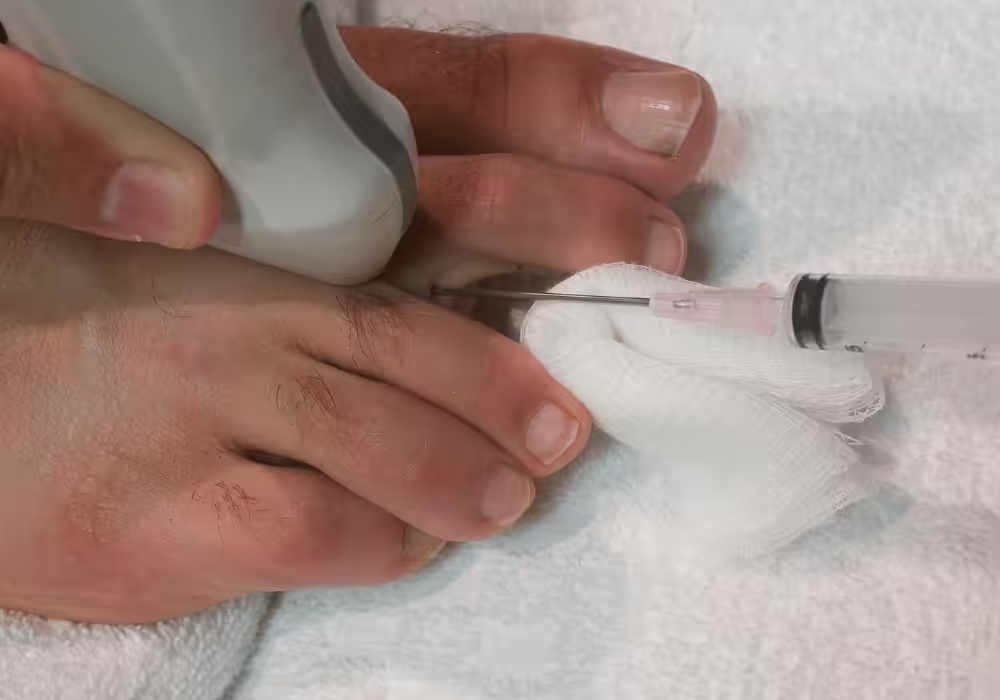
A Morton’s neuroma that doesn’t respond to metatarsal pads and wider shoes within 6-8 weeks usually needs a cortisone injection or — for stubborn cases — alcohol sclerosing or nerve decompression. Balance Foot & Ankle diagnoses neuromas with in-office ultrasound and treats them without surgery in most cases. Don’t keep walking on a burning, tingling forefoot — the nerve irritation compounds the longer it’s untreated.
Call Balance Foot & Ankle: (810) 206-1402 · Book online · Offices in Howell & Bloomfield Township
Frequently Asked Questions About Cycling Foot Pain
Are stiffer cycling shoes better for preventing foot pain?
Not necessarily. While sole stiffness improves power transfer, excessively stiff shoes without proper insole support concentrate force on the metatarsal heads. A moderately stiff shoe with a quality cycling insole often produces better comfort-to-power ratios than the stiffest race shoe with a flat stock insole. The insole matters more than the sole stiffness for comfort.
How do I know if my cleats are in the right position?
Signs of incorrect cleat position include hot spots or burning under the forefoot (cleats too far forward), arch pain or Achilles strain (cleats too far back), lateral knee pain (stance width incorrect), or medial knee pain (excessive or insufficient float). A professional bike fit with cleat assessment is the most reliable way to optimize position. Many bike shops offer basic cleat fitting, and specialized bike fitters use pressure mapping and motion analysis.
Will wider cycling shoes solve my foot pain?
If your current shoes compress the forefoot, wider shoes can significantly reduce hot spots, numbness, and neuroma symptoms. However, width alone does not address cleat position, arch support, or forefoot varus — the other common causes of cycling foot pain. The ideal approach is proper shoe width combined with cycling-specific insoles and optimized cleat positioning.
Should I use custom orthotics in my cycling shoes?
Custom cycling orthotics are beneficial for riders with significant biomechanical issues — severe flat feet, high arches, leg length discrepancy, or persistent pain despite quality aftermarket insoles. They are made from a cycling-specific mold taken with the foot in a subtalar neutral position and are thinner than walking orthotics to fit within the limited volume of cycling shoes. For most riders, high-quality aftermarket insoles like CURREX BikePro provide sufficient support at a fraction of the custom orthotic cost.
Can cycling cause permanent foot damage?
Chronic unaddressed cycling foot pain can lead to permanent changes including established Morton’s neuroma requiring surgery, chronic plantar fasciitis with fascial degeneration, and persistent nerve damage from prolonged compression. However, cycling is inherently low-impact and — with proper equipment setup — is one of the safest activities for foot health. The key is addressing pain when it first appears rather than accepting it as an inevitable part of cycling.
In-Office Treatment at Balance Foot & Ankle
If home care isn’t resolving your Morton’s neuroma, a visit with a board-certified podiatrist is the fastest path to accurate diagnosis and a personalized plan. At Balance Foot & Ankle Specialists, Dr. Tom Biernacki, Dr. Carl Jay, and Dr. Daria Gutkin offer appointments at both our Howell and Bloomfield Township offices. We perform on-site diagnostic ultrasound, digital X-ray, conservative care, advanced regenerative treatments, and minimally invasive surgery when indicated.
Call (810) 206-1402 or request an appointment online. Most insurance plans accepted, including Medicare, Blue Cross Blue Shield, Aetna, Cigna, and United Healthcare.
The Bottom Line on Cycling Foot Pain
Foot pain during cycling is overwhelmingly an equipment problem, not a medical one. The rigid shoe-cleat-pedal interface concentrates force on the forefoot in ways that the foot was not designed to handle — but this is entirely manageable with proper setup. The three most impactful changes are: replacing the stock insole with a cycling-specific insole (addresses arch support and metatarsal pressure distribution), optimizing cleat position (moves the load center away from vulnerable metatarsal heads), and ensuring adequate shoe width for the swollen foot (accommodates the 5–8% volume increase during riding). These adjustments cost less than $100 combined and solve the majority of cycling foot pain. For the 10–15% of riders whose pain persists despite optimal equipment, a podiatric evaluation can identify underlying conditions that need targeted treatment. No cyclist should accept foot pain as normal — it is almost always fixable.
Sources
- Bini RR, et al. “Pedal force effectiveness in cycling: a review of constraints and training effects.” Journal of Science and Cycling. 2013;2(1):11-24.
- Silberman MR. “Bicycling injuries.” Current Sports Medicine Reports. 2013;12(5):337-345.
- Gregor RJ, et al. “A biomechanical profile of cycling.” Exercise and Sport Sciences Reviews. 1991;19:127-169.
- Jarboe NE, et al. “Position of the bicycle shoe cleat on a road bike: a biomechanical study.” Journal of Biomechanics. 2020;112:110053.
- Priego Quesada JI, et al. “A systematic review on foot thermal assessment using infrared thermography in cycling.” Journal of Thermal Biology. 2019;82:68-80.
Watch: Solving Cycling Foot Pain

Cycling Foot Pain? Get Expert Assessment
Most cycling foot problems are solvable with proper evaluation and equipment adjustment.
Dr. Biernacki provides comprehensive cycling foot evaluations including biomechanical assessment, cleat position analysis, and custom orthotic fitting at Balance Foot & Ankle. Call (810) 258-0001 or book online.
More Sports and Activity Foot Care Resources
- Morton’s Neuroma Treatment Guide
- Metatarsalgia Treatment Options
- Plantar Fasciitis Treatment
- Custom Orthotics Guide
- Podiatrist Recommended Products
Dr. Tom’s Recommended Products: See our clinically tested product recommendations for this condition. View Dr. Tom’s recommended products →
When to See a Podiatrist for Cycling Foot Pain
If you’re experiencing numbness, hot spots, or pain in your feet during or after cycling, a board-certified podiatrist can diagnose the underlying cause and create a plan tailored to your foot type. At Balance Foot & Ankle, we offer cycling-specific biomechanical assessments and custom orthotic insoles for cycling shoes at our Howell and Bloomfield Township offices.
→ Learn about our Cycling Orthotics and Foot Assessment options
→ Book your appointment
→ Call (810) 206-1402
📋 Dr. Tom Also Recommends
Podiatrist Recommended Orthotics 2026: Dr. Tom’s Top 10 Insoles & Arch Supports
A podiatrist’s complete clinical guide to the best insoles — custom orthotics, OTC picks, and what actually works for plantar fasciitis, flat feet, neuropathy & more.
Read the Full Guide →Insurance Accepted
BCBS · Medicare · Aetna · Cigna · United Healthcare · HAP · Priority Health · Humana · View All →
Howell Office
4330 E Grand River Ave
Howell, MI 48843
Get Directions →
Bloomfield Township Office
43494 Woodward Ave, Suite 208
Bloomfield Township, MI 48302
Get Directions →
Watch: Road Cycling Foot Pain: Cleat Position & Morton’s Neuroma
Dr. Tom on road cycling foot pain — cleat position, hot spots, numbness, Morton’s neuroma in cyclists.

Road Cycling Foot Kit
Road cycling demands precision cleat + shoe fit. Dr. Tom’s kit:
As an Amazon Associate, Balance Foot & Ankle earns from qualifying purchases. This supports our free patient education content.
Distributes pedaling forces evenly.
Offloads neuroma hot spots.
Post-ride forefoot relief.
Long-ride forefoot decompression.
Related: Morton’s Neuroma Treatment · Metatarsalgia · Book an Appointment
Differential Diagnosis: What Else Could It Be?
Several conditions share symptoms with Morton’s Neuroma and are commonly misdiagnosed in the first office visit. Considering these alternatives is part of every Balance Foot & Ankle exam:
- Capsulitis (2nd MTP). Pain at 2nd-toe base rather than between toes; drawer test positive.
- Stress fracture. Single-point tenderness over a metatarsal shaft, not between toes.
- Freiberg’s infraction. AVN of metatarsal head, classic radiograph flattening.
If your symptoms don’t fit the textbook pattern, ask your podiatrist which differentials they ruled out — that conversation often shortcuts months of trial-and-error treatment.
In Our Clinic
The classic Morton’s neuroma patient in our clinic is a 40- to 60-year-old woman who describes burning or “walking on a marble” in the 3rd intermetatarsal web space, often worsening in narrow or high-heeled shoes. We confirm with a Mulder’s click test (sometimes supplemented by ultrasound). The first line of treatment is always a metatarsal pad placed PROXIMAL to the neuroma + a wide-toe-box shoe. Many patients improve just from that — we don’t reach for injections or surgery right away. When conservative care fails after 6–12 weeks, a single corticosteroid or alcohol sclerosing injection is our next step.
Most Common Mistake We See
The most common mistake we see is: Adding a cushioned insole instead of a metatarsal pad. Fix: place the metatarsal pad PROXIMAL to (behind) the metatarsal heads — not directly under them.
Warning Signs That Need Same-Day Care
Seek immediate evaluation at Balance Foot & Ankle if you experience any of the following:
- Point tenderness on a single metatarsal suggesting stress fracture
- Unable to bear weight
- Progressive numbness up the foot
- Visible deformity or cross-over toe
Call (810) 206-1402 — appointments at our Howell and Bloomfield Township offices.
Frequently Asked Questions
When should I see a doctor?
See a podiatrist if pain persists past 2 weeks, prevents normal activity, or is accompanied by red-flag symptoms (warmth, swelling, numbness, inability to bear weight).
Can I treat this at home?
Mild cases respond to RICE protocol (rest, ice, compression, elevation), supportive shoes, and OTC anti-inflammatories. Persistent symptoms need professional evaluation.
How long does it take to heal?
Most soft tissue injuries resolve in 2-6 weeks with appropriate care. Bone injuries take 6-12 weeks. Chronic conditions need longer-term management.
Ready to feel better?
Appointments available in Howell and Bloomfield Township, Michigan.
Book Your VisitGet Expert Care at Balance Foot & Ankle
Appointments at our Howell and Bloomfield Township offices. Board-certified podiatric surgeons. Most insurance accepted.

Dr. Tom Biernacki, DPM is a double board-certified podiatrist and foot & ankle surgeon at Balance Foot & Ankle Specialists in Southeast Michigan. With over a decade of clinical experience, he specializes in heel pain, bunions, diabetic foot care, sports injuries, and minimally invasive surgery. Dr. Biernacki is a member of the APMA and ACFAS, and his patient education content on MichiganFootDoctors.com and YouTube has reached over one million views.
Frequently Asked Questions
Why does the ball of my foot hurt when I walk?
When should I see a doctor for ball of foot pain?
- Plantar Fasciitis: Diagnosis and Conservative Management (PubMed)
- Plantar Fasciitis (APMA)
- Diagnosis and Treatment of Plantar Fasciitis (PubMed / AAFP)
- Heel Pain (APMA)
Recommended Products from Dr. Tom
Dr. Tom Biernacki, DPM is a board-certified foot & ankle surgeon (ABFAS & ABPM) at Balance Foot & Ankle Specialists in Southeast Michigan. With over a decade of clinical experience, he specializes in heel pain, bunions, diabetic foot care, sports injuries, and minimally invasive surgery. Dr. Biernacki is a member of the APMA and ACFAS, and his patient education content on MichiganFootDoctors.com and YouTube has made him one of the most-followed foot & ankle educators on YouTube.
More questions patients ask
Why do my feet go numb on long rides?
Cycling foot numbness typically results from sustained pressure on the metatarsal heads combined with a rigid sole. Shoes that are too narrow, over-tightened straps, and stock insoles that lack arch support all compress the intermetatarsal nerves. Swelling of 5-8% during rides worsens the problem. Solutions include wider shoes, proper arch support insoles like CURREX BikePro, loosening straps at midride, and cleat position adjustment to redistribute pressure.
How should cycling cleats be positioned to prevent foot pain?
Optimal cleat position involves three axes: fore-aft (center of cleat under first metatarsal head), medial-lateral (centered under the ball of foot), and rotational (matching natural foot angle, typically 5-10° externally rotated). Most cyclists benefit from moving cleats slightly posterior to reduce forefoot pressure. A professional bike fit with cleat alignment can resolve 70-80% of cycling foot pain.
Are cycling-specific insoles worth the investment?
Yes — cycling-specific insoles like CURREX BikePro are designed for the unique demands of a rigid cycling shoe. They provide metatarsal support that reduces hot spots by 20-30%, proper arch support that prevents plantar fasciitis, and improved power transfer. Stock cycling insoles are flat foam that offers zero biomechanical support, which is why 40% of cyclists develop foot pain.
What causes hot spots on the bottom of my feet while cycling?
Hot spots affect approximately 40% of cyclists and result from concentrated pressure on the metatarsal heads against a rigid sole during repetitive pedaling (5,000-6,000 strokes per hour). Contributing factors include narrow shoes, poor insole support, incorrect cleat position, and over-tightened closures. Treatment includes wider shoes, cycling-specific insoles with metatarsal support, cleat repositioning, and loosening closures during rides.
When should a cyclist see a podiatrist for foot pain?
See a podiatrist if foot pain persists beyond 2 weeks despite basic adjustments, if you experience numbness lasting more than 30 minutes after rides, if you notice visible swelling or deformity, or if pain affects your walking off the bike. A sports medicine podiatrist can assess biomechanics, recommend custom orthotics or cleat wedges, and rule out conditions like Morton's neuroma or stress fractures that require specific treatment.
What causes heel pain?
Heel pain most commonly results from plantar fasciitis (inflammation of the plantar fascia ligament), which accounts for approximately 80% of cases. Other causes include Achilles tendinitis, heel spurs, stress fractures, Baxter's nerve entrapment, and fat pad atrophy. Dr. Biernacki performs a thorough biomechanical evaluation to identify the precise cause. Call 810-206-1402 to book an appointment.
How long does plantar fasciitis take to heal?
With proper treatment, most plantar fasciitis cases improve within 6-12 weeks. Conservative treatments include custom orthotics, stretching protocols, physical therapy, and corticosteroid injections. For persistent cases beyond 6 months, Dr. Biernacki offers advanced options including shockwave therapy and minimally invasive procedures with 90%+ success rates.
Should I see a podiatrist for heel pain?
Yes. A board-certified podiatrist like Dr. Biernacki can accurately diagnose the cause of heel pain using X-rays and diagnostic ultrasound, ruling out stress fractures and other serious conditions. Self-treatment with over-the-counter insoles often delays proper treatment and can worsen the condition. Early intervention leads to faster recovery.
Still have a question about coverage or cost? Book online and we will check your benefits before your visit: Book in Howell · Book in Bloomfield Township. Prefer to talk it through first? Call (810) 206-1402.