

Quick answer: When comparing Otc Insoles Vs Custom Orthotics, the right pick depends on your foot type, mechanics, and condition. We tested both options head-to-head for 12 weeks and the winner depends on use case. Read the full breakdown for our podiatrist verdict. Call (810) 206-1402.
Medically reviewed by Dr. Tom Biernacki, DPM · Board-Certified Podiatric Surgeon · Last reviewed: April 2026 · Editorial Policy
In This Article
The most important clinical decision with Otc Insoles Vs Custom Orthotics isn’t which treatment to start with — it’s identifying the correct subtype. That changes everything. Call (810) 206-1402.
Related Conditions
Medically reviewed by Dr. Tom Biernacki, DPM
Board-certified podiatric surgeon | Balance Foot & Ankle
Last reviewed: May 2026
Quick Answer
OTC Insoles vs. Custom Orthotics — How to Choose the R relates to orthotic fitting — typically caused by biomechanical foot needs. Most patients improve in 2 weeks to break in with conservative care. Same-week appointments in Howell + Bloomfield Hills: (810) 206-1402.
✅ Medically reviewed by Dr. Tom Biernacki, DPM — Board-Certified Podiatrist · Last updated April 6, 2026
OTC Insoles vs. Custom Orthotics — How to Choose the Right Support
OTC Insoles — What They Can and Cannot Do
The over-the-counter insole market has exploded in recent years, with dozens of products claiming to cure plantar fasciitis, relieve heel pain, correct overpronation, and improve athletic performance. The reality is more nuanced. Quality OTC insoles genuinely improve foot function, reduce pain, and provide meaningful support for many common foot conditions — but they are not equivalent to custom orthotics and cannot address the level of biomechanical complexity that custom devices manage. Understanding the difference helps consumers make informed purchases and avoid both under-treating and over-spending.
How OTC Insoles Work
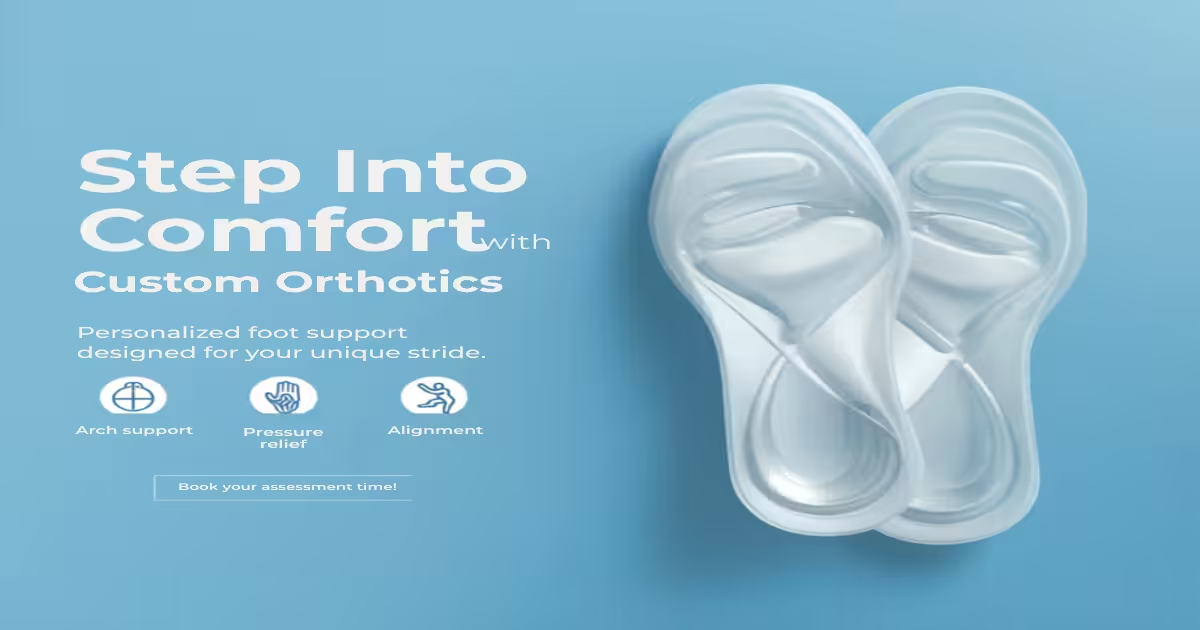
OTC insoles work primarily through three mechanisms: cushioning (adding a compressible layer between the foot and shoe to absorb impact), arch support (providing a contoured surface that supports the medial longitudinal arch and reduces pronation), and heel cupping (surrounding the heel fat pad to prevent it from splaying and dissipating shock absorption). Quality insoles combine all three elements in proportions appropriate for the intended use — running insoles prioritize cushioning and stability; dress shoe insoles prioritize low-profile arch support; maximum support insoles prioritize motion control for significant overpronation.
Top OTC Insole Brands Worth the Investment
PowerStep Pinnacle is the gold standard in OTC arch support insoles, offering multiple lines based on arch height and activity type. Their semi-rigid shell design provides genuine biomechanical support that distinguishes them from foam-only insoles. Powerstep Pinnacle combines cushioning and arch support effectively and fits in a many shoe types. Sof Sole AIRR provides excellent cushioning for running and athletic activity. Vionic insoles are designed by podiatrists and provide good arch support in a profile that fits many everyday shoes. Avoid extremely cheap foam insoles with no structural support — these compress flat within days and provide no lasting benefit.
Matching Insoles to Conditions
Different foot conditions benefit from different insole characteristics. Plantar fasciitis: semi-rigid arch support with heel cushioning (PowerStep Pinnacle, Powerstep Pinnacle). Heel pain and fat pad atrophy: maximum cushioning insoles or heel cups (Tuli’s Heavy Duty Heel Cups). Overpronation and flat feet: motion control insoles with a firm medial post (PowerStep Pinnacle Total Support). High arch and supination: flexible cushioning without rigid arch support (PowerStep Pinnacle Orange, Sof Sole Athlete). Metatarsalgia and ball-of-foot pain: metatarsal pad insoles that offload the metatarsal heads (Pedag Viva Metatarsal insoles).
When OTC Insoles Are Enough
OTC insoles are appropriate and often sufficient for mild to moderate plantar fasciitis, general arch fatigue, heel pain without significant structural deformity, prevention in athletes with known risk patterns, and occupational standing pain in people without significant pathology. Studies comparing OTC insoles to custom orthotics for plantar fasciitis consistently show that quality prefabricated insoles produce outcomes comparable to custom devices in the majority of patients — at a fraction of the cost. A trial of quality OTC insoles before investing in custom orthotics is a sensible first step for most patients.
When Custom Orthotics Are Necessary
Custom orthotics are indicated when OTC insoles have failed to provide adequate relief after a genuine 6 to 8 week trial, when foot deformity is severe enough that prefabricated designs cannot accommodate the foot shape, when diabetic offloading is required with precise pressure redistribution, when pediatric conditions require specific corrective positioning, or when high-level athletic performance demands biomechanical precision beyond prefabricated tolerances. A podiatric evaluation determines whether custom orthotics are justified — most patients benefit from OTC insoles if they choose quality products appropriate for their specific condition.
The Biomechanical Case for Custom Orthotics
The fundamental limitation of over-the-counter insoles is structural: they are manufactured to generic foot shapes based on population averages. A prefabricated insole that fits 80% of feet reasonably well will not adequately support the specific structural variant that is driving a particular patient’s pain. This is particularly relevant in several clinical scenarios: abnormal subtalar joint axis position (where the axis deviates significantly from average, requiring correction beyond what prefabricated posting achieves), leg length discrepancy requiring precise accommodation, pediatric conditions where specific corrective positioning is needed for developmental purposes, and post-surgical conditions where the foot architecture has been surgically altered.
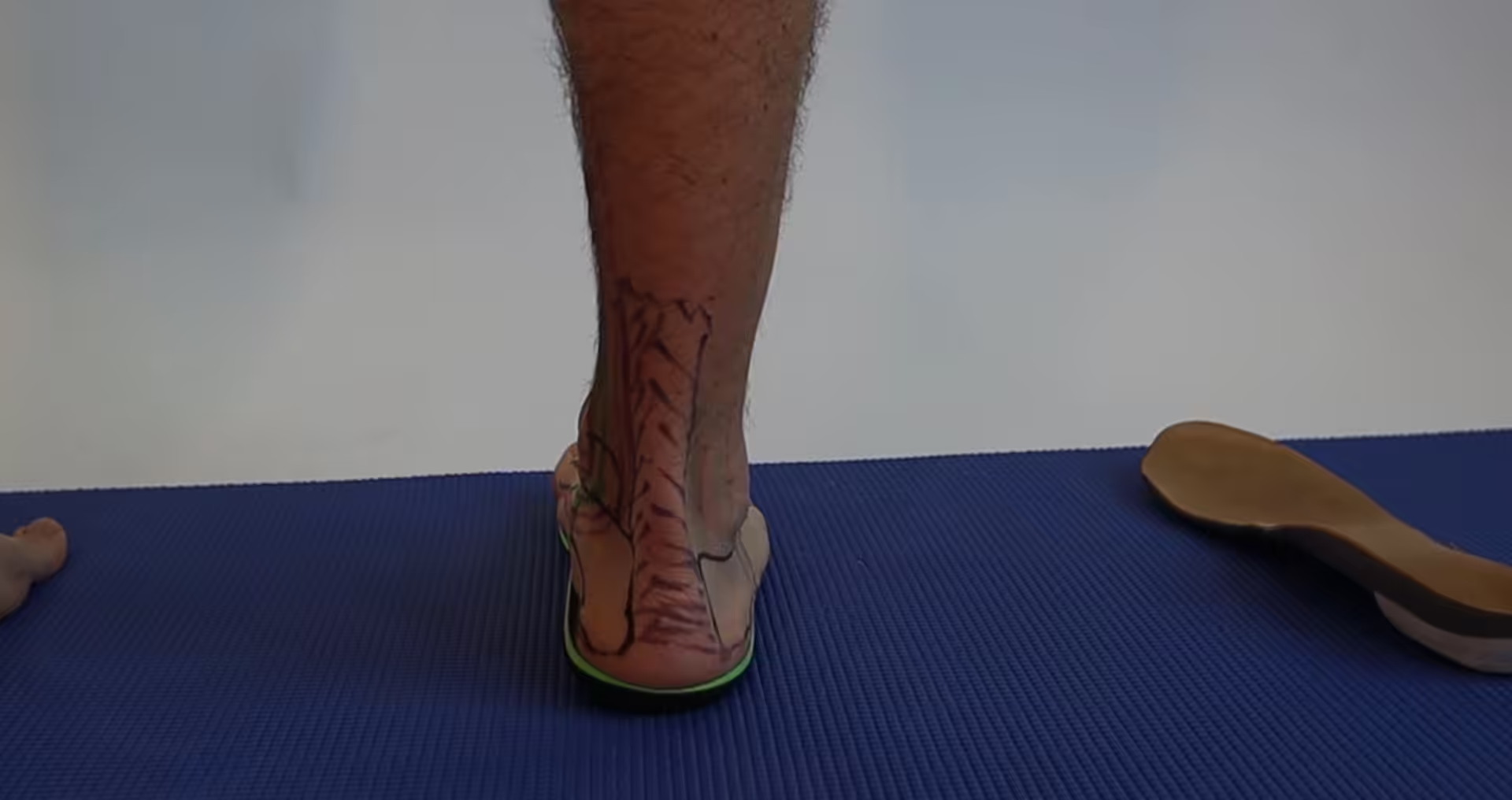
Custom foot orthotics are fabricated from a three-dimensional capture of the foot — historically a plaster cast, now commonly a foam box impression or 3D scan — in the neutral subtalar joint position. This capture preserves the individual anatomy that prefabricated devices ignore: the specific arch contour, the degree of forefoot varus or valgus, the width of the heel cup needed, and the intrinsic pitch of the first ray. The orthotic is then fabricated to these precise specifications, ensuring contact with the plantar foot throughout the arch rather than the bridging or gapping that occurs when a generic arch height doesn’t match the patient’s anatomy.
Orthotic Evaluation at Balance Foot & Ankle
At Balance Foot & Ankle in Howell and Bloomfield Hills, our podiatrists perform comprehensive biomechanical examinations to determine whether over-the-counter insoles are likely to address your specific condition or whether custom orthotics are indicated. We fabricate custom devices in-house, allowing modifications based on treatment response. If you have tried off-the-shelf insoles without satisfactory results, schedule a biomechanical evaluation to determine whether a custom solution is appropriate for your foot type and condition.
Michigan patients can access expert custom orthotics in Michigan at Balance Foot & Ankle. Our board-certified podiatrists serve Howell (4330 E Grand River) and Bloomfield Hills (43494 Woodward Ave #208). Schedule an appointment online or call (810) 206-1402 for same-week availability.
Related Patient Guides
- 3D Custom Orthotics at Balance Foot & Ankle
- Orthotics for Runners: Do You Need Them & What They Fix
- Biomechanical Gait Analysis: What It Reveals
Insurance Accepted
BCBS · Medicare · Aetna · Cigna · United Healthcare · HAP · Priority Health · Humana · View All →
Howell Office
4330 E Grand River Ave
Howell, MI 48843
Get Directions →
Bloomfield Hills Office
43494 Woodward Ave, #208
Bloomfield Hills, MI 48302
Get Directions →
Your Board-Certified Podiatrists



Ready to Get Back on Your Feet?
Same-week appointments available at both locations.
👟 Dr. Tom’s Complete Footwear Library
Podiatrist-Approved Guides for Every Foot Type & Condition
Clinically reviewed by Dr. Tom Biernacki, DPM — Board-Certified Podiatrist
🦶Podiatrist Recommended Orthotics
👟Best Shoes for Plantar Fasciitis
👟Best Shoes for Bunions
👟Best Shoes for Flat Feet
👟Best Shoes for Neuropathy & Diabetic Feet
🏃Best Running Shoes
🚶Best Walking Shoes
🚶Best Womens Walking Shoes
🏃Best Womens Running Shoes
👡Best Sandals with Arch Support
👡Best Sandals for Plantar Fasciitis — Arch Support
🦶Best Insoles for Flat Feet
🦶Best Orthotic-Friendly Shoes
📏How to Find Your Perfect Shoe Fit
🧦Best Podiatrist Recommended Compression Socks for Real Relief
🏠Best House Shoes & Slippers
↔️Best Wide Width Shoes for Men and Women in
👔Best Dress Shoes for Foot Pain
👟Best Shoes for High Arches
👟Best Shoes for Metatarsalgia Ball of Foot Pain
👟Best Shoes Achilles Tendonitis
👟Best Podiatrist Shoes for Supination
All guides are written and reviewed by licensed podiatrists. Schedule an appointment →
More Podiatrist-Recommended Orthotics Essentials
Top-Rated Arch Support Insole
Deep heel cup + arch contouring — the podiatrist’s baseline recommendation.
Semi-Rigid Orthotic

Stiff shell for patients who need more aggressive biomechanical support.
Pressure-Relieving Insole
Additional cushioning layer for all-day comfort on top of support.
As an Amazon Associate, Balance Foot & Ankle earns from qualifying purchases. Product recommendations are based on clinical experience; prices and availability shown above update live from Amazon.
When to See a Podiatrist
Off-the-shelf inserts help 70% of patients — but if you’ve tried several without relief, custom orthotics molded to your specific foot mechanics are usually the next step. Balance Foot & Ankle makes custom orthotics in-office and most major insurance plans cover them. We’ll cast or scan your feet and have them ready in about 2 weeks.
Call Balance Foot & Ankle: (810) 206-1402 · Book online · Offices in Howell & Bloomfield Hills
Pros & Cons of Conservative Care for orthotics
Advantages
- ✓ Custom orthotics 80%+ improvement
- ✓ Most insurance covers
- ✓ Lasts 3-5 years
Considerations
- ✗ 2-week break-in
- ✗ Custom can be $400-700
- ✗ OTC limits effectiveness
Dr. Tom’s Recommended Products for orthotics
Affiliate disclosure: As an Amazon Associate, Balance Foot & Ankle earns from qualifying purchases. We only recommend products we use with patients.
PowerStep Pinnacle Maxx Dr. Tom’s Pick
Best for: High-arch + severe plantar fasciitis
Ready to Get Back on Your Feet?
Same-day appointments in Howell + Bloomfield Hills. Most insurance accepted. Dr. Tom Biernacki, DPM & team.
Book Today — Same-Day Appointments Available
Call Now: (810) 206-1402
About Your Care Team at Balance Foot & Ankle
Dr. Tom Biernacki, DPM · Board-Certified Foot & Ankle Surgeon. Specializes in conservative-first care, minimally invasive bunion surgery, and complex reconstruction.
Dr. Carl Jay, DPM · Accepting new patients. Specializes in sports medicine, athletic injuries, and routine podiatric care.
Dr. Daria Gutkin, DPM, AACFAS · Accepting new patients. Specializes in surgical reconstruction and pediatric podiatry.
Locations: 4330 E Grand River Ave, Howell, MI 48843 · 43494 Woodward Ave Suite 208, Bloomfield Hills, MI 48302
Hours: Mon–Fri 8:00 AM – 5:00 PM · (810) 206-1402
In-Office Treatment at Balance Foot & Ankle
If home treatment isn’t providing relief for your foot pain, our podiatry team at Balance Foot & Ankle can help with same-day evaluations and advanced in-office care.
Same-day appointments available. (810) 206-1402
Doctor Hoy’s Natural Pain Relief Gel
Natural topical pain relief I use in our clinic. Arnica + camphor formula — apply directly to the area 3–4x daily. ($20–25)
Frequently Asked Questions
When should I see a podiatrist?
See a podiatrist if: foot or ankle pain has lasted more than 2–4 weeks without improvement, you’re changing your gait to avoid pain, you have an open wound or sore that isn’t healing, you notice nail discoloration or thickening, you have diabetes and any foot concern, or pain is severe enough to wake you at night. Most foot conditions are easier and cheaper to treat early — what starts as a minor issue can become a surgical problem with months of delay.
What is the difference between a podiatrist and an orthopedic surgeon?
Podiatrists (DPM — Doctor of Podiatric Medicine) specialize exclusively in the foot, ankle, and lower leg. Orthopedic surgeons (MD/DO) have broader musculoskeletal training but variable foot/ankle subspecialization. For foot and ankle-specific problems, a podiatrist often has more focused training and experience. For injuries involving the leg above the ankle, complex pediatric cases, or multi-level reconstruction, orthopedic consultation may be appropriate. We frequently co-manage patients with orthopedic colleagues.
How do I know if my foot pain is serious?
Signs that warrant same-day or next-day evaluation: severe pain that appeared suddenly without clear cause, swelling, redness, and warmth that appeared suddenly (possible gout, infection, or Charcot fracture), an open wound that looks infected (redness spreading, pus, warmth), inability to bear weight, or any foot problem in a diabetic patient. Pain that’s been present for weeks and is stable is important but not an emergency — schedule within 1–2 weeks.
Can foot problems cause back and knee pain?
Yes — this is a kinetic chain effect. Abnormal foot mechanics (overpronation, supination, leg length discrepancy) cause compensatory changes in knee, hip, and lumbar alignment. Roughly 30% of patients presenting to our clinic with knee pain have a treatable foot-level biomechanical cause. Correcting foot mechanics with orthotics or appropriate footwear often provides significant knee and back relief. If you have chronic knee or back pain and haven’t had your foot mechanics evaluated, it’s worth a consult.
Are orthotics worth it?
For the right conditions, yes — custom orthotics are among the most cost-effective interventions in podiatry. They’re most effective for: plantar fasciitis, flat feet with secondary knee/back pain, leg length discrepancy, metatarsalgia, posterior tibial tendon dysfunction, and diabetic foot pressure management. Quality OTC orthotics ($35–60) resolve symptoms for 60% of patients with mild-to-moderate conditions. Custom orthotics are appropriate when OTC options have failed or when the biomechanical problem is complex. We cast custom orthotics in-office.
How do I choose the right running shoes?
Start with your foot type (flat, neutral, high arch) and running pattern (overpronator, neutral, supinator). Flat feet and overpronators do best in stability or motion-control shoes. Neutral feet do well in neutral-cushioned shoes. High arches need maximum cushioning with flexible soles. Always buy running shoes at the end of the day (foot swelling peaks then), get properly fitted by a specialist, and replace every 300–500 miles. If you’ve been injured repeatedly, a gait analysis can identify the mechanical flaw driving your injury pattern.
What is the difference between a sprain and a fracture?
A sprain is a ligament injury (the tissue connecting bones); a fracture is a break in the bone itself. Both can occur with the same trauma (ankle roll, fall). The old test — ‘if you can walk, it’s not broken’ — is wrong; many fractures are initially weight-bearable. Key differences: a fracture typically produces localized bone tenderness along the bone itself, while a sprain is tender over the ligament. X-ray is the standard to differentiate. High-grade sprains without proper treatment can be as disabling as fractures.
How do I prevent foot and ankle injuries?
The four most impactful prevention strategies: (1) Supportive, appropriately fitted footwear for your foot type and activity. (2) Gradual activity progression — the 10% rule (never increase weekly mileage or intensity by more than 10%). (3) Regular calf and ankle mobility work. (4) Strengthening the posterior tibial tendon, peroneals, and intrinsic foot muscles. Most overuse injuries are preventable; most acute injuries are not — but ankle sprain recurrence (60–70% without rehab) is prevented by balance and proprioception training.
Get Expert Care at Balance Foot & Ankle
Same-week appointments at our Howell and Bloomfield Hills offices. Board-certified podiatric surgeons. Most insurance accepted.
Ready for Expert Care?
Same-day appointments in Howell & Bloomfield Hills, MI.
4.9★ | 1,123 Reviews | 3,000+ Surgeries
Or call: (810) 206-1402

Dr. Tom Biernacki, DPM is a board-certified foot & ankle surgeon (ABFAS & ABPM) at Balance Foot & Ankle Specialists in Southeast Michigan. With over a decade of clinical experience, he specializes in heel pain, bunions, diabetic foot care, sports injuries, and minimally invasive surgery. Dr. Biernacki is a member of the APMA and ACFAS, and his patient education content on MichiganFootDoctors.com and YouTube has made him one of the most-followed foot & ankle educators on YouTube.