
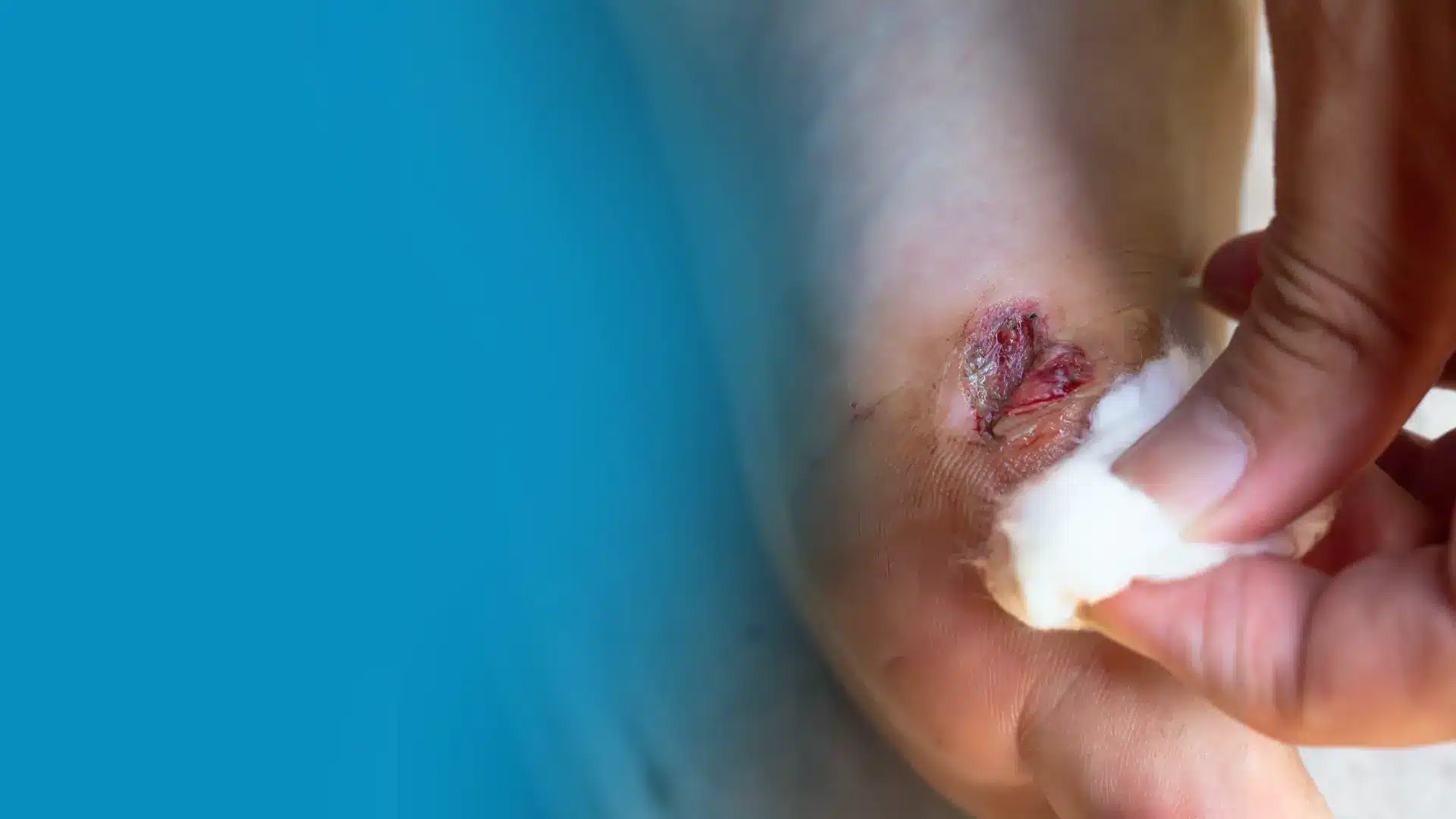
Quick answer: A foot or ankle wound that has not closed in four weeks needs specialist care — a diabetic foot ulcer left untreated can progress to amputation. Treatment means debriding the wound, taking pressure off it, controlling infection, and correcting the circulation or pressure problem that caused it in the first place. We do all of that at both our Howell and Bloomfield Township offices, and most wound care is covered by Medicare and major insurers. Book online for the next available appointment, or call (810) 206-1402.
Medically reviewed by Dr. Tom Biernacki, DPM
Board-certified podiatric surgeon | Balance Foot & Ankle
Last reviewed: May 2026

Foot and ankle wounds are among the most complex and consequential injuries in medicine. A diabetic foot ulcer that doesn’t receive expert wound care can lead to amputation within weeks. A seemingly minor wound that won’t heal may be the first sign of peripheral arterial disease, osteomyelitis, or a systemic condition that hasn’t been diagnosed. At Balance Foot & Ankle, wound care is one of our highest-priority services — because getting it right can be limb-saving and life-changing.
The most important clinical decision with Wound Care isn’t which treatment to start with — it’s identifying the correct subtype. That changes everything. Call (810) 206-1402.
Types of Foot Wounds We Treat
Diabetic foot ulcers are the most common and serious foot wounds we manage. They result from the combination of peripheral neuropathy (inability to feel pain and pressure), peripheral arterial disease (poor healing), and immune compromise (infection susceptibility). The classic presentation is a painless plantar wound — often under a metatarsal head — that the patient didn’t notice forming. These require aggressive wound care combined with total contact casting or specialized offloading devices.
Venous stasis ulcers develop from chronic venous insufficiency, typically on the medial gaiter area of the lower leg or ankle. They are shallow, moist, irregularly bordered, and associated with surrounding hyperpigmentation, lipodermatosclerosis, and significant edema. Graduated compression therapy is the cornerstone of treatment alongside local wound care.
Arterial (ischemic) ulcers develop from insufficient arterial blood flow, appearing on pressure points (heel, toe tips, lateral malleolus) with a dry, punched-out appearance and minimal exudate. These require vascular assessment and often vascular intervention (angioplasty, bypass) to achieve healing conditions.
Surgical wounds, traumatic wounds, pressure wounds, and infected wounds are also treated in our wound care clinic.
Key takeaway: The most important principle in chronic wound care: treat the cause, not just the wound. A diabetic ulcer that is cleaned and dressed but not offloaded will never heal. An arterial ulcer without revascularization will not close regardless of wound care approach.
The Wound Care Process at Balance Foot & Ankle
Each wound care visit includes wound measurement and photography (to objectively track progress), wound bed assessment (bioburden, exudate, tissue quality), debridement of devitalized tissue (sharp, enzymatic, or mechanical as appropriate), selection of an optimal advanced wound dressing, offloading assessment and modification, and vascular review. When indicated, we order HbA1c, vascular studies, MRI for osteomyelitis, wound cultures for antibiotic guidance, and laboratory metabolic panels. We communicate actively with primary care, endocrinology, and vascular surgery when complex cases require coordinated care.
Advanced Wound Treatments Available
Beyond standard dressings, we provide negative pressure wound therapy (wound VAC) for complex wounds requiring granulation tissue formation, cellular and tissue products (CTPs) including placental allografts and amniotic membrane grafts for stalled wounds, biofilm-disrupting debridement protocols for chronic wounds with bacterial biofilm, total contact casting for plantar diabetic ulcers, and hyperbaric oxygen therapy referral for ischemic wounds and osteomyelitis where indicated.
⚠️ Foot Wounds That Require Same-Day Podiatric Care
- Any open foot wound in a patient with diabetes — even if it looks minor
- Wound with redness spreading beyond its borders, pus, fever, or red streaks
- Wound that has not shown size reduction after 4 weeks of home care
- Wound on the heel or toe tips in a patient with known vascular disease
- Foot wound with bone visible in the wound base (possible osteomyelitis)
- Any wound that develops a foul odor or black/necrotic tissue in the wound bed
Frequently Asked Questions
How long does a diabetic foot ulcer take to heal?
With expert wound care, proper offloading, and adequate circulation, most diabetic foot ulcers heal in 6–12 weeks. Larger wounds, wounds with poor vascular supply, or infected wounds may take 3–6 months. Neuropathic ulcers that recur require ongoing foot care and preventive offloading.
When should I go to urgent care vs a podiatrist for a foot wound?
Go to urgent care or the emergency room for rapidly spreading infection (redness moving up the foot or leg, fever, systemic symptoms), deep puncture wounds, wounds from high-risk mechanisms, or any wound with exposed tendon or bone. See a podiatrist for any wound that is not healing normally, is associated with neuropathy or vascular disease, or requires specialized wound care.
Does wound debridement hurt?
Sharp debridement of neuropathic diabetic foot ulcers is typically painless due to sensory loss. Debridement of wounds with intact sensation is done with local anesthesia or under topical numbing agents. We prioritize patient comfort throughout wound care procedures.
What is the best home dressing for a foot wound?
For simple wounds, hydrocolloid dressings (if moderate exudate) or non-adherent foam dressings (if higher exudate) are excellent. Diabetic foot wounds should always be evaluated by a podiatrist — home management of diabetic wounds is not recommended given the risks involved.
The Bottom Line
Foot wounds — particularly in diabetic and vascular patients — require expert evaluation and cause-directed treatment, not just dressing changes. At Balance Foot & Ankle, our wound care program combines evidence-based debridement, advanced wound technologies, offloading protocols, and coordinated specialist care to achieve the best possible healing outcomes. A wound that isn’t healing is a medical problem that needs attention — don’t wait.
🩺 Dr. Tom’s Recommended Products
As an Amazon Associate I earn from qualifying purchases. These are products I personally use and recommend to patients.
The OTC orthotic I recommend most in our clinic. Sub-$50 before custom orthotics.
View on Amazon →
Natural menthol + arnica topical. FSA-eligible — what I switched my family to from Doctor Hoy’s Natural Pain Relief Gel.
View on Amazon →
Ready to Get Relief?
Same-day appointments available in Howell & Bloomfield Township, MI
4.9★ | 1,123 Reviews | 3,000+ Surgeries
Or call: (810) 206-1402
Sources
- Armstrong DG et al. “Diabetic foot ulcers and their recurrence.” N Engl J Med. 2017.
- Bus SA et al. “IWGDF guidelines on prevention and management of diabetic foot.” Diabetes Metab Res Rev. 2020.
- Wounds International. Best practice guidelines for chronic wound management. 2022.
Visit Balance Foot & Ankle — Same-Day Appointments Available

Our podiatry team serves patients throughout Michigan including Howell, Brighton, and Bloomfield Township. If you’re dealing with heel pain, ingrown toenails, or a foot injury, we have same-day appointment availability.
Same-day appointments available. (810) 206-1402

Dr. Tom Biernacki, DPM is a double board-certified podiatrist and foot & ankle surgeon at Balance Foot & Ankle Specialists in Southeast Michigan. With over a decade of clinical experience, he specializes in heel pain, bunions, diabetic foot care, sports injuries, and minimally invasive surgery. Dr. Biernacki is a member of the APMA and ACFAS, and his patient education content on MichiganFootDoctors.com and YouTube has reached over one million views.
Wound Care & Surgery Resources
Guides on foot and ankle wound care, surgical procedures, and post-op recovery:
- Big Toe Pain Causes 2026: Arthritis vs Dislocation
- Wound VAC Therapy for Foot 2026
- Foot Fusion Surgery: When Is It Necessary?
- Foot Rehab After Achilles Surgery 2026
- Foot Surgery Pain Management: Medications and Methods
- Foot Rehab After Ankle Surgery 2026
- Kobe Bryant Achilles Rupture: What Really Happened
- When Can You Drive After Foot Surgery? A Clear Timeline
- Neuropathic Foot Ulcer 2026: Wound Care
- Diabetic Foot Ulcer Prevention 2026
- Tarsal Coalition: Calcaneonavicular and Talocalcaneal
- Hammertoe Surgery Michigan
- Will Bunions Go Away Without Surgery 2026
- Venous Stasis Dermatitis 2026: Causes, Symptoms & Treatment
- Morton Neuroma Surgery 2026: Nerve Removal
- Achilles Rupture Surgery 2026: Tendon Repair
- Diabetic Foot Care Ulcer Prevention 2026
- Hallux Rigidus Surgery: Comparing Cheilectomy, Osteoto
- Diabetic Foot Ulcer Prevention 2026: 10 Steps
- Total Ankle Replacement (TAR): Preserving Motion While
- Metatarsal Fracture Surgery 2026: Foot Break
- Ankle Fusion for Ankle Arthritis 2026
- Minimally Invasive Foot Surgery Guide 2026
- Chronic Wound Care for Foot 2026
- Open vs MIS Bunion Surgery 2026: Which Is Better
- Lapidus Bunionectomy: TMT Fusion 2026
- Do Podiatrists Do Surgery? What to Expect
- Diabetic Amputation Prevention 2026
- Bunion Surgery Recovery 2026
- Foot Rehab After Bunion Surgery 2026
- Diabetic Wound Care Michigan 2026
- Achilles Tendon Rupture Surgery 2026
- Blood Clot Prevention After Foot Surgery: What to Know
- How Long Does Foot Surgery Take? A Podiatrist Explains
- Lapidus Bunionectomy: Tarsometatarsal Fusion for Hyper
- Foot & Ankle Soft Tissue Mass 2026
- Exercises After Bunion Surgery: Rehab Timeline & Guide
- Midfoot Arthritis Lisfranc Fusion 2026
- Foot Surgery Anesthesia Options: What to Expect
- Diabetic Foot Ulcer: Wound Care Prevention 2026
- Lapiplasty vs Traditional Bunion Surgery: Key Differences
- How Painful Is Bunion Surgery 2026: Recovery Instructions
- Diabetic Foot Ulcer 2026: Wound Care
- Ankle Fracture Non-Surgical Treatment 2026
- Plantar Fascia Rupture: Acute Treatment & Recovery
- Diabetic Foot Ulcer Warning Signs 2026
- Acute Achilles Tendon Rupture: Surgical Repair and Rec
- Subtalar Joint Fusion: Surgery for Hindfoot Arthritis
- Lapidus Bunionectomy Michigan 2026
- Returning to Exercise After Foot Surgery: A Timeline a
- Ankle Fracture Surgery 2026: ORIF Repair
- Hallux Rigidus Surgery Michigan
- Ingrown Toenail Surgery Nail Avulsion 2026
- How Much Does Foot Surgery Cost? 2025 Pricing Guide
- Congenital Foot Deformities 2026: Clubfoot & More
- Tarsal Tunnel Release Surgery 2026
- Achilles Tendon Rupture Treatment 2026
- Posterior Tibial Tendon Rupture 2026
- Total Contact Casting Diabetic Ulcer 2026
- Achilles Tendon Rupture Treatment 2026
- Tarsal Tunnel Release Surgery 2026
- Plantar Fascia Rupture 2026: Acute Tear Guide
- Achilles Rupture vs Tendinitis: How to Tell the Difference
- Morton Neuroma Excision Surgery 2026
- Negative Pressure Wound Therapy Foot 2026
- Chronic Ankle Instability Treatment 2026
- Icing and Elevation After Foot Surgery: The Right Way
- Foot Ulcer Wound Care Guide 2026
- Osteomyelitis Foot & Ankle Bone Infection 2026
- Mortons Neuroma: Diagnosis, Nerve Injections, and Surg
- When Can You Return to Work After Foot Surgery?
- Bunion Recurrence After Surgery 2026
- Ingrown Toenail Surgery 2026: Permanent Fix
- How Much Does Bunion Surgery Cost? 2025 Guide
- Flat Foot Surgery 2026: Is It Worth It and What to Expect
- Venous Insufficiency 2026: Leg & Foot Swelling
- Wound Care Foot Ulcer Treatment 2026
- Plantar Plate Tear Repair Surgery: Second Toe 2026
- Scleroderma and the Foot: Raynaud Phenomenon, Digital
- How to Prepare for Foot Surgery: Pre-Op Checklist
- Foot Surgery Recovery Timeline: Week-by-Week Guide
- Ankle Fusion for Arthritis 2026
- Ankle Fracture ORIF Surgery Recovery 2026
- Tendon Transfer Surgery Foot Ankle 2026
- Bunion Surgery Recovery 2026: Healing Guide
- Navicular Stress Fracture: Diagnosis and Surgical Trea
- Ankle Replacement vs Fusion: End-Stage Arthritis 2026
- Peroneal Tendon Repair Surgery: Treating Tears, Splits
- Shockwave vs Surgery for Plantar Fasciitis 2026
- Why Diabetics Need Professional Callus Care 2026
- Physical Therapy After Foot Surgery: When and Why
- Bunion Non-Surgical Treatment 2026
- Foot Osteomyelitis 2026: Bone Infection Care
- Achilles Tendon Rupture: Surgical vs Non-Surgical 2026
- Ankle Replacement vs Fusion 2026
Dr. Tom Biernacki, DPM is a board-certified foot & ankle surgeon (ABFAS & ABPM) at Balance Foot & Ankle Specialists in Southeast Michigan. With over a decade of clinical experience, he specializes in heel pain, bunions, diabetic foot care, sports injuries, and minimally invasive surgery. Dr. Biernacki is a member of the APMA and ACFAS, and his patient education content on MichiganFootDoctors.com and YouTube has made him one of the most-followed foot & ankle educators on YouTube.
More questions patients ask
What wound care services does Balance Foot & Ankle provide?
Balance Foot & Ankle provides comprehensive foot and leg wound care including: wound debridement, advanced wound dressing selection, infection management and antibiotic prescription, off-loading for diabetic ulcers, vascular assessment, tissue biopsy when needed, and coordination with vascular surgeons and wound care centers for complex cases. We treat diabetic foot ulcers, venous ulcers, arterial ulcers, and traumatic wounds.
How often should a foot wound be seen by a podiatrist?
Most chronic foot wounds require weekly podiatric wound care visits for debridement, dressing changes, and healing assessment. Infected or rapidly worsening wounds may need twice-weekly visits. As wounds heal, visit frequency can be reduced. At Balance Foot & Ankle, we monitor each wound's healing trajectory and adjust the treatment protocol if progress is inadequate — a wound that doesn't improve by 50% in 4 weeks needs treatment reassessment.
What is wound debridement and why is it important?
Wound debridement is the removal of dead, necrotic, or infected tissue from a wound to allow healthy tissue to heal. At Balance Foot & Ankle, debridement is performed at each visit for chronic wounds — it removes the biofilm and devitalized tissue that prevent healing and allow bacteria to proliferate. Regular sharp debridement by a podiatrist is one of the most important interventions for chronic diabetic foot wounds.
What are the signs that a foot wound is not healing properly?
Signs of poor wound healing include: no size reduction after 2-4 weeks of appropriate treatment, increasing size, deepening (wound tunneling), new or worsening wound odor, increasing pain, surrounding skin redness or warmth, tissue that looks gray or black rather than pink-red, and drainage that changes from clear to cloudy or foul-smelling. Contact Balance Foot & Ankle immediately if you notice these signs. Call (810) 206-1402.
Can I manage a foot wound at home?
Minor cuts and superficial wounds in non-diabetic patients can often be managed at home with cleaning, antibiotic ointment, and bandaging. However, all foot wounds in diabetic patients should be evaluated by Balance Foot & Ankle immediately — what appears minor can progress rapidly in diabetics due to neuropathy and impaired immunity. Any wound that is not healing within 2-3 weeks, is deep, shows infection signs, or is in a pressure area requires professional wound care.
How are diabetic foot wounds treated?
Diabetic foot ulcer treatment follows a systematic approach: (1) debridement — removing dead and infected tissue to promote healthy wound edges; (2) offloading — removing pressure from the wound with a total contact cast, surgical boot, or wheelchair; (3) moisture management with appropriate dressings (hydrocolloid, foam, silver-impregnated for infection); (4) antibiotic therapy for infected ulcers (topical or oral, IV for deep infection); (5) vascular assessment and revascularization if circulation is poor. Offloading is the most critical element — ulcers will not heal under continued pressure.
How long do diabetic foot ulcers take to heal?
Simple surface (Wagner Grade 1) diabetic foot ulcers typically heal in 4-12 weeks with proper offloading and wound care. Deeper ulcers involving tendon, capsule, or bone (Grade 2-3) may take 3-6 months or longer and often require hospitalization for IV antibiotics and surgical debridement. Ulcers with poor blood supply (Grade 4-5) may require vascular surgery before healing is possible. Consistent blood sugar control (HbA1c below 7%) dramatically accelerates healing.
When is amputation necessary for a diabetic foot wound?
Amputation is considered when: the bone is infected (osteomyelitis) and does not respond to IV antibiotics, the blood supply cannot be restored surgically and tissue is dying (gangrene), the infection is life-threatening and spreading rapidly despite treatment, or there is a severe Charcot collapse with recurrent ulceration that cannot be managed with footwear. Modern limb-salvage surgical techniques have significantly reduced amputation rates — aggressive wound care combined with vascular intervention saves limbs in most cases.
Can diabetic foot ulcers be prevented?
Yes — the most effective prevention strategies: daily foot inspection (use a mirror for the sole), never going barefoot, wearing properly fitted diabetic shoes with custom orthotics, controlling blood sugar rigorously, regular podiatry visits (every 1-3 months for high-risk patients), and prompt treatment of any skin breakdown, blister, or callus before it deepens. Managing blood pressure and cholesterol reduces the vascular disease that impairs healing.
Still have a question about coverage or cost? Book online and we will check your benefits before your visit: Book in Howell · Book in Bloomfield Township. Prefer to talk it through first? Call (810) 206-1402.