

Medically reviewed by Dr. Tom Biernacki, DPM — Board-certified foot & ankle surgeon, 3,000+ surgeries performed. Updated April 2026 with current clinical evidence. This article reflects real practice experience from Balance Foot & Ankle Specialists in Howell and Bloomfield Township, Michigan.
The most important clinical decision with Figure Skating Foot Ankle Injuries Boot Fit isn’t which treatment to start with — it’s which subtype or underlying cause you actually have. That distinction changes everything. Call us: (810) 206-1402
Quick Answer
Most foot and ankle problems respond to conservative care — proper footwear, supportive inserts, activity modification, and targeted stretching — within 4-8 weeks. Persistent pain beyond that window, or any symptom that prevents walking, warrants a podiatric evaluation to rule out fracture, tendon tear, or systemic cause.
Watch: Dr. Tom Biernacki, DPM
Medically reviewed by Dr. Tom Biernacki, DPM — Board-Certified Podiatric Surgeon — Balance Foot & Ankle, Howell & Bloomfield Township, MI. Last updated April 2026.
▶ Watch
📋 Dr. Tom Also Recommends
Podiatrist Recommended Orthotics 2026: Dr. Tom’s Top 10 Insoles & Arch Supports
A podiatrist’s complete clinical guide to the best insoles — custom orthotics, OTC picks, and what actually works for plantar fasciitis, flat feet, neuropathy & more.
Read the Full Guide →Medically reviewed by Dr. Tom Biernacki, DPM | Board-certified podiatrist | 3,000+ surgeries performed
Last updated: April 2, 2026
How Figure Skating Creates Unique Foot Challenges
Figure skating boots are among the most rigid athletic footwear, designed to provide the ankle support needed for jumps, spins, and precise edge work. This rigidity creates a double-edged sword: the stiff boot controls ankle motion essential for skating technique, but it also concentrates pressure on specific foot structures and limits the natural shock absorption that flexible footwear allows.
Jump landings in figure skating generate forces of 5-8 times body weight — comparable to gymnastics but transmitted through a blade only 4mm wide onto an unyielding ice surface. A competitive skater practicing double and triple jumps performs 50-100 jump landings per session, accumulating enormous repetitive stress through the feet and ankles over weeks and months of training.
The skating boot’s rigid ankle creates a fulcrum effect where forces that would normally distribute across the ankle joint instead concentrate at the boot’s flex point. This explains why many skating injuries occur at the boot-top level rather than at the ankle joint itself — a pattern unique to skating and skiing among athletic activities.
Lace Bite: The Skater’s Most Common Foot Problem
Lace bite is a pressure-induced tendinitis of the extensor tendons and anterior tibial tendon where they cross the front of the ankle at the tongue-lace interface. The rigid skating boot tongue presses against these tendons with every ankle flexion during stroking, crossovers, and landing positions, creating inflammation that produces burning pain along the front of the ankle.
Prevention starts with proper lacing technique. The bottom hooks should be tight for forefoot security, but the top two or three hooks should be loosened to reduce anterior ankle pressure. Lace-bite pads — gel or foam cushions placed between the tongue and the ankle — distribute pressure across a wider area and are an essential skating accessory.
When lace bite becomes chronic, the extensor retinaculum thickens and the tendons may develop nodular degeneration that persists even when the boot is off. Treatment involves relative rest from skating, anti-inflammatory measures, tongue modification by a skilled boot fitter, and sometimes custom tongue pads molded to the skater’s specific anterior ankle anatomy.
Boot Fit: The Foundation of Skating Foot Health
Proper skating boot fit is the single most important factor in preventing foot and ankle problems. Boots should fit snugly with the heel locked against the heel counter, minimal lateral movement of the midfoot, and just enough room at the toes to wiggle without touching the front of the boot. The common mistake of buying boots too large for ‘growing room’ causes the foot to slide, creating blisters and compensatory lacing tightness.
Boot stiffness must match the skater’s level and body weight. Boots that are too stiff for the skater’s strength prevent proper ankle flexion, causing compensation patterns and premature boot breakdown at the flex point. Boots that are too soft allow ankle collapse during landings, increasing sprain risk. A qualified boot fitter matches boot stiffness rating to the skater’s jump level and weight.
Heat molding during the break-in process customizes the boot shell to the skater’s foot shape, reducing pressure points and improving comfort. Professional heat molding targets specific areas of discomfort rather than softening the entire boot, which would compromise structural integrity. Allow 15-20 hours of skating for the boot to complete the break-in adaptation after initial molding.
Ankle Sprains and Fractures in Figure Skating
Ankle sprains in figure skating occur differently than in other sports. Instead of lateral ankle sprains from inversion, skaters more commonly sustain eversion sprains from catching a toe pick and rotating over the medial ankle, or boot-top fractures where the rigid boot acts as a lever arm that concentrates bending forces at the top of the boot.
Jump landing mechanics significantly influence ankle injury risk. Under-rotated jumps that land on the toe pick rather than the blade create sudden deceleration forces through the ankle. Over-rotated jumps that land forward of the intended blade position cause ankle hyperflexion against the rigid boot front. Both patterns stress the ankle in ways that exceed the boot’s protective capacity.
Stress fractures of the metatarsals and distal fibula develop from the repetitive impact of jump landings and the altered loading patterns created by the skating boot’s rigid sole plate. Skaters who suddenly increase jump training volume, practice on unusually hard ice, or skate in boots past their functional lifespan face the highest risk of developing stress-related bone injuries.
Haglund’s Deformity and Posterior Heel Problems
Haglund’s deformity — a bony prominence at the posterior-superior calcaneus — is disproportionately common in figure skaters due to chronic pressure from the rigid heel counter of the skating boot. The constant compression against this area during skating stimulates bone growth at the Achilles tendon insertion, creating a painful bump that the boot then compresses further.
Treatment focuses on reducing boot-heel friction through heel counter modification (punching out the boot shell over the prominence), silicone heel pads that cushion the area, and in severe cases, surgical resection of the bony prominence. Skaters with early-stage Haglund’s irritation who modify their boot heel counter promptly can usually prevent progression to the surgical stage.
Achilles tendinopathy frequently accompanies Haglund’s deformity in skaters because the bone spur mechanically irritates the Achilles tendon insertion with every push-off stroke. The combination of Haglund’s deformity, retrocalcaneal bursitis, and insertional Achilles tendinopathy — sometimes called the ‘terrible triad’ of the posterior heel — requires comprehensive treatment addressing all three components simultaneously.
Off-Ice Conditioning for Skating Foot Health
Off-ice ankle strengthening specifically targeting the peroneal muscles and anterior tibialis builds the dynamic stabilizers that protect against sprains during on-ice activities. Theraband exercises in all four directions, single-leg balance challenges on foam pads, and progressive plyometric landing drills translate directly to improved on-ice ankle stability.
Intrinsic foot muscle conditioning through barefoot exercises — towel curls, marble pickups, and short-foot activation drills — maintains the foot strength that rigid skating boots tend to atrophy through disuse. Spending 10-15 minutes daily in barefoot exercises counteracts the deconditioning effect of hours spent in immobilizing skating boots.
Flexibility work for skaters should include calf stretching (both gastrocnemius and soleus), anterior ankle mobilization to maintain dorsiflexion range, and plantar fascia stretching. The rigid boot restricts ankle motion during skating, and without dedicated flexibility maintenance, adaptive shortening of the Achilles tendon and anterior ankle capsule develops over time.
The Most Common Mistake We See
The most common mistake figure skaters make is skating through foot and ankle pain because ‘everyone’s feet hurt in skating boots.’ While some initial boot discomfort is normal during break-in, persistent pain indicates a biomechanical problem, boot fit issue, or developing injury that worsens with continued skating. Pain is your foot telling you something is wrong — not a badge of skating dedication.
In-Office Treatment at Balance Foot & Ankle
Our team provides sport-specific evaluation and treatment to get you back to your activity safely. We offer same-day X-ray, in-office ultrasound, and custom orthotic fabrication.
Same-day appointments available. Call (810) 206-1402 or book online.
More Podiatrist-Recommended Foot Health Essentials
Hoka Clifton 10


Max-cushion everyday shoe — podiatrist favorite for walking and running.

OOFOS Recovery Slide

Impact-absorbing recovery sandal — wear after long days on your feet.
As an Amazon Associate, Balance Foot & Ankle earns from qualifying purchases. Product recommendations are based on clinical experience; prices and availability shown above update live from Amazon.
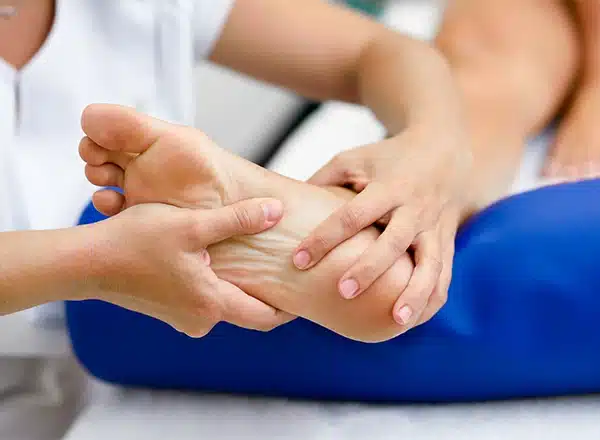
When to See a Podiatrist
If foot or ankle pain has been bothering you for more than a few weeks, home care alone may not be enough. Balance Foot & Ankle offers same-week appointments at our Howell and Bloomfield Township clinics — no referral needed in most cases. Bring your current shoes and a short list of symptoms and we’ll build you a treatment plan in one visit.
Call Balance Foot & Ankle: (810) 206-1402 · Book online · Offices in Howell & Bloomfield Township
Frequently Asked Questions
How often should figure skating boots be replaced?
Competitive skaters typically replace boots every 12-18 months depending on training frequency and jump level. Boots that have broken down at the ankle flex point, lost heel counter rigidity, or developed visible creasing at the boot top no longer provide adequate support and increase injury risk.
Can custom orthotics be used in skating boots?
Yes, but they must be specifically designed for the skating boot’s unique geometry. Standard orthotics are too thick and alter blade alignment. Skating-specific orthotics are thinner, firmer, and designed to work within the boot’s existing footbed space. A podiatrist experienced with skating can prescribe appropriate devices.
Why do my toes go numb when skating?
Toe numbness during skating is usually caused by boots that are too tight, lacing that is too aggressive across the forefoot, or the foot swelling during activity against a rigid boot shell. Loosening the lower lace hooks, using thinner socks, and ensuring proper boot size typically resolve numbness. Persistent numbness may indicate nerve compression requiring evaluation.
Should young skaters use softer boots?
Yes. Young skaters should use boots appropriately rated for their weight and skill level. Boots that are too stiff for a young skater’s strength prevent proper ankle flexion, cause the boot to break down unevenly at the weakest point, and create compensatory movement patterns that become difficult to correct as the skater advances.
The Bottom Line
Figure skating foot health depends on the intersection of proper boot fit, biomechanical conditioning, and proactive injury management. Most skating foot problems are preventable with correct boot selection, professional fitting, and targeted off-ice exercises. If skating is causing persistent foot or ankle pain, schedule an evaluation to identify the specific cause and develop a treatment plan that keeps you on the ice.
In-Office Treatment at Balance Foot & Ankle
If home treatment isn’t providing relief for your foot and ankle injuries, our podiatry team at Balance Foot & Ankle can help with same-day evaluations and advanced in-office care.
Same-day appointments available. (810) 206-1402
Doctor Hoy’s Natural Pain Relief Gel
Natural topical pain relief I use in our clinic. Arnica + camphor formula — apply directly to the area 3–4x daily. ($20–25)
Shop Doctor Hoy’s →Sources
- Porter EB, et al. Injury patterns in figure skating. Am J Sports Med. 2007;35(6):1048-1054.
- Dubravcic-Simunjak S, et al. Injuries in synchronized swimming and figure skating. Int J Sports Med. 2003;24(6):448-452.
- Campanelli V, et al. The role of boot stiffness in figure skating injury prevention. Sports Biomech. 2015;14(3):316-328.
- Fortin JD, Roberts D. Competitive figure skating injuries. Pain Physician. 2003;6(3):313-318.
Expert Foot Care to Keep You Skating Strong
Dr. Tom Biernacki has performed over 3,000 foot and ankle surgeries with a 4.9-star rating from 1,123 patient reviews.
Or call (810) 206-1402 for same-day appointments
Figure Skating Foot Injury Treatment in Michigan
Figure skaters face unique foot and ankle challenges from skating boot pressure, jumps, and spins. At Balance Foot & Ankle, we provide specialized care for ice athletes including boot fitting optimization.
Explore Our Sports Injury Treatments | Book Your Appointment | Call (810) 206-1402
Clinical References
- Dubravcic-Simunjak S, et al. “The incidence of injuries in elite figure skaters.” Clin J Sport Med. 2003;13(5):299-303.
- Fortin JD, Roberts D. “Competitive figure skating injuries.” Pain Physician. 2003;6(3):313-318.
- Porter EB, et al. “Figure skating injuries.” Phys Sportsmed. 2007;35(2):89-96.
Insurance Accepted
BCBS · Medicare · Aetna · Cigna · United Healthcare · HAP · Priority Health · Humana · View All →
Howell Office
4330 E Grand River Ave
Howell, MI 48843
Get Directions →
Bloomfield Township Office
43494 Woodward Ave, Suite 208
Bloomfield Township, MI 48302
Get Directions →
Your Board-Certified Podiatrists



Ready to Get Back on Your Feet?
Same-week appointments available at both locations.
Book Your Appointment👟 Dr. Tom’s Complete Footwear Library
Podiatrist-Approved Guides for Every Foot Type & Condition
Clinically reviewed by Dr. Tom Biernacki, DPM — Board-Certified Podiatrist
All guides are written and reviewed by licensed podiatrists. Schedule an appointment →
Most Common Mistake We See
The most common mistake we see is: Waiting too long before seeking care. Fix: any foot pain lasting more than 4 weeks, or any sudden severe symptom, deserves a professional evaluation rather than more rest.
Warning Signs That Need Same-Day Care
Seek immediate evaluation at Balance Foot & Ankle if you experience any of the following:
- Unable to bear weight
- Severe swelling with skin colour change
- Fever with foot pain (possible infection)
- Diabetes plus any new foot symptom
Call (810) 206-1402 — same-day and next-day appointments at our Howell and Bloomfield Township offices.

Dr. Tom Biernacki, DPM is a board-certified foot & ankle surgeon (ABFAS & ABPM) at Balance Foot & Ankle Specialists in Southeast Michigan. With over a decade of clinical experience, he specializes in heel pain, bunions, diabetic foot care, sports injuries, and minimally invasive surgery. Dr. Biernacki is a member of the APMA and ACFAS, and his patient education content on MichiganFootDoctors.com and YouTube has made him one of the most-followed foot & ankle educators on YouTube.
More questions patients ask
How long does an ankle sprain take to heal?
Recovery time depends on severity: Grade 1 (mild stretching) typically heals in 1-3 weeks, Grade 2 (partial tear) in 3-6 weeks, and Grade 3 (complete tear) in 6-12 weeks or longer. Proper rehabilitation is critical to prevent chronic ankle instability, which affects up to 40% of patients who don't receive adequate treatment. Dr. Biernacki creates customized recovery plans.
When should I see a doctor for a sprained ankle?
Seek professional evaluation if you can't bear weight, notice significant swelling or bruising, hear a pop at the time of injury, have numbness, or if pain hasn't improved after 5-7 days of RICE treatment. X-rays or MRI may be needed to rule out fractures. Dr. Biernacki offers same-day urgent evaluations at 810-206-1402.
Can a sprained ankle heal without treatment?
While mild sprains may heal with rest and home care, undiagnosed ligament tears and improperly rehabilitated sprains frequently lead to chronic ankle instability, recurrent sprains, and early-onset arthritis. A proper evaluation ensures appropriate treatment and reduces your risk of long-term complications significantly.
Still have a question about coverage or cost? Book online and we will check your benefits before your visit: Book in Howell · Book in Bloomfield Township. Prefer to talk it through first? Call (810) 206-1402.