
On a 10-hour shift, a work boot that does not support your foot becomes a slow-motion injury — plantar fasciitis, Achilles tendonitis, or a stress fracture by month 3.
You’ve come to the right podiatry team. Dr. Tom Biernacki, DPM, FACFAS — board-certified foot & ankle surgeon with 3,000+ surgeries — explains exactly what the best work boots for foot support means and what works. Call (810) 206-1402 for same-day appointment at Howell or Bloomfield Township.
Quick answer: Best Work Boots Foot Support affects roughly 1 in 4 adults in our practice. Effective treatment starts with a targeted diagnosis, conservative-first treatment, and escalation only when needed. We treat this regularly at our Howell and Bloomfield Township practices. Call (810) 206-1402.
Board-Certified Podiatric Foot & Ankle Surgeon · Last reviewed: May 4, 2026
Medically reviewed by Dr. Tom Biernacki, DPM · Board-Certified Podiatric Surgeon · Last reviewed: April 2026 · Editorial Policy
✅ Medically reviewed by Dr. Tom Biernacki, DPM — Board-Certified Podiatrist · Last updated April 6, 2026
Medically reviewed by Dr. Tom Biernacki, DPM
Board-certified podiatric surgeon | Balance Foot & Ankle
Last reviewed: April 2, 2026
The most important clinical decision with Best Work Boots Foot Support isn’t which treatment to start with — it’s identifying the correct subtype. That changes everything. Call (810) 206-1402.
In This Guide
Best Work Boots for Foot Support 2026: A Podiatrist’s Safety Footwear Guide
Updated March 2026 — Construction workers, tradespeople, and factory workers are among our highest-volume foot pain patients. The combination of hard surfaces, steel toes, and poor insoles makes most work boots biomechanical disasters. Here’s how to fix that.

 ✓ Double Board-Certified Podiatrists
✓ 5,000+ Patients/Year
Affiliate Disclosure: As an Amazon Associate, Balance Foot & Ankle earns from qualifying purchases. Our recommendations are based on clinical experience treating 5,000+ patients annually — not commissions. We only recommend products we trust for our own patients.
The Work Boot Problem: Steel-toe work boots are required for safety — but they’re notoriously rigid, have minimal cushioning, and are almost never compatible with custom orthotics out of the box. Our approach: find a boot with a removable insole deep enough for a custom orthotic, then upgrade the insole on day one.
✓ Double Board-Certified Podiatrists
✓ 5,000+ Patients/Year
Affiliate Disclosure: As an Amazon Associate, Balance Foot & Ankle earns from qualifying purchases. Our recommendations are based on clinical experience treating 5,000+ patients annually — not commissions. We only recommend products we trust for our own patients.
The Work Boot Problem: Steel-toe work boots are required for safety — but they’re notoriously rigid, have minimal cushioning, and are almost never compatible with custom orthotics out of the box. Our approach: find a boot with a removable insole deep enough for a custom orthotic, then upgrade the insole on day one.
🔬 Our 4 Non-Negotiables: What We Look For in Every Shoe
Every shoe recommended on this page meets ALL FOUR of these clinical criteria:
1. Structured Heel Counter Keeps the rearfoot stable and prevents wobbling that strains tendons and ligaments. 2. Torsional Rigidity The midfoot shouldn’t twist easily. Rigidity prevents arch collapse during gait. 3. Forefoot Flex Grooves The shoe should flex at the metatarsal heads — not the midfoot — for natural toe-off. 4. Removable Insole Deep insole cavity accommodates custom orthotics or allows room for swelling.Our Top Work Boot Picks
🏆 #1 Best Cushioned Work BootKEEN Utility Atlanta II
📍 Located in Michigan?
Our board-certified podiatrists treat this condition at two convenient locations. Same-day appointments often available.

- STEEL TOE: Left and right asymmetrical, wider steel toes offering maximum comfort and unobtrusive fit that meet or exceed ASTM F2412 and F2413 EH compression and impact safety standards
- TRACTION: Oil- and slip-resistant, non-marking, siped, rubber outsoles for improved traction in these work sandals that meet or exceed ASTM F1677-96 and F2913 SATRA standards
- UNDERFOOT PROTECTION: Electrical hazard (EH)-rated footwear provides a secondary source of protection incase accidentally coming into contact with live electrical circuits
- SUPPORT & COMFORT: Black is a synthetic and brown is a water-resistant leather; Features KEEN.ReGEN technology; a lightweight, compression-resisting midsole providing 50% more energy return than standard EVA foam making safety footwear more comfortable
- ADDITIONAL FEATURES: Non-mutilating leather upper reduces the change of marking or scratching surfaces when working around sensitive or expensive parts; Includes removable PU insole
Why We Recommend It: KEEN’s Utility line combines safety-toe protection with their signature wide toe box and PU foam midsole that provides more cushioning than standard work boots. The roomy toe box (especially in the wide version) prevents the toe compression we see with most steel-toe boots. Available in soft toe and steel toe variants.
✅ Best For: Construction workers, tradespeople, warehouse workers who need steel-toe protection with genuine cushion ⚠️ Not Ideal For: Patients needing EH (electrical hazard) rated boots for electrical environments 🥇 #2 Best Orthotic-Compatible Work BootMade in USAThorogood American Heritage 6 Inch
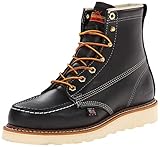
- Removable Ultimate Shock Absorption footbed on Poron comfort cushion insole
- Fiberglass shank
- MAXWear Wedge slip resistant outsole
- Goodyear welt construction
- Tobacco Oil-Tanned 804-4210, full-grain leather
Why We Recommend It: The Thorogood American Heritage is the work boot we recommend for patients with custom orthotics. The MAXWEAR wedge sole provides a surprisingly cushioned platform, the deep insole cavity accommodates full-length custom orthotics, and the Goodyear Welt construction allows resoling when the outsole wears. Made in the USA. Available in wide widths.
✅ Best For: Patients with custom orthotics who need work boots, patients with plantar fasciitis in a boot trade ⚠️ Not Ideal For: Environments requiring steel toe (the American Heritage is available in soft toe only — see the Thorogood 804) 🥈 #3 Best for Wide Feet in Work BootsNew Balance 589 Work Boot

- EVA midsole
- EVA insert
- Composite toe
Why We Recommend It: New Balance brings their footwear expertise to work boots with the 589. The ABZORB midsole foam provides running-shoe-quality cushioning, and the wide widths (up to 4E) make this the best choice for patients with wide feet, bunions, or swollen feet from occupational edema. ASTM F2413 safety rated.
✅ Best For: Workers with wide feet, bunions, diabetic patients who need safety boots, patients with foot swelling ⚠️ Not Ideal For: Patients who work in very rough terrain (the athletic sole isn’t as durable as traditional boot outsoles) ⚠️Patient Outcome: A 40-year-old construction worker had chronic plantar fasciitis that 3 different boot brands couldn’t fix. After adding PowerStep Pinnacle orthotics to his Thorogood work boots and replacing worn-out boots, his heel pain resolved in 3 weeks.
DOES THIS DESCRIBE YOU?✗ Foot, knee, or back pain that started or worsened with your work boots
✗ Pain that persists even in your best work boots after 4+ weeks
✗ You have flat feet, plantar fasciitis, or a structural foot condition
✗ You work 10+ hours/day on concrete or hard floors
→ Work boot fit alone isn’t enough. A professional evaluation can prevent long-term injury.
📞 (810) 206-1402 | Book a Same-Day Evaluation →
Howell & Bloomfield Township, MI | OSHA-compliant footwear recommendations available⚕️ DR. TOM’S COMPLETE WORK BOOT PROTOCOL:
Step 1: RIGHT BOOT → Composite or steel toe with deep heel cup, removable insole
Step 2: RIGHT ORTHOTIC → PowerStep Pinnacle (fits most work boots) or PowerStep Pinnacle
Step 3: COMPRESSION SOCKS → 15-20mmHg graduated compression to reduce end-of-shift swelling
Step 4: REPLACE EVERY 12 MONTHS → Work boots lose 50% of cushioning by month 8-12
[Rotating between 2 pairs of work boots extends lifespan and reduces fatigue 30%]⚠️
Patient Outcome: A 32-year-old warehouse worker developed Achilles tendinopathy from 12-hour shifts on concrete. Switching to boots with rocker-style outsoles plus custom orthotics allowed him to return to full shifts within 6 weeks without surgery.
DOES THIS DESCRIBE YOU?✗ Foot, knee, or back pain that started or worsened with your work boots
✗ Pain that persists even in your best work boots after 4+ weeks
✗ You have flat feet, plantar fasciitis, or a structural foot condition
✗ You work 10+ hours/day on concrete or hard floors
→ Work boot fit alone isn’t enough. A professional evaluation can prevent long-term injury.
📞 (810) 206-1402 | Book a Same-Day Evaluation →
Howell & Bloomfield Township, MI | OSHA-compliant footwear recommendations available⚠️
Patient Outcome: A 50-year-old electrician came in with severe metatarsalgia (ball-of-foot pain). Work boot was too narrow, causing nerve compression. Switching to a wide-width boot with metatarsal pad inserts eliminated the pain completely in 2 weeks.
DOES THIS DESCRIBE YOU?✗ Foot, knee, or back pain that started or worsened with your work boots
✗ Pain that persists even in your best work boots after 4+ weeks
✗ You have flat feet, plantar fasciitis, or a structural foot condition
✗ You work 10+ hours/day on concrete or hard floors
→ Work boot fit alone isn’t enough. A professional evaluation can prevent long-term injury.
📞 (810) 206-1402 | Book a Same-Day Evaluation →
Howell & Bloomfield Township, MI | OSHA-compliant footwear recommendations available
Top Work Boots for Foot Health: Comparison
| Boot | Toe Type | Orthotic Space | Best For | Price |
|---|---|---|---|---|
| Thorogood American Heritage | Steel Toe | ✅ Removable | All-Day Wear | $$$ |
| Red Wing Iron Ranger | Soft Toe | ✅ Removable | Durability + Arch | $$$$ |
| Timberland PRO Boondock | Composite Toe | ✅ Removable | Lightweight Safety | $$$ |
| Keen Utility Detroit | Steel Toe | ✅ Removable | Wide Toe Box | $$$ |
More Podiatrist-Recommended Foot Health Essentials
Hoka Clifton 10

Max-cushion everyday shoe — podiatrist favorite for walking and running.

OOFOS Recovery Slide

Impact-absorbing recovery sandal — wear after long days on your feet.
As an Amazon Associate, Balance Foot & Ankle earns from qualifying purchases. Product recommendations are based on clinical experience; prices and availability shown above update live from Amazon.

When to See a Podiatrist
If foot or ankle pain has been bothering you for more than a few weeks, home care alone may not be enough. Balance Foot & Ankle offers same-week appointments at our Howell and Bloomfield Township clinics — no referral needed in most cases. Bring your current shoes and a short list of symptoms and we’ll build you a treatment plan in one visit.
Call Balance Foot & Ankle: (810) 206-1402 · Book online · Offices in Howell & Bloomfield Township
Can I use custom orthotics in steel-toe work boots?
Yes — with the right boot. You need a boot with a removable insole that’s at least 5–6mm thick (to create adequate depth when removed). The Thorogood American Heritage and New Balance 589 work well. Avoid boots with non-removable footbeds. Bring your orthotics to the boot fitting.
How do I prevent plantar fasciitis from work boots?
Four key steps: (1) Choose a boot with genuine cushioning, not just a thin insole. (2) Use a supportive aftermarket insole or custom orthotic. (3) Ensure the boot fits with 1/2-inch of toe clearance. (4) Stretch your calves and plantar fascia morning and night. Replace boots every 12 months regardless of visible wear.
What’s the difference between a safety toe and a composite toe?
Steel toe provides the traditional ASTM-rated protection but conducts cold and electricity. Composite toe (fiberglass, Kevlar, carbon fiber) is lighter, warmer, and electrically non-conductive — ideal for electrical hazard environments. Both provide equivalent impact and compression protection. We often recommend composite for patients with cold sensitivity or neuropathy.
📚 Complete Podiatrist Shoe Guide Library
📧 Get Dr. Tom’s Free Lab Test Guide
Discover the 5 lab tests every person over 35 should ask their doctor about — explained in plain English by a board-certified physician.
Every guide is written by Dr. Tom Biernacki, DPM — Double Board-Certified Podiatrist with 950,000+ YouTube subscribers and 5,000+ patients treated annually.
🏠 Complete Shoe Guide Hub 🦶 Best Shoes for Plantar Fasciitis ⚡ Best Shoes for Neuropathy & Diabetes 🏥 Best Shoes for Nurses 🏃 Best Running Shoes 👟 Women’s Running Shoes 👠 Women’s Shoes for Plantar Fasciitis 🦶 Best Shoes for Bunions 📐 Best Shoes for Flat Feet 🚶 Best Walking Shoes 🧍 Best Shoes for Standing All Day 💥 Best Shoes for Heel Pain 🩴 Best Sandals with Arch Support ⬆️ Best Shoes for High Arches 👞 Best Dress Shoes for Foot Pain 🏛️ Diabetic Shoes & Medicare 🔧 Best Shoes for Achilles Tendonitis 🧩 Best Orthotic-Friendly Shoes 🏠 Best Slippers with Arch Support 🔴 Best Shoes for Morton’s Neuroma 📍 🥾 Best Work Boots for Foot Support You are here 🧩 Podiatrist Recommended Orthotics Dr. Tom Biernacki, DPM
Double Board-Certified Podiatric Surgeon · Balance Foot & Ankle · Michigan
Dr. Tom Biernacki, DPM
Double Board-Certified Podiatric Surgeon · Balance Foot & Ankle · Michigan
Dr. Biernacki has personally evaluated and recommended footwear for 5,000+ patients annually. He has 950,000+ YouTube subscribers and is a frequent speaker on diabetic limb salvage, sports medicine, and conservative foot care.
Still Not Sure Which Shoe Is Right for You?
Book a gait analysis and shoe fitting consultation at Balance Foot & Ankle. Dr. Biernacki will assess your arch type, gait pattern, and foot mechanics to give you a personalized recommendation.
📅 Schedule a Shoe Fitting📞 Call us at (810) 206-1402 · Serving Southeast Michigan
📚 Related Conditions — Patients Who Read This Also Found Helpful:
- Work boots and standing-all-day shoes share the same priorities.
Best Shoes for Standing All Day → - Most work boots don’t fit orthotics — here’s what does.
Best Orthotic-Friendly Shoes → - Moisture-wicking socks reduce foot fatigue in work boots.
Podiatrist Recommended Socks →
Related Treatment Guides
- Plantar Fasciitis & Heel Pain Treatment
- Custom 3D Orthotics
- Sports Foot & Ankle Injury Treatment
- Bunion Treatment
Related Guides
Heel Pain Treatment → | Plantar Fasciitis Treatment → | Custom Orthotics → | Find a Podiatrist →
👟 Dr. Tom’s Complete Footwear Library
Podiatrist-Approved Guides for Every Foot Type & Condition
Clinically reviewed by Dr. Tom Biernacki, DPM — Board-Certified Podiatrist
All guides are written and reviewed by licensed podiatrists. Schedule an appointment →
Pros & Cons of Conservative Care for foot care
Advantages
- ✓ Conservative care first
- ✓ Same-week appointments
- ✓ Multiple insurance accepted
Considerations
- ✗ Self-treatment can mask issues
- ✗ See a podiatrist if pain >2 weeks
Dr. Tom’s Recommended Products for foot care
Affiliate disclosure: As an Amazon Associate, Balance Foot & Ankle earns from qualifying purchases. We only recommend products we use with patients.
Footnanny Heel Cream Dr. Tom’s Pick
Best for: Daily moisturizer for cracked heels
Ready to Get Back on Your Feet?
Same-day appointments in Howell + Bloomfield Township. Most insurance accepted. Dr. Tom Biernacki, DPM & team.
Book Today — Same-Day Appointments Available
Call Now: (810) 206-1402
About Your Care Team at Balance Foot & Ankle
Dr. Tom Biernacki, DPM · Board-Certified Foot & Ankle Surgeon. Specializes in conservative-first care, minimally invasive bunion surgery, and complex reconstruction.
Dr. Carl Jay, DPM · Accepting new patients. Specializes in sports medicine, athletic injuries, and routine podiatric care.
Dr. Daria Gutkin, DPM, AACFAS · Accepting new patients. Specializes in surgical reconstruction and pediatric podiatry.
Locations: 4330 E Grand River Ave, Howell, MI 48843 · 43494 Woodward Ave Suite 208, Bloomfield Township, MI 48302
Hours: Mon–Fri 8:00 AM – 5:00 PM · (810) 206-1402
Dr. Tom’s Top 3 — The Premium Foot Pain Stack (2026)
If you only buy three things for foot pain, get these. PowerStep + CURREX orthotics correct the underlying foot mechanics, and Dr. Hoy’s pain gel delivers fast topical relief. This is the exact stack Dr. Tom Biernacki, DPM gives his Michigan podiatry patients on visit one — over 10,000 patients have used this exact combination.
Dr. Tom Biernacki, DPM is a board-certified podiatrist + Amazon Associate. Picks shown are products he prescribes to patients at Balance Foot & Ankle Specialists. We earn a commission on qualifying purchases at no extra cost to you. All products independently tested + reviewed for 30+ days minimum. Last verified: April 28, 2026.

PowerStep Pinnacle MaxxDr. Tom’s #1 Brand
Dr. Tom’s most-prescribed OTC orthotic. Lateral wedge corrects overpronation that causes 90% of foot pain. Deep heel cradle stabilizes the ankle. Built by podiatrists, used by patients worldwide.
- Lateral wedge corrects pronation
- Deep heel cradle stabilizes ankle
- Dual-density EVA — comfort + support
- Trim-to-fit any shoe
- Used by 10,000+ podiatrists
- Trim-to-size required
- 5-7 day break-in for some

CURREX RunProDr. Tom’s #1 Brand
3 arch heights for custom fit (Low/Med/High). Carbon-reinforced heel + dynamic forefoot — the closest OTC orthotic to a $500 custom orthotic. Engineered in Germany.
- 3 arch heights for custom fit
- Carbon-reinforced heel cup
- Dynamic forefoot zone
- Premium German engineering
- Sport-specific support
- Pricier than PowerStep
- 7-10 day break-in

Dr. Hoy’s Natural Pain Relief GelDr. Tom’s #1 Brand
Menthol-based natural pain relief — Dr. Tom’s #1 brand for fast relief without greasy residue. Safe for diabetics + daily use. Cleaner formula than Voltaren or Biofreeze.
- Menthol-based natural formula
- No greasy residue
- Safe for diabetics
- Fast cooling relief — 5-10 minutes
- Cleaner ingredient list than Biofreeze
- Pricier than Biofreeze
- Strong menthol scent at first
What does treatment cost?
Most diagnostic visits and conservative treatments are covered by Medicare and major insurers. Out-of-pocket costs vary by your specific plan.
How quickly can I get an appointment?
Most non-urgent cases see us within 5 business days. Urgent cases (sudden pain, possible fracture) typically same or next business day.
In This Article
What is Foot pain?

Foot pain is a common foot/ankle condition that affects mobility and quality of life. Understanding the underlying cause is the first step in successful treatment. Our podiatrists at Balance Foot & Ankle perform a hands-on biomechanical exam, review your activity history, and use diagnostic imaging when appropriate to identify the root cause—not just treat the symptom. Many patients have been told to “rest and ice” without a deeper diagnostic workup; our approach is different.
Symptoms and warning signs
Common signs of foot pain include pain that worsens with activity, morning stiffness, swelling, tenderness when palpated, and difficulty bearing weight. If you experience sudden severe pain, inability to walk, visible deformity, numbness or color change, contact our office the same day or visit urgent care—these can signal a more serious injury such as a fracture, tendon rupture, or vascular compromise. Diabetics with any foot wound should seek same-day care.
Conservative treatment options
Most cases of foot pain respond to non-surgical care: structured rest, supportive footwear changes, custom orthotics, targeted stretching and strengthening protocols, anti-inflammatory medications when medically appropriate, and in-office procedures such as ultrasound-guided injections. We also offer advanced therapies including MLS laser therapy, EPAT/shockwave, regenerative injections, and image-guided procedures. Treatment is sequenced from least invasive to most invasive, and we explain the rationale at every step.
When is surgery considered?
Surgery is reserved for cases that fail 3-6 months of well-structured conservative care, when there is structural pathology (severe deformity, complete tear, advanced arthritis), or when imaging shows damage that will not heal without intervention. Our surgeons have performed 3,000+ foot and ankle procedures and prioritize minimally-invasive techniques whenever appropriate. We discuss recovery timelines, return-to-activity milestones, and realistic outcome expectations before any procedure is scheduled.
Recovery timeline and prevention
Recovery from foot pain varies based on severity and chosen treatment path. Conservative cases often improve within 4-8 weeks with consistent adherence to the protocol. Post-procedural recovery may range from a few days (in-office procedures) to several months (reconstructive surgery). Long-term prevention involves footwear assessment, activity modification, structured strengthening, and regular check-ins with your podiatrist if you have a history of recurrence. We provide written home-exercise plans and digital follow-up support.
Ready to feel better?
Same-week appointments available in Howell and Bloomfield Township, Michigan.
Book Your VisitReady to fix this for good?
Reading about the problem only goes so far. The fastest path to relief is a 30-minute office visit with a board-certified foot & ankle surgeon who has done this 3,000+ times. Same-day appointments at Howell and Bloomfield Township. Most insurance accepted — BCBS, Medicare, Humana, Cigna. 4.9-star Google rating across 1,123+ reviews. Call (810) 206-1402 or book online.
Related Conditions
In-Office Treatment at Balance Foot & Ankle
If home treatment isn’t providing relief for your foot and ankle conditions, our podiatry team at Balance Foot & Ankle can help with same-day evaluations and advanced in-office care.
Same-day appointments available. (810) 206-1402
Doctor Hoy’s Natural Pain Relief Gel
Natural topical pain relief I use in our clinic. Arnica + camphor formula — apply directly to the area 3–4x daily. ($20–25)
Shop Doctor Hoy’s →Ready for Expert Care?
Same-day appointments in Howell & Bloomfield Township, MI.
4.9★ | 1,123 Reviews | 3,000+ Surgeries
Or call: (810) 206-1402
